

Compressing air squeezes out water—by the tens to hundreds of liters per shift—and that moisture carries oil with it. Automotive assembly lines maintain quality and avoid fines by using the right dryers, filtration systems, and condensate treatment. Industry: Automotive | Process: Assembly_Line_Utilities
Atmospheric air always contains water vapor. Compress that air to 100 psig (pounds per square inch gauge), and volume drops to about one‑eighth; nearly all that moisture eventually condenses (comcoinc.com). In practical terms, a 100 kW (≈135 hp) compressor operating 8 h at 20 °C and 60% relative humidity can generate ~84–86 L of condensate per day (angliancompressors.com), and in hot, humid tropical climates that volume can be several hundred liters daily (angliancompressors.com). Even a 25 hp unit can yield ~20 gal (∼75 L) per day (www.plantengineering.com).
All this condensate carries liquids (water + oil). Unremoved moisture in air or pipes leads to corrosion, filter/dryer clogging and microbial growth — the “smelly gym sock” kind (www.plantservices.com; angliancompressors.com). In automotive assembly, excess moisture can foul pneumatic tools, degrade paint/finish quality, and increase maintenance, so compressed‑air quality (dew point) and condensate must be actively managed.
Moisture load in compressed air
Condensate volumes correlate with inlet humidity and pressure. At 7 bar(a) (≈100 psig), a compressor condenses ~7/8 of its inlet air volume to water (angliancompressors.com). Seasonal swings are dramatic: a 100 hp compressor with a refrigerated dryer produced >45 gal (170 L) in 8 h on a hot summer day but <1 gal on a cold winter day (www.ingersollrand.com).
Water in compressed air fosters corrosion, damages seals/valves, and degrades lubricants; it also “emulsifies” with oil, increasing oil carryover (nxcompressor.com; comcoinc.com). In end processes — especially paint or electronics — entrained moisture can ruin products; industry experts stress that dry, stable compressed air with a controlled dew point is critical to avoid microbial growth and the rust “black gunk” seen at outlets (www.ingersollrand.com).
Pressure dew point and dryers
To remove vapor, facilities use air dryers to lower the pressure dew point (PDP, the temperature at system pressure at which moisture begins to condense). Two main types are refrigerated and desiccant (adsorption) dryers.
Refrigerated dryers cool compressed air — often to ~3 °C — so that >90% of the moisture condenses and is drained; typical units achieve about 38 °F (≈3 °C) PDP and remove most condensable moisture (~99%) by settling (america.sullair.com). They’re used for general‑purpose supply (tools, controls) because capital and operating costs are relatively low (no purge air loss), and units use ambient or water cooling; when ambient air cools the discharge in an aftercooler, moisture drops out and is drained off. The advantage is low energy and maintenance cost; the downside is some residual vapor remains — not 100% dry (america.sullair.com).
Desiccant dryers use hygroscopic media (e.g., silica gel, alumina) to adsorb water, achieving much lower dew points (often –40 °C or below, with some reaching –73 °C/–100 °F) (america.sullair.com). They’re used where “bone‑dry” air is required — for example, semiconductors, pharmaceuticals, and automotive paint booths — and some facilities use both refrigerated dryers for general supply and a point‑of‑use desiccant unit where critical (america.sullair.com; america.sullair.com).
Energy/performance tradeoffs matter: a standard heatless desiccant dryer bleeds ~15% of output flow for purge — in a 3000 cfm (cubic feet per minute) system that’s ~450 cfm of air lost to regeneration — whereas blower‑purge or heated types reduce this to ~2–6% (america.sullair.com). Dryer capacity and dew point vary with inlet pressure and temperatures, so actual performance should be measured — dew‑point inflation is a service flag (www.airbestpractices.com). Installing appropriate dryers improves system reliability and reduces downtime; an auditor stresses that keeping dew point low (metered) is “a big thing” in food/auto plants to prevent contamination or equipment failure (www.plantservices.com).
Aerosol and vapor filtration
Even after drying, water and oil aerosols remain. Cascade filtration handles these: particulate prefilters, coalescing filters, and adsorption stages.
Coalescing filters are fine‑fiber elements that trap tiny liquid droplets (water/oil aerosols) and coalesce them into larger drops that drain out; they’re rated by efficiency — typically 90–99.99% for micron‑range particulates — and remove sub‑micron droplets that standard particulate filters cannot (www.sealingandcontaminationtips.com; www.sealingandcontaminationtips.com). As compressed air flows through the media, diffusion, interception, and inertial impaction cause droplets (down to ~0.01–0.1 µm) to adhere to fibers and merge, then drain to a bowl (www.sealingandcontaminationtips.com; www.sealingandcontaminationtips.com).
Properly sized coalescers are often placed at point‑of‑use (before spray guns or lab instruments) because high‑efficiency filters add pressure drop (~2–6 psi) and have limited capacity; replace elements when ΔP exceeds ~8 psi (www.sealingandcontaminationtips.com). For upstream particulate capture around 3 µm to prolong coalescer life, plants commonly deploy a cartridge filter.
Note: coalescing filters do not remove water vapor or oil vapor — only liquid droplets — so an adsorption stage follows where needed (www.sealingandcontaminationtips.com). For final cleanup, activated carbon reduces residual oil/odor and can bring oil content down to ~10 ppm; no other filter media reliably reaches that level (www.plantengineering.com). Point‑of‑use coalescing and carbon stages for paint booths are typical in auto plants; high‑pressure service often uses steel filter housings, and carbon beds are built around activated carbon media.
Typical treatment train configuration
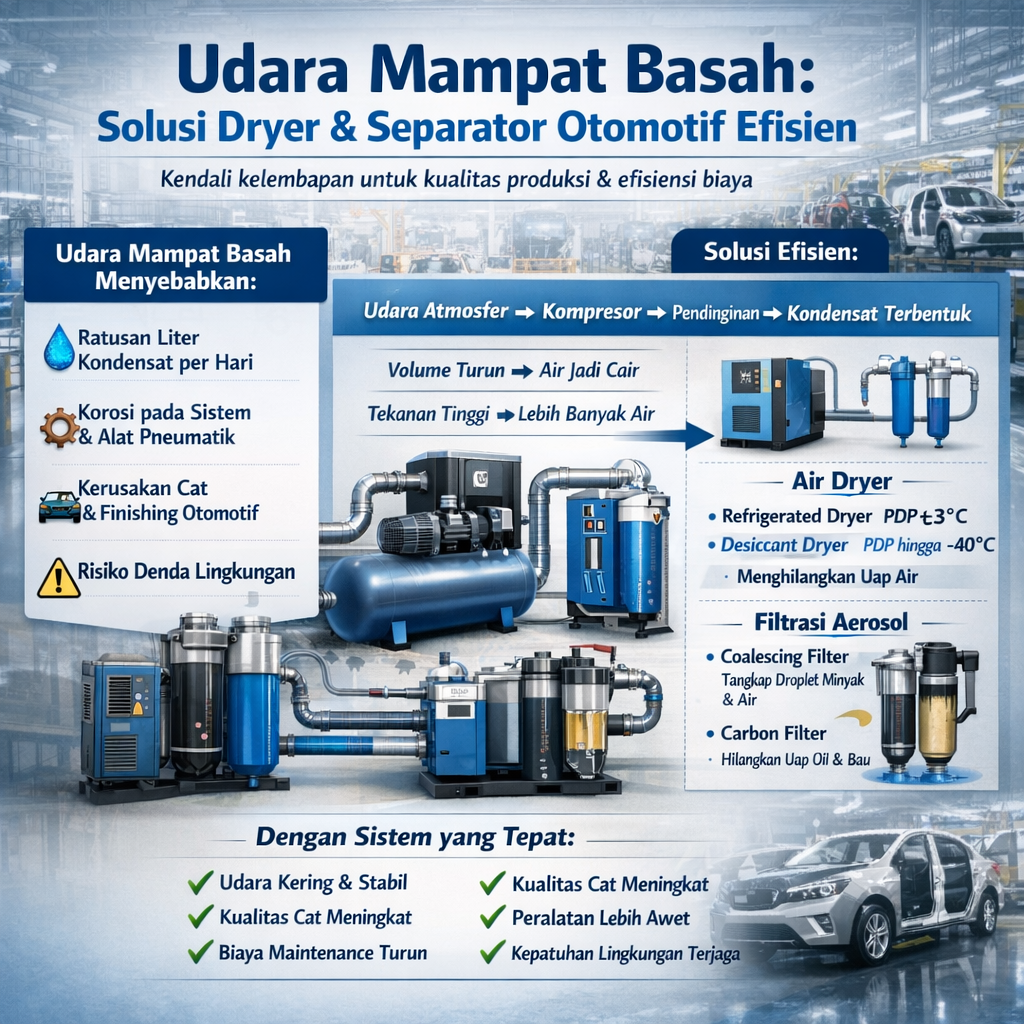
A representative chain in automotive assembly is: aftercooler → refrigerated dryer → particulate/coalescing filters → point‑of‑use coalescing + carbon for the paint booth. This ensures moisture and oil carryover are removed before air contacts paint or controls.
Condensate volumes and composition
After drying/filtration, remaining liquid (condensate) from aftercoolers, receivers, filters, and dryers is removed via automatic drains — timer‑based or level‑actuated — to a collection system (www.ingersollrand.com).
Quantities add up fast: the same 100 hp compressor with a refrigerated dryer that produced >45 gal (170 L) in 8 h in summer made <1 gal in winter (www.ingersollrand.com). A 25 hp compressor can make ~20 gal/day — roughly 11 drums (55 gal each) per month — potentially costing ~$5,500 in disposal fees if untreated (www.plantengineering.com).
Composition-wise, compressor condensate is mostly water but contains oil and dirt. Older sources cite ~99% water / 1% oil; others note ~95% water / 5% oil (www.plantengineering.com; www.omega-air.si). Oil carryover is usually tens of ppm but can be hundreds of ppm depending on compressor wear and lubricant; in hot, humid air, more water dilutes the oil fraction, whereas in dry/cold air oil percentage rises — but contaminant loads remain (www.plantengineering.com). The condensate is essentially an oil‑in‑water emulsion and is treated as hazardous — a “B3” waste under many enviro regs.
Oil/water separation and discharge
Untreated condensate is an environmental hazard: one liter of oil can contaminate a million liters of water, and regulations “strictly prohibit” dumping compressor condensate (www.omega-air.si). UK law classifies condensate as hazardous waste and can fine up to £20,000 for illegal release; in Germany, permits require “best available technology” and typically ≤20 mg/L oil (www.atlascopco.com; www.atlascopco.com). Indonesian regulations similarly treat used oil as hazardous (B3); condensate with any oil would require special handling under Permen LHK (even if direct Indonesian citation is hard to find, global practice is clear).
To comply and cut costs, plants use oil/water separators so water can often be safely discharged. Types include chemical absorption (resin media that bind oil; a 15 gal unit holds ~7–8 gal oil before replacement), gravity separators (simple settling; ineffective on emulsions), coalescing separators (coalesce tiny oil droplets; ~99% oil removal), and activated carbon filters for post‑polishing to <~10 ppm (www.plantengineering.com; www.plantengineering.com; www.plantengineering.com; www.plantengineering.com). Atlas Copco’s OSC separator claims outlet water with only ~5 ppm residual oil — well below most standards (www.atlascopco.com). Designers spec stages to meet local effluent limits (often 10–30 mg/L) (www.atlascopco.com).
For free‑oil knock‑out ahead of polishing, facilities deploy dedicated equipment such as oil removal systems. Where onsite treatment is unavailable, hauling is expensive: the ~$5,500/month example for one 25 hp compressor shows why separators often “pay for themselves,” assuming treated water meets legal limits (www.plantengineering.com).
Maintenance metrics and outcomes
Best practice is to use capacity‑sensing drains rather than simple timers, drain receivers often, and inspect separators; measure condensate flow versus expectations to catch drifts — for example, a failing coalescer can spike oil in water (www.ingersollrand.com; www.ingersollrand.com). Track PDP at key points, monitor coalescing filter ΔP (2–6 psi normal; replace >8 psi), and check separated water oil content (e.g., monthly). Some standards require <10 ppm, so even a small rise signals maintenance is needed (www.sealingandcontaminationtips.com; www.plantengineering.com). Keeping spare desiccant, filter cartridges, and carbon on hand avoids downtime — supported by spare parts and consumables programs.
Outcomes are measurable: ensuring a ~3 °C PDP versus 20 °C can eliminate all liquid water downstream (virtually 100% moisture removal), protecting valves and cylinders and preventing rust‑related downtime; reliable drip‑free airlines also maintain consistent pressure (america.sullair.com; www.sealingandcontaminationtips.com). On the condensate side, oil/water separators are “not only common sense but required by law in most countries,” with illegal discharge risking fines and shutdowns (www.atlascopco.com).
Source notes
Authoritative industry and regulatory publications underpin these data. Notable references include Joseph L. Foszcz, Plant Engineering (2005), “The Rules and Tools to Dispose of Compressor Condensate” (www.plantengineering.com; www.plantengineering.com), Kris McCullough, Sullair blog (Jan 2024), “Desiccant Air Dryers vs. Refrigerated Air Dryers” (america.sullair.com; america.sullair.com), Atlas Copco technical blog (Oct 2024), “Why oil-water separation is needed?” (www.atlascopco.com; www.atlascopco.com), Anglian Compressors (UK), “Compressed Air Condensate and Its Disposal” (angliancompressors.com; angliancompressors.com), Ingersoll Rand, “Fundamentals of Condensate Management” (www.ingersollrand.com; www.ingersollrand.com), and technique notes on coalescing filtration (www.sealingandcontaminationtips.com).