

Industry: Automotive | Process: Assembly_Line_Utilities
When sprinklers work, they control 96% of fires. That’s the National Fire Protection Association’s finding when systems operate properly (buildings.com). But water that sits for months in fire lines can quietly cripple that performance. In one U.S. high‑rise incident, a hotel blaze burned for six to seven hours — firefighters ultimately rescued occupants — because a largely failed sprinkler system delayed suppression (buildings.com).
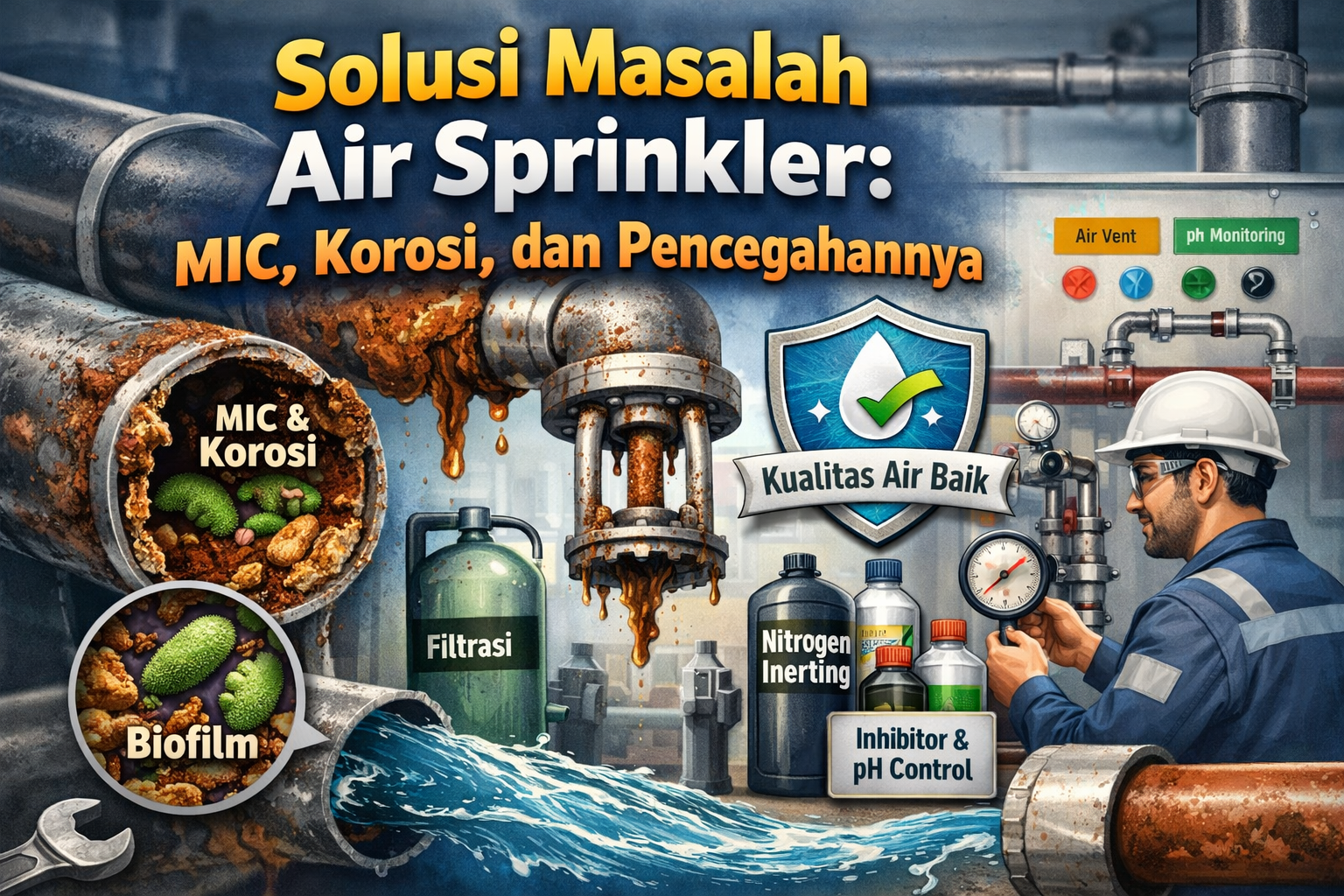
The culprit in many failures is MIC (microbiologically influenced corrosion, corrosion accelerated by microbial biofilms). As one engineering source puts it, “FPS make‑up waters are typically stagnant, soft (relatively low in hardness), acidic and devoid of antimicrobial agents such as sodium hypochlorite” — in other words, ideal conditions for biofilm growth once municipal chlorine dissipates (pmengineer.com).
Stagnation, soft water, and MIC
Standing water in sprinkler piping invites aerobic and anaerobic microbes that produce corrosive acids, sulfides, and gas. Iron‑oxidizers and sulfide‑reducers colonize the lines, creating rust tubercles (“tubercles” are corrosion deposit mounds) that can occlude branch lines and block spray‑head orifices (pmengineer.com; pmengineer.com). Pitting beneath biofilms causes pinhole leaks that undermine integrity.
Corrosion intensifies with oxygen (O₂). Corrosion experts note that significant oxygen and water coexisting in steel pipes can pit through the wall in less than five years (buildings.com). Municipal supplies often introduce O₂ through aeration or chlorination and lose disinfectant before the water reaches new sprinkler lines (buildings.com; pmengineer.com). Each refill during testing introduces fresh O₂ and nutrients.
Failures, case studies, and trends
Evidence is widespread. A U.S. National Fire Sprinkler Association survey (1996) reported 20 of 30 failures showing MIC‑induced leaks within months of startup (corrosion.com.au). One hospital in Norway documented “serious internal corrosion with large corrosion products and rust lumps” in untreated carbon‑steel sprinkler piping; untreated fresh water sat until a fire test, generating extensive tubercles (ntnuopen.ntnu.no).
Even “corrosion‑resistant” materials can backfire. Recent Norwegian experience with zinc‑coated pipes (installed 2013–2021) showed MIC attacking the zinc liner and generating hydrogen (H₂) pockets, prompting regulators to withdraw zinc‑approved pipe and implement routine venting (sintef.no). As sprinkler mandates expand internationally, more idle lines mean higher stagnation risks; for example, Norway’s rapid rollout to schools, homes, and eldercare after 2017 coincided with reports that “MIC has already triggered major maintenance and repair costs” (sintef.no; sintef.no).
Standards, inspections, and blind spots
NFPA 25 (Inspection/Testing/Maintenance) requires periodic internal pipe assessments, typically five‑year CCTV or pipe‑removal inspections targeting obstructions (buildings.com; ecscorrosion.com). These protocols focus on hydraulic functionality and can miss MIC until advanced stages. Current engineering guidance argues water quality itself must be managed to ensure readiness (ecscorrosion.com; corrosion.com.au).
Source assessment and first fill
Baseline water testing is foundational. Ideal makeup water is relatively hard (around >150 ppm hardness as CaCO₃ provides buffering), near‑neutral pH, and low in chloride/sulfate. Soft, acidic water is more aggressive; if pH <7 or hardness is very low, pre‑entry adjustment may be warranted. Adding continuous high‑dose chlorine is not advised; verify any residual disinfectant levels (pmengineer.com; corrosion.com.au). Where inlets need debris control, facilities commonly specify filter strainers; an inline option is a strainer installed on the fill line.
During installation, full‑system flushing removes mill scale, slag, and debris. Australasian guidance goes further: clean pipework and disinfect with alcohol prior to installation, cap pipes dry, and monitor internal conditions to avoid early biofilm establishment (corrosion.com.au).
Materials and oxygen control
Material choice matters. Stainless steel, painted/epoxy‑coated steel, or fire‑rated copper can improve resilience, while zinc‑coated steel has shown MIC of the zinc layer with hydrogen generation risks in field experience (sintef.no).
Oxygen removal is a high‑impact control. For wet‑pipe systems, automatic air‑release vents at high points reduce trapped O₂; inexpensive vents let oxygen escape as the system fills, cutting corrosion drivers (kinetixfire.com). Nitrogen (N₂) inerting — displacing oxygen with nitrogen during filling — is widely applied in dry/preaction systems via generators and can be applied to wet systems; costs for small systems are cited at roughly $2–7.5K (kinetixfire.com; internationalfireprotection.us).
Chemistry, pH, and inhibitors
Neutral‑to‑slightly alkaline pH (about 7.0–8.0) mitigates corrosion; acidic, CO₂‑enriched fills can be buffered. Film‑forming corrosion inhibitors (e.g., nitrite or molybdate) are used sparingly in potable‑connected systems and must be NSF/ANSI 61 compliant with any flammability risks assessed. One commercial product claims a “self‑healing protective barrier” and pH lift (rkwaters.com); such chemistries are applied with caution. Where inhibitor programs are approved, facilities reference potable‑safe corrosion inhibitors and track effective concentrations.
Shock disinfection protocols
Short, infrequent shock chlorination is a proven way to disrupt biofilms. Raising free chlorine (Cl₂) to about 3–5 mg/L for 60–120 minutes can deliver an >80–90% biofilm reduction, with one study reporting dominant iron‑oxidizing species dropping from ~40% to ~17% after 3 mg/L for 60 minutes (mdpi.com). A 2021 analysis recommends infrequent high‑dose cycles to “rapidly remove biofilm” (mdpi.com).
Operationally, fire tanks and mains can be drained, dosed with sodium hypochlorite or chlorine dioxide, held, and flushed. Accurate delivery is routine with a metering device such as a dosing pump. Chlorinated discharges must meet environmental limits; residuals are commonly neutralized using a dechlorination agent. In small systems, this cycle during five‑year maintenance is common practice; large facilities may engineer an in‑line disinfection step. Post‑treatment microbiology (e.g., checking indicator organisms) confirms effectiveness.
Biocides, add‑ons, and trade‑offs
Some fire systems employ continuous or periodic biocides. Options marketed to control biofilm exist, but two risks are frequently cited: sprinkler water is expected to be non‑toxic, and stagnant chemical additives can precipitate solids that worsen blockage. Industry data cites ~$14–20K per chemical‑injection cycle for a 20,000 ft² building, with cautions that “even if the chemicals are nontoxic…there’s still a concern about whether they’ll impact firefighters during a fire or harm sprinkler components” (kinetixfire.com). Where policies allow, facilities standardize approved biocides for specialist use only. Expert guides frame routine chemical dosing as an additive measure that must be balanced against solids formation and combustibility concerns (corrosion.com.au).
Monitoring and maintenance programs
Internal inspections remain the anchor. NFPA 25 prescribes five‑year internal checks — typically pipe removal and sprinkler opening at representative dead‑ends to assess obstructions (buildings.com; ecscorrosion.com). Modern practice adds CCTV, targeted sampling at high points in wet systems and low points in dry, where corrosion severity concentrates (ecscorrosion.com).
Routine flushing via test valves doubles as water refresh. Quarterly or annual flow tests on dry/pump systems flush stagnant sections; subsequent drainage avoids remixing spent water. Eliminating or isolating permanently unused branches (“dead‑legs”) reduces Legionella and stagnation risk (watertreatmentservices.co.uk).
Sampling and “fitness‑for‑service” checks round out the picture. Annual stored‑water sampling tracks drops in chlorine, pH, or rising microbes. Because bacteria detection alone poorly correlates with MIC severity, engineers emphasize trends and condition findings (ecscorrosion.com). Practical targets used in programs include HPC (heterotrophic plate count, a general measure of bacterial load) under ~500 cfu/mL, residual chlorine above ~0.2 mg/L by end‑of‑retention if present, pH within about 6.8–8.2, and action levels such as pH dropping below ~6.5 or conductivity rising ~20% triggering investigation.
Internal condition monitoring tools — corrosion coupons, galvanic probes in bypass loops, or ultrasonic thickness on risers — add early warning. One industry note underscores that “receiving full water samples will always yield some microbes, but the severity of corrosion is a much better guide” (ecscorrosion.com).
Water quality management plan
A formal WQMP (Water Quality Management Plan) for fire systems functions like a building plumbing water safety plan. Typical elements include:
-
Baseline assessment: source survey (municipal or on‑site), initial tests (pH, dissolved oxygen, residual Cl₂, hardness, alkalinity, microbial plate counts), and “as‑installed” documentation.
-
Treatment program: chemistry adjustment if needed (e.g., neutralizers), passive devices at inlets — such as a strainer — and air vents; N₂ supply for dry systems; annual or biannual shock disinfection (about 3–5 mg/L Cl₂ for 60–120 minutes) of tanks and yard lines with downstream flushing.
-
Monitoring regimen: quarterly chemistry checks; annual microbial counts and metals; test‑valve operation at least once per year; an O₂ monitor at the fill point.
-
Inspection and maintenance: NFPA 25 five‑year internal inspections at minimum, with focus on dead‑ends and high/low points; cleaning or replacement for ≥10% wall loss or heavy tuberculation; twice‑yearly verification of air vents and nitrogen systems.
-
Documentation: detailed logs of tests, inspections, treatments, repairs, and trend analysis integrated with site safety management and insurer/regulator audits.
Specialized treatments and outcomes
Chlorine‑based disinfection remains the workhorse. Short shock cycles reduce reservoir and line biofilms by >80–90%, with 60–90‑minute exposures around ~3 mg/L documented to significantly suppress α‑ and β‑Proteobacteria associated with biocorrosion (mdpi.com). Longer or higher doses approach near‑total kill but require downstream chlorine neutralization prior to discharge — operationalized with a dechlorination agent.
Continuous biocide additives and long‑term inhibitors (e.g., monochloramine, bromine compounds, isothiazolinones; nitrite or silicate film formers) are seldom standardized for potable‑connected sprinklers. Expert resources frame these as optional tools, secondary to mechanical fixes like drainable design, inerting, cleaning, and venting (corrosion.com.au). Field cases reported by insurers indicate removing stagnant zones and venting trapped air can cut obstruction incidents nearly in half. Where inhibitor programs are adopted, potable‑approved classes are chosen and levels (for example, >~30 ppm nitrite) are monitored to avoid sludge formation.
Measured outcomes support the approach: in one industrial program, quarterly flushes and annual chlorination coincided with zero new leaks over five years versus annual leaks prior; nitrogen concentration control reduced average corrosion rates by about 80% in internal data. Replacement costs of $10K–$20K for a medium facility are commonly avoided when prevention programs are maintained (kinetixfire.com).
Managerial alignment and local context
Program ownership, training, and insurer alignment complete the picture. Plans assign roles (asset engineer, facility technician, external contractor) and cadence (monthly checks, quarterly tests, annual reviews). Coordination with municipal water suppliers matters; disinfectant regimes like chloramination alter persistence and materials interactions. NFPA 25 mandates visual checks annually and internal checks every five years (buildings.com; corrosion.com.au). NFPA 13 implies drainable installation. Insurers reference FM Global loss‑prevention guidance that prioritizes mechanical controls before chemicals.
Local notes: Indonesia’s SNI (Standar Nasional Indonesia, national standards) are expanding in firefighting scope — 31 new SNI were published in 2024 (bsn.go.id) — focusing on equipment and installation. Maintenance practices typically adopt NFPA/ISO, making international findings on water quality directly applicable. Local procedures often mirror NFPA 25 and NFPA 13 in spirit; citations to these in site documentation help align with auditors and insurers.
Key takeaways and risk framing
Untreated, stagnant water rapidly drives biofilm growth and MIC in fire lines (pmengineer.com; corrosion.com.au). The remedy is a documented WQMP that marries design (drainable lines, venting/inerting), proactive treatment (shock disinfection, pH control), and vigilant monitoring (inspections, sampling, recordkeeping). The payoff is reliability: NFPA’s 96% control rate for properly operating sprinklers underscores the stakes (buildings.com). Integrating water treatment into fire‑system maintenance is increasingly seen as standard practice for preserving safety and controlling costs (corrosion.com.au; corrosion.com.au).