

Industry: Aquaculture | Process: Hatchery_&_Larval_Rearing
Global aquaculture output is on track to exceed 100 Mt by 2030 — a 22% increase from 2020 — according to FAO projections (openknowledge.fao.org). In that world, early life stages in intensive hatcheries live or die by water quality.
The stakes are not abstract. In one trial, continuous UV treatment of inlet water at 400 mJ/cm² cut rainbow trout egg mortality from 77.3% to 14.3% (sciencedirect.com). Another combined low‑dose ozone (0.1–0.2 mg/L) with UV (50 mJ/cm²) to produce water “nearly free” of coliforms and heterotrophic bacteria (researchgate.net).
The engineering response is a multi‑barrier system: graded mechanical filtration to strip solids and “shadowing” organics, then high‑intensity UV, then controlled ozonation — and, critically, post‑ozone activated carbon to mop up residual oxidants. What follows is a design brief for hatchery engineers, with doses, flows and contact times anchored to trials and guidance.
Coarse screening and sand filtration
Start upstream with coarse screening (e.g., rotating drum or 100–300 μm mesh) to protect downstream units from clogging. Many intake lines use continuous debris removal via an automatic screen filter for this duty.
For finer solids, sand filtration is the first barrier. FAO guidance points to dual 3 m diameter × 0.5 m deep sand filters (effective porosity ≈0.4) with 0.02–0.03 mm grain size operating at ~5–10 m/h through the bed, retaining >99% of particles ≥25 μm (fao.org). In practice, each sand filter runs at ~3–10 m³/min and is sized in pairs so one can backwash while the other operates (fao.org).
Media selection is standard: dual‑media beds commonly pair silica sand with anthracite. Hatcheries often specify sand media for 5–10 μm cut‑offs and add anthracite to build a multi‑layer profile and extend run times. Note: sand filters do not remove bacteria, viruses or dissolved organics (fao.org), so they are only the first barrier.
Bag and cartridge micro‑filtration
Downstream polishing typically sequences a 50 μm pre‑filter, then a 5–10 μm bag, and finally a 1 μm absolute cartridge. A cartridge filter at 1 μm captures >99% of particles ≥1 μm, stripping remaining flocs and bacterial aggregates. Free viruses (<0.2 μm) pass, but removing particulates slashes “shadowing” and organic demand, immediately boosting UV and ozone efficacy (id.scribd.com).
Design targets used in practice are turbidity <3 NTU and UV transmittance (UVT) >70–80% to ensure reliable UV disinfection (id.scribd.com). For food‑grade and hatchery hygiene, engineers often specify 316L stainless cartridge housings; in seawater service, lightweight FRP housings resist corrosion (composite housings).
Filtration performance outcomes
A well‑designed filter train typically cuts suspended solids and turbidity by 90–99%. Moving‑bed RAS hatcheries routinely report outlet turbidity <1 NTU after polishing, even when intake water is high in color or plankton (id.scribd.com; id.scribd.com). Paired with sterilization, filtration has translated to survival gains — including the 77.3% to 14.3% egg loss reduction after UV noted above (sciencedirect.com).
UV‑C sterilization dose and sizing
UV‑C (200–280 nm, typically 254 nm from low‑pressure mercury lamps) damages DNA/RNA to inactivate bacteria, viruses and fungi without leaving chemical residuals (researchgate.net; sciencedirect.com). Typical design goals target 3–4 log (99.9–99.99%) pathogen reductions using 30–100 mJ/cm². Indonesian recirculation guidelines cite 2,000–10,000 μWs/cm² (2–10 mJ/cm²) for 90% kill of bacteria/viruses, and 50,000–200,000 μWs/cm² (50–200 mJ/cm²) for small parasites (id.scribd.com). Salmonid hatcheries often aim ~40 mJ/cm², while UV‑resistant agents like Infectious Pancreatic Necrosis virus may require ≈246 mJ/cm² for a 3‑log reduction (aguatopone.com).
Sizing follows Dose = (lamp intensity) × (residence time) × (UVT). For a given flow Q, lamp count/power sets intensity, and chamber volume/baffling sets time. Low‑pressure high‑output (LPHO) lamps are ~40% efficient at 254 nm, versus ~15% for medium‑pressure lamps (aguatopone.com). Manufacturer curves — e.g., UltraAqua Ultrabarrera and Trojan — commonly show 50–100 mJ/cm² at 10–100 m³/h depending on lamp count. As a rule, aim ≥50 mJ/cm² on full hatchery intake, or ≥100 mJ/cm² if water quality is poor. Typical systems specify an ultraviolet disinfection unit here.
Design example: at 20 m³/h (≈5.6 L/s) and 80% UVT targeting 40 mJ/cm², one 100 W LPHO lamp producing ~25 mW/cm² would require two lamps in series (~50 mW/cm²). Residence time needed is 40 mJ ÷ 50 mW = 0.8 s; reactor volume ≈5.6 L/s × 0.8 s = ~4.5 L. In practice a two‑lamp chamber of ~10 L with internal baffling or serpentine flow would suffice, with 20–30% extra capacity to account for lamp aging and fouling. Consider a UV sensor for feedback and schedule sleeve cleaning and lamp changes every 9–12 months.
Performance is immediate near‑sterilization: trials show >3‑log reductions with minimal water chemistry change (sciencedirect.com). Limits are optical: if turbidity >5 NTU or UVT <50%, increase dose or improve pre‑filtration.
Ozone treatment: CT and generator sizing
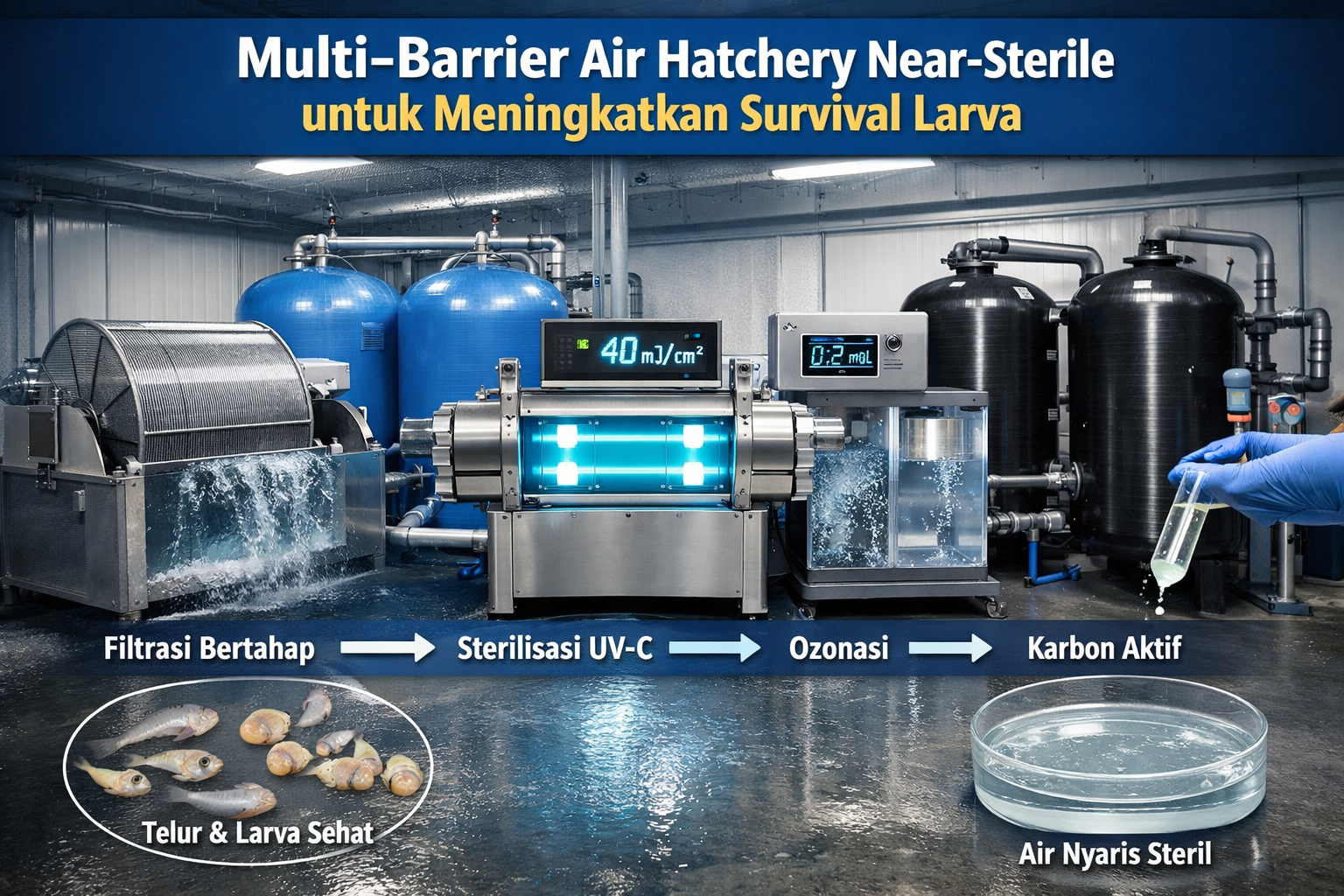
Ozone (O₃) is a mixed oxidant/biocide injected via venturi or diffuser to oxidize dissolved organics and inactivate microorganisms. Benefits include broad disinfection (dpi.nsw.gov.au; researchgate.net), removal of dissolved organics and color (dpi.nsw.gov.au), flocculation of fine/colloidal particles (dpi.nsw.gov.au), and direct oxidation of nitrite NO₂⁻ to nitrate NO₃⁻ (dpi.nsw.gov.au). Experimental RAS data show faster nitrification and clearer, higher‑DO water under ozone (dpi.nsw.gov.au; researchgate.net).
Dosage is set by residual concentration and contact time (CT). For relatively clean intake water, guidance targets ~0.1–0.2 mg/L residual for 1–5 minutes to inactivate pathogens (dpi.nsw.gov.au). Practically, that corresponds to CT ≈ 0.2 mg·min/L (e.g., 0.2 mg/L for 1 min). In organically rich recirculation loops, 0.2–0.4 mg/L residuals may be needed for similar kill rates (dpi.nsw.gov.au). Very pure water can need only 0.01–0.1 mg/L for tens of seconds (dpi.nsw.gov.au). Another rule of thumb in high‑load RAS is 10–15 g O₃ per kg feed per day (dpi.nsw.gov.au).
Generator sizing is straightforward: required ozone production (g/h) ≈ flow Q (m³/h) × target residual C (mg/L). For a 50 m³/h intake at 0.2 mg/L residual, that’s ~10 g/h; a 10 g/h module (≈0.5–1 kW) would serve. Larger hatcheries (100+ m³/h) may need 50–100 g/h capacity. Oxygen‑fed corona‑discharge generators boost yield and avoid nitrogen oxides; typical efficiency is ~3–6 g O₃ per g O₂ input. Ensure good mass transfer (venturi injector or diffuser) and provide 1–5 minutes of gas‑liquid contact in a column or packed contactor. Off‑gas must be vented or destructed with activated carbon to protect workers. Inline ORP or ozone sensors keep residuals in the 0.1–0.3 mg/L range for short duration; in bromide‑rich brackish/seawater, control is critical to limit bromate/bromamine formation (researchgate.net). Instrumentation and skids are commonly bundled as supporting equipment in treatment packages.
Performance can be dramatic. Even low‑dose ozone (0.1–0.2 mg/L for seconds) teamed with UV has produced “nearly coliform‑free” water (researchgate.net). Higher doses (up to ~0.5 mg/L) can yield >99% reductions of nitrifiers and most pathogens, but overdosing injures fish and biofilters — making measurement and control non‑negotiable (researchgate.net).
Post‑ozone activated carbon polishing
A granular activated carbon (GAC) filter after ozonation is essential. Carbon rapidly decomposes dissolved O₃ and brominated oxidants and adsorbs oxidation byproducts (e.g., bromate, aldehydes). Without it, residual oxidants elevate ORP to toxic levels. As aquaculture experts note, “activated carbon filtration, UV, or reducing agent… will reduce or eliminate” residual O₃ and bromine (researchgate.net). A typical design targets ~5–10 minutes empty‑bed contact time (EBCT; the hydraulic residence time within the carbon bed). In practical terms, a 1 m³ GAC bed treating 10 m³/h delivers ~3–6 minutes EBCT.
Pilot tests show UV doses of ~80–150 mJ/cm² are needed to fully destroy 0.3 mg/L ozone (researchgate.net), whereas carbon achieves the same via oxidation/adsorption with minimal head loss. The result is water with zero measurable ozone and safe ORP. Post‑ozone carbon protects fish and nitrifiers; Gupta et al. advise post‑O₃ UV or AC “to ensure that biofilter and fish are not exposed to high ORP” (onlinelibrary.wiley.com). Hatcheries commonly specify activated carbon media for this duty, with periodic regeneration or replacement.
Cumulative log reductions and outcomes
Each barrier adds incremental protection:
- Sand filter: ~1–2 log removal of particles/eggs (≥25 μm) (fao.org).
- Bag/cartridge: ~2–3 log (90–99.9%) removal down to 1 μm.
- UV (30–50 mJ/cm²): ~3–4 log pathogen reduction (id.scribd.com; sciencedirect.com).
- Ozone (0.1–0.2 mg/L, 1–5 min): additional ~3 log kill plus organics oxidation (researchgate.net; dpi.nsw.gov.au).
- GAC polishing: essentially 100% removal of residual oxidants, returning ORP to safe ranges (researchgate.net; onlinelibrary.wiley.com).
Together, systems have approached near‑sterile water. One trial of ozone + UV reported virtually zero culturable bacteria (researchgate.net). Another hatchery saw egg mortality fall from ~77% to ~14% after installing high‑intensity UV (sciencedirect.com).
Design specifications and checks
- Filter sizing: operate sand filters at ~5–10 m/h with automatic backwash. Size staged bag filters for peak flow (e.g., 50 μm → 5–10 μm). Size cartridge banks to polish to ≤1 μm at full flow with acceptable ΔP. Media choices often include silica sand and deeper beds with anthracite.
- UV system: target ≥30–50 mJ/cm² for a 3‑log kill (use ≥50–100 mJ/cm² to be conservative). Dose = I × t × UVT, where t = Vchamber / Q. Example: for 20 m³/h at 80% UVT, two 100 W lamps (~25 mW/cm² each) deliver 40 mJ/cm² in ~0.5 s; chamber ≈3–4.5 L, typically built ~10 L for mixing and margin. Include hydraulic uniformity (baffles) and ~20–30% capacity headroom; add a UV sensor.
- Ozone system: size generator as Q × C. Residual 0.2 mg/L at 100 m³/h needs ~20 g/h; at 10 m³/h needs ~2 g/h. Use oxygen‑fed corona discharge (efficiency ~3–6 g O₃ per g O₂ input). Provide a venturi + degassing column or bubble tower with ≥2 minutes contact at design flow. Include off‑gas destruction and monitor ORP or residual O₃; target <0.05 mg/L leaving the contactor.
- Activated carbon: route all post‑ozone water through a GAC unit with ~1 m bed height and 5–10 minutes EBCT. A 1 m³ bed at 10 m³/h gives ~3–6 minutes EBCT. Replace or regenerate routinely. Engineers frequently specify GAC media for this stage.
- Instrumentation: verify turbidity drop (>90% removal) with online meters; log UVT; use UV radiometers; monitor ozone off‑gas and ORP. Finished‑water microbiology (e.g., total coliform/HPC) should read ≈0–5 CFU/mL.
- Spares and upkeep: sleeves, lamps and filter elements are routine consumables in UV/filtration skids, typically supplied as parts and consumables.
The through‑line is redundancy. Graded mechanical filtration removes solids and organic “shadows,” UV delivers immediate inactivation, ozone polishes organics while adding another kill step, and post‑ozone carbon restores water to safe redox conditions. The last step is not optional: carbon after ozone safeguards fish and biofilters by removing all residual oxidants (researchgate.net; onlinelibrary.wiley.com).
The data — from FAO growth forecasts to hatchery trials — point to a clear engineering path: a multi‑barrier train that hatchery teams can size and specify with confidence, using established flow rates, media grades, UV doses and ozone CT values (fao.org; dpi.nsw.gov.au; researchgate.net; sciencedirect.com; id.scribd.com).