

Industry: Desalination | Process: Reverse_Osmosis_(RO)
RO (reverse osmosis) membranes are unforgiving about what enters the vessel. “All organic matter, colloids and biological material must be removed upstream” (ResearchGate). Designs target a very low SDI (silt density index) — typically <3–5 — and low turbidity (<1 NTU, nephelometric turbidity units) (EPA WBS). When feed quality slips, fouling accelerates: “poor feed water quality can lead to short RO membrane lifetime, short periods of operation, and high maintenance” (ScienceDirect).
The costs are not abstract. At Orange County’s groundwater‑replenishment RO plant, a single clean‑in‑place (CIP, clean‑in‑place) cycle — chemicals, labor, lost production — ran $15,929 per train (WWD). Budget models typically assume a 4–5 year element life (EPA WBS; EPA O&M assumptions).
Multi‑barrier pretreatment and SDI targets
In practice, pretreatment is multi‑barrier: coagulation/flocculation, multimedia filtration or UF (ultrafiltration), activated carbon, degasification or softening (to remove scale‑forming ions), then cartridge polishing filters (ResearchGate). Target SDI <3–5 and turbidity <1 NTU to keep colloids off the membrane surface (EPA WBS).
For high‑fouling seawater or surface water feeds, UF ahead of RO is described as “the most competitive pre‑treatment…especially for high‑fouling feed” and is key to long membrane life (ResearchGate; ResearchGate). Many seawater facilities pair UF with sea‑water RO trains when surface conditions vary. Where metals and hardness drive scale, softening upstream supports longer runs; plants routinely deploy a softener in that role.
Dechlorination protects thin‑film polyamide from oxidative damage; that’s commonly handled with activated carbon in pretreatment. Final solids removal relies on polishing cartridges — a typical plant choice is a cartridge filter in a dedicated housing — before feed enters the pressure vessels. Where particles and color fluctuate, some operators opt for pressure‑rated ultrafiltration as the “filter of record.”
Put simply, transforming raw feed to near‑saturated SDI strips the particulates and colloids that would otherwise cake on the membrane and dramatically shorten its useful life (ResearchGate; EPA WBS).
Measured CIP triggers and staged chemistry
Even with strong pretreatment, fouling — inorganic scale, biofilm, organics — is inevitable. Operators track normalized permeability metrics (e.g., specific flux, normalized flux) and ΔP (differential pressure) to decide when to clean (WWD). Industry guidance: trigger CIP when normalized permeate flux falls ~10–25%, or when normalized ΔP rises ~20–50% (WWD).
CIP is typically staged — a low‑pH (acid) wash to dissolve inorganic scale, then a high‑pH (caustic or oxidant) wash to remove organics and biofilm (EPA WBS). Many plants standardize cleaner inventories around membrane cleaners and dose them through skid‑mounted systems with dedicated chemical dosing pumps.
CIP equipment — tanks, heaters, pumps, 100‑mesh screens and polishing filters — is often sized to wash one rack at a time (EPA WBS). Utilities source this hardware as part of water‑treatment ancillaries. A well‑executed clean returns flux close to original levels (typically >90% recovery when fouling is mild).
Cleaning too often inflates costs; cleaning too late drives up energy and risks irreversible fouling. A 70‑mgd brackish plant analysis found the economic optimum cleaning interval ran 5–10 months depending on train‑specific fouling rates (WWD). The minimum total O&M cost occurred far from the anecdotal 3–4 month CIP; seven trains favored ~5‑month intervals and seven trains ~8‑month intervals (WWD). Such results inform programs for brackish‑water RO as well as seawater service.
Given a per‑train event cost of $15,929 (WWD), the choice of interval is a direct OPEX lever. In all cases, CIP must be performed before membranes are irreversibly fouled; tracking post‑clean recovery helps set the next interval (WWD).
Operating limits and shutdown preservation
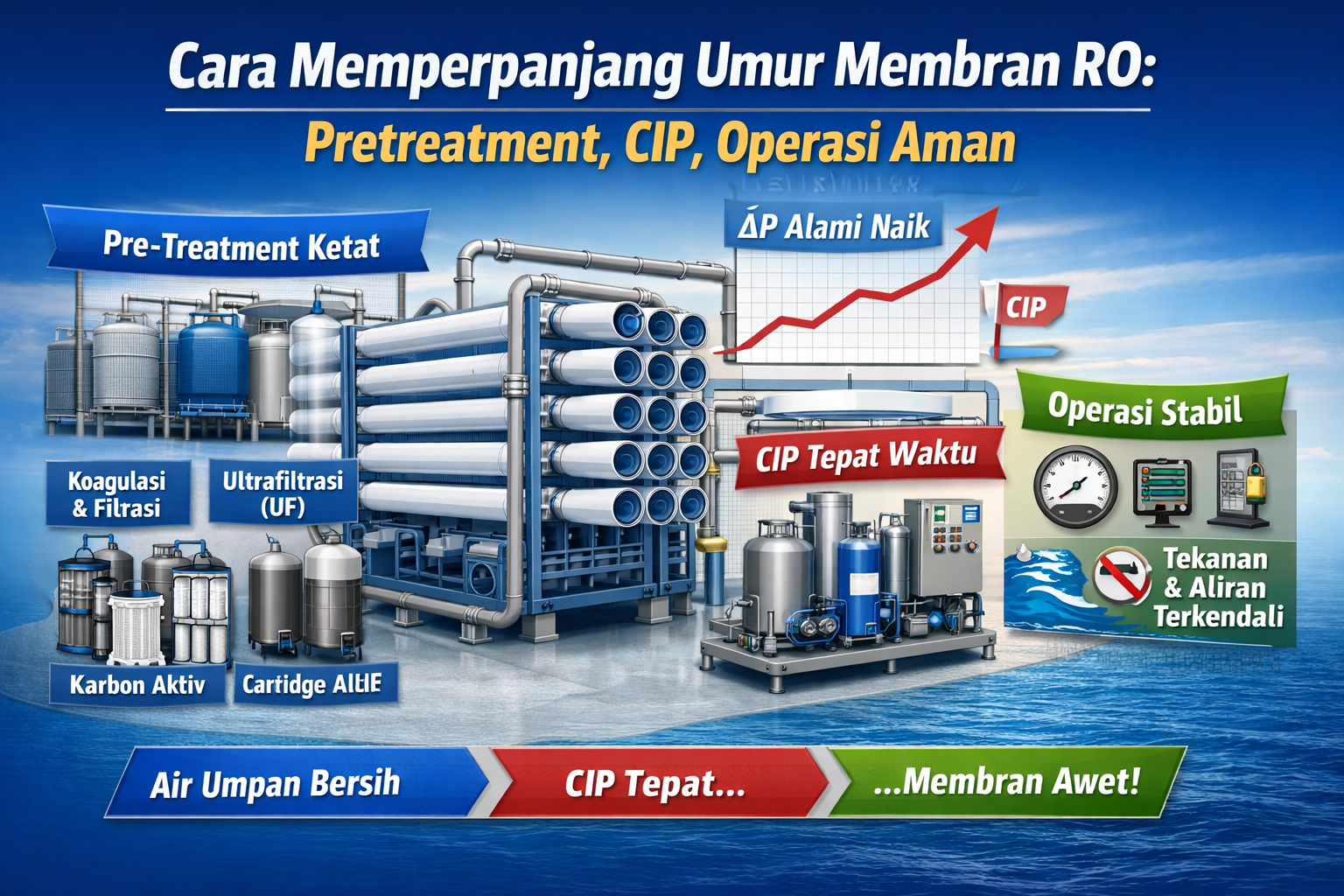
Operating within design matters. Exceeding pressure, flux, or cross‑flow limits can compact or physically stress elements. Critically, no oxidants (free chlorine or strong ozone) should contact thin‑film polyamide membranes due to irreversible polymer degradation; feed is commonly dechlorinated upstream (e.g., via activated carbon) before RO. Chemical additives must be membrane‑compatible.
Shutdown and startup procedures are central to longevity. On shutdown, systems are flushed with permeate or high‑quality feed at low pressure (~40 psi/3 bar) to rinse salts (WaterTreatmentGuide). After flushing, valves close to prevent siphoning. Membranes must not dry out; any element allowed to dry will “irreversibly lose flux” (WaterTreatmentGuide).
For short stops (<48 h), flushing is sufficient. For longer outages, elements are chemically preserved (with biocide) or kept flooded (WaterTreatmentGuide). Pressure gauges and check‑valves prevent reverse pressurization of the permeate side — static backpressure over ~5 psi (0.3 bar) on permeate can damage membranes (WaterTreatmentGuide).
Other best practices: maintain constant crossflow to avoid stagnant zones; avoid excessive recovery that concentrates scaling salts; and operate within allowed pH and temperature ranges. Many thin‑film composite (TFC) elements specify pH ~2–11 and maximum feed temperatures ~40–45 °C. Gentle ramp‑ups, continuous flow, and no hydraulic shock preserve physical integrity.
Trend analysis and replacement thresholds
End‑of‑life is predicted by trending normalized performance. Key metrics include normalized permeate flow (flux), specific energy or feed pressure, and salt rejection (permeate conductivity). Right after a clean, baselines are recorded and compared over time; normalized metrics (corrected for temperature and salinity) let teams compare across trains (WWD).
One facility found normalized feed pressure rose steeply for ~20 days post‑clean, then linearly; the early slope became a per‑train fouling rate used for planning (WWD). Alarms can be set on trends — for example, if flux drops >15% since the last clean or if permeate conductivity creeps above a threshold. Replacement is scheduled before catastrophic failure: when cleaning cannot restore performance near baseline (e.g., <80% flux recovery) or when salt passage breaches spec, and when normalized permeability cannot meet design ΔP limits.
Life expectancy and budget planning
Membrane replacement is a major expense, with hundreds of elements per train at large plants. Engineers typically assume 4–5 years of life when budgeting; the U.S. EPA WBS cost model explicitly uses a 5‑year life for RO elements and lists 4–5 years in its O&M assumptions (EPA WBS; EPA O&M assumptions). In practice, well‑maintained membranes often run 5–7 years; poorly maintained ones may fail in 2–3 years.
A simple planning example: 120 elements per train at ~$1,000 per element yield ~$120k for a full‑train replacement. Exchanged every 5 years, that’s ~$24k per year per train in capital. Consumables belong in the OPEX line: frequent prefilter changeouts and antiscalant supply. EPA assumptions note cartridge filters needing replacement ~every 5 months per filter (EPA O&M assumptions). Plants commonly standardize on membrane antiscalants as part of their dosing programs.
The data‑driven play is to track operating metrics and costs together. One facility’s ~$16k per CIP event (WWD) meant avoiding a single unnecessary clean saved as much as doing one too few. Most operators reflect typical ~5‑year replacement cycles in annual budgets while investing enough in pretreatment and right‑time CIP to meet those targets (EPA WBS).
Sources and context
Industry best‑practice guides and case studies (WWD; WWD), U.S. EPA design models (EPA WBS; EPA O&M assumptions), and membrane technology reviews (ResearchGate; ScienceDirect; ResearchGate; WaterTreatmentGuide) all emphasize rigorous pretreatment, normalized‑performance monitoring, and scheduled maintenance/CRECIP to sustain membrane life. Regulatory contexts — e.g., Indonesian drinking‑water standards — impose strict output‑quality requirements, making effective RO operation critical to compliance.
Many facilities bundle these practices into integrated membrane systems programs that align pretreatment, CIP, and operating envelopes from design through O&M.