

Industry: Brewery | Process: Lautering
Brewers know the feeling: a lauter tun that crawls. The culprit, in many brewhouses, is β‑glucan — long‑chain polysaccharides (mixed‑link 1,3/1,4‑β) that absorb water, thicken wort, and plug pores in the grain bed. Unmodified or adjunct‑rich malts can push β‑glucans to 100–300 mg/L, and occasionally beyond 1000 mg/L (ResearchGate).
Those gums don’t just raise viscosity; they “stick to filter aids and membranes” and even bind starch, slowing mash drainage and dragging down extract yield (Novozymes; ResearchGate). In trials that dialed in 0–20% under‑modified malt, β‑glucan content correlated strongly with poor lautering — high‑β‑glucan samples showed the slowest runoff — while other factors like protein were minor contributors (GRDC).
β‑glucanase dosing at mash‑in
Commercial β‑glucanase enzymes (often blended with xylanase, for example Novozymes Ultraflo Max) are added at mash‑in to hydrolyze those cell‑wall gums. The preparations are thermostable over mash temperatures and act on 1,3/1,4‑β bonds to “degrade both major cell wall components” (BeerCo). Typical dosing lands around 0.1–0.25 kg per tonne of grist (dependent on malt modification and adjuncts) (BeerCo), and brewhouses commonly meter such processing aids with accurate chemical dosing tools such as a dosing pump.
In laboratory mash trials on “under‑modified” malt, β‑glucanase at ≈1,300 U/L delivered substantially reduced run‑off times (GRDC). Commercial data echo that trend. One brewer’s switch to an enzyme blend at 200 ppm Ultraflo Max sped wort filtration by about 30%, even though the new product cost more per kilogram; the “benefits far exceeded the expense” (Novozymes).
The enzyme boost can show up in extraction, too. In that same case set, the brewer could mash in enough grain to raise gravity by roughly 1°Plato, increasing yield and productivity (Novozymes). Novozymes cites 0.5–2.0% extract gains from aggressive cell‑wall breakdown (BeerCo). Put simply, every 1% increase in brewhouse yield on a 100‑million‑L brewery is thousands of liters of beer per year.
Measured cycle‑time reductions
Case data repeatedly point to shorter lauter and filtration cycles. Novozymes reports a 15% reduction in run‑off time after switching to Ultraflo Max (Novozymes). Another brewer documented a 30% faster filter cycle plus a 40% drop in added filter aids (Novozymes).
In a larger‑scale trial on roughly 12‑tonne brews, Ultraflo use raised filter run volume by about 29% — from 3,800 to 4,900 hL per cycle (BeerCo). Across these examples, enzyme spend is typically outweighed by throughput and yield — a point underscored by the brewer who said the benefits “far exceeded the expense” (Novozymes).
Filter‑bed porosity with hulls
Adjunct‑heavy or husk‑poor grists (such as wheat) can compact the grain bed and slow sparge. Inert filter aids like rice hulls — the fibrous outer layer of rice — are mixed into the mash to open up pore space. Standard practice is on the order of 3–5% of the grist weight (European Food Research and Technology). For a 1‑tonne mash that’s ~30–50 kg; even 5% of 12 tonnes is 600 kg — still cheaper than a stuck brew.
Experimental work validates the practice. One open‑access study dosed 50–100 g rice husk per 1.6 kg wheat mash (≈3–6% by mass) and compared it with a no‑hull control. The control took about 40 min per 1000 mL to lauter (classified “slow”), whereas with hulls the run‑off was much faster (all cases under 1 hour). A 100 g dose of coffee husk — same concept, different material — produced the fastest run‑off at 10 min/1000 mL. Rice hull additions were the next best (“< rice hull < buckwheat < cocoa husk” < reference), and even the rice hull mash filtered in perhaps 15–20 min/1000 mL (interpolating their data) (European Food Research and Technology).
Side effects were minor (slight FAN reduction or pH shift), and beers were normally indistinguishable (European Food Research and Technology). Added porosity also enables finer grist milling and recirculation without clogging, further improving extraction (Novozymes).
Cost and availability signals
Rice hulls are low‑cost and inert. Industry suppliers list them around R43/ZAR (±USD 2.5) per kg (BrewKegTap), so adding 50 kg costs only about $150 — negligible against the value of the beer or the pain of a stuck mash. Spent hulls remain in the grain for livestock feed or compost, so no disposal complications. In practice, importers and regulators treat rice hulls as a normal brewing ingredient.
On the enzyme side, spend is often a few cents per liter of wort. Reduced run‑off times of 10–15% across a year can translate into dozens more brews, and combined use of β‑glucanase and filter‑bed aids often lifts brewhouse capacity by 15–30%. Novozymes reports that reduced filtration time and diatomaceous earth usage “easily outweighed enzyme costs” (Novozymes), with measured outcomes — faster run‑off, higher gravity, fewer blockages — documented across case studies and trials (Novozymes; European Food Research and Technology).
Processing‑aid status and labeling
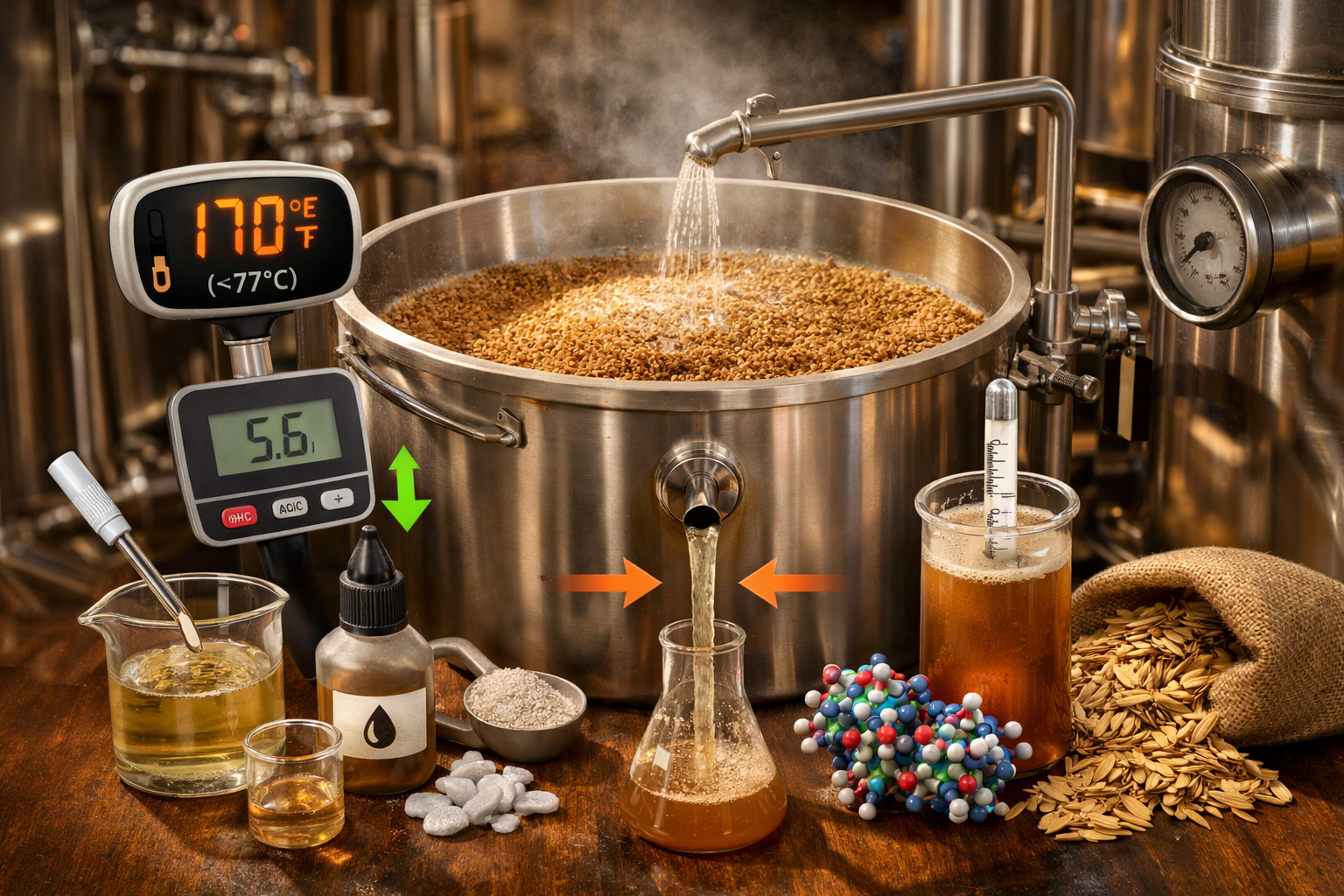
Both β‑glucanase enzymes and inert plant husks are widely treated as “processing aids,” not beer ingredients. Indonesia’s BPOM Regulation No. 28/2019 (revising a 2016 enzyme rule) explicitly lists categories such as clarifying and filtration aids in food processing, suggesting conventional brewhouse enzymes and plant‑husks are permissible under Indonesian law, subject to standard food‑safety requirements (India Trade Portal). These aids are removed or rendered harmless in the finished beer (enzymes denature; hulls stay in the mash), so special labeling is not required.
References
Edison, L.K.*, S. Sree, N.S. Pradeep, et al. (2022). “Beta‑Glucanase in Breweries.” In Microbial Beta‑Glucanases: Molecular Structure, Functions and Applications, pp. 85–98, Springer (Singapore). DOI:10.1007/978-981-19-6466-4_6. ResearchGate
Eglinton, J. (2003). UA472 – The effect of barley malt quality on lautering and beer filtration efficiency. GRDC (Grains Research & Development Corp., Australia), Final Report. Univ. of Adelaide. GRDC | GRDC
Novozymes (2021). Brewing case study: Filtration benefits far exceed enzyme cost. 02 Oct 2021. Novozymes
Novozymes (2021). Brewing case study: Updated filtering approach gives better yield, productivity, and performance. 02 Oct 2021. Novozymes
Cioch‑Skoneczny, M., A. Cempa, K. Klimczak, et al. (2025). Application of various grain shells (coffee husk, cocoa bean husk, rice hull, buckwheat hull) to enhance the mash filtration and sensory characteristics of wheat beer. European Food Research and Technology, 251:405–414. DOI:10.1007/s00217-024-04638-1. Springer | Springer
FIEO (2019). Indonesia published Regulation of FDA RI No. 28 Year 2019 on Processing Aids in Food Processing. India Trade Portal news, 16 Oct 2019. India Trade Portal
BrewKegTap (2024). Rice Hulls per KG. Online retailer listing (South Africa). Price: ZAR 43/kg. BrewKegTap