

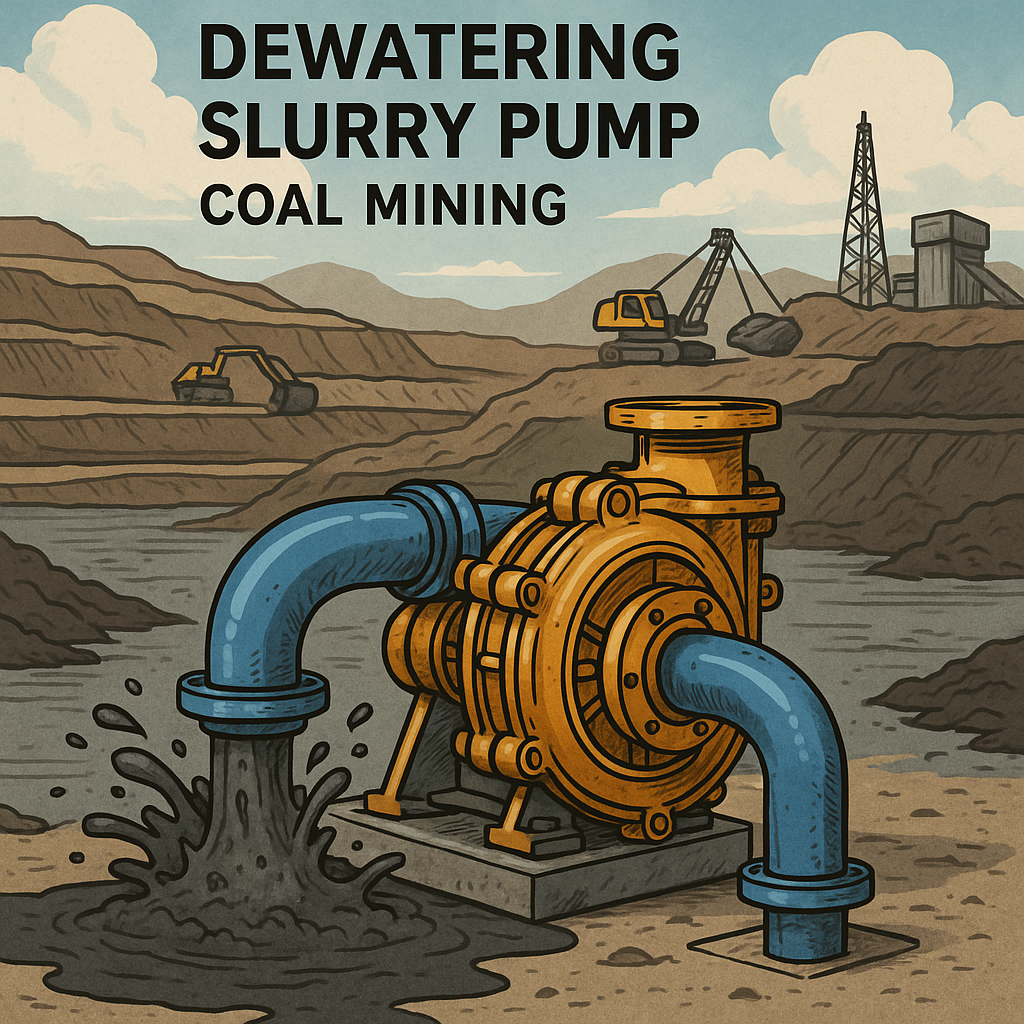
Industry: Coal_Mining | Process: Dewatering
Coal dewatering isn’t gentle. Large flows of sand, clay, and coal fines run 24/7; in severe service, wet‑end wear life can be only 2–3 months (sgb-slurrypump.com), and any failure or inefficiency can halt operations and cut profits (sgb-slurrypump.com). A case study of an Indonesian coal mine designed a sump for ≈19,427 m³ of water (journal.ubb.ac.id), a reminder of the volumes at stake.
Against that backdrop, pump choice, materials of construction, and how close the pump runs to its best‑efficiency point (BEP, the flow/head where a pump is most efficient with minimal internal recirculation) dictate both uptime and cost. The closer to BEP, the smoother the internal hydraulics and the more evenly distributed the wear (giw.ksb.com; giw.ksb.com).
Hydraulic sizing and BEP alignment
Selection starts with duty: define flow rate (Q) and head (H). Oversizing is risky: an oversized unit typically runs left of BEP and suffers high wear (giw.ksb.com; c.coek.info). A well‑matched pump, by contrast, can run near BEP to maximize efficiency and life (northamericanmining.com).
In practice, operators aim to run at ≈90–100% of BEP flow. Deviation carries a steep penalty: one reference estimates a large slurry pump run at only 20% of BEP may achieve ~30% of normal life; at 50% of BEP, ~80% of life (c.coek.info). Smaller pumps show similar trends: at 50% BEP ~90% of life, and at 20% BEP ~75% (c.coek.info). Pump makers and mining experts align on this: the nearer the BEP, the better the wear (northamericanmining.com; sgb-slurrypump.com).
Slurry characteristics and materials of construction
Coarse, hard particles (e.g., sand, gravel) call for heavy‑duty internals and wide‑passage impellers — open or semi‑open geometries tolerate larger solids. Very fine or stringy slurries (e.g., coal fines) may suit elastomer‑lined designs.
High‑chrome white irons (~25–30% Cr) dominate mining wear parts. Their carbide microstructures reach ≈60–63 HRC (HRC is the Rockwell C hardness scale) and deliver outstanding abrasion resistance (totalmateria.com). Many OEMs specify 27% Cr cast‑iron liners and impellers, often to ASTM A532 grades such as A05 or A07, and supply interchangeable liner kits (e.g., “A05” high‑chrome vs. “AHR” rubber kits) to match duty.
Rubber linings (often nitrile or EPDM) are used when abrasives are sufficiently fine or where corrosion/shock is a concern; they can absorb impact and reduce noise. However, rubber wears rapidly with large or sharp mineral grains; experienced suppliers recommend rubber only when abrasives are fine (atlanticpumps.co.uk). Hybrid configurations — such as a metal impeller paired with a rubber‑lined volute — balance impeller strength at high speed with casing damping (kingdapump.com).
Pump type and configuration
Dewatering services typically use centrifugal pumps (horizontal or vertical) or submersible units. Solids‑handling capability is critical; gravel or solids‑handling submersibles with large clearances and robust shafts are preferred when sand is entrained. Submersibles are self‑priming but must be rated for slurry; many are not. Diaphragm or peristaltic designs are generally reserved for light‑duty or hazardous liquids, not coarse slurry.
Supplier choice and parts availability matter. Established mining brands (e.g., Weir, KSB/GIW, Atlas Copco) and local access to liners and impellers support uptime; experts emphasize that having local service and spares is crucial (northamericanmining.com).
Operating practices to minimize wear
Operation near BEP is the anchor. Variable‑speed drives, throttling valves, or parallel/series configurations help keep flow on target; running 20–30% below BEP can slash remaining life to tens of percent (c.coek.info). At BEP, internal flow is smooth and wear is more uniformly distributed (giw.ksb.com; giw.ksb.com).
Avoid long shutdowns with slurry trapped; stagnant solids settle and accelerate erosion/corrosion. Cavitation prevention is fundamental: ensure adequate NPSH (net positive suction head, the suction margin that avoids vapor formation at the impeller eye). Keep suctions clean and straight; elbows or crossings at the inlet induce swirl and uneven wear. In sumps, continuous debris removal upstream via an automatic screen can keep trash out of the pump eye while maintaining consistent hydraulics.
Impeller clearance should be restored as wear progresses. Maintaining the impeller‑to‑throatbush gap around ~1–2 mm helps limit internal recirculation and turbulent zones that accelerate wear (northamericanmining.com). Proper seal/gland flushing is equally important: maintain flush pressure and keep lines clean so abrasives do not grind the shaft or packing; abrasive ingress into the stuffing box lowers wear life and undermines sealing (northamericanmining.com). Replace wear parts in balanced sets so hydraulics remain as designed.
Maintenance and monitoring program
Scheduled wet‑end renewal beats run‑to‑failure. Replacing liners, impellers, and throatbushes before efficiency collapses avoids a spiral of added power draw and accelerated erosion; industry advice favors periodic replacement to prevent efficiency losses (northamericanmining.com).
Condition monitoring — vibration, temperature, pressure, power draw — signals wear or misalignment early. Digital systems are increasingly used to spot deviations and optimize maintenance schedules (northamericanmining.com; northamericanmining.com). Routine checks of axial play (impeller clearance), bearing condition, and shaft alignment prevent vibration‑induced wear. Walk‑arounds to spot leaks, listen for noise, and read wear patterns help decide when to pull a pump for overhaul (giw.ksb.com).
Ancillaries matter: plugged valves or strainers can starve the inlet, pushing operation left of BEP; suction‑side protection with rugged strainers helps stabilize flow and keep abrasives out of sensitive seal lines.
Maintenance planning in practice can include:
- Daily logging of pump hours and operating data (flow, power).
- Weekly checks of gland flush, bearings, and visual liner wear.
- Monthly flow/pressure validation against duty to confirm BEP operation.
- Scheduled liner replacement — e.g., every 2–3 months in severe service or as indicated by wear measurements.
- Periodic vibration analysis (especially for multi‑stage units) to detect imbalance before failure.
Hard‑wearing alloys and elastomers
High‑chrome cast irons (often 27–30% Cr) are the hallmark of slurry wet ends; after heat treatment they often exceed 60 HRC, delivering high abrasion resistance (totalmateria.com). In mining service, these alloys can last months where ordinary steels would fail in hours.
Rubber liners (typical Shore‑A ≈60–70) are favored for fine abrasives or corrosive slurries and can damp particle impacts. With large, sharp grains, rubber life can be much shorter; for similar duties with large particles, a rubber‑lined pump may need overhaul up to 2–3× more often than a metal‑lined unit, whereas with very fine slurry, rubber life can approach that of metal (manufacturer experience). Hybrid and special alloys appear as duty demands: Ni‑hard or Ni‑resist irons (≈15–30% Ni) for moderate wear, stainless‑duplex for aggressive chemistry, and in extreme cases, ceramic/cermet tiles. Industry practice is to avoid plain carbon steel in abrasive slurry contact because it wears out almost immediately.
Efficiency, energy, and cost trade‑offs
Slurry pumps often run at 60–75% peak hydraulic efficiency, so any deviation from BEP wastes energy. At high flows beyond BEP, added pipe losses raise power draw and reduce efficiency (sgb-slurrypump.com). The usual triad holds: matching the right pump and holding BEP tends to cut power while extending wear life (northamericanmining.com; sgb-slurrypump.com). Digital monitoring “unlocks new levels of efficiency” by surfacing incipient problems (northamericanmining.com).
Recommendations summary (selection and operation)
- Selection of a pump designed for slurry: confirm solids‑handling capacity and material options; size so normal duty sits near BEP using manufacturer curves (northamericanmining.com). Oversizing drives low‑flow operation and severe wear (giw.ksb.com; giw.ksb.com).
- Specification of wear‑resistant materials: use high‑chrome (≥Cr27) alloy liners/impellers for sharp abrasives (totalmateria.com); use rubber only when abrasives are confirmed fine (atlanticpumps.co.uk); hybrids for unusual duties (kingdapump.com).
- BEP‑centric operation: maintain flows at or very near BEP; adjust speed or trim impellers to compensate for wear. As a guide, at 50% BEP ~80% life for large pumps, at 20% BEP ~30%; small pumps ~90% at 50% BEP and ~75% at 20% BEP (c.coek.info).
- Clearances and seals under control: maintain impeller‑to‑liner clearance around ~1–2 mm; keep seal flush systems clean and at correct pressure (northamericanmining.com).
- Planned maintenance over run‑to‑failure: schedule inspections and liner changes, track KPIs (flow, head, amps), and replace wear parts before sharp efficiency drops (northamericanmining.com).
- Monitoring as default: instrument pumps with vibration/pressure/speed sensors; act on early warnings like rising vibration or sudden power changes to prevent unplanned downtime (northamericanmining.com).
The throughline is consistent across manufacturers and case experience: run close to design, and pumps wear more slowly, more uniformly, and for longer (giw.ksb.com; giw.ksb.com). In practice, that can move wear horizons from months to years, with compounding savings in parts, downtime, and energy.
Sources: authoritative industry and academic references — technical notes, mining engineering reviews, and case studies — underpin these guidelines (sgb-slurrypump.com; c.coek.info; northamericanmining.com; atlanticpumps.co.uk; giw.ksb.com; giw.ksb.com; totalmateria.com; northamericanmining.com; giw.ksb.com; northamericanmining.com), and a coal‑mine sump case quantifies the extreme volumes involved (journal.ubb.ac.id).