

Industry: Fertilizer_(Ammonia_&_Urea) | Process: Boiler_Feedwater_&_Steam_Generation
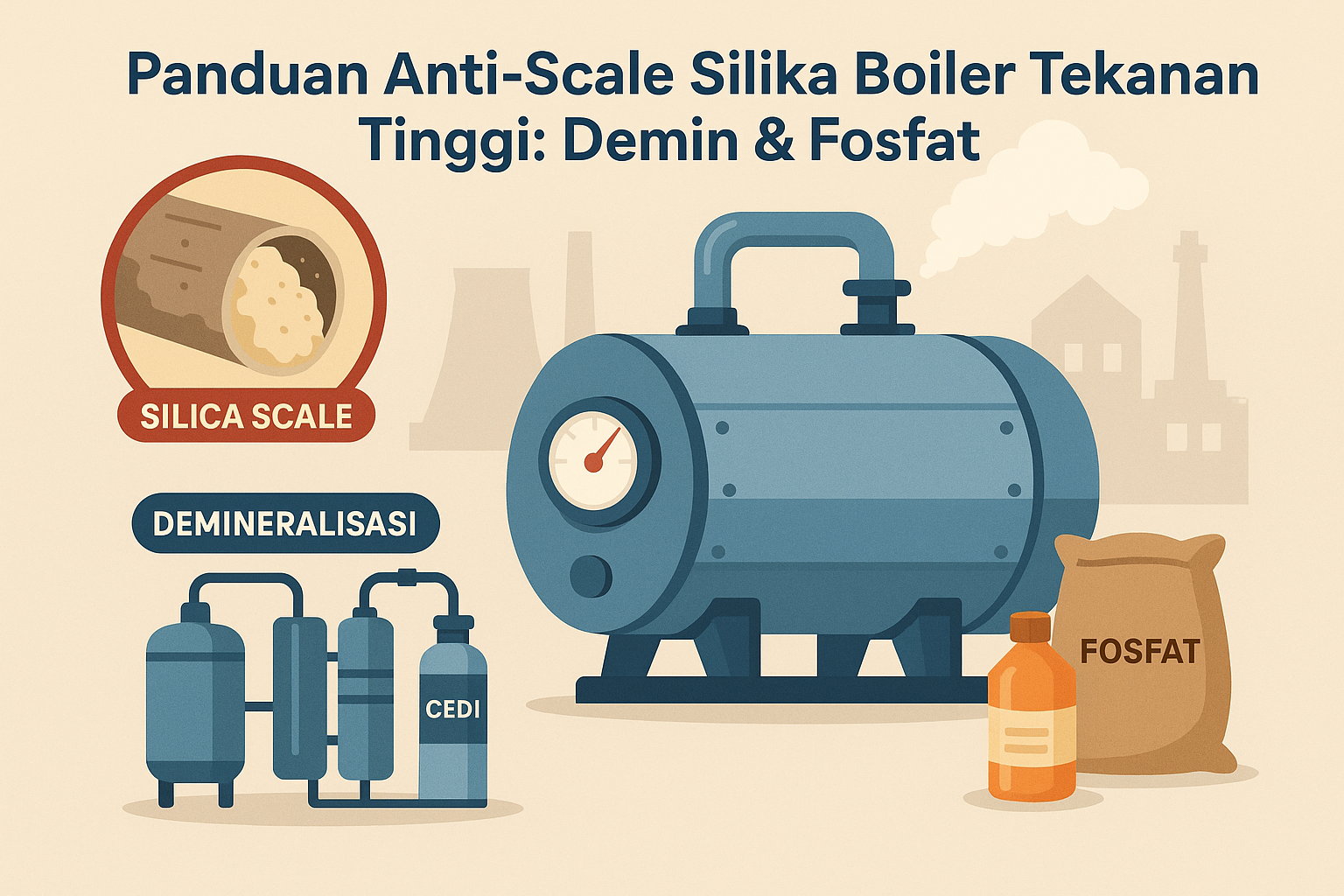
Silica has little corrosive bite, but in a boiler it “caramelizes into glassy scale,” a hard deposit that insulates tubes and fouls turbine blades as steam is generated (Chemical Engineering; Veolia Water Handbook). Extremely hard silica films (SiO₂ scale) can cut thermal transfer by tens of percent (Chemical Engineering), which is why modern practice is to minimize silica and silicates throughout the boiler/steam cycle.
For high-pressure steam, ASME-driven practice puts steam silica at less than 0.02 ppm (20 ppb) (Saka.co.id). Typical boiler-water silica limits tighten with pressure, ranging from the hundreds of ppm at low pressures down to roughly 2–8 ppm at ultra-high pressures (Saka.co.id; Eng-Tips).
Demineralization and monitoring strategy
Because natural waters routinely carry 5–50 mg/L as SiO₂ (Chemical Engineering), fertilizer boilers lean on advanced pretreatment and demineralization to strip silica before it ever sees heat. Reverse osmosis (RO) is central here: modern systems remove on the order of 98–99% of dissolved silica and salts, and “up to 99% of dissolved minerals” overall (Xylem), before downstream polishing drives residuals to the ppb range.
Plants typically pair RO with ion exchange and polishing. A brackish‑water RO train followed by a demineralizer and mixed‑bed deionizer or CEDI (“continuous electrodeionization”) delivers high‑purity, low‑conductivity makeup in which silica is routinely well under 0.1 ppm, enabling tens of boiler concentrations with minimal carryover (Xylem). Softening upstream helps scavenge hardness—plants commonly specify a softener to knock down calcium and magnesium—and many trains include carbon filtration and degasification; “final polishing is critical to achieve low conductivity, silica, [and] sodium… in the final treated water” (Xylem). Where carbon filtration is specified, activated carbon media is the usual selection.
If demineralization is ever inadequate, operators elevate vigilance rather than risk turbine warranties that demand ppb‑level silica in incoming steam. Continuous silica analyzers in the cycle catch ppb‑to‑ppm excursions quickly because “silica is in all water supplies, and membrane separation and ion exchange is needed to extract it” (Chemical Engineering). With state‑of‑the‑art pretreatment, breakthroughs are rare: feeds often sit at less than 0.05–0.1 ppm SiO₂, supporting the steam silica ≤0.02 ppm benchmark (Saka.co.id). One fertilizer cogeneration site reported a “dramatic drop” in unplanned silica incidents after installing continuous analyzers that flagged even slight resin leakage (Chemical Engineering).
Phosphate precipitation for residual hardness
Even with excellent DM makeup, small amounts of hardness (calcium/magnesium) may slip through or enter via condensate leaks. High‑pressure units therefore run a phosphate precipitation program that converts hardness into benign solids removed by blowdown (Veolia Water Handbook). Dosing is controlled with an accurate chemical dosing pump, often in concert with a boiler scale‑control program.
Calcium reacts with phosphate to form calcium phosphate (Ca₃(PO₄)₂), which is “virtually insoluble” under boiler conditions; at pH 10.5–11.5 it precipitates as a fine, non‑adherent solid in the bulk water—away from hot surfaces—effectively displacing classic CaCO₃ scaling (Veolia Water Handbook). Magnesium behaves differently: at high pH it forms magnesium hydroxide (Mg(OH)₂), and “if silica is present, it is preferred that the magnesium hydroxide undergo a second reaction to form magnesium silicate,” co‑precipitating both Mg and silica (Chemical Engineering). Magnesium silicate is not highly adherent and tends to stay as a sludgy solid. If boiler pH falls below specification, sticky magnesium phosphate can form—another reason to hold alkalinity high.
Polymers are typically added to keep these solids dispersed until blowdown; the program is “supplemented with a polymer to condition the solids to remain dispersed” (Chemical Engineering). Plants often specify dispersant chemicals for this duty.
Performance targets and pH windows
A well‑executed phosphate/polymer regime holds boiler hardness at near‑zero in the water phase—typical targets are less than 0.1 ppm Ca as CaCO₃ with similarly negligible Mg (Veolia Water Handbook). Residual phosphate is maintained at a few ppm (as P): enough to ensure continuous precipitation, but not so high that it risks carryover.
Industry experience shows phosphate can prevent CaCO₃ or CaSO₄ scale when boiler water is kept between pH 10.8–11.5 (Veolia Water Handbook). As one text notes, by forming Ca₃(PO₄)₂ in high‑alkalinity boiler water, “the introduction of phosphate eliminated the problem of calcium carbonate scale” (Veolia Water Handbook). Operators monitor sludge weight and schedule blowdown accordingly.
Boiler chemistry controls and ratios
Both feedwater and drum‑water specs are critical. Feedwater conductivity and hardness should be near zero (Veolia Water Handbook). For drum conditions in a phosphate cycle, total alkalinity is commonly held around 250–300 ppm as CaCO₃ to keep pH near 11 (Veolia Water Handbook), and some guidance calls for at least a 3:1 ratio of hydroxide alkalinity to silica to discourage silica volatility (Energy Efficiency Handbook).
pH and alkalinity are managed with alkalinity‑control chemicals and, where appropriate, a neutralizing amine. Oxygen must be removed at the deaerator and with scavengers to keep dissolved O₂ in feedwater below 7 ppb (ASME recommended) (Chemical Engineering). High‑pressure units commonly dose hydrazine or carbohydrazide scavengers; maintaining the correct feed “as far upstream as possible” is emphasized (Chemical Engineering; Chemical Engineering). Plants standardize with an oxygen‑scavenger program.
Troubleshooting guide for chemistry upsets
Symptoms, checks, and short‑term actions are well‑defined. The following items align with boiler handbook practice and industry case notes:
- Silica/Caustic Carryover: If steam conductivity rises or silica analyzers spike, suspect silica or caustic carryover. Check that DM beds or RO units are functioning (regeneration or membrane integrity), and that blowdown is properly set. Reduce cycles or increase blowdown temporarily if silica is above spec. Physically inspect demisters and separators for broken trays. If carryover persists, do a cold blowdown to flush any silica films. (Online silica analyzers are highly recommended: they quickly detect even ppb changes Chemical Engineering.)
- Hardness in Boiler: Hardness should be zero. Any detected Ca/Mg (by EDTA titration) means external water treatment failed or a leak. Check water softener/regeneration or RO integrity. Temporarily increase phosphate dosing (“hardness shock”) to precipitate escaping salts, then flush via blowdown. Replenish alkalinity as needed. If hardness remains, consider cleaning the water plant resins.
- High Alkalinity or Caustic: Excess NaOH can cause caustic gouging. If local tube thinning/grooving (detected by outage inspection) is seen, reduce caustic (possibly change to weaker amine regime). Adjust the hydrazine/sulfite balance if needed to target pH 10.5–11.5 and avoid >200–300 ppm free NaOH.
- Scale/Fouling Symptoms: Slugging steam, pressure drop, or degraded heat output suggest deposits. Shut boiler and inspect for slag. Use chemical descaling if needed. Analyze boiler sludge composition: a high SiO₂ or Ca/Mg silicate content indicates feedwater issues. Adjust treatments accordingly. Where cleaning is required, plants rely on a boiler cleaning service.
- Corrosion & Oxygen: Ensure deaerators/oxygen scavengers keep O₂ <7 ppb in feed (ASME recommended) (Chemical Engineering). Verify feedwater dissolved oxygen (DO) with sensors and maintain the required scavenger feed (hydrazine or carbohydrazide for high‑pressure units) (Chemical Engineering; Chemical Engineering).
Additional quick checks emphasized by operators include steam purity monitors for carryover and proper antifoam use in foaming events; silicone‑based agents are common, and many plants standardize with an antifoam compatible with high‑pressure service.
Operating outcomes and setpoints
When makeup purity is maintained and phosphate/polymer programs are balanced, fertilizer boilers operate with no silica or hardness scaling. Facilities that adopt continuous monitoring and rigorous DM maintenance report virtually zero silica‑related shutdowns over years of operation; those that compromise on feedwater purity see efficiency drops and frequent reactor trip‑outs. The data‑driven approach is consistent: hold steam silica to less than 0.02 ppm (20 ppb) (Saka.co.id) and manage alkalinity in the drum at approximately 200–250 ppm as CaCO₃ with phosphate dosing (alongside the 250–300 ppm range noted above) while maintaining the phosphate precipitation window (pH 10.8–11.5) (Veolia Water Handbook). This keeps tubes clean and boilers at peak thermal efficiency, minimizing energy and maintenance costs.
Troubleshooting quick checks (summary)
- High silica or conductivity in steam: Check DM (resin exhaustion, membrane leaks), increase blowdown, recalibrate silica analyzer (Chemical Engineering).
- Silica in drum water: Add phosphate to drive any Mg(OH)₂ to Mg‑silicate, increase blowdown. Verify silica analyzer calibration.
- Detected hardness (Ca/Mg) in boiler: Regenerate water softener/clarifier; treat with high‑dose phosphate to precipitate hardness, then drain.
- High NaOH/pH: Lower alkali feed, possibly switch to neutralizing amine; watch for caustic gouging indicators (pH 12+ local).
- Foaming or carryover: Ensure proper steam drum levels, add antifoam (e.g., silicone), remove any oil contamination, and verify demister condition.
- Alarms (DO, pH, conductivity): Investigate feedwater unit operation; correct chemical feeds or mechanical faults.
Sources and references
Sources: Authoritative boiler water guidelines and case studies from industry. We have relied on boiler handbook analyses and industry reports to provide data‑backed recommendations. Inline citations refer to the source materials as follows.
- Skiles, Dan (2020). Treating Boiler Feedwater for Reliable Operation. Chemical Engineering, Dec. 2020 (online Cleaver‑Brooks Boiler Systems). Comprehensive industry guide describes feedwater treatment, including silica and hardness removal (Chemical Engineering; Chemical Engineering).
- Reduce the Risk of Corrosion in Fertilizer Production (2019). Chemical Engineering (MTlicon‑sponsored). Highlights the damage from silica in boiler/steam cycles and advocates membrane/ion‑exchange and online silica monitoring (Chemical Engineering; Chemical Engineering).
- Water Handbook – Boiler Deposits: Occurrence and Control. Veolia Water Technologies. Coverage of scale formation and phosphate/chelant treatments, including calcium phosphate precipitation and magnesium silicate formation (Veolia Water Handbook; Veolia Water Handbook).
- Boiler Feedwater Treatment. Xylem Indonesia. Technical note on pretreatment, RO and polishing (emphasizing >99% removal of dissolved minerals and low silica in final water) (Xylem; Xylem).
- Monitoring Nilai Silika pada Air Umpan Boiler… (2025). Saka.co.id. Discusses silica control in boiler systems, including ASME limits (steam silica ≤0.02 ppm) and deposition effects (Saka.co.id).