

Industry: Landfill | Process: Leachate_Treatment_(Aerobic
Landfill leachate is a different animal: extremely high ammoniacal nitrogen (often >500–2000 mg/L NH4‑N) and low biodegradable BOD. Mature (10+ yr) leachate can reach 1000–3000 mg/L NH4‑N (pmc.ncbi.nlm.nih.gov)). The lever that matters is nitrification — the aerobic oxidation of NH4⁺ to NO2⁻/NO3⁻ by autotrophic nitrifiers — which demands roughly 4.5 mg O2 per mg NH4‑N oxidized (water.mecc.edu) and yields about 0.15 mg volatile solids per mg N as biomass (nepis.epa.gov).
For design engineers, that translates to big oxygen, big retention, and tight control of pH, temperature, and dissolved oxygen. Benchmarks in the literature cite theoretical peak nitrification rates up to ~2 lb NH4‑N per lb VSS·d under ideal conditions (nepis.epa.gov) — with real mixed cultures delivering far less — and show that maintaining DO around 2.7 mg/L was needed for about 90% total nitrogen removal in activated sludge (researchgate.net).
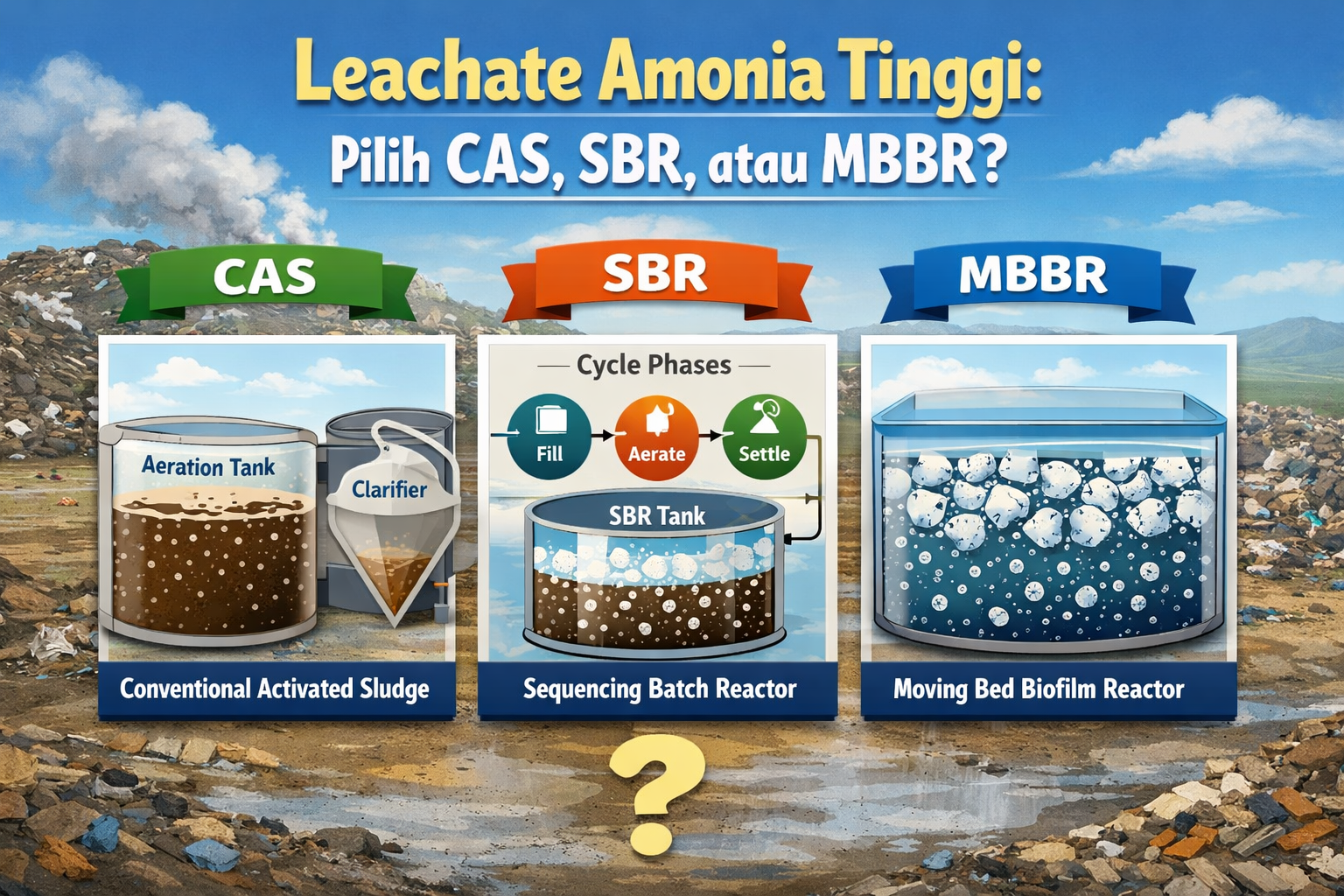
The principal aerobic biological trains are conventional continuous‑flow activated sludge (CAS), sequencing batch reactors (SBR), and moving bed biofilm reactors (MBBR). Each must supply sufficient reactor volume (HRT) and solids retention time (SRT) to keep slow‑growing nitrifiers on the job — often 8–15 days or more of SRT for >80–90% nitrification — while holding DO ≥2–3 mg/L to avoid oxygen limitation. Nitrifier growth roughly doubles for every +10 °C (water.mecc.edu), so warm basins buy shorter SRTs.
Leachate load and stoichiometry
With ammoniacal nitrogen often >500–2000 mg/L (and 1000–3000 mg/L in mature leachate) (pmc.ncbi.nlm.nih.gov)), the stoichiometry sets the tone: ~4.5 mg O2 per mg NH4‑N consumed (water.mecc.edu), ~0.15 mg biomass per mg N produced (nepis.epa.gov). Continuous or batch systems must therefore be aeration‑limited, not clarifier‑limited, and should be paired with robust secondary clarification such as a clarifier sized for the long sludge ages nitrifiers require.
Conventional activated sludge nitrification
CAS nitrification is delivered in an aerobic basin, often after organics removal and primary settling. To handle high ammonia loads, designs run extended aeration and long SRT/MCRT. Typical guidelines at ~25–30 °C assume nitrifiers with maximum specific growth μ ≈0.8–0.9 d⁻¹ and half‑saturation NH4 of ~1–2 mg/L, implying SRT ≥6–10 days for robust nitrification (nepis.epa.gov). In practice, achieving >80–90% nitrification often means 8–15 d or more of SRT.
Aeration is the bottleneck: maintain DO ≥2–3 mg/L, with ~4.5 mg O2 per mg NH4‑N needed for oxidation (water.mecc.edu). Operating below ~1–2 mg/L DO dramatically slows nitrification and can stall it; one review reported ~90% total N removal only when DO was ~2.7 mg/L (researchgate.net). A single continuous nitrification stage may require several hours (e.g., 4–6 h) of aeration to oxidize 500+ mg/L NH4‑N, and at ~30 °C many basins land near ~0.5–1.0 kg N/m³·d; above that, designers turn to multi‑stage trains or supplemental carriers.
Sludge age and toxicity matter. Nitrifiers yield ~0.15 g VSS/g N (nepis.epa.gov) — slow compared with heterotrophs — and are sensitive to septic conditions or inhibitory compounds. Acclimation or pre‑treatment may be required. Equipment layouts typically include secondary settling and recycle; for supporting gear, utilities, and media handling, wastewater ancillaries round out the installation.
Sequencing batch reactor cycles
An SBR nitrifies during the aerobic react phase within a time‑sequenced cycle of fill, react/aerate, settle, and decant. High‑strength leachate cycles commonly run 12–24 h, with 4–8 h of aeration. One study achieved essentially full NH4‑N removal in about 5.5 h of aeration under fixed solids and DO conditions (mdpi.com).
DO control (≥2 mg/L) is direct via aeration on/off and intensity. There is no sludge recycle pump; SRT is controlled by wastage and decanting, and must still be long for nitrifiers. The batch mode is flexible — intermittent aeration can promote simultaneous nitrification/denitrification — and comparisons have found both continuous SBR and biofilm‑enhanced SBBR achieving full nitrification, with SBBR delivering better simultaneous N removal (mdpi.com) (mdpi.com). For packaged or decentralized builds, the one‑tank format aligns with SBR offerings that handle variable loads and deliver 90%+ BOD removal.
Performance is on par with continuous flow: well‑operated SBRs report effluent NH4‑N <5–10 mg/L from much higher influent. Bench tests show >90% NH4‑N removal during aeration — for example, from 1000 mg/L down to trace levels — when DO and time are sufficient (mdpi.com) (mdpi.com). The batch mode does not inherently increase the nitrification rate, but it does ease washout control. Hourly capacity is similar to continuous systems at equivalent size.
Moving bed biofilm reactor capacity
MBBR concentrates nitrifiers on mobile carriers in an aeration basin. Typical carriers offer high specific surface area (~500 m²/m³ of media) (pmc.ncbi.nlm.nih.gov), and fills often run ~30–60% by volume. A common geometry is a short cylinder around ~9 mm diameter, such as K1‑type media. The dense attached biomass drives higher volumetric nitrification than suspended flocs, and biofilm stratification (aerobic outer layers, anoxic inner layers) can support both nitrification and denitrification in the same carrier (pmc.ncbi.nlm.nih.gov). For retrofit or compact builds, MBBR systems shrink footprint substantially.
Oxygen transfer is two‑fold: bulk aeration and diffusion into biofilm. Modeling suggests bulk DO should be several times the ammonia concentration to avoid diffusion limitation (nepis.epa.gov) — phrased in equation terms, for 100 mg/L NH4‑N, DO should be ≫270 mg/L — hence designs keep basin DO ~3–5 mg/L and vigorous mixing in practice. Attached growth is more resilient to low temperatures than suspended sludge, with less drop in nitrification rates when cold shocks hit (nepis.epa.gov).
Results track: an ammonia‑selected MBBR community cleared ~80% of >1000 mg/L NH4‑N within 24 h, roughly a ~10× higher nitrification rate than conventional sludge (pmc.ncbi.nlm.nih.gov). Full‑scale reports include 95%‑ile effluent <0.8 mg/L and multiple UK plants consistently delivering 1–5 mg/L NH4‑N (blog.veoliawatertechnologies.co.uk) (blog.veoliawatertechnologies.co.uk). Because activity sits on carriers, effluent suspended solids are often lower, easing downstream clarification (blog.veoliawatertechnologies.co.uk). High‑area media such as honeycomb bio media (500 m²/m³) fit the brief; sloughed solids are managed with screens and occasional media maintenance.
Comparison and design benchmarks
Kinetics and capacity: MBBR generally supports the highest specific nitrification — due to dense biofilm — and removes ammonia fastest per m³ (pmc.ncbi.nlm.nih.gov). CAS and SBR are comparable as suspended growth systems. Footprint: for the same load, MBBR tanks are often 50–70% smaller; SBR needs more net volume because fill/settle time trims aeration duty.
Startup time: all need acclimation; biofilm maturation can take weeks, while inoculated activated sludge may nitrify sooner. Operational complexity: CAS uses recycle pumps and secondary clarifiers; SBR relies on automated valves/timers; MBBR needs carrier retention screens. Reliability: mature CAS/SBR nitrify reliably if kept aerobic, but nitrifiers are sensitive to inhibitors, while attached growth buffers cold and shock loads better (nepis.epa.gov). For biological trains that integrate with other unit ops, designers often start at the system level, e.g., specifying upstream biological digestion trains and downstream polishing as needed.
Environmental conditions for nitrifiers
pH: Nitrifiers prefer ~7–8. Nitrosomonas optimum ≈7.0–8.0; Nitrobacter ≈7.5–8.0 (water.mecc.edu). Below ~6.5–7.0, rates drop sharply; above ~9, nitrification is inhibited. Nitrification consumes alkalinity — about 7.1 mol HCO3⁻ per mol NH4‑N (water.mecc.edu) and ≈8.64 mg CaCO3 per mg N (water.mecc.edu) — so adding bicarbonate (e.g., CaCO3 or NaHCO3) is common. Precise chemical feed is typically handled with a dosing pump.
Temperature: Activity spikes with heat; optimum is ~28–32 °C (water.mecc.edu). At 16 °C the rate is only ~50% of that at 30 °C (water.mecc.edu); below ~10 °C nitrification becomes very slow and may cease (water.mecc.edu). Each +10 °C roughly doubles growth (Q10≈2) (water.mecc.edu), halving required SRT. In tropical Indonesia, high ambient temperatures ease nitrification, but caution is needed if leachate is cooled by other processes or seasons.
Dissolved oxygen: Nitrifiers are strict aerobes. Maintain DO ≥2 mg/L; at ≈1 mg/L, nitrification is often partial. Studies tie ~2.7 mg/L DO to ~90% total N removal (researchgate.net). Oxygen demand sits around 4.5–4.8 mg O2 per mg NH4‑N (water.mecc.edu), which must be added to any BOD aeration load.
Alkalinity and inhibitors: Ensure sufficient bicarbonate or alkalinity (if exhausted, pH will crash below ~6). High free ammonia (NH3) is toxic; its fraction increases with higher pH and temperature, so designers check that free NH3 stays below inhibitory ranges (often <10–150 mg/L NH3‑N). Heavy metals, phenols, sulfides, and other toxins in leachate can severely inhibit nitrifiers; pre‑treatment — for example, chemical precipitation, air stripping, or adsorption — may be necessary. Many guidelines advise a “safety margin” (extra oxygen capacity, buffer dosing) because nitrifiers have low tolerance for upset. Regular monitoring of DO, pH, and NH4‑N is essential; one study achieved 90% TN removal in an SBR only after DO was held at ~2.7 mg/L, with lower DO giving much poorer results (researchgate.net).
What the system choice buys
CAS leans on high SRT and aeration in suspended growth; it’s proven, but reactor volume rises fast when influent NH4‑N exceeds ~1000 mg/L. SBRs offer similar biology with flexible batch operation; hourly nitrification capacity tracks continuous systems of equal size. MBBRs maintain very high nitrifier mass on carriers, achieving dramatic volumetric rates — e.g., ~80% of >1000 mg/L NH4‑N within 24 h (pmc.ncbi.nlm.nih.gov) — and very low effluent NH4‑N (95%‑ile <0.8 mg/L; multiple plants at 1–5 mg/L) (blog.veoliawatertechnologies.co.uk) (blog.veoliawatertechnologies.co.uk), at the cost of carriers and media management. For compact footprints or upgrades, high‑efficiency media such as honeycomb bio media or foam‑based options pair naturally with MBBR basins.
Design constants and references
Engineers often anchor kinetics and yields to the U.S. EPA Nitrogen Control Process Design Manual — including autotrophic yield at ~0.15 g VSS/g N and theoretical peaks up to ~2 lb NH4‑N per lb VSS·d (nepis.epa.gov) — and use temperature/DO guidance from academic summaries (water.mecc.edu) (water.mecc.edu) (water.mecc.edu). For system selection, the evidence base spans landfill leachate reviews (pmc.ncbi.nlm.nih.gov)) and process‑specific performance datasets for activated sludge, SBR, and MBBR.