

Industry: Aquaculture | Process: Recirculating_Aquaculture_Systems_(RAS)
As aquafarming becomes the main global source of fish, according to Reuters on June 7, 2024 (www.reuters.com), the industry’s disease‑control math is changing. Recirculating aquaculture systems (RAS, closed‑loop farms that continuously filter and reuse water) often hit >95% reuse—some push to 99.7%—which means biosecurity lives or dies on what flows through the loop.
One trout RAS in Finland, holding 25 million liters at 99.7% recirculation, installed an ozone injector on all incoming seawater followed by multiple UV lamps—“water is already fully disinfected when it reaches the factory area,” the operator reports (ultraaqua.com; ultraaqua.com). Studies back the approach: full‑flow ozone plus UV drove heterotrophic bacteria below 1 CFU/mL (colony‑forming units per milliliter) in research by Summerfelt et al. (2009) (www.ars.usda.gov).
The stakes are not theoretical. Indonesia’s 2002 koi‑herpes outbreak killed 80–95% of carp, costing ≈US$15 million (www.fao.org). The country is now emerging as a leader in aquaculture, per the World Aquaculture Society (Mar 2024) (www.was.org), and its fisheries ministry has emphasized rapid disease response and containment under Ministerial Regulation No.13/2021 (press release, Oct 2021) (www.kkp.go.id; www.kkp.go.id).
Two‑stage disinfection on the main loop
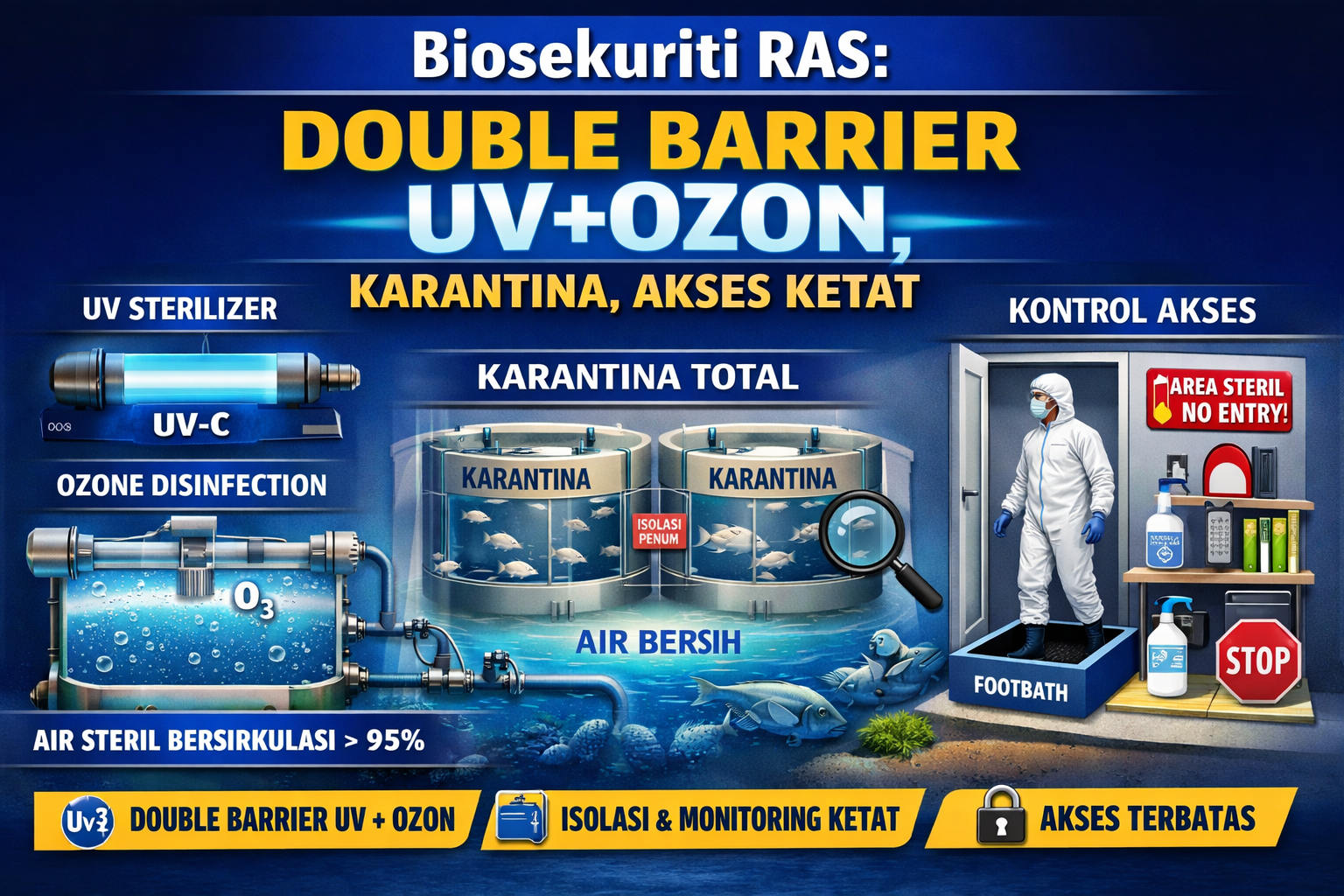
Continuous “double‑barrier” treatment—ozonation followed by UV—on the make‑up and recirculation flow is now standard in high‑biosecurity RAS. The Finnish trout case specifically added ozone on the inlet and put UV in sequence to combine effects (ultraaqua.com), echoing research that an ORP‑controlled (oxidation–reduction potential) ozone dose of ~20 ppb dissolved O₃ with ~0.34–0.39 mg/L applied ozone, followed by UV irradiation, cut heterotrophic bacteria to <1 CFU/mL (www.ars.usda.gov).
UV (germicidal UVC, ultraviolet light used for disinfection) inactivates bacteria and viruses such as Aeromonas, Vibrio, and Flavobacterium when water is clear (UVT>90% UV transmittance) (onlinelibrary.wiley.com; link.springer.com). Ozone is a stronger oxidant, inactivating bacteria, fungi, parasites, and viruses while oxidizing organics (reducing TOC, color, turbidity) (onlinelibrary.wiley.com; onlinelibrary.wiley.com). In marine RAS, dissolved ozone also forms hypobromous acid, adding a residual kill step (onlinelibrary.wiley.com).
Targets, doses, and design parameters
Typical UV reactor design aims around ~40 mJ/cm² at full flow (consult manufacturer), which corresponds to ~99% inactivation for bacteria/viruses in clear water. Farms commonly target ORP ~450–525 mV in the loop—≈20–30 ppb dissolved ozone—with UV placed downstream for full kill assurance (www.ars.usda.gov; onlinelibrary.wiley.com). Ozone generators must supply ~0.3–0.4 mg/L (dissolved) continuously in the loop, with one case study reporting that achieving 450–525 mV required ~29 g ozone per kg fish produced (~0.35 mg/L dose) (www.ars.usda.gov).
Implementation is straightforward: inject ozone before a contact tank and place an in‑line UV stage on the influent; add a second UV stage after mechanical/biological filters for redundancy (ultraaqua.com). Excess ozone should be quenched so fish never see high free O₃—commonly through an activated carbon stage—because sterilizers only treat water passing through them and residual oxidants can be dangerous to fish and humans (onlinelibrary.wiley.com; onlinelibrary.wiley.com; edis.ifas.ufl.edu).
Pretreatment and sensor maintenance
Particles shield microbes from UVC. Membrane prefiltration improved UV transmittance in trials, with microfiltration removing ~96% total suspended solids (TSS) and UV or membrane+UV removing ~98–99% of culturable bacteria (MF+UV removed 99%, UV‑alone 98%) (link.springer.com). Many RAS lines boost clarity ahead of UV with a sand filter or membrane step, and fine polishing via an inline cartridge filter. On the disinfection train, in‑loop UV sterilizers are paired with UVT (UV transmittance) and ORP sensors, part of standard water‑treatment ancillaries, and require routine lamp cleaning and dose logging.
UV versus ozone in marine and shrimp systems
For brackish or marine systems, dissolved ozone yields hypobromous acid, providing a residual antimicrobial effect downstream (onlinelibrary.wiley.com). Asian shrimp RAS trials showed ozone stabilized microbial populations and kept nitrite low, while UV alone was associated with water chemistry fluctuations; the conclusion: ozonation in a brackish‑water shrimp RAS is recommendable (onlinelibrary.wiley.com; onlinelibrary.wiley.com).
Quarantine operations for new stock
New fish—broodstock, juveniles, or post‑larvae—are held in fully isolated quarantine units with dedicated water and gear until cleared. The all‑in/all‑out rule applies: groups move together into quarantine; no additions to an existing batch; no mixing shipments (edis.ifas.ufl.edu). Facilities use separate rooms or tanks with their own disinfection train (ideally a standalone UV/ozone), and any shared gear is fully disinfected between uses (edis.ifas.ufl.edu; edis.ifas.ufl.edu; thefishsite.com).
Duration typically runs 2–4 weeks or more, depending on species and risk profile, to cover incubation windows and transport stress; no biological material enters or exits during this period (edis.ifas.ufl.edu). Feeding and behavior are recorded daily; mortalities are logged and disposed of safely. Sampling (gill, blood, microscopy) early in quarantine screens for parasites or bacteria, with prophylactic treatments—salt baths, praziquantel dips, metronidazole for flagellates—under veterinary guidance. Some facilities run a cohabitation test: one resident fish placed with quarantined fish for 1–2 weeks to check for transmissible disease (edis.ifas.ufl.edu; edis.ifas.ufl.edu). Before transfer, nets and tanks can receive a final acid/alcohol dip or medicated bath (edis.ifas.ufl.edu; fishhealth.ie).
Cleaning and disinfection protocols
Disinfectants work only on clean surfaces. Facilities first remove solids and biofilms by flushing, brushing, and power‑washing tanks, filters, nets, hoses, and piping; debris severely inhibits disinfectant action (fishhealth.ie; thefishsite.com; fishhealth.ie).
Then comes chemical disinfection: 0.5–1.0% peracetic acid/Virkon with 10–30 minutes’ contact, 0.1% iodine for 10 minutes, or 200–500 ppm sodium hypochlorite (bleach) for 5–10 minutes are broadly virucidal and bactericidal when applied per label and kept wet for the full contact time; gear is rinsed afterward (fishhealth.ie; fishhealth.ie; thefishsite.com). Nets, siphon hoses, and boots are kept off the floor, which is considered “dirty,” and equipment is dedicated by system or disinfected between tanks; cleaned nets are hung to dry and stored separately, with handy access to disinfectant footbaths, hand‑wash stations, and net‑dip stations (thefishsite.com; thefishsite.com).
Filters concentrate pathogens in sludge, so mechanical units (sand/bead/drum) are backwashed daily; after a disease event, filter media is disinfected (e.g., with bleach) or replaced. Biofilters are never chemically sterilized, to protect nitrifiers. Water lines get sampling ports and quick‑flush valves; lines are periodically flushed with disinfectant. When using ozone, operators remove activated carbon before injecting O₃ and replace it after to strip residual ozone, or use carbon specifically to quench ozone before water returns to fish—an operational detail that protects animal health (onlinelibrary.wiley.com; onlinelibrary.wiley.com). Footbaths and chemical stations are often kept on‑spec with a small dosing pump to maintain target disinfectant concentrations.
Access control and visitor management
Facilities enforce unidirectional “clean‑to‑dirty” flow with zones (e.g., hatchery/quarantine as clean; grow‑out as dirty), physical barriers, and signage such as “Authorized Personnel Only” and “Quarantine Zone”; backtracking from dirty to clean is not allowed (thefishsite.com). Entrance disinfection points at every building and tank room include footbaths (bleach or Virkon ~0.5–1.0% w/v), boot scrapers, handwashing/sanitizer, and clean clothing/gloves. Vehicle cleaning mats or spray barrels disinfect tires on entry (thefishsite.com; thefishsite.com).
Visitor access is restricted by policy and signage. All visitors check in, wear protective gear (dedicated boots or disposable covers, coveralls, hairnets), and use footbaths/hand sanitizers; quarantine, broodstock, and larval areas are off limits, with visitors kept to isolated entrances. Vehicles that must enter have cabin door handles and cargo beds sanitized; logs record all entries. Personnel training emphasizes that people can transmit disease on shoes and hands simply by touching water or equipment in one system and failing to disinfect before another; supervisors audit compliance (thefishsite.com; thefishsite.com; thefishsite.com). Dead or sick fish are removed daily and disposed of by incineration or deep burial per local rules; after removals, tanks (drains, walls, nets) are disinfected before reuse (thefishsite.com).
Measurable outcomes and monitoring
Operators monitor water quality and pathogen loads—HPC (heterotrophic plate counts) or qPCR per tank—to validate UV/ozone efficacy. A practical benchmark from research is <1 CFU/mL for heterotrophic bacteria when ORP‑controlled ozone (~20 ppb dissolved; ~0.34–0.39 mg/L applied) is paired with UV (www.ars.usda.gov). Production metrics tell the rest of the story: one large trout RAS reported “better growth rates, lower mortality rates, and… improved feed conversion” after installing UV+ozone (ultraaqua.com).
Logging is non‑negotiable. Facilities record UV dose, ORP, lamp and sensor maintenance, quarantine durations, disinfection dates, and chemicals used. Such records demonstrate regulatory compliance and support rapid response and containment, consistent with Indonesia’s Ministerial Regulation No.13/2021 emphasis on outbreak control (www.kkp.go.id; www.kkp.go.id).
What the full plan looks like in practice
On the water line: ozonation in the make‑up and main loop, ORP targeted at ~450–525 mV (≈20–30 ppb O₃), UV downstream, and residual quenching through activated carbon; operators often pair these with pre‑UV clarity steps such as sand or membrane filtration to maintain UVT>90% (sources: www.ars.usda.gov; ultraaqua.com; link.springer.com). Disinfection happens on the line only—tanks and tools are cleaned and chemically disinfected separately, per IFAS/SRAC guidance (edis.ifas.ufl.edu; edis.ifas.ufl.edu).
On the people and equipment side: segregated quarantine with all‑in/all‑out stocking and dedicated tools; cleaning first, then disinfection with 0.5–1.0% peracetic acid/Virkon (10–30 min), 0.1% iodine (10 min), or 200–500 ppm sodium hypochlorite (5–10 min); footbath and hand‑wash stations at every entrance; strict zone flow and visitor limits; daily carcass removal and safe disposal (sources: fishhealth.ie; thefishsite.com).
The outcome is measurable. In controlled systems, UV and ozone—applied at the doses and placements above—have removed ~98–99% of culturable bacteria (UV‑alone 98%, membrane+UV 99%), stabilized microbial populations in shrimp RAS, and in one facility correlated with better growth rates, lower mortality, and improved feed conversion (link.springer.com; onlinelibrary.wiley.com; ultraaqua.com).
References and further reading
Key references for the protocols and targets above include UF/IFAS SRAC Fact Sheets FA099 and FA100 (edis.ifas.ufl.edu; edis.ifas.ufl.edu); Katya A.B. et al. (2018) on membrane filtration and UV in RAS (link.springer.com); Teitge F. et al. (2023) on ozonation vs UV in brackish‑water shrimp RAS (onlinelibrary.wiley.com; onlinelibrary.wiley.com); Summerfelt S.T. et al. (2009) on full‑flow ozone+UV disinfection (www.ars.usda.gov); fishhealth.ie’s disinfection guidance (fishhealth.ie; fishhealth.ie); UltraAqua case studies (ultraaqua.com; ultraaqua.com); FAO and KKP sources on outbreak impacts and policy (www.fao.org; www.kkp.go.id; www.kkp.go.id); and The Fish Site’s RAS biosecurity series (thefishsite.com).