

Industry: Automotive | Process: Assembly
Automotive assembly plants drink a lot of water—around 4–5 m³ per vehicle, on average (www.sciencedirect.com). Floors scrubbed with detergents then turn that water into a messy mix of grit, surfactants, and oils. One test run of a typical floor-scrubber dose (2% detergent with ~5% surfactant) produced ~800 mg/L of suspended solids (www.mdpi.com).
Recycling that low-grade stream isn’t just green—it’s cash-efficient. In a field trial, treating and reusing the scrubber effluent delivered 60 cleaning cycles with no fresh water added, saving ~18,000 L and halving unit water costs (from ~6 to ~3 €/m³) (www.mdpi.com). Automotive OEMs (e.g., BMW) facing sustainability targets (e.g., 38% water‑use cuts to reduce CO₂) are obvious beneficiaries (www.sciencedirect.com).
Wastewater characterization and baseline
This “mixed” industrial wastewater carries high TSS (total suspended solids), free and emulsified oils/greases, and residual surfactants/detergents; ~800 mg/L inlet TSS has been observed in floor-scrubber effluent (www.mdpi.com). BOD/COD (biochemical/chemical oxygen demand—measures of organic load) is moderate; heavy metals such as Fe, Mn, Cu, and Zn can appear at tens of mg/L (www.mdpi.com). pH is typically near neutral; odor is minimal after flocculation, though residual organics may benefit from a “polish.”
Centralized collection and primary separation
Floor drains feed sealed collection sumps with screens or sediment buckets for coarse solids and initial settling. This step prevents grit surges downstream and is standard in industrial shops. For packaged front-end equipment (screens, oil removal, and primary treatment), plants typically source from solutions grouped as waste-water-physical-separation.
Oil–water separator (gravity/coalescing)
From the sumps, effluent is pumped to an API-type separator (an oil-industry standard gravity device) or a coalescing plate unit. These stages target free-floating oils and gross solids, using density differences to achieve >80–90% removal of floating oil. Modern, CAN/ULC‑S656 certified designs routinely reach <10 ppm (mg/L) oil in the effluent (freytech.com), aligning with North American limits often set around ~10 ppm oil (freytech.com). For reuse here, the separator is sized to cut oil to ≲20–50 mg/L; trapped oil is skimmed to drums and sludge to a hopper. Typical retention times are 10–30 minutes, with skimmers supporting even strict 10 ppm targets (freytech.com). Coalescing systems in this duty are often categorized under oil-removal.
Chemical destabilization and floc growth
Clarified overflow enters a rapid-mix tank for coagulation (adding metal salts to neutralize colloids and emulsions), then a flocculation tank (gentle mixing to build settleable flocs). Dosing accuracy matters; many facilities pair this stage with a metering unit like a dosing-pump for tight control.
Polyaluminum chloride (PAC) is often favored: bench tests on floor‑scrubber effluent achieved 98–99% TSS removal with only ~10–15 mg/L of PAC (Al by weight), whereas alum might need ~50–60 mg/L (www.mdpi.com). Designs start at 10–20 mg/L PAC, driving clarified TSS to ≈1–2% of influent (<10–20 mg/L residual) (www.mdpi.com). Plants commonly source these reagents as PAC within a broader program of coagulants.
After a 1–2 minute rapid mix, a high‑molecular‑weight polymeric flocculant (e.g., cationic or non‑ionic polyacrylamide at 0.5–5 mg/L) aggregates fines and emulsified oil droplets; mixing times of 15–30 minutes help flocs mature. In heavily contaminated trials (ship bilge effluent at 3,000–5,000 mg/L oil), ~300 mg/L coagulant plus 30 mg/L polyacrylamide reduced oil to <15 mg/L (pmc.ncbi.nlm.nih.gov)—our automotive flow is far weaker, so doses are an order of magnitude lower. Feed is typically run near natural pH (~7), with flexibility to adjust; Fe/Al coagulants work best around neutral. Polymer programs here are drawn from flocculants.
Clarification and sludge management
The mixed liquor flows to a settling tank sized for ~30–60 minutes residence. Settled flocs and adsorbed oils form a sludge blanket; in the referenced test, sludge was ~6% solids (www.mdpi.com), translating to roughly 100–150 L of settleable sludge per m³ treated. Clarified overflow typically drops below 20 mg/L TSS (www.mdpi.com). Avoiding short‑circuiting calls for surface area around ≥2 m² per m³/h.
For the core settling duty, facilities generally specify a dedicated clarifier. As a separate operational note, expect ~5–10 L of wet sludge per m³ water (at ~5–10% solids). This oily waste requires dewatering and compliant disposal. Continuous dosing/mixing control helps prevent chemical overdosing; lab work indicated raising PAC beyond ~15 mg/L produced no added benefit (www.mdpi.com).
Polishing and disinfection options
“Non‑critical” reuse still demands clear, stable water that won’t foam or foul. Common polishers include media filtration (sand or multimedia) to strip fines and some organics; facilities often implement this via sand-silica filtration.
Activated carbon can reduce trace surfactants and odor; comparable refinery-plant reuse schemes have shown carbon’s effectiveness for cutting COD (chemical oxygen demand) load (scholar.undip.ac.id). Plants typically specify activated-carbon for this role.
Where tighter turbidity and oil polish is needed, microfiltration/ultrafiltration offers a robust barrier; many industrial users deploy ultrafiltration as pretreatment to keep suspended solids and emulsified oils in check. For microbiological control, either UV (ultraviolet) disinfection at ~40–60 mJ/cm² or a small chlorine residual (~0.2–0.5 mg/L free chlorine) is typical; low‑opex systems often add a final ultraviolet stage. In practice, many floor‑wash reuse schemes rely on sand filters plus periodic chlorination.
Reuse targets and quality benchmarks
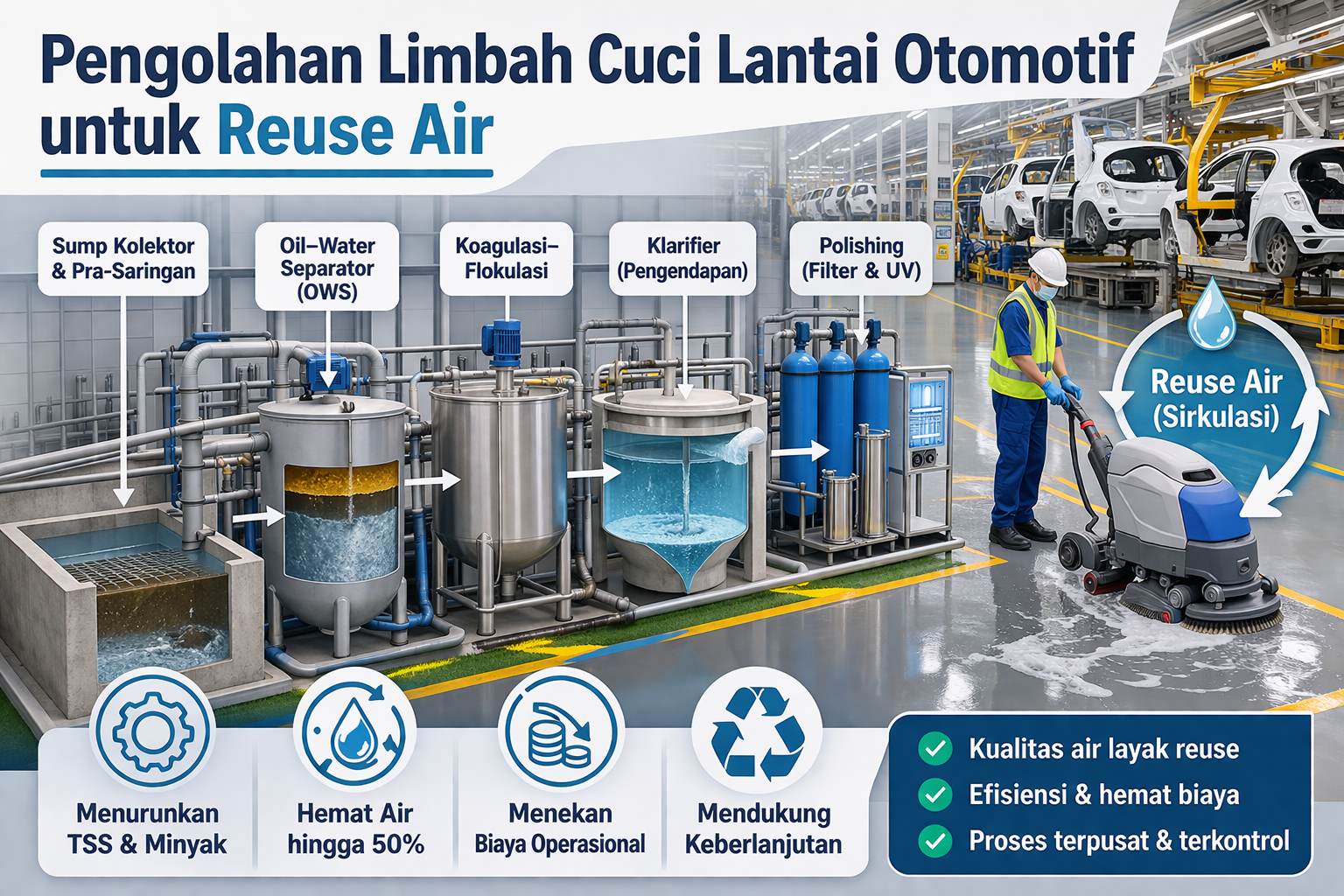
Design targets at the outlet: TSS ≪50 mg/L (typically <20 mg/L), turbidity <5 NTU (nephelometric turbidity units), and total oil & grease ≪10 mg/L. In trials, coagulated scrubber effluent at ~800 mg/L inlet TSS saw ≈98% removal, implying ~16 mg/L final TSS (www.mdpi.com). Leveraging an OWS plus coagulant/polymer, oil can fall from possibly hundreds of mg/L to single digits (e.g., <10–15 mg/L) (pmc.ncbi.nlm.nih.gov).
Those levels align with industrial graywater benchmarks; for context, North American discharge limits often require ~10 ppm oil and 30 mg/L TSS, which this design aims to outperform (freytech.com). COD following flocculation is expected to land around <100–200 mg/L; if surfactant foaming persists, a carbon polish can further reduce organics (as seen in refinery reuse work, scholar.undip.ac.id).
Performance, costs, and scale effects
Analogous systems routinely deliver major savings. A car‑wash setup combining flocculation, flotation, sand filtration, and chlorination reclaimed ≈70% of washwater and cut fresh draws to <40 L per wash (www.mdpi.com). In the floor‑scrubbing case, reusing 265 L per cycle for 60 cycles eliminated fresh water use, saving ~18,000 L and halving unit water costs (from 6 to 3 EUR/m³) (www.mdpi.com).
Scale the math: if water tariffs are ~$0.50/m³, a 50% reduction saves ~$0.25/m³. With industry water intensities at ~5 m³/car (www.sciencedirect.com), a 10,000‑car plant uses ~50,000 m³/year; halving that saves ~25,000 m³. On larger footprints, even a 10–20% reuse slice is material.
Regulatory and implementation notes
In Indonesia, industrial discharges are governed by Government Regulation No. 82/2001; typical thresholds include BOD <60 mg/L and oil/grease <20 mg/L for many sectors (specific limits vary by industry). Treating water on‑site and reusing internally helps avoid discharge penalties and, practically, applies a lower‑tier internal standard than full external discharge. Designing to North American discharge limits—10 mg/L oil (freytech.com) and 30 mg/L TSS—adds safety margin. Instrumentation (on‑line turbidity, oil alarms) supports steady compliance.
Bottom line and sourcing
A centralized train—sumps → oil–water separator → coagulation–flocculation → clarifier → polishing—consistently produces rinse water fit for floor‑scrubbing recycle. Data show ~98% solids removal at ~10–15 mg/L PAC dose (www.mdpi.com) and oil reduced to <10 mg/L with added polymer in a high‑oil analog (pmc.ncbi.nlm.nih.gov). That performance mirrors reuse successes (e.g., ≈70% car‑wash recycling, www.mdpi.com) and cost cuts (from ~6 to ~3 €/m³, www.mdpi.com). Outlet TSS <20 mg/L with negligible oil meets or exceeds non‑potable reuse needs for repeated floor cleaning.
Sources: Ruffino et al., Resources 9(3):26 (2020) (www.mdpi.com) (www.mdpi.com); You et al., RSC Advances 8:40639 (2018) (pmc.ncbi.nlm.nih.gov); Almutairi et al., J. Water Health 20(8) (2022) (www.mdpi.com); Semmens et al., J. Cleaner Prod. 246:118970 (2020) (www.sciencedirect.com); industry guidelines and analyses (freytech.com) (www.mdpi.com) (www.mdpi.com).