

Industry: Cement | Process: Clinker_Production
In rotary cement kilns, ring formation is driven by excess low‑melting liquid phases in the burning zone (molten clinker melt that can glue solids to the refractory). The result is familiar and expensive: in one case study, roughly one ring formed per month, and 70% of them forced shutdowns, costing up to ~€150k per stoppage (slideshare.net).
Why here and not elsewhere? Computational modeling shows rings concentrate in kiln zones of “maximal radiative heat flux,” the hot spots near the flame where liquid phase spikes (researchgate.net). Plants that broaden the flame and cool the peak — for example by increasing secondary/tertiary air near the burner — have suppressed rings and saved heavily (researchgate.net).
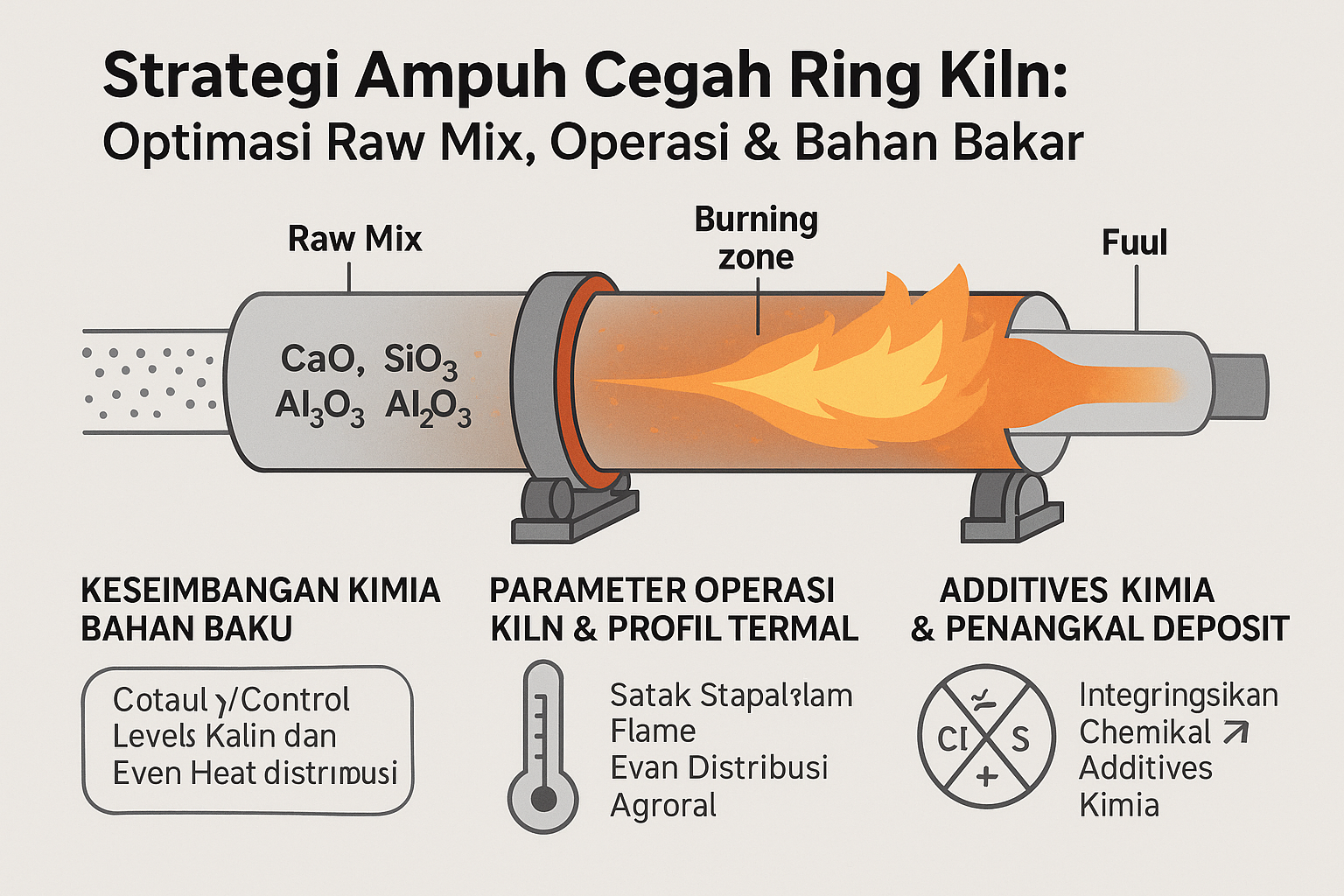
The chemistry matters as much as the heat. Tight raw‑mix control, careful fuel selection, and, where needed, chemical additives have all been documented to reduce buildups — even with aggressive alternative fuels.
Raw‑mix chemistry and liquid phase control
Start with the mix. Controlling raw feed chemistry to limit liquid‑phase formation is crucial. Plants target balanced oxide ratios, including a balanced alkali:sulphur ratio (~1:1 by molecular weight) to minimize rings: a low alkali/S ratio promotes low‑temperature anhydrite deposition, while excess alkalies form alkali sulfates and crusts (cemenequipment.org). Chloride must be kept very low (typically <0.02% Cl) because even trace Cl can form sticky KCl (sylvite) rings and alkali‑chloride crusts (cemenequipment.org).
Magnesia also matters. Maintaining ≤4–5% MgO in the raw mix helps because MgO is a strong flux; at >4% it causes “balling” of the feed (cemenequipment.org).
What rings are made of underscores the point. In‑situ analyses found typical ring deposits composed of ~60–64% CaO, ~20–22% SiO₂, and ~5–6% Al₂O₃ (plus minor K₂O, Na₂O) — essentially calcite/belite and alkali‑carbonate phases — showing rings incorporate both raw‑feed and fuel‑derived elements (slideplayer.com). The practical takeaway: optimize the raw mix to minimize excess fluxing oxides — controlling LSF (lime saturation factor; a qualitative index of CaO relative to SiO₂/Al₂O₃/Fe₂O₃), silica, alumina, alkalis, and S/Cl — and keep the feed finely homogenized. Plants targeting stable free‑CaO (~2–4%) with balanced ratios report cleaner burn‑out and less fusible residue (slideshare.net, cemenequipment.org).
Kiln thermal profile and combustion stability
Even a well‑designed mix can form rings under adverse operating conditions. Key variables include flame temperature/profile, airflow, and solids velocity. Rings concentrate at “hot spots” near the flame where heat flux spikes; CFD (computational fluid dynamics) confirms formation in zones of maximal radiative heat flux (researchgate.net, slideshare.net).
Plant trials show that increasing secondary/tertiary air near the burner can cool these hot spots and dissipate excess heat. Adjusting the air–fuel split or burner geometry to broaden the flame — raising the air:fuel ratio — “reduced hotspot temperatures” and suppressed rings in one kiln (researchgate.net, slideshare.net).
Shops also keep tail‑end kiln gas and shell temperatures within tight bounds, avoiding sudden spikes from unburned coal surges or feed surges. Stable feed rate and moisture, consistent feed/grate distribution (to prevent dead zones), and sufficient kiln speed/ducting to prevent “pillarging” of solids all help. Continuous monitoring — shell thermocouples and flame cameras — flags early deposition. When deposits appear, planned short cool‑downs or soot‑blowing before hardening can avert a full ring (slideshare.net).
The economics are stark: that case with ~one ring per month, 70% causing shutdowns, carried costs up to ~€150k per stoppage (slideshare.net).
Fuel ash chemistry and reducing patches
Fuel choice strongly influences ring risk because fuel ash contributes fluxing agents. High‑ash, low‑fusing fuels — certain petcokes, high‑silica coals, untreated wastes — deposit low‑melting ash. In one analysis of a 150 m lime kiln, coal ash (9% O₂‑free) was ~50% SiO₂/24% Al₂O₃/10% Fe₂O₃; chemical equilibrium showed this ash fully molten at burner temperature and “incorporated into the ring deposit” along the deposit zone (pubs.acs.org). Much of the ring mass came from the fuel ash, not the raw lime (pubs.acs.org, pubs.acs.org).
Problematic species include chlorides and alkalies (K₂O, Na₂O), which vaporize and re‑condense downstream as sticky alkali chlorides or sulfates. Even 0.02% chloride in the combined raw+fuel stream can drive heavy sylvite (KCl) deposits as it recirculates (cemenequipment.org). Incomplete combustion makes matters worse: unburned fuel in the lower kiln creates reducing patches (low‑oxygen zones), boosting internal circulation of S, Cl, Na, and K and promoting low‑melting salts (pubs.acs.org).
By contrast, cleaner fuels (natural gas, low‑ash petrocoke with Sc/Al treatments, or high‑quality biomass) reduce ash flux. Plants in Indonesia, for example, co‑fire plastics and biomass to cut coal use (journal.ugm.ac.id), but those wastes must be free of PVC or chlorides to avoid rings. Studies there show carefully sized and characterized plastic waste — HV (heating value) ~7,200 kcal/kg — substituted ~24,000 GJ/year at one plant with stable operation because feed chemistry, especially Cl/S content, was tightly managed (journal.ugm.ac.id). And with Indonesia’s 2024 cement decarbonization plan explicitly targeting more alternative fuel use, controlling fuel ash chemistry is non‑negotiable (demo.indonesiabusinesspost.com).
Chemical additives for deposit control
Chemical additives can actively suppress ring buildup. One approach doses alkaline‑earth compounds with the fuel to capture troublesome elements. For example, patents describe adding MgO‑based powders to cement‑kiln fuels: the MgO reacts with vanadium and sulfur in high‑V coal to form high‑melting vanadates/sulfates, preventing molten salt deposits (patents.google.com, patents.google.com). Such additives, often dosed at a few percent of fuel mass, are reported to eliminate crusts and rings without degrading the fuel. Systems include water‑based MgO or dolomite blends (~20–60% active alkaline‑earth oxides) co‑ground with coal (patents.google.com, patents.google.com).
Industry supplements such as the Adi3tek® fuel enhancer are applied via fuel or direct injection. Published reports claim Adi3tek — a surfactant/polymer blend — “redirects sulfur… into higher‑melting alkali compounds” that do not adhere to walls; trials showed it “inhibits ring formation and even helps remove existing rings” while boosting clinker output (zkg.de). One blend, dosed ~1 L per tonne fuel, reportedly turned recurring ring faults into five‑figure savings per month of continuous operation (slideshare.net).
Plants commonly meter such additives with accurate chemical dosing equipment — for example, an industrial dosing pump to hold rates steady at low liters‑per‑tonne.
Raw‑mix adjustments and forensic monitoring
Altering the raw mix can also change fusion behavior. In theory, adding “poisons” or inert diluents (fine silica or waste slags) can raise the bed’s melting point; small additions of Al₂O₃ or SiO₂ reduce free CaO and liquid fraction. Any raw additive, however, must be weighed against clinker quality and burnability. In practice, direct raw‑additive strategies are less common than fuel additives. More typical are substitutions: replace a fraction of high‑flux ingredients with more silica‑rich rock to shift the liquidus, or limit high‑sulphur limestones with cleaner Ca sources.
Monitoring is the backbone. Periodic deposit analysis by XRD/XRF (X‑ray diffraction/fluorescence) — and, where available, SEM (scanning electron microscopy) — shows whether buildups are clay/SO₄‑rich or dominated by fuel ash/KCl, guiding corrective actions. Kiln dust analyses help track alkali buildup. One producer documented 75 days with no additive while monitoring SO₃ (sulfur trioxide) in stack gas, then saw buildup issues until additive injection resumed — a measurable validation of the additive’s impact.
Documented outcomes and case evidence
At Almatis (rotary kiln, Ca‑aluminate cement), CFD‑guided airflow changes eliminated unplanned shutdowns entirely, implying monthly savings in the tens of thousands of dollars (researchgate.net). Fuel additive usage has been reported to reduce maintenance downtime by 90% in some facilities. A common industry claim is 15–30% reduction in unscheduled stops after aggressive ring‑management programs.
In Indonesia, preliminary reports on high alternative fuel (AF) usage indicate cement output was maintained — or even increased — while incorporating 240% more plastic fuel, validating that rings and coatings can be controlled even with aggressive waste RTP usage (journal.ugm.ac.id).
Integrated strategy for ring suppression
Evidence converges on a holistic strategy: engineer the raw mix to limit low‑melting compounds (control CaO:SiO₂:Al₂O₃, alkalis, and S/Cl); operate with stable, uniform combustion (balanced flames, smooth feed, mitigated hot spots; researchgate.net, slideshare.net); and choose or treat fuels to minimize problematic ash. Where necessary, add chemistry: MgO/CaO‑based additives with the fuel to sequester S/V (patents.google.com) or commercial crust inhibitors such as Adi3tek (zkg.de). Plants report fewer stoppages, higher clinker per day, and better availability and profitability when these data‑driven adjustments are sustained.
Sources: modeling and plant studies on heat‑flow and liquid‑phase effects (researchgate.net, slideshare.net); ring deposit analyses confirming fuel ash and Ca‑rich phases (pubs.acs.org, pubs.acs.org); cement‑industry publications on additives and operational solutions (zkg.de, patents.google.com); and Indonesian industry data on alternative fuels without loss of reliability (journal.ugm.ac.id, demo.indonesiabusinesspost.com).