

Industry: Fertilizer_(Ammonia_&_Urea) | Process: Process_Cooling_Systems
In fertilizer complexes, open evaporative cooling towers are quiet water sinks. Design values suggest about 1.8 gal (≈6.8 L) per refrigeration ton-hour are evaporated regardless of tower efficiency, according to EPA guidance (nepis.epa.gov). That means a 1,000‑ton tower evaporates roughly 6.8 m³ per hour. On top of that, drift—fine droplets carried with exhaust air—and blowdown—the purge to control dissolved solids—add up.
EPA notes drift may be 0.05–0.2% of circulation flow (≈0.24–0.36 gal per ton‑hour) without controls (nepis.epa.gov). Blowdown volume depends on cycles of concentration (COC), the ratio measuring how much the recirculating water concentrates; higher COC means less frequent blowdown and less makeup.
Effective conservation, then, focuses on three levers: (a) eliminating drift and leaks, (b) maximizing COC safely, and (c) using non‑potable or recycled sources for makeup.
Cooling tower water balance and losses
For context, typical towers move 120–180 gal per ton·hour of circulation. With uncontrolled drift running 0.05–0.2% of that flow (≈0.24–0.36 gal per ton‑hour), cumulative losses become material (nepis.epa.gov). Evaporation itself remains about 1.8 gal per ton‑hour irrespective of tower efficiency (nepis.epa.gov).
High‑efficiency drift eliminators
Modern drift eliminators push losses down by orders of magnitude. For typical towers, uncontrolled drift of 0.05–0.2% can be slashed to below 0.005% with high‑efficiency eliminators (nepis.epa.gov). In a practical example, eliminating 0.18 gal/ton·hr drift in a 1,000‑ton tower running 24 hours (≈180 gal/ton·hr flow) saves about 4,000 gal/day (~15 m³/day) (nepis.epa.gov).
Reducing drift also mitigates aerosol deposition and corrosion around structures. Pairing eliminators with optimized chemical programs—delivered via an accurate dosing pump—tightens overall control.
Operating at higher cycles of concentration (COC)
Raising COC dramatically cuts blowdown. Cycles = (TDS in blowdown)/(TDS in makeup) (also roughly Makeup/(Makeup+Blowdown)), so a COC of 10 means only 10% of flow is blown down. In a 1,000‑ton system (evaporating ~9.69×10^6 gal/yr), one plant dropped annual blowdown from 8.08×10^6 gal at COC≈2.2 to 1.08×10^6 gal at COC=10 (prochemtech.com). Makeup fell from ~17.77×10^6 to 10.77×10^6 gal, saving ~7.0×10^6 gal/yr (≈26.5×10^6 L) (prochemtech.com).
Another case lifted cycles from ~2 to ~9.9 (via softened water and dosing) and cut fresh‑water use by 5 million gal/yr (~19×10^6 L) (prochemtech.com). Across studies, each cycle increase yields roughly linear savings; doubling COC roughly halves blowdown volume.
Achieving high COC requires treatment. In hard‑makeup regions, baseline programs often allow only 2–4 COC (prochemtech.com). Softening makeup enables ≥10 COC (prochemtech.com), and doing so in one analysis not only saved ~7.0×10^6 gal/yr but also ~$78,800/yr in chemical cost (prochemtech.com). The trade‑off is higher corrosion propensity of soft water, which must be controlled with silicates/phosphates (prochemtech.com).
In practice, many plants operate at 5–8 cycles routinely. Pushing cycles toward 10–15 can yield tens of percent water savings if water quality (conductivity, silica, Ca hardness) remains within limits. For water conditioning, a softener is a common path to remove calcium and magnesium to prevent scale formation, while a scale inhibitor program supports higher COC. In high‑hardness cases, nano‑filtration can remove hardness at lower pressure than RO.
Alternative makeup water and reuse
Using non‑potable or recycled makeup can reduce freshwater intake markedly. A Saudi industrial pilot replaced high‑TDS groundwater with treated sewage effluent (TSE, secondary effluent), doubling COC from ≈2 to ~3.5 and cutting cooling‑tower makeup demand by ~27%, saving ~16,500 m³/yr in a 1,200‑ton system (watertechonline.com). The same study reported TDS ~1,500 mg/L and a Langelier index (scaling index) of 0–0.5, low scaling potential; condenser scale virtually disappeared with TSE, and pathogen monitoring showed effective disinfection (watertechonline.com).
One techno‑economic study found treating and reusing cooling‑tower blowdown could cut system water use by ~13%—more than boosting COC in that assessment (sciencedirect.com). Rainwater can also be significant: an Australian factory captured ~5×10^6 L/yr from roofs into 1.2×10^6 L tanks, halving its cooling tower’s fresh‑water needs and saving about $6,000/yr (water360.com.au).
Industrial recycle is viable too. In Indonesia, a dairy/food plant installed UF+RO to reclaim process wastewater for cooling makeup; treating a 1,225 mg/L‑TDS stream enabled replacing ~21 m³/day of city water, cutting fresh usage by ~5.46 m³/day (≈2,000 m³/yr) (jurnal.polinema.ac.id). Pretreatment steps such as ultrafiltration support reuse filtration, and a brackish‑water RO train can polish TSE or process effluent for towers. For containerized or integrated deployment, complete membrane systems provide RO, NF, and UF options.
Overall, alternatives—effluent, blowdown, rainwater—can often meet 20–50%+ of cooling‑water demand. Key enablers are robust pretreatment (filtration, chemical dosing) and corrosion/bio‑control.
Measured outcomes across case studies
Facilities report reducing drift losses >90% with high‑efficiency eliminators, saving thousands of gallons daily on large towers (nepis.epa.gov). On COC, one plant cut makeup from 17.8×10^6 to 10.8×10^6 gal/yr by moving from 2.2 to 10 cycles (prochemtech.com)—a 39% reduction (≈26.5×10^6 L). Using softeners and optimized chemistry not only allowed 10× COC but yielded cost savings ($79k/yr) and corrosion rates within acceptable limits (prochemtech.com).
On reuse, the Saudi pilot achieved a 27% demand drop (16,500 m³/yr) by switching makeup to TSE (watertechonline.com), while blowdown‑reuse pilots report ~13% footprint reduction (sciencedirect.com). Rainwater projects quote ~50% cuts in mains use (water360.com.au). Even small reductions add up: an Indonesian case saved ~2,000 m³/yr by onsite RO recycling (jurnal.polinema.ac.id).
Implementation and regulatory considerations
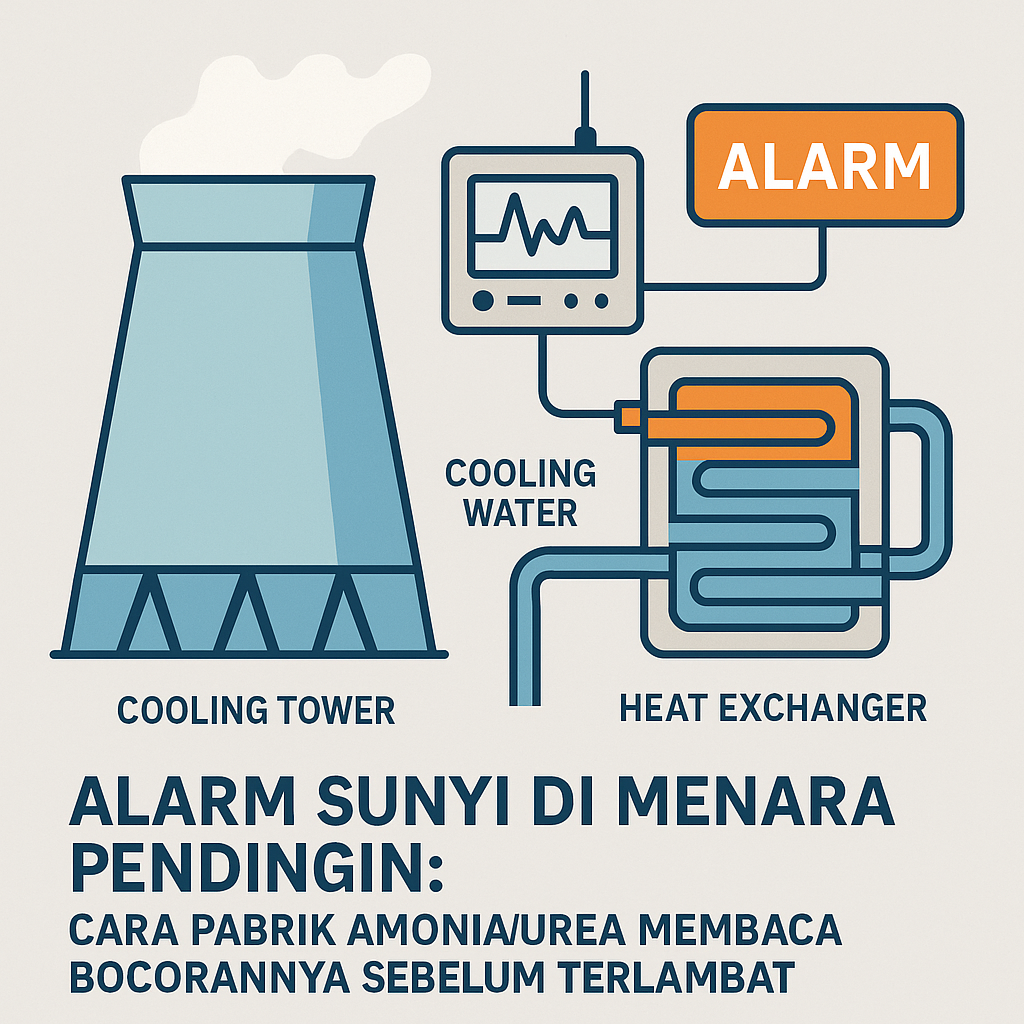
Data‑driven controls are essential: continuous water‑chemistry monitoring to safely push cycles, ensuring sufficient biocide for reclaimed water, and meeting site regulations. In Indonesia, environmental standards (e.g., Government Reg. PP22/2021 on water quality) and rising water/emission costs spur reuse. A robust program typically includes a biocide for biofilm control and a corrosion inhibitor to manage metallurgy risks when chemistry changes.
Near‑term quick wins include upgrading drift eliminators and tightening blowdown controls. Longer‑term ROI comes from water‑treatment upgrades—softening and UF/RO—to sustain >10× COC or to use lower‑quality sources. For softening, packaged softener systems are standard in makeup conditioning; for recycle, UF pretreatment stabilizes downstream membranes. Per EPA guidance, inventorying network leaks/overflows and installing alarms further cuts waste (nepis.epa.gov), and the mass balance remains straightforward: Makeup = Evaporation + Blowdown (nepis.epa.gov).
Integrated outcomes and outlook
Putting it together, a combination of ≥95% drift containment, high recirculation (COC≈8–12), and alternative makeup (wastewater/rain) typically yields multi‑tens‑of‑percent reductions in makeup demand. A managed upgrade might even halve fresh makeup (saving millions of liters/year) while maintaining performance. These evidence‑backed measures reduce costs and environmental impact and enhance resilience under water‑scarce conditions.
Sources: EPA/DOE water management guides (nepis.epa.gov) (nepis.epa.gov), industrial case studies (prochemtech.com) (prochemtech.com), pilot trials (watertechonline.com) (sciencedirect.com), and published industry analyses (prochemtech.com) (water360.com.au). These give concrete figures (e.g., millions L/yr saved, percentage reductions) to inform engineering decisions.