

Industry: Brewery | Process: Fermentation_&_Maturation
Fermentation and maturation vessels don’t just hold beer; they collect what beer leaves behind. Heavy organic deposits—yeast cells, proteins, hop debris, sugars—and inorganic “beerstone” such as calcium oxalate and phosphates accumulate through brewing cycles (academicjournals.org). Beerstone forms from reactions of proteins, caustic cleaners, and hard‑water minerals (academicjournals.org).
Even small residues can seed spoilage (for example, lactic bacteria in sour beers) and dent efficiency, so the hygiene bar is high: food‑contact equipment must be “cleaned effectively…and disinfected frequently” (academicjournals.org). In Indonesia, BPOM’s Good Manufacturing Practices expect validated cleaning—CPOB 2012 calls for tanks to be cleaned by divalidasi procedures—to ensure freedom from contaminants (academicjournals.org) (academicjournals.org).
Multi‑step CIP sequence and parameters
A robust fermenter CIP follows a predictable arc: (1) a water pre‑rinse with hot water (≥50°C) for several minutes to flush loose soil; (2) an alkaline wash using 1–4% sodium hydroxide (NaOH) or potassium hydroxide (KOH) at 65–80°C for 15–30 minutes (academicjournals.org) (academicjournals.org); (3) a water rinse; (4) an acid wash—0.5–1% phosphoric or nitric acid—run at ambient to ~50°C for 10–20 minutes (alliancechemical.com) (academicjournals.org); (5) a final rinse; and often (6) sanitization, commonly a low‑temperature peracetic acid (PAA) rinse at ≈0.5–1% v/v for ~10 minutes (academicjournals.org). In larger operations, some replace the acid rinse with steam sterilization, but most still include a mild acid pass to remove residual inorganics (academicjournals.org).
Alkaline detergent strength is often tuned: while legacy guides called for ~2–5% NaOH (w/v), modern breweries frequently run ~1–2% to save chemical and energy, balancing with time and temperature (academicjournals.org) (academicjournals.org) (academicjournals.org). Additives (silicates, surfactants) improve detergent action in hard water, and the acid step both dissolves mineral scale and passivates stainless steel (alliancechemical.com) (academicjournals.org).
Research‑backed conditions and timing
These conditions aren’t guesswork. Chisti & Moo‑Young reported that a 1% NaOH wash at 75–80°C for 15–20 minutes yields strong protein/fat removal (academicjournals.org). A UK microbrewery study confirmed ~2% caustic at ~75°C achieved clean ATP swab readings (<10–30 RLU) within 20–30 minutes (academicjournals.org) (academicjournals.org). Lower temperatures or concentrations may suffice for light soils, but typically require longer contact; inorganic removal still depends on an acid pass (academicjournals.org) (alliancechemical.com).
Chemistry choices and temperature control
Alkaline detergents: sodium hydroxide remains the workhorse; a 2–4% NaOH solution at ~70–80°C removes most organic films (academicjournals.org) (academicjournals.org). Potassium hydroxide can be used similarly, often with silicates for hardness tolerance; surfactants and chelants (for example, phosphates or nitrilotriacetates) help prevent redeposition.
Acid cleaners: phosphoric or nitric acids at ~0.5–1% dissolve calcium oxalate and hydroxide scales from the alkaline step and lower surface pH to aid microbial kill (academicjournals.org) (alliancechemical.com). Many breweries use peracetic acid or hydrogen peroxide for final sanitization because they leave no harmful residues (academicjournals.org). Stronger acids such as HCl are rarely used due to fumes and corrosivity, except in rare cases of stubborn scale.
Time and temperature are levers. Caustic is more effective hot, while PAA sanitizers should not exceed ~60°C to avoid decomposition. Rinse cycles typically last ~15–30 minutes, with total CIP duration often 1–1.5 hours for large tanks (academicjournals.org) (academicjournals.org).
One‑step cleaners versus traditional multi‑step
Traditional multi‑step CIP—alkali then acid—is time‑tested and targets soils with optimal chemistry. One‑step cleaners bundle functions so a single recirculation can attack mixed soils, potentially saving time and labor. The trade‑off: simultaneously dissolving heavy proteins and beerstone often demands very high alkalinity or aggressive oxidizers, raising cost and sometimes requiring neutralization. For example, a multi‑step might run ~2% NaOH plus 1% HNO₃; a one‑step blend might need ≥3–5% sodium metasilicate/NaOH with chelants and oxidants.
Peer‑reviewed brewing comparisons are sparse, but beverage experience shows one‑steps can leave residual minerals or organics if the pH doesn’t drop low enough long enough; a separate acid rinse reliably attacks scale. Even with “formulated” detergents, experts recommend at least one acid pass—or in‑situ pH drop—to ensure scale removal (academicjournals.org). Quantified trade‑offs cited here: one‑step CIP may shorten cycle time by ~20–30% but can increase chemical cost by 10–20% and may necessitate periodic acid shock‑cleaning; large breweries usually favor multi‑step for AVP‑level sanitation, while some very small breweries accept simpler one‑tank cleaners with a slightly higher risk and/or more frequent cleaning.
Cost factors cut both ways. Well‑designed multi‑step CIP can re‑use caustic solutions or rinse waters to save costs (csidesigns.com), and a UK microbrewery study found optimizing water/caustic use could save >£1000 annually on utilities and chemicals (academicjournals.org). Meanwhile, CIP chemical demand in Asia is growing ~9–12% annually (marketsandmarkets.com).
Validation methods and acceptance limits
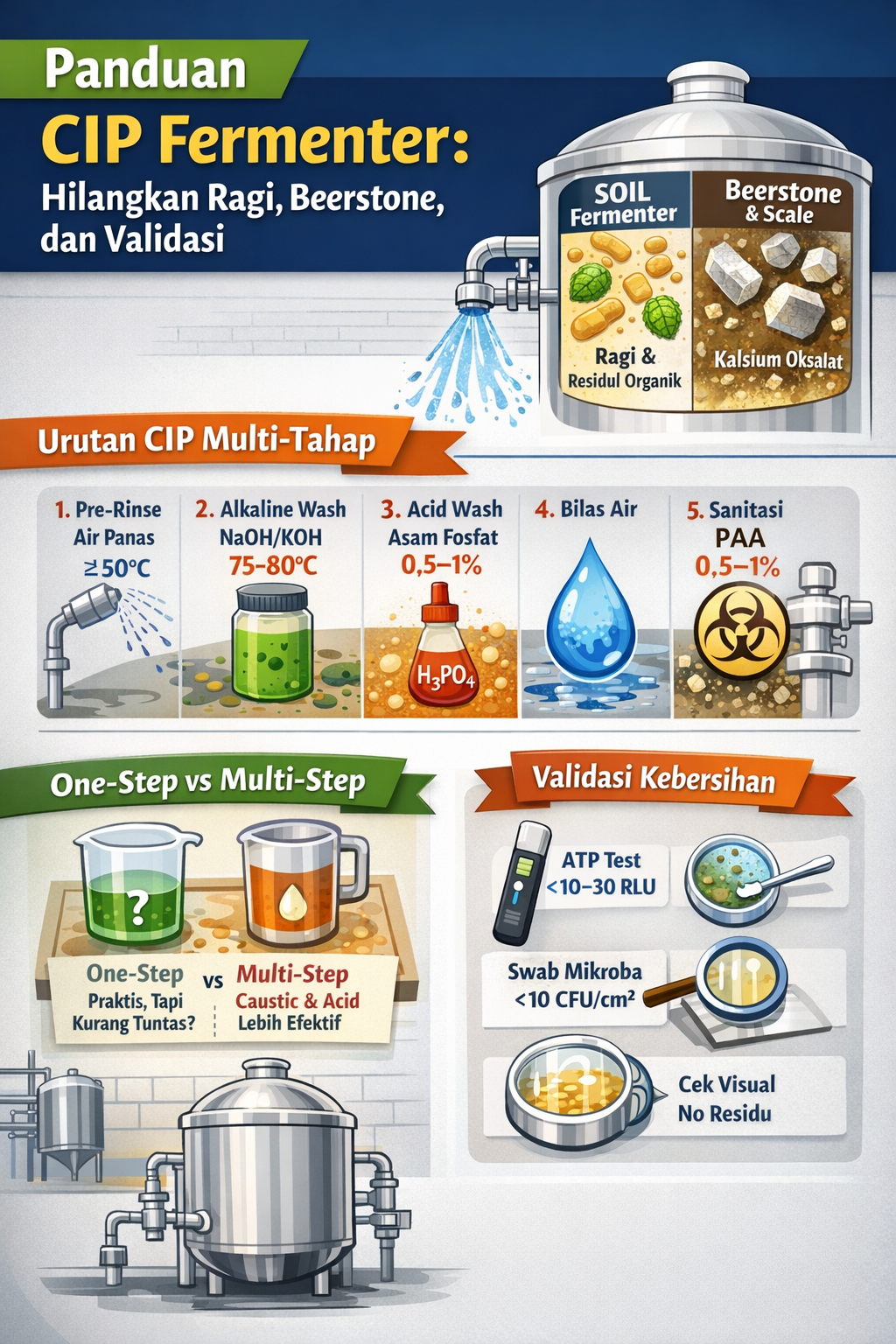
Validation closes the loop. ATP bioluminescence swabs deliver rapid RLU (relative light units) readings of residual organic matter; a widely used tolerance is <10–30 RLU on cleaned surfaces, with site‑specific action limits set after validation runs (academicjournals.org). Microbial swabs or plates provide confirmatory data: many breweries aim for <10–100 CFU/cm², with “no detectable colonies” as an operational target (numbers vary by facility). Some sample rinse water or product lines for spoilage organisms such as Lactobacillus, Pediococcus, or wild yeasts.
Chemical indicator tests—like a phenolphthalein check for residual caustic—plus conductivity and film monitors help verify detergent removal; in‑line sensors (pH, ORP) confirm each cycle hit targets (academicjournals.org). Records of CIP cycles should capture volumes, concentrations, and temperatures alongside verification data as part of HACCP. Hitting those concentrations depends on accurate chemical dosing, making accurate chemical dosing a practical control point.
Regulators back the discipline. The UK Food Standards Agency requires equipment to be “cleaned effectively…and disinfected frequently” (academicjournals.org), and Indonesian GMP expects “pembersihan [yang] telah divalidasi” (validated cleaning) for vessels (academicjournals.org). After validation, typical acceptance criteria are: no visible residue, ATP <20 RLU, and microbial recovery <10 CFU/cm² on all swabbed surfaces—some breweries also track finished beer quality (for example, no lactic acid increase). If a run fails (for example, high RLU), operators adjust parameters: increase caustic percentage, extend temperature/time, or add a stronger acid skid.
Automation and mechanical performance
In a multi‑brewery study, only facilities with automated CIP passed hygiene targets; hand‑scrubbed tanks still showed contamination (academicjournals.org) (academicjournals.org). Engineers flag mechanical factors—spray‑ball pressure and tank filling—as ROI drivers: high‑pressure spray balls at ≥50 L/min per tank zone improve removal, while flooded (unexposed) zones can shelter soils (academicjournals.org) (foodengineeringmag.com).
Practical benchmark setup
One practical specification drawn from the data: 2% NaOH at 75°C for 20 minutes; 0.5% HNO₃ at ambient for 15 minutes; and 0.5% PAA for 10 minutes. The standard sequence—pre‑rinse → caustic wash → rinse → acid wash (and/or PAA soak) → rinse—remains the benchmark. One‑step formulations must match these cleaning metrics and usually trade higher chemical dose for shorter cycle, whereas a well‑tuned multi‑step program can re‑use solutions and document thoroughness at lower per‑cycle chemical usage (csidesigns.com). As a critical control, CIP performance hinges on concentration, temperature, time, and flow—and on verifying the result with quantitative checks (academicjournals.org) (academicjournals.org).
Sources for the data‑driven recommendations include peer‑reviewed studies on brewery CIP via the Journal of Brewing & Distilling (academicjournals.org) (academicjournals.org) (academicjournals.org) and industrial reviews (academicjournals.org) (academicjournals.org), plus market and standards references including the UK Food Standards Agency and Markets & Markets on CIP trends (academicjournals.org) (marketsandmarkets.com).