

Industry: Aquaculture | Process: Hatchery_&_Larval_Rearing
In aquaculture hatcheries, the difference between a routine reset and a biosecurity breach is measured in parts per million and minutes of contact time. Marine guidelines cite ~100 ppm sodium hypochlorite (NaOCl) for 10 minutes on equipment and surfaces (fishhealth.ie). Ozone, a stronger oxidant, is commonly applied to intake water in contact tanks at ~8 mg/L for 3 minutes (redox ~600–750 mV) (fishhealth.ie). Peracetic acid (PAA) and stabilized chlorine dioxide (ClO₂) are increasingly favored for their broad-spectrum performance and equipment profile across recirculating aquaculture systems (RAS).
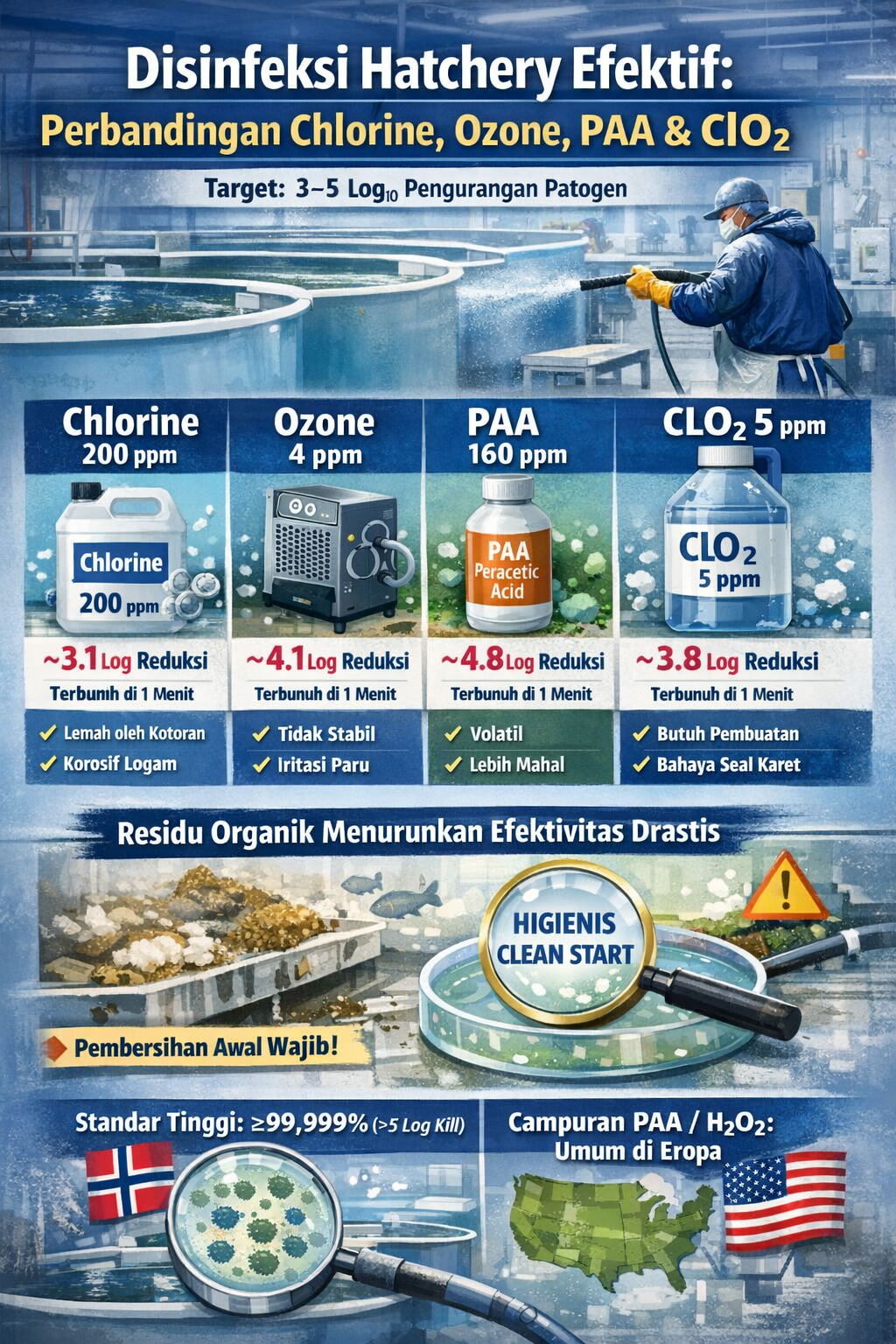
There’s a catch: any organic debris can slash disinfectant performance. Guidance is blunt—pre-cleaning must precede disinfection because remaining organic load “severely decreases” efficacy (fishhealth.ie).
Disinfectant performance and trade-offs
Chlorine (sodium hypochlorite): A hatchery staple for a reason: it’s broad-spectrum, low-cost, and widely available. On plastic surfaces, 1 minute at 100–200 ppm hypochlorous acid (HOCl) delivered ~2.0–3.1 log10 reductions against Listeria biofilms (≈99–99.9% kill) (Europe PMC). Heavy soiling drives up the dose: 1000 ppm and hours-long soaks are often used for nets (fishhealth.ie). The downsides are well known—rapid inactivation by organics (fishhealth.ie), corrosion or material degradation over time (EPA NEPIS) (EPA NEPIS), and trihalomethane byproducts—so rinsing and neutralization are non-negotiable. Residual chlorine is typically quenched with sodium thiosulfate before reuse (fishhealth.ie) (Scribd). In practice, chlorine still underpins most North American hatchery protocols—“used by the majority of surveyed sites” (Hatchery International).
Ozone: A top-tier oxidant that leaves no chemical residue, ozone is usually applied to water (not directly to surfaces). One minute at 4.0 ppm achieved ~4.1 log10 kill on Listeria biofilm (Europe PMC), and standard intake-water disinfection runs ~8 mg/L for 3 minutes (redox ~600–750 mV) (fishhealth.ie). The trade-offs: onsite generation is mandatory, ozone is highly toxic to fish and humans so use is confined to empty systems or contact tanks (fishhealth.ie) (Doczz), and organics can blunt efficacy—2 ppm gave only ~0.1 log kill on fouled surfaces (Europe PMC). Modern RAS teams value ozone for water treatment (often alongside UV disinfection) but rarely on nets or hands due to safety concerns and capital costs (Hatchery International).
Peracetic acid (PAA): A peroxyacid disinfectant increasingly favored in aquaculture. At 80–160 ppm for 1 minute, PAA delivered ~3.6–4.8 log10 reductions on plastic biofilms (Europe PMC). Operationally, 100–200 ppm soaks for ≥10–30 minutes are common. In RAS water, very low doses suffice: 5 mg/L for 5 minutes produced a 6‑log (99.9999%) kill of Yersinia ruckeri, and 3 mg/L for 5 minutes killed Flavobacterium columnare entirely (Wiley Online Library). PAA breaks down to acetic acid and O₂ and is less pH-dependent (Europe PMC) (EPA NEPIS), and it retains activity in dirty conditions: at 160 ppm, PAA still achieved ~3–4 log10 kill with organic soil, while 2–4 ppm ozone was virtually ineffective (Europe PMC). An EPA assessment found PAA had the least visual impact on metals and polymers among tested sporicides (EPA NEPIS). Caveats: it can still corrode some rubbers or magnets at high concentration, it’s somewhat pricier than bleach, and it’s volatile. Its “green” profile helps explain wider adoption, notably in Europe (Hatchery International).
Stabilized chlorine dioxide (ClO₂): Effective across a broad pH range and used for water and surfaces in food and medical settings, with growing aquaculture interest (PubMed). In water, 0.25–2.5 mg/L can suppress pathogens: 0.25 mg/L suppressed 5 of 7 Vibrio strains for 24 h, and 2.5 mg/L reduced Vibrio counts by log 3.5 over 24 h (PubMed). ClO₂ has a higher safety margin for fish than free chlorine: LC₅₀ (lethal concentration for 50% of organisms) to clownfish is ~0.7–0.9 mg/L over 10–24 h exposures (PubMed). In practice, 0.1–0.25 mg/L is non‑lethal to juveniles yet suppresses many pathogens (PubMed). For surfaces and lines, common practice involves flushing or soaking at levels similar to potable-water disinfection (tens of mg/L) (PubMed); stabilized ClO₂ is widely recognized as “safe and effective” at ~20–30 mg/L in such applications (PubMed). It leaves no harmful residue beyond chlorite, which must be rinsed out. ClO₂ is generally less corrosive than strong bleach or ozone, though repeated exposure can degrade organic seals. In hatcheries, it can rapidly sanitize equipment and water lines between batches if used with caution to avoid toxicity (PubMed).
Other agents and physical methods
Iodine-based iodophors remain common for egg surface sterilization at ~100 ppm for 5–10 minutes; they kill bacteria and viruses but can stain and require neutralization (fishhealth.ie). Quaternary ammonium compounds and phenolics (e.g., Virkon Aquatic, Virasure) are sometimes deployed for floors or nets; 1% Virkon Aquatic kills IPN/IPNV viruses in 10 minutes (fishhealth.ie). Heat or UV can disinfect equipment—70°C for 1–2 hours kills many viruses (fishhealth.ie)—and UV is used on nets and diving gear (fishhealth.ie). In practice, halogens (chlorine, iodophors) and peroxygens (PAA) dominate hatchery disinfection.
Equipment and surface compatibility
Material choices affect longevity under oxidants. Plastics like PVC, polyethylene, polycarbonate, polystyrene, and polyurethane are generally resistant; diluted bleach caused little change on polycarbonate or polystyrene (EPA NEPIS). Metals can tarnish or corrode: prolonged bleach immersion left white residue on galvanized steel and color changes on brass (EPA NEPIS). PAA was rated the least visually impactful to metals and polymers among tested agents (EPA NEPIS).
Elastomers require care. High ozone levels can attack elastomers (rubber hoses may stiffen with repeated exposure). Rubber and silicone generally tolerate bleach and PAA reasonably well, but neoprene showed damage under sporicide tests (EPA NEPIS). Segregating equipment by material and rinsing metals after disinfection are common-sense measures; guidance notes steel nets should be “left to dry for days or neutralized” after chlorine bathing, while plastic tanks can be rinsed (fishhealth.ie).
Between-batch cleaning workflow
A data-backed, stepwise protocol underpins clean starts between larval batches. The sequence below consolidates industry practice (fishhealth.ie) and operational examples (Huvepharma):
1) Depopulation and debris removal. All fish, eggs, feed residues, and removable kit (nets, thermometers, pumps) are taken out; tanks are drained and opened. Visible organics—feces, uneaten feed, biofilms—are removed first because organic load “severely decreases” disinfectant efficacy (fishhealth.ie). Waste is disposed of safely; empty systems may sit or dry briefly.
2) Pre-cleaning with detergent. A robust detergent (alkaline or enzymatic) is applied to floors, walls, and tank interiors; high-pressure spraying assists soil removal. One example uses a 2% detergent foam (DT Foam®) on tank surfaces for ~20 minutes (Huvepharma). Pipelines are flushed with 2–3% detergent (DT Smart®) for 30–60 minutes (Huvepharma). Full agitation/scrubbing lifts biofilm, followed by thorough rinsing with clean water (fishhealth.ie).
3) Disinfection. Fresh solutions are prepared and applied by spray, fog, or soak with complete coverage (corners, substrates, nets, skimmers, filter housings). Representative choices and contact conditions include: chlorine (100–200 ppm for 10–30 minutes) (fishhealth.ie); PAA such as Proxitane or Virkon at 0.4–1% (~4,000–10,000 ppm) for 10–30 minutes, with one reported use of Vulkan® Max (likely PAA) at 0.6% for 30 minutes (Huvepharma); stabilized ClO₂ to flush lines at ~1–5 ppm or higher for short contact in empty systems; and ozonated water circulation at 4–8 mg/L for several minutes. Iodophor at 100 ppm is typically held 10 minutes for virus kill (fishhealth.ie). Some sensitive viruses demand higher exposures; 70°C heat for 2 hours kills IPN virus (fishhealth.ie). After chlorine use, residual HOCl is neutralized—for example, with sodium thiosulfate—and then rinsed (fishhealth.ie) (Scribd). Accurate chemical dosing supports consistent concentration control during this step (dosing equipment).
4) Rinse and dry. All surfaces are rinsed thoroughly; pumps and pipework are flushed until no disinfectant odor remains. Where chlorine or ClO₂ were used, absence of free chlorine is confirmed (test kits). Complete drying follows; sunlight or heat provides additional kill. Guidance specifically advises leaving pipes and aeration systems to dry between cycles (Scribd). Floors and nets should dry fully, as some pathogens do not survive prolonged dryness.
5) Reassembly and final flushing. Clean or new filter media are reinstalled; tanks are refilled with clean water. A final intake-water sanitation step is often run: 1–2 ppm chlorine or ozone for 1–2 hours prior to stocking larvae. System checks ensure pH, redox, and residual oxidant levels are safe for fish. Where chlorine was used, dechlorination is completed before reuse with appropriate agents (dechlorination media).
6) Documentation and monitoring. Records capture chemicals, concentrations, contact times, and solution change dates; disinfectant solutions must be replaced before they lose strength (fishhealth.ie). Safety data sheets guide handling. Staff don fresh gear before restocking; tools or nets used outside the system are re-disinfected.
Efficacy benchmarks and regional practice shifts
Quantitative studies set realistic targets. On inoculated biofilms, 1‑minute treatments achieved ~3–5 log10 reductions: ozone 4 ppm (4.1 log), chlorine 200 ppm (3.1 log), ClO₂ 5 ppm (3.8 log), and PAA 160 ppm (4.8 log) (Europe PMC). In RAS water, even a few ppm of PAA achieve >5‑log kill of cultured pathogens (Wiley Online Library). For “sterile” conditions, operators calibrate protocols to aim for ≥5‑log reduction (99.999%), with the critical caveat that residual organics drastically reduce outcomes (fishhealth.ie) (Europe PMC).
Industry surveys reflect regional patterns: in a 2020 salmon RAS snapshot, PAA/H₂O₂ mixes were most common for surfaces in Norway, while chlorine/quaternary ammoniums predominated in North America (Hatchery International). Across approaches, the throughline is consistent: thorough pre-cleaning, strong disinfectant contact, and verified neutralization reset systems within minutes to hours, enabling the next cycle to start clean.