

Industry: Automotive | Process: Industrial_Wastewater_Treatment_(Oily_&_Metals)
In Indonesia, metal discharge limits that mirror auto manufacturing are unforgiving: Cu ≤0.5 mg/L, Zn ≤1.0 mg/L, Ni ≤1.0 mg/L, Cd ≤0.05 mg/L, Pb ≤0.1 mg/L (Permen LH 5/2014; karbonaktif.org). Plants routinely stack treatment stages to get there, often polishing with a sulfide step after primary hydroxide precipitation to push residual metals lower.
The technical arc is clear in the literature: convert dissolved ions into insoluble particles, then remove the solids. What makes or breaks performance is how precisely a facility controls pH, which precipitants it chooses, and whether the solids are pulled out by gravity or by a membrane—choices that also set up the cost and handling of the resulting sludge.
Hydroxide precipitation and pH control
The mainstream move is to raise pH (acidity/alkalinity scale) so dissolved metals form insoluble hydroxides/carbonates. Plants dose slaked lime (Ca(OH)2) or caustic soda (NaOH) to reach roughly pH ~8.5–11, with the exact target set by each metal’s narrow pH of minimum solubility (nepis.epa.gov). In bench tests on cable‑industry wastewater rich in Cu2+ and Zn2+, raising final pH to ~8–10 with Ca(OH)2, NaOH, or Na2CO3 achieved >90% Cu and Zn removal (researchgate.net).
Metal behavior isn’t uniform. Cu(OH)2, Pb(OH)2, Cr(OH)3, and Zn(OH)2 generally precipitate at pH 8.5–10, but some hydroxides are amphoteric (can re‑dissolve if pH is pushed too far), such as Al(OH)3 and Zn(OH)42− (nepis.epa.gov; link.springer.com). After pH adjustment, plants commonly add polymers (“flocculants”) so fine hydroxide flocs agglomerate into larger, settleable solids (nepis.epa.gov), often metered through a dosing pump for control.
When polymer aids are required, commodity programs lean on flocculants or, upstream, coagulants to boost particle aggregation—tools that sit alongside the pH chemistry without changing the underlying solubility regime.
Sulfide and organosulfide precipitants
An alternative is to form metal sulfides, which have much lower solubility products than hydroxides. Inorganic sulfide donors like Na2S or NaHS, and organic sulfur reagents, react with metal cations to form insoluble MS solids (e.g., CuS, PbS, ZnS), enabling lower residual metals (link.springer.com; ascelibrary.org). Theoretical and lab studies show Cu and Cd sulfides can remain insoluble even in the presence of strong chelators (chelating agents are complexing chemicals that bind metals), with residual <1 mg/L in the presence of EDTA, whereas Zn and Ni sulfides are more sensitive to complexation (nepis.epa.gov).
On the organic side, commercial reagents include thiocarbonates (potassium/sodium thiocarbonate, trade name “Thio‑Red”) and triazines (2,4,6‑trimercaptotriazine, “TMT‑15”), which target “soft” metals, and dithiocarbamates such as sodium dimethyldithiocarbamate (SDTC) (link.springer.com; link.springer.com). Choice is often dictated by complexants. Hydroxide routes can fail even at ~1 mg/L EDTA, which can keep tens of mg/L of metals in solution, while sulfide precipitation resists complexation better (ascelibrary.org; nepis.epa.gov).
Even so, experiments on real automotive wastewater show limits: all precipitants removed Cu effectively, but Ni and Zn often remained above target levels (ascelibrary.org)—consistent with EPA findings that ZnS/NiS precipitation is strongly hindered by EDTA, whereas CuS/CdS are not (nepis.epa.gov). In broad summary, pH‑driven hydroxide precipitation is simple and cheap and can achieve >90% removal (especially for Cu, Zn) when no chelators are present (researchgate.net; nepis.epa.gov), while sulfur‑based chemicals (inorganic or organic) can further push residuals lower (often <0.1 mg/L) for the hardest‑to‑remove species (link.springer.com; ascelibrary.org).
Gravity clarification versus membrane filtration
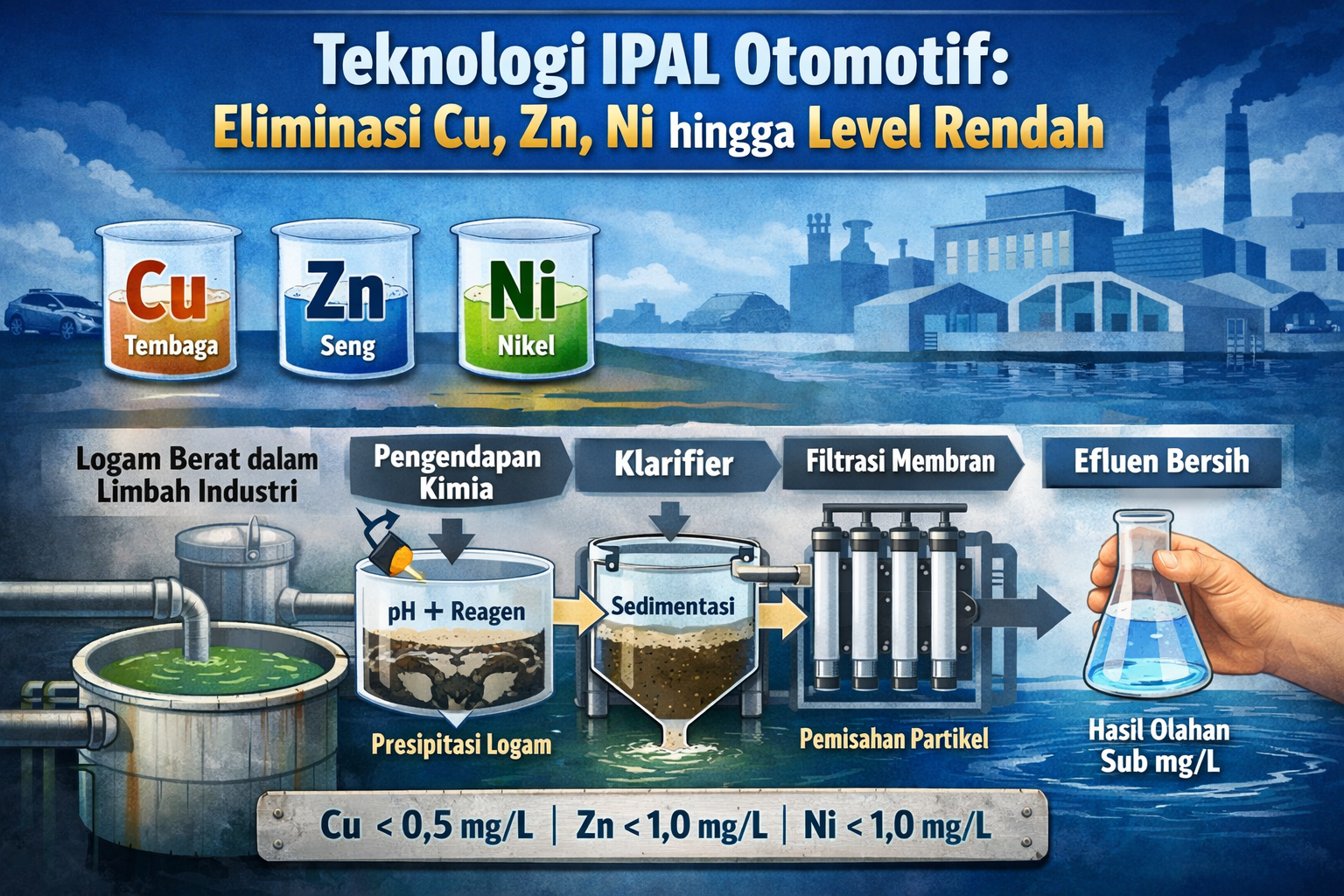
Once metals are precipitated, solids must be removed. The traditional choice is gravity clarification—rectangular basins or lamella settlers—that, aided by polymers or coagulants, take out the bulk of suspended solids (nepis.epa.gov). In practice, well‑operated precipitators plus clarifiers typically reduce turbidity and suspended solids by 80–95%, though effluent often still carries a few mg/L of fines. Many facilities specify a clarifier for this duty, and compact installations use a lamella settler to intensify settling area.
Membrane filtration (MF/UF) flips the script: a submerged or crossflow module replaces the clarifier, producing permeate with essentially no suspended solids and a concentrated sludge retentate. Case studies in metal finishing report microfiltration concentrating precipitated sludge into a 2–5%‑solids slurry (versus e.g., 0.1–0.5% in a clarifier effluent), while delivering effluent with much lower suspended solids than clarifiers (sterc.org; sterc.org). In effect, MF achieves >99% particulate removal; treated water is essentially free of settleable solids (sterc.org). Plants deploying modules akin to ultrafiltration treat the precipitated stream as a membrane feed rather than a settling duty.
There are trade‑offs. Membranes demand higher capital and energy and are prone to fouling. Critically, they cannot use polymer flocculants—polymers will clog pores—so systems rely on coarser flocculation or direct precipitation (sterc.org). Only ~1–2% of metal‑plating shops use MF, typically when very low metal limits or complexants are present (sterc.org). For example, if a plant must improve Ni/Cu in a chelated rinse to <0.1 mg/L, MF may be chosen, often at ~10× the cost (sterc.org; sterc.org). Conventional clarifiers—often preceded by coagulation/flotation—remain the norm, with facilities adding units such as dissolved air flotation upstream when needed.
Where membrane trains are adopted, packaged membrane systems provide a defined barrier and stable effluent solids, while gravity routes emphasize simplicity and sludge handling capacity.
Sludge thickening, dewatering, disposal
The precipitate—hydroxide or sulfide—becomes a metal‑rich sludge. Operations first thicken it by gravity in a holding tank to concentrate to a few percent solids, then mechanically dewater via filter presses, centrifuges, or belt/screw presses (sterc.org; sterc.org). Typical yields: centrifuge/cyclone ~10–25% dry solids; vacuum belt or filter ~15–40%; a well‑operated filter press (100–200 psi) produces 25–60% solids cake (sterc.org). Further drying—beds or thermal—can reach ~80–90% solids (sterc.org).
Economics reward dryness. STERC data show increased cake solids sharply cut disposal cost; drying to ~90% solids reduces volume by an order of magnitude (sterc.org). For reference, in a typical industrial filter press run, about 100–200 kg of precipitate (2–5% solids) might be collected per 10 m³ of treated water, then concentrated to ~20–50% solids cake. Disposal costs (landfill fees, transport) can exceed $100/ton of dry sludge. Plants often introduce a sludge treatment aid to reduce volume and improve dewatering characteristics before hauling.
Regulatory status is non‑negotiable: the final sludge is classified as hazardous (B3) due to heavy‑metal content and must be tested/managed per regulations. Commonly, it is stabilized/solidified (e.g., with cement) to immobilize metals, then sent to a licensed hazardous‑waste landfill; where concentrations are exceptionally high, some recovery or stabilization process (such as smelting or chemical stabilization) may be considered (sterc.org).
Process selection and compliance targets
The treatment pathway follows the compliance math. Hydroxide precipitation can deliver >90% metal removal—especially for Cu and Zn—when chelators are absent, with flocculation to build robust settleable solids (researchgate.net; nepis.epa.gov). When chelants like EDTA are in play, sulfide chemistries—including inorganic sulfide and organosulfur precipitants—can resist complexation better and push residuals lower (often <0.1 mg/L), though Ni and Zn can remain stubborn in real wastewaters (nepis.epa.gov; ascelibrary.org).
For solid–liquid separation, clarifiers emphasize simplicity and high sludge‑handling capacity but leave residual fines (effluent suspended solids often a few mg/L), whereas MF/UF “polish” particulates into a concentrate and produce clear permeate—often chosen when targets are very low (e.g., <0.1 mg/L) or complexants are present, albeit at higher (~10×) cost (sterc.org; sterc.org). Gravity routes often pair with coagulation/flotation; packaged units and wastewater ancillaries fill out the train, depending on the site footprint and load variability.
Sources and data points
Authoritative reviews and case studies of heavy‑metal precipitation and filtration underpin this analysis: ascelibrary.org; nepis.epa.gov; researchgate.net; link.springer.com; link.springer.com. US EPA and industry guides provide process specifics and performance ranges: nepis.epa.gov; nepis.epa.gov; sterc.org; sterc.org; sterc.org; sterc.org. Indonesian effluent standards are summarized at karbonaktif.org.