

Industry: Desalination | Process: Post
Desalinated water—think reverse osmosis (RO) or thermal distillate—is nearly mineral‑free, slightly acidic (often pH 6–7), and, without post‑treatment, aggressive enough to dissolve pipe minerals and metals rather than form protective films (sciencedirect.com) (researchgate.net). That’s why RO permeate from seawater RO systems is never sent straight to taps.
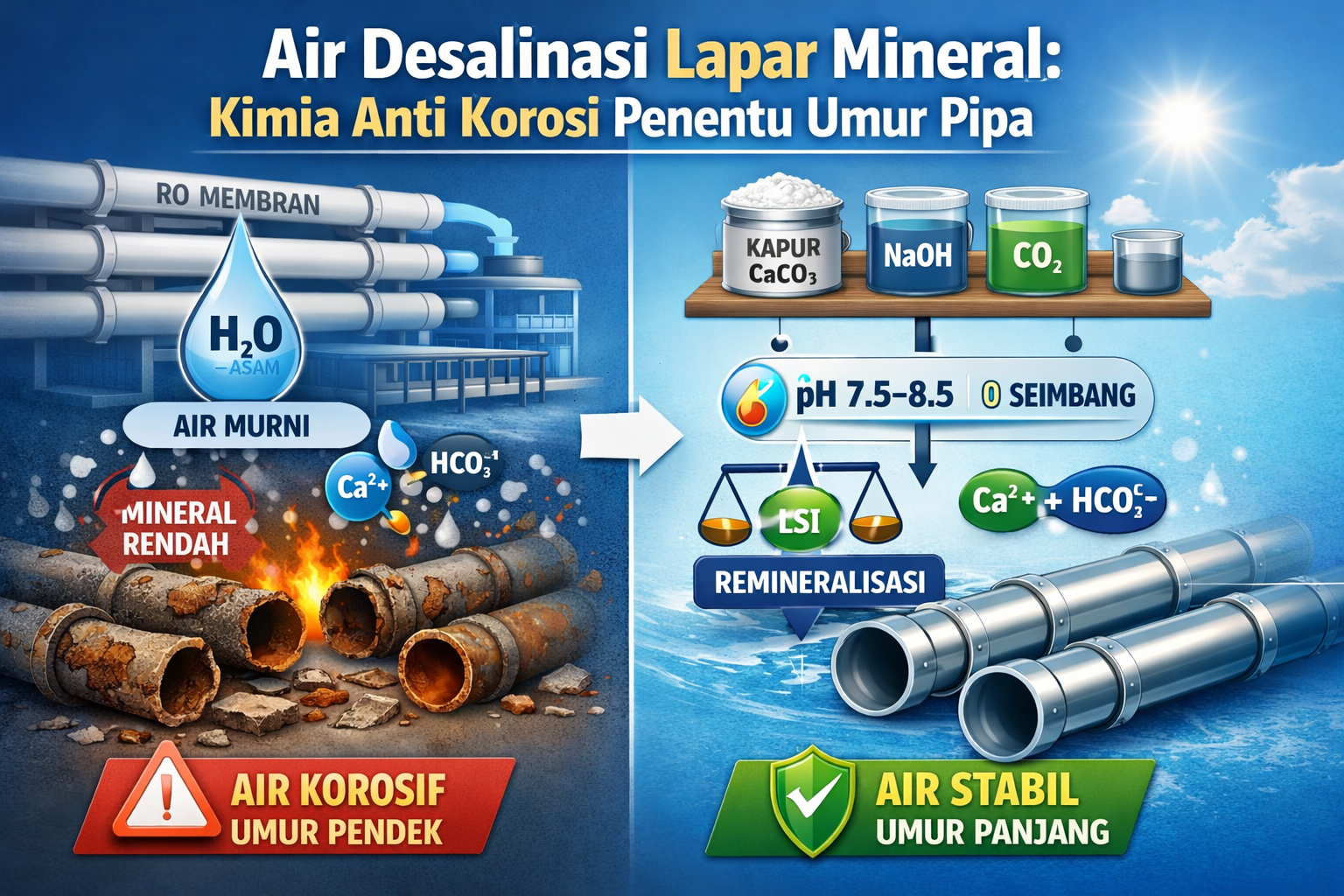
Studies warn untreated RO permeate “does not meet standards” and will “promote dissolution of toxic metals such as lead and copper and increase leaks” in networks (researchgate.net). The corrosion bill for cast‑iron mains alone: an estimated $325 billion over 20 years for U.S. utilities (researchgate.net). The fix is remineralization: adding hardness, alkalinity, and adjusting pH to make water “non‑corrosive.”
Calcium carbonate equilibrium indices
The workhorse metric is the Langelier Saturation Index (LSI), defined as LSI = pH − pHs (pHs is the pH at which the measured calcium and alkalinity are at calcium carbonate saturation). LSI > 0 means CaCO3 is supersaturated (scale‑forming), LSI = 0 is equilibrium, LSI < 0 is undersaturated (tends to dissolve CaCO3) (nepis.epa.gov) (nepis.epa.gov).
How it behaves in the field: water with LSI = +0.6 is “very encrusting,” while LSI = −3.6 is “extremely corrosive” (carbotecnia.info). Utilities often target a slightly positive LSI (about +0.2 to +0.5) so a thin protective CaCO3 film forms without heavy scaling (nepis.epa.gov) (nap.nationalacademies.org). Historic guidance calls LSI ≈ +0.5 “satisfactory,” with LSI above +1.0 risking excessive scale (nap.nationalacademies.org) (nepis.epa.gov).
Other indices round out the picture. The Aggressiveness Index (AI, AWWA C‑400) is AI = pH + log10(A × H), where A is total alkalinity (mg/L as CaCO3) and H is calcium hardness (mg/L as CaCO3) (nepis.epa.gov). AI <10 is “very aggressive,” 10–12 “moderately aggressive,” and AI ≥12 is “non‑aggressive” for cement/asbestos‑cement pipe (nepis.epa.gov) (nap.nationalacademies.org). These thresholds roughly align with LSI ≈ 0. The Ryznar Stability Index (RSI ≈ 2·pHs − pH) signals corrosion when RSI > 7 and scaling when RSI < 6.
RO permeate often sits at LSI ≪ 0. In one case, a permeate around pH ~6.0 with negligible hardness had a negative LSI; after raising pH and adding calcium, the adjusted water hit LSI ≈ 0 and iron release dropped sharply (researchgate.net) (researchgate.net).
Important caveat: LSI is a calcite‑equilibrium tool; it does not capture all corrosion modes. For copper or lead, higher alkalinity aimed at boosting LSI can aggravate metal release. A corrosion pilot found a traditional “Larson’s Ratio” (pH‑alkalinity) approach worsened copper corrosion—higher alkalinity increased copper release (researchgate.net). Aeration to raise pH without adding HCO3− (researchgate.net) or film‑forming inhibitors may be needed for those materials.
Material‑specific corrosion behavior
Cast iron/ductile iron: Protection comes from a CaCO3 film. Negative LSI water dissolves it; slightly positive LSI promotes a passivating layer. Utilities aim for LSI around +0.2 to +0.5 at pH ~7.5–8.0, with sufficient hardness/alkalinity (researchgate.net) (nepis.epa.gov). At the 40 MIGD Ras Laffan plant, final water at Ca2+ ≈ 28 mg/L, alkalinity ≈ 72 mg/L (as CaCO3), and pH ≈ 7.7 corresponds to LSI ≈ 0 (calculated ~ +0.1), judged non‑corrosive to cast iron (researchgate.net). Indonesian standards allow hardness up to 500 mg/L; in practice any residual hardness > ~30 mg/L helps protect iron without exceeding limits (id.scribd.com).
Cement‑lined/asbestos‑cement: Low pH/alkalinity water leaches Ca(OH)2, weakening linings. LSI ≈ 0 is ideal; negative LSI drives leaching. Non‑aggressive definitions for concrete/AC pipes typically match LSI ≥ 0 and AI ≥ 12 (nap.nationalacademies.org) (nepis.epa.gov). (German DIN 4030 adds criteria, but LSI control is widely used.)
Copper plumbing: Behavior diverges from iron. In oxygenated water, at pH values higher than 9 “both iron and copper are usually protected,” the EPA notes (nepis.epa.gov). Practical limits keep pH < 9, and simply boosting alkalinity to chase LSI can promote pitting or galvanic issues in new copper (researchgate.net). Common practice is to raise pH by removing CO2 (degassing) or dosing caustic, targeting the upper‑7s to ~8.5 to reduce lead solubility and general copper corrosion (researchgate.net) (nepis.epa.gov). Many systems co‑feed orthophosphate or polyphosphate to form protective films (nepis.epa.gov).
PVC/plastic: These materials are technically inert to pH/scale, but their copper/brass fittings see the same water, so copper guidance applies.
Adjusting pH, alkalinity, and hardness
pH adjustment: RO/thermal permeate typically sits at pH ~6–7. Operators raise it into the 7.5–8.5 range for LSI control and disinfectant stability via CO2 stripping (aeration), caustic dosing, or CO2 addition. Ras Laffan uses a packed tower to strip excess CO2 after limestone contact, a step that raises pH without adding chemicals (researchgate.net). Where fine control is needed, NaOH or soda ash (Na2CO3) is dosed—Ras Laffan adds NaOH into a bypass line to trim pH (researchgate.net) (researchgate.net). That kind of chemical metering is standard with a dosing pump. If pH overshoots, CO2 gas can be dissolved to bring it down, though RO permeate usually starts low.
Ras Laffan ultimately delivers water at ~pH 7.7–7.8 (researchgate.net). This sits comfortably within the Indonesian drinking‑water standard (Permenkes 492/2010) of pH 6.5–8.5 (id.scribd.com). Note: pH alone doesn’t protect iron effectively; carbonate chemistry and LSI drive stability.
Alkalinity and hardness: Desalinated water lacks both and needs them added. The go‑to is limestone (calcite) dissolution: feed CO2 to water, then pass it through calcite so CO2 + H2O + CaCO3 → Ca2+ + 2HCO3−, adding calcium and bicarbonate together. In practice, a portion of permeate is acidified (CO2 or H2SO4) and sent to a granular limestone contactor (researchgate.net). Ras Laffan tapped seawater MSF vent‑gas CO2 to acidify before limestone contact, calculating the CO2 dose stoichiometrically to hit the target bicarbonate (researchgate.net) (researchgate.net).
The limestone‑CO2 route “is more operator‑friendly” and safer than slaking lime (Ca(OH)2), according to comparative reviews (researchgate.net). Lime dosing can still be used, though it boosts pH and hardness more than alkalinity unless followed by CO2 addition (researchgate.net).
Another cost‑effective tactic is sulfuric or carbonic acid pretreatment plus limestone contact—studies report it “could lead to great results and correct calco‑carbonic equilibrium” and is often the cheapest pretreatment (researchgate.net). Direct mineral dosing (CaCl2, MgCl2) is another option to add hardness without alkalinity; brackish plants using brackish‑water RO sometimes add MgCl2 or use dolomite filtration for a magnesium boost (researchgate.net).
Post‑contact, excess CO2 must be stripped to avoid depressing pH. Ras Laffan removes unreacted CO2 in a packed stripping tower (researchgate.net)—the kind of unit commonly grouped with supporting water‑treatment ancillaries. The plant then blends treated flow with bypassed distillate and adds caustic as needed (researchgate.net) (researchgate.net). Operating tests delivered Ca2+ ≈ 26–28 mg/L, bicarbonate ≈ 72–88 mg/L (as CaCO3), TDS ~190 mg/L, and pH ~7.7—a stable, non‑corrosive mix (researchgate.net).
Targets, standards, and verification
The Indonesian drinking‑water standard (Permenkes 492/2010) requires pH 6.5–8.5 and hardness < 500 mg/L (id.scribd.com). Corrosion control typically calls for pH ~7.5–8.5 and alkalinity/hardness of at least ~50–100 mg/L as CaCO3 to land near LSI ≈ 0. Many desalination systems aim for post‑treatment hardness on the order of 30–80 mg/L (as CaCO3) and similar alkalinity, which produces AI ≥ 12 (non‑aggressive) (researchgate.net) (nepis.epa.gov). Total dissolved solids usually remain low (≈200–300 mg/L, as in Ras Laffan), so LSI isn’t overly influenced by ionic strength.
By dosing limestone (or lime) and CO2 carefully, treated desalinated water can satisfy the Indonesian regulations and achieve the buffer needed for pipe stability. Targets frequently cited by operators include LSI ~0 (slightly positive, e.g., +0.2 to +0.5) (nepis.epa.gov) (h2owarehouse.co.za). Monitoring should include indices (LSI, AI) and actual metal release. In one pilot distribution trial, raising LSI from −2 to +0.5 after remineralization dropped copper and lead to negligible levels (researchgate.net).
All of the above applies across desal streams, whether the permeate rolls off RO/NF/UF membrane trains or thermal distillation. The technical guidance and case studies cited throughout—including nepis.epa.gov, multiple researchgate.net sources, nap.nationalacademies.org, and Indonesia’s standard on id.scribd.com—anchor the targets, formulas, and operating ranges referenced here (EPA/AWWA manuals cited therein).