

Industry: Aquaculture | Process: Disinfection_&_Water_Quality_Management
In ponds and recirculating systems, pH — a logarithmic measure of hydrogen ion (H⁺) concentration — sets the stage for survival. Most aquaculture waters operate between pH 6.5–9.0, with an optimal near neutral to slightly basic (~7.0–8.0), according to a widely cited extension guide (studylib.net). Fish blood pH averages ~7.4, so water much below pH 5 or above pH 10 drives severe stress or mortality (studylib.net).
Daily chemistry cycles are pronounced. Daytime photosynthesis by plankton consumes dissolved CO₂ (carbon dioxide), which raises pH; nighttime respiration produces CO₂, which lowers pH (studylib.net; see also the “Table 1” summary here: daylight O₂ increases/CO₂ decreases/pH increases; night O₂ decreases/CO₂ increases/pH decreases: studylib.net). In a well‑aerated pond, CO₂ typically remains in the 5–10 mg/L range; at sunset, dissolved oxygen (DO) falls while CO₂ rises, forming carbonic acid (H₂CO₃) and dropping pH (studylib.net; the same diel pattern is reiterated here: studylib.net). Catfish, for example, tolerate up to 20–30 mg/L CO₂ if it accumulates slowly, but elevated CO₂ lowers blood oxygen carrying capacity at the gills; if DO is already low, excess CO₂ can cause suffocation even when DO is marginally adequate (studylib.net).
Carbonate system and buffer capacity
Stability hinges on alkalinity — the concentration of bases (primarily bicarbonate HCO₃⁻ and carbonate CO₃²⁻) that neutralize acids, commonly reported as mg/L CaCO₃ (studylib.net; additional context on alkalinity in aquaculture waters appears here: studylib.net). In natural waters, alkalinity originates when CO₂ in rain dissolves limestone (CaCO₃) in soils, following the reaction: CaCO₃ + H₂O + CO₂ → Ca²⁺ + 2 HCO₃⁻ (studylib.net). Weathering raises water hardness, alkalinity, and pH.
In buffered waters (moderate‑to‑high alkalinity), pH remains neutral to slightly basic (≈7.0–8.3) and resists swings; “higher amounts of CO₂ (carbonic acid) are required to lower pH because there is more base available to neutralize the acid” (studylib.net; direct quote and method reminder also appear in the same reference: studylib.net). By contrast, low‑alkalinity waters see wide diurnal swings — pH can fall to 4–5 at night or rise above 9–10 by midday if not buffered (two corroborating notes: studylib.net; and the day–night trend tabulation again: studylib.net). In practice, a minimum alkalinity of ~20 mg/L (as CaCO₃) supports “good productivity,” while 75–200 mg/L CaCO₃ is considered desirable for stable culture (studylib.net).
Calcium carbonate (limestone) dissolves below ~pH 8.3; above pH 8.3 it becomes ineffective (studylib.net). In hard, alkaline waters, gypsum or sodium bicarbonate (NaHCO₃) or calcium hydroxide [Ca(OH)₂] can be used to boost hardness and/or alkalinity instead (studylib.net).
Quantifying CO₂–pH–alkalinity linkage
Carbonate equilibrium ties CO₂, pH, and alkalinity quantitatively. A practical estimate is: CO₂ (mg/L) ≈ [alkalinity in mg/L] × [factor from tabulated data], where the factors are temperature and pH dependent (studylib.net). At 25 °C, the factor for pH 7.0 is 0.291 (so 100 mg/L alkalinity implies ~29 mg/L CO₂), whereas at pH 8.0 the factor is only 0.029, nearly negligible CO₂ (see also the “Table 2” pointer: studylib.net and the factor‑application note again: studylib.net). In practice, CO₂ above ~pH 8.4 is essentially zero (studylib.net).
Alkalinity also shifts other chemistry. Higher pH (and higher alkalinity) increases the fraction of toxic un‑ionized ammonia (NH₃) at any given total ammonia load, because the NH₃/NH₄⁺ equilibrium moves toward NH₃ as pH rises; conversely, low pH is lethal on its own. Metals such as copper (Cu) and zinc (Zn) become more toxic at low pH as they dissolve more readily (studylib.net).
Automated pH monitoring and feedback dosing
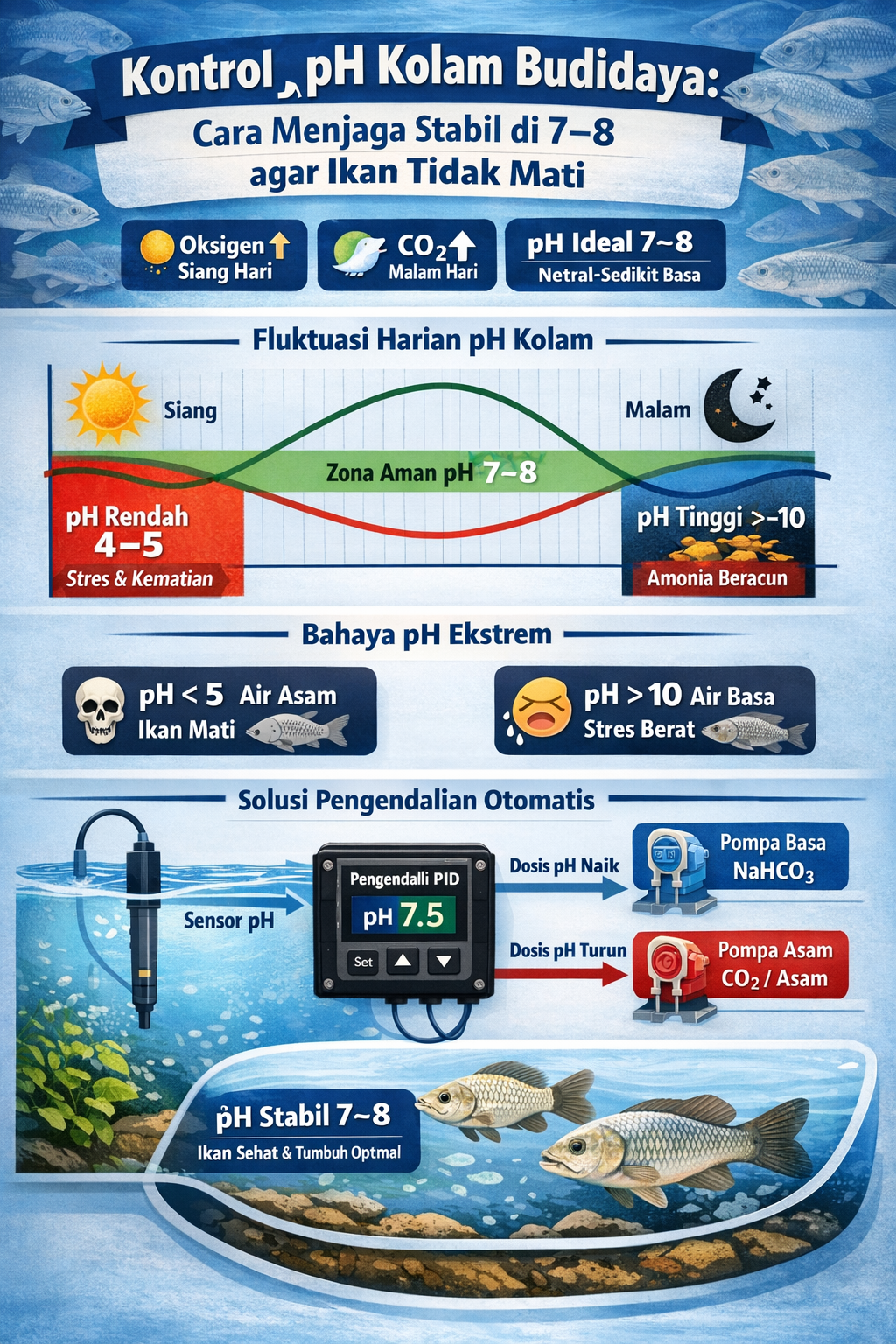
Modern setups use continuous monitoring with feedback dosing to stabilize pH and alkalinity. A typical system combines a pH sensor (glass electrode or optical probe, with temperature compensation), a controller (microprocessor/PLC), and one or more dosing pumps. The sensor reports pH in real time; the controller compares it to a setpoint or range and commands pumps to add chemicals.
Research examples include an Arduino‑based Outseal PLC with a pH probe (RDD‑AFE‑001) commanding peristaltic pumps, with a tuned PID (proportional‑integral‑derivative) loop — Kp=30, Ki=20, Kd=15 — to minimize overshoot (researchgate.net; tuning and reading integration details: researchgate.net). In tests, this kept catfish pond pH tightly at 7.0 over 26–30 °C, with improved fish growth and health (study outcome summary here: researchgate.net). A dual‑pump approach was employed: when pH fell below setpoint, a base pump injected alkaline solution; when pH exceeded setpoint, an acid pump injected acid solution, turning off when equilibrium was reached (control logic confirmation here: researchgate.net).
Commercial sensors and controllers from instrumentation vendors (Yokogawa, Endress+Hauser, Seachem) log data and trigger alerts remotely; low‑cost open‑source solutions (Arduino, Raspberry Pi with analog pH boards) have also been demonstrated. Calibration and maintenance are critical: glass electrodes drift and should be calibrated in pH 4, 7, and 10 standards at least weekly to maintain ±0.05–0.1 accuracy. Data trending software smooths noise and avoids reactions to spurious spikes. Well‑designed systems include alarm thresholds, data logging, and manual override.
The investment case is clear. Unstabilized, low‑alkalinity ponds can swing to pH 4–5 or above 10, causing fish kills (studylib.net). In contrast, maintaining pH in the 7–8 range has been shown to improve feed conversion and growth; shrimp grown with Ca(OH)₂ or NaHCO₃ buffering had significantly better growth and feed efficiency than un‑buffered controls (sciencedirect.com). In the Outseal PLC study, stabilized pH led to “increased growth and development of catfish” and reduced disease incidence (researchgate.net). Market analyses also report a growing trend in “precision aquaculture” sensors, with pH metering identified as a rapidly expanding segment.
Buffer and acid selection in practice
Raising pH and alkalinity typically involves carbonates and hydroxides. Calcium carbonate (limestone) slowly dissolves to yield bicarbonate, raising alkalinity and pH when pH is below ~8.3; above ~8.3 it stops dissolving and becomes ineffective (studylib.net). Hydrated lime (Ca(OH)₂) and quicklime (CaO) dissolve faster and can rapidly raise pH and hardness, but they are caustic: overdosing risks dangerous overshoot. Gradual addition and aggressive aeration to off‑gas CO₂ help stabilize pH (overdose caution and aeration guidance are documented here: studylib.net).
For incremental control, sodium bicarbonate (NaHCO₃, “baking soda”) is widely used. It dissolves fully; each 84 g adds one mole of HCO₃⁻, equivalent to 2 equivalents of CaCO₃ alkalinity. In biofloc shrimp ponds, adding ~0.1–0.2 g/L NaHCO₃ kept alkalinity above 60–100 mg/L and improved survival and growth (researchgate.net; related trials and carbonate system discussion: sciencedirect.com). Vinatea et al. (2010) dosed 0.12 g/L NaHCO₃ whenever alkalinity fell below 60 mg/L CaCO₃ (sciencedirect.com), and Zhang et al. (2017) found maintaining pH at 7.6–8.1 via NaHCO₃ yielded greatly higher shrimp growth and immunity than a non‑buffered control (researchgate.net).
Sodium carbonate (Na₂CO₃, “soda ash”) is stronger and raises pH more aggressively, increasing overshoot risk. Padilha et al. (2011) reported soda ash effectively raised pH but did not supplement alkalinity as well as NaHCO₃ or Ca(OH)₂ under biofloc conditions (sciencedirect.com). In brackish/marine systems, sodium bicarbonate/carbonate are preferred (adding Ca²⁺ can distort salinity), while in freshwater ponds lime or dolomite may be chosen. If hardness (Ca²⁺) is low, gypsum (CaSO₄·2H₂O) or calcium chloride (CaCl₂) can increase Ca²⁺ without affecting pH, though they add no alkalinity (studylib.net). In ozonated marine water, NaHCO₃ and hydrated lime were identified as effective buffers, with the caveat that lime overdoses risk pH overshoot (researchgate.net).
When pH climbs too high — a common outcome in sunny, eutrophic ponds with intense photosynthesis — downward adjustment protects against ammonia toxicity and fish stress (yokogawa.com). Dissolved CO₂ is the safest “acid,” injected from cylinders via a diffuser to form carbonic acid with precise control in recirculating systems. In outdoor ponds, simple aeration will release excess CO₂ to the atmosphere, naturally raising pH. Chemical acids (HCl, H₂SO₄) provide rapid correction in small systems but risk overshoot and require careful handling; if used, they should be diluted and added slowly with mixing. Many aquaculturists avoid direct dosing of concentrated acids in earthen ponds. Organic acids (e.g., acetic) are rarely used due to odour and stress considerations.
Buffer and acid inventories are operationalized through chemical supply and storage; many farms integrate standardized reagents and reservoirs within broader water‑treatment setups (water and wastewater chemicals).
Designing reliable feedback dosing systems
Sensors: high‑quality industrial probes or optical pH sensors with ±0.01–0.05 accuracy are specified. Installations often place probes in a bypass or flow cell (or rugged submersible locations), with weekly calibration in pH 4, 7, and 10 standards.
Controllers: embedded controllers or PLCs accept analog inputs from pH and drive analog/digital outputs to pumps. PID control is recommended; tuned gains (as in the Outseal example: Kp=30, Ki=20, Kd=15) deliver faster response with minimal overshoot (researchgate.net). Simpler ON/OFF (bang‑bang) control with hysteresis can also work: for example, energize a base pump while pH<6.8 until pH=7.2, then stop; mirror logic for acid at high pH.
Pumps and plumbing: peristaltic or diaphragm pumps with chemical‑resistant wetted parts (PVC or PTFE tubing) are typical. Sizing follows dose rates. For instance, to raise alkalinity by 50 mg/L in a 100 m³ pond, the NaHCO₃ requirement is ~1.68 kg (since 1 mg/L as CaCO₃ equals ~1.68 mg/L NaHCO₃). Pumps may run continuously with variable speed or in pulses. Discharge points should enter a mixing basin or well‑aerated flow to disperse chemicals; for acids, inject downstream of pumps and away from fish intakes. Many systems employ two pumps — one for a base (NaHCO₃ solution) and one for an acid (HCl or a CO₂ bubbler) — a pattern mirrored in the Outseal PLC design (researchgate.net). Supporting components such as reservoirs, diffusers, flow cells, and calibration stations are standard water‑treatment accessories (water-treatment ancillaries).
Alarms and safety: systems alert when pH drifts outside bounds (e.g., >9.0 or <6.5), when pumps fail (via flow or pressure sensing), or when calibration is overdue. Redundant sensors hedge against drift or fouling. Chemical reservoirs should be secured. Maximum buffer capacity should be computed to avoid catastrophic pH shifts. Manual shutoff or maintenance modes are standard.
Outcome monitoring: regular tests (pH, alkalinity, NH₃/NH₄⁺) verify performance. A well‑tuned system can hold pH within ±0.1 of setpoint, vastly narrower than the 5–10 point swings observed in unbuffered ponds (studylib.net). Trials have linked buffering to better economics: lime or bicarbonate improved feed conversion and productivity versus no‑buffer controls (sciencedirect.com), and in shrimp, raising pH/alkalinity with NaHCO₃ increased weight gains by ~9–10% and specific growth rate by ~4–5% compared with poorly buffered ponds (agris.fao.org). These gains underpin the business case for sensors, controllers, and precise chemical delivery.
Diel cycle snapshot (24‑hour pattern)
Figure reference: daylight reduces CO₂ and raises pH via photosynthesis; night increases CO₂ and reduces pH via respiration. CO₂ peaks coincide with dawn low pH; DO peaks at midday high pH (summary after Wurts & Durborow, illustrated in “Table 1”: studylib.net).
Sources and further reading
All data and relationships above derive from aquaculture water‑chemistry studies, industry extension manuals, and engineering implementations, including: pH ranges, diel cycles, alkalinity thresholds, and carbonate‑system factors (studylib.net; studylib.net; carbonate factor usage and tabulation: studylib.net; factor table pointer: studylib.net; desirable alkalinity ranges: studylib.net; buffering behavior and water chemistry interactions: studylib.net; ammonia and metals toxicity shifts: studylib.net). Buffer strategies and performance are detailed in shrimp and biofloc studies (researchgate.net; sciencedirect.com), with automation and PID control implementations documented in catfish trials (researchgate.net; researchgate.net; researchgate.net), and application notes on pH control in fish farming (yokogawa.com). Documented outcomes include ~9–10% higher weight gains and ~4–5% higher specific growth rate from NaHCO₃ buffering in shrimp relative to poorly buffered ponds (agris.fao.org).