

Industry: Brewery | Process: Milling_&_Mashing
Barley and cereal grains carry cell-wall polysaccharides that swell and gel in the mash. When wort β-glucan (mixed-linkage β-1,3/1,4–glucans) rises above 178 mg/L, flow slows and filterability suffers (www.scielo.br). In two Brazilian barley cultivars containing 3.72% and 3.37% β-glucan by weight, short (64 h) germination produced wort β-glucan of ~320–371 mg/L — well over the ≤178 mg/L recommendation (www.scielo.br). Brewers also point to pentosans/arabinoxylans (a hemicellulose family abundant in wheat, rye, oats, and unmalted adjuncts) as culprits that gel and compact the lauter bed, causing gummy mash, stuck sparges, and even haze in finished beer (www.scielo.br) (www.scielo.br).
The operational target is straightforward: keep wort β-glucan below 178 mg/L and degrade arabinoxylans to restore porosity and run-off (www.scielo.br) (erbsloeh.com).
Cell‑wall polymers and mash viscosity
β-glucans (mixed-linkage β-1,3/1,4–glucans) and arabinoxylans/pentosans (hemicelluloses) swell in hot mash and spike viscosity. The Brazilian examples — 3.72% and 3.37% β-glucan by weight in barley — yielded ~320–371 mg/L wort β-glucan after 64 h germination, far above the ≤178 mg/L benchmark (www.scielo.br). At those levels, lautering (wort separation) slows and the lauter bed compacts (www.scielo.br) (www.scielo.br).
Enzymatic processing aids (β‑glucanase and xylanase)
Specific hydrolases target each polymer. β‑Glucanases (endo‑β‑1,3(4)‑glucanases, EC 3.2.1.6) cleave barley β‑glucans; xylanases/pentosanases (endo‑β‑1,4‑xylanase, EC 3.2.1.8) hydrolyze arabinoxylan. Indonesian regulatory listings authorize fungal β‑glucanases (e.g., from Talaromyces, Aspergillus) as processing aids (listed as endo‑1,3(4)‑β‑glucanase, EC 3.2.1.6) and explicitly permit several endo‑1,4‑β‑xylanases (from Aspergillus aculeatus, Talaromyces leycettanus, Bacillus licheniformis) (standarpangan.pom.go.id) (standarpangan.pom.go.id). In practice, breweries deploy multi‑enzyme blends to tackle both polymer classes.
One example is Erbslöh’s Beerzym® Penta, a commercial mix of fungal pentosanase and β‑glucanase promoting “rapid pentosan and glucan degradation” in malt, mash or even green/finished beer, with use also noted in cold wort prior to fermentation (erbsloeh.com) (erbsloeh.com). The stated aim is “lower[ing] viscosity [and] improving filterability” in high‑adjunct mashes (erbsloeh.com). Dosages of 100–250 mL per metric ton of grist (roughly 0.1–0.25 g enzyme per kg grain) are cited to produce measurable viscosity drops.
Data back the effect. In one brewer’s practice, adding ~20 β‑glucanase units per gram of barley (≈20 g enzyme per kg) increased fine‑milling extract from ~79.3% to 80.5% (www.scielo.br). Other studies show ~100 mg enzyme per kg malt cutting wort β‑glucan sharply — a −77% drop from 320 to ~75 mg/L — bringing levels below the 178 mg/L threshold and restoring lautering comparable to fully modified malts (www.scielo.br).
Novozymes (via distributor Novonesis) markets Ultraflo® Max, blending β‑glucanase with GH10‑family xylanase; its literature highlights “thorough breakdown of beta‑glucans and pentosans during mashing” for faster wort separation and filtration (www.novonesis.com). A case study reported that 200 ppm (parts per million) Ultraflo Max shortened wort run‑off time by ~30% and reduced diatomaceous filter aid use by ~40%, with gains that “far exceeded” the extra enzyme cost (www.novonesis.com) (www.novonesis.com). Dosed at milliliter‑per‑ton levels, the additions align with accurate chemical metering via an in‑line dosing pump for process control.
Rice hulls as physical filter aid
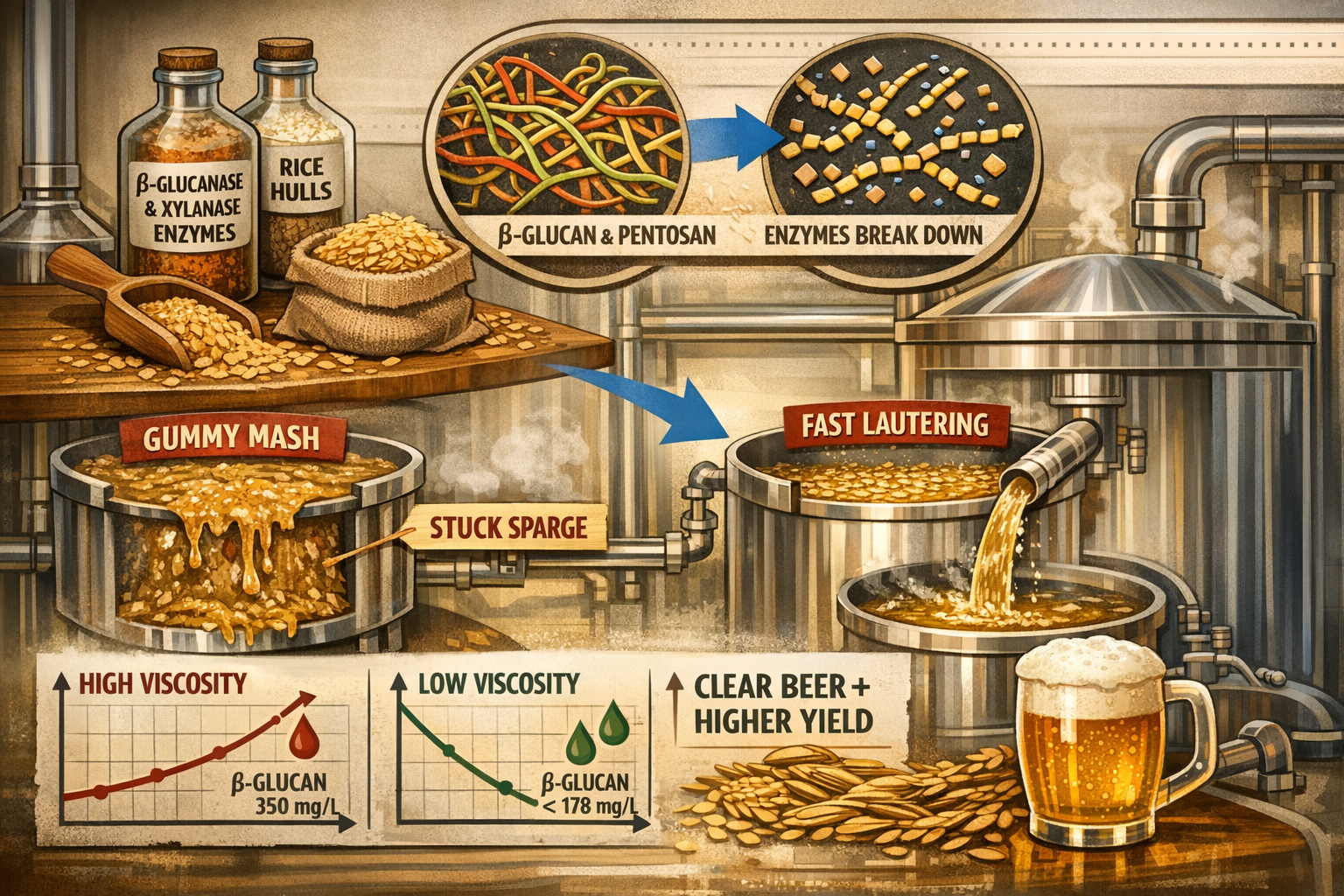
Rice hulls, the indigestible silica shells of rice, physically “open up” the grain bed in adjunct‑heavy or hull‑less mashes (wheat, rice, oat, corn). Mixing in ~5–10% hulls by grain weight recreates a porous filter cake and prevents compaction. Trials show the effect clearly: without hulls, a finely milled wheat mash required ~40 min to runoff 1 L of wort, while adding ~5% hulls cut that time roughly in half; coffee husks were slightly quicker than rice hulls in that experiment, but hulls were nearly as effective (link.springer.com) (link.springer.com).
Industry guidelines referenced in brewing texts routinely recommend ≥5% hulls with unmalted adjuncts, and some brewers add hulls to all‑grist recipes above 20% adjunct (link.springer.com). Because hulls are inert, there is essentially no change to wort composition. Pricing is low: one UK supplier lists £4.8 per kg ($6/kg) (www.themaltmiller.co.uk), and bulk costs are often lower. Even at $5/kg, 5 kg of hulls in a 100 kg grist costs ~$25 — easily outweighed by avoiding a stuck mash and the hours of lost production it can cause.
Measured outcomes and economics
Filtration‑rate gains are material. The Novonesis example above showed 200 ppm Ultraflo Max improving wort run‑off by ~30% and cutting diatomaceous earth consumption by ~40% (www.novonesis.com). Adjunct brewing studies (e.g., 50–80% sorghum adjunct) similarly report that adding amylases plus β‑glucanase/xylanase significantly decreased wort viscosity and increased extract versus untreated controls (www.scirp.org).
Yield moves matter. A 1–2% increase in extract has been observed with added β‑glucanase — for instance, ~79.3% to 80.5% fine‑milling extract (www.scielo.br). On 1000 kg malt, raising extract from 79.3% to 80.5% corresponds roughly to 150 L more beer in a 10% (v/v) wort, worth several hundred dollars at retail — far exceeding enzyme cost. Modern brewing enzymes typically land at a few cents per liter of wort. A rough calculation: treating 1 hm³ (~100,000 L) might use ≤5 kg enzyme (product‑potency dependent) at ~$50/kg — about $250 for 100,000 L (≈$0.0025/L) — while a +1% extract gain yields far more than 1000 L extra beer. Downstream savings also accrue: ~40% less diatomaceous earth means lower raw‑material expense and less hazardous waste (www.novonesis.com).
Regulatory clearance and adoption
Regulators in Indonesia list β‑glucanases (endo‑1,3(4)‑β‑glucanase, EC 3.2.1.6) and xylanases (endo‑1,4‑β‑xylanase, EC 3.2.1.8) as approved processing aids, with source organisms such as Aspergillus and Talaromyces identified (standarpangan.pom.go.id) (standarpangan.pom.go.id). Evidence and ROI strongly favor their use: enzymatic glucanases/xylanases routinely cut wort viscosity and increase extract (e.g., −77% β‑glucan, +1–2% yield) (www.scielo.br) (www.scielo.br), enabling 20–30% faster lauter and filtration in practice, while rice hulls at a few cents per liter nearly eliminate stuck mashes (www.novonesis.com) (link.springer.com) (link.springer.com).
Sources used include peer‑reviewed brewing and food‑engineering studies and industry data: Brazilian Brewery Technology research on β‑glucanase dosing and outcomes (www.scielo.br) (www.scielo.br); a 2024 European Food Research and Technology report on hull additives (link.springer.com) (link.springer.com); enzyme product technical sheets (erbsloeh.com) (www.novonesis.com); and case studies by major suppliers (www.novonesis.com) (www.novonesis.com). Indonesian regulatory lists confirm β‑glucanase and xylanase approvals as processing aids (standarpangan.pom.go.id) (standarpangan.pom.go.id).