
Granular activated carbon (GAC) filters strip chlorine and off‑flavors from brewing water — and, without upkeep, can become biofilm reservoirs. A data‑backed regimen of backwashing, sanitizing, and media replacement keeps taste consistent and microbes out.
Brewers lean on granular activated carbon (GAC) to polish their most important ingredient. GAC removes disinfectants and organic contaminants to stabilize flavor and protect downstream equipment such as reverse osmosis (RO) membranes (water.co.id). It efficiently strips free chlorine/chloramine and adsorbs off‑flavor volatiles (including aldehydes and phenols) (water.co.id) (activatedcarbon.net). In brewhouse practice, that means the carbon media itself — the same class of media found at /products/activated-carbon — does the heavy lifting on taste, while also shielding membrane trains such as those in /products/membrane-systems.
There is a catch. Once chlorine is removed, microbes can colonize the bed. In an EPA study of drinking‑water GAC filters, over 40% of effluent samples contained carbon fines heavily colonized with heterotrophic bacteria, and 17% harbored coliforms (nepis.epa.gov). GAC‑bound bacteria survived 20 mg/L chlorine for 1 hour (nepis.epa.gov), and microbial releases peaked seasonally (spring/fall) when turbidity or flow increased (nepis.epa.gov). The bottom line: without maintenance, GAC beds become biofilm reservoirs, including chlorine‑resistant organisms.
Backwash parameters and triggers
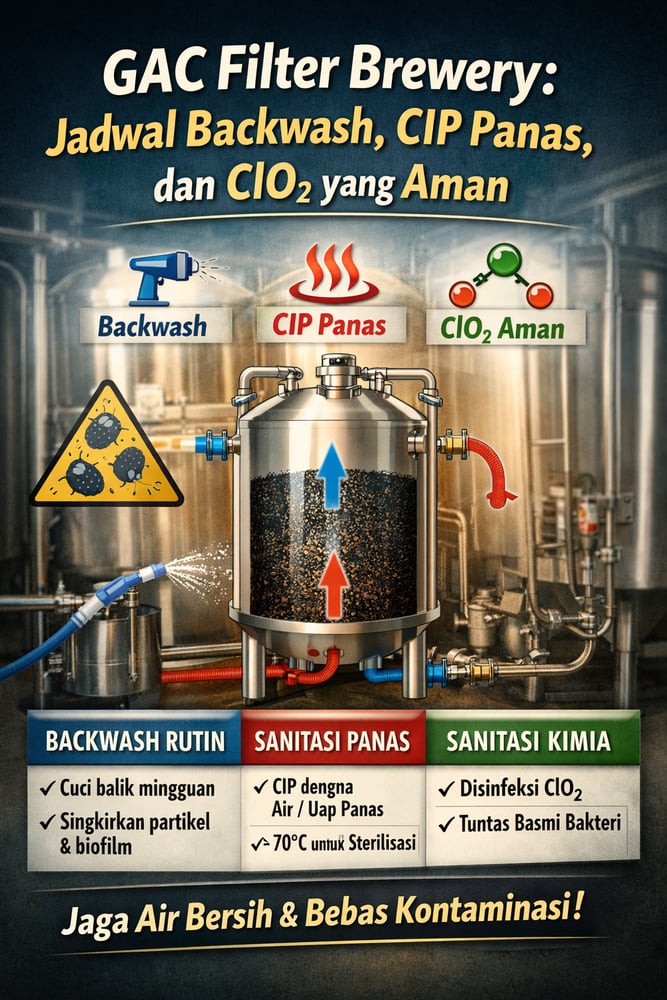
Objective: remove trapped solids and biomass and prevent compaction. Proper backwashing expands the carbon bed by approximately 30–40% by volume. During expansion, granules rub together, dislodging particulates and microbes, and the bed re‑stratifies — denser/larger granules resettle below finer ones — which preserves the mass‑transfer zone (MTZ, the portion of the bed where adsorption is active) and delays breakthrough (carbotecnia.info) (carbotecnia.info).
In practice, reverse the flow through the vessel (typically up‑flow) using service water. If equipment allows, a brief air‑and‑water scour can enhance fines removal. Calibrate the backwash rate so the bed expands fully without carbon loss (screened outlet). One guideline is to ramp flow gradually until ~30–40% expansion is achieved; verify by observing the backwash effluent run clear (carbotecnia.info) or, on top‑registored units, by visual inspection of the fluidized bed (carbotecnia.info).
Frequency is either condition‑based or scheduled. In pressurized down‑flow filters, a typical trigger is ~0.5–0.7 kg/cm² (≈7–10 psi) differential pressure; in gravity (open‑tank) units, a rise of ~1–1.5 m in weir height signals the same headloss (carbotecnia.info). Where clogging is slow, use a fixed interval — at minimum weekly — to prevent “cementation” by biomass or scale (carbotecnia.info). Each cycle starts with expansion and ends with a rinse to allow carbon to settle and re‑stratify; continue until discharge runs clear. Proper backwashing has been shown to remove nearly all accumulated biomass and fines (carbotecnia.info) (carbotecnia.info).
Thermal and chemical sanitization cycles
Mechanical backwashing does not kill attached bacteria; periodic sanitization is needed. Two approaches are used. Thermal methods: breweries specify “steam‑sanitizable” stainless steel vessels that allow steam or hot water clean‑in‑place (CIP). Industrial GAC filters exist that routinely steam at 70–90 °C to inactivate biofilms (pureaqua.com) (pureaqua.com). After a backwash and drain, the vessel is charged with hot water (or steam) for a 30–60 minute soak; outcome claims include >5‑log reductions of bacteria on carbon surfaces (industry claims). Caution: ensure the carbon and seals are rated for temperature and pressure (stainless filters designed for industrial service are pertinent to this discussion).
Chemical methods: general oxidants (free chlorine, ozone, hydrogen peroxide) are ineffective deep in GAC because carbon destroys them before full penetration. Chlorine dioxide (ClO₂) is preferred; the recommended procedure is to fully backwash and drain, flood the bed with ~30 mg/L ClO₂ solution (enough to fill void volume and overflow), hold for ≥1 hour, then backwash/rinse to purge the sanitant (carbotecnia.info) (carbotecnia.info). Testing of the GAC effluent — heterotrophic plate count (HPC) and coliform — should guide frequency; at minimum, include the GAC outlet in monthly potability lab protocols, and any exceedance triggers a sanitation cycle (carbotecnia.info). In practice, breweries perform chlorine dioxide or hot‑water sanitization quarterly or semi‑annually, or immediately if testing shows >0 CFU. Carbotecnia notes that non‑silver‑impregnated GAC in industrial use must be disinfected when output fails bacterial standards (carbotecnia.info).
Media life, change‑out, and cost
Adsorption sites exhaust over time. Chlorine breakthrough is not a reliable indicator of organic capacity; carbon can still remove residual chlorine long after organic removal has faded (carbotecnia.info). In one example, a 5‑minute empty‑bed contact time (EBCT) bed running 6 days per week removed dissolved organics (chemical oxygen demand, COD, ~20 mg/L) effectively for ~12 months, whereas residual chlorine was retained for 2–3 years (carbotecnia.info).
In practice, brewers generally replace GAC annually. An industry calculation showed that yearly carbon replacement (at ~35 MXN/kg) adds only ~0.0006 MXN (≈0.6 cent Rupiah) per cubic meter of treated water — a negligible cost of quality (carbotecnia.info). Some large beverage suppliers explicitly cycle carbon beds annually as routine maintenance (carbotecnia.info). Replacement timing can also be adjusted by monitoring usage or water quality (for example, if feed‑water organics spike or treated‑water total organic carbon, TOC, or UV absorbance trends upward). Smaller brewers sometimes extend carbon life by reactivating — e.g., drying at 100 °C — and reusing 4–5 times (cheekypeakbrewery.com.au) (cheekypeakbrewery.com.au), though this is labor‑intensive and less common in continuous plants. Overall, plan media renewal every 1–2 years, sooner if off‑flavors or breakthrough are detected (carbotecnia.info) (carbotecnia.info). Practicalities of parts and media procurement sit within /products/water-treatment-part-and-consumables.
Quality outcomes and operational risk
Applied systematically, the regimen keeps effluent plate counts negligible and prevents biofilms from reaching beer tanks or downstream RO systems, avoiding fouling and spoilage. After a proper chlorine dioxide sterilization, microbial assays typically drop from thousands of CFU/mL (colony‑forming units per milliliter) to zero in the filtrate. Neglect can do the opposite: coliforms have been intermittently isolated from GAC effluent in some facilities (nepis.epa.gov) (nepis.epa.gov). Keeping water clear and chlorine‑free also protects beer sensory quality (chlorine residuals cause phenolic off‑notes; organic surges drive staleness).
There is a business upside, too: routine backwashing reduces headloss buildup (which otherwise drives pump energy up or interrupts flow), and scheduled change‑outs avoid last‑minute capacity failures. Given the low annualized carbon cost (see cost example, carbotecnia.info), the program is cost‑effective and supports food‑safety compliance and brand protection.
Sources and technical anchors
Authoritative studies and industry sources underpin this guide: EPA research on GAC bacteriology (nepis.epa.gov) (nepis.epa.gov); technical guidelines on backwashing and sanitization (carbotecnia.info) (carbotecnia.info); and industry publications on GAC replacement (carbotecnia.info) (carbotecnia.info). Indonesian F&B water‑treatment references were also considered (water.co.id).
