

Brewers are tightening clean‑in‑place cycles and swapping heat for peracetic acid when necessary — then proving sterility with integrity tests that catch a single torn pore. The payoff: ATP‑clean results and four‑figure savings, according to recent data.
Industry: Brewery | Process: Filtration_&_Carbonation
Beer filtration rigs — trap filters, polishing filters, sterile membrane filters — live or die by their cleaning and sanitizing routine. The standard sequence is brutally simple and rigorously documented: a pre‑rinse, alkaline (caustic) wash, rinse, optional acidic passivation, a sanitizing step, and a final rinse, per CSI Designs.
The details matter: 1–4% NaOH (sodium hydroxide) is circulated at moderate temperature to dissolve yeast, protein and hop soils, driven hard enough to shear biofilms. Industry guidance calls for turbulent flow at ≥1.5 m/s (≈1.8 m/s suggested) in pipes for effective scouring, according to Christeyns. Where filtration lines use sanitary cartridges, many breweries pair this with robust stainless housings; see stainless cartridge housings used in food‑grade service such as stainless cartridge housings.
Validated CIP sequence and flow parameters
After caustic, a single 100‑L freshwater rinse can suffice even for a ≤1200 L tank — a finding that challenges multiple‑pass rinse habits — per Laing et al. (2021) on ResearchGate. Acidic cleaners (0.5–2% nitric/phosphoric) can follow if beerstone or scale is present (CSI Designs; Asian Beer Network), as well as aluminum oxide where relevant.
To keep concentrations consistent across loops and vessels, brewers often rely on controlled chemical dosing; dosing accuracy underpins repeatable cleaning performance with equipment such as dosing pumps.
Thermal sterilization: hot water and steam limits
Where systems are heat‑rated (stainless tanks and piping), hot water or steam can provide sterilization. One equipment source recommends ~0.5 bar steam (≈121 °C) for 15–20 min for fermenters (Tiantai Brewery Equipment). Uncontrolled steam, however, can damage rubber gaskets and welds if vacuum or thermal stress occur (same source). Steam‑in‑place (SIP) is therefore done with controlled pressure (≈0.5 bar) and duration (same source).
Many breweries instead run hot caustic (50–85 °C) CIP and skip high‑pressure steam (Alliance Chemical). Notably, Laing et al. found that raising caustic CIP to 40–60 °C gave no cleanliness benefit over ambient water (10–20 °C) for a 35‑min cycle (ResearchGate), signaling energy savings at moderate temperatures. For heat‑sensitive lines and housings, composite options such as composite cartridge housings drive a shift toward chemical, not thermal, sanitization.
Chemical sanitization with peracetic acid (PAA)
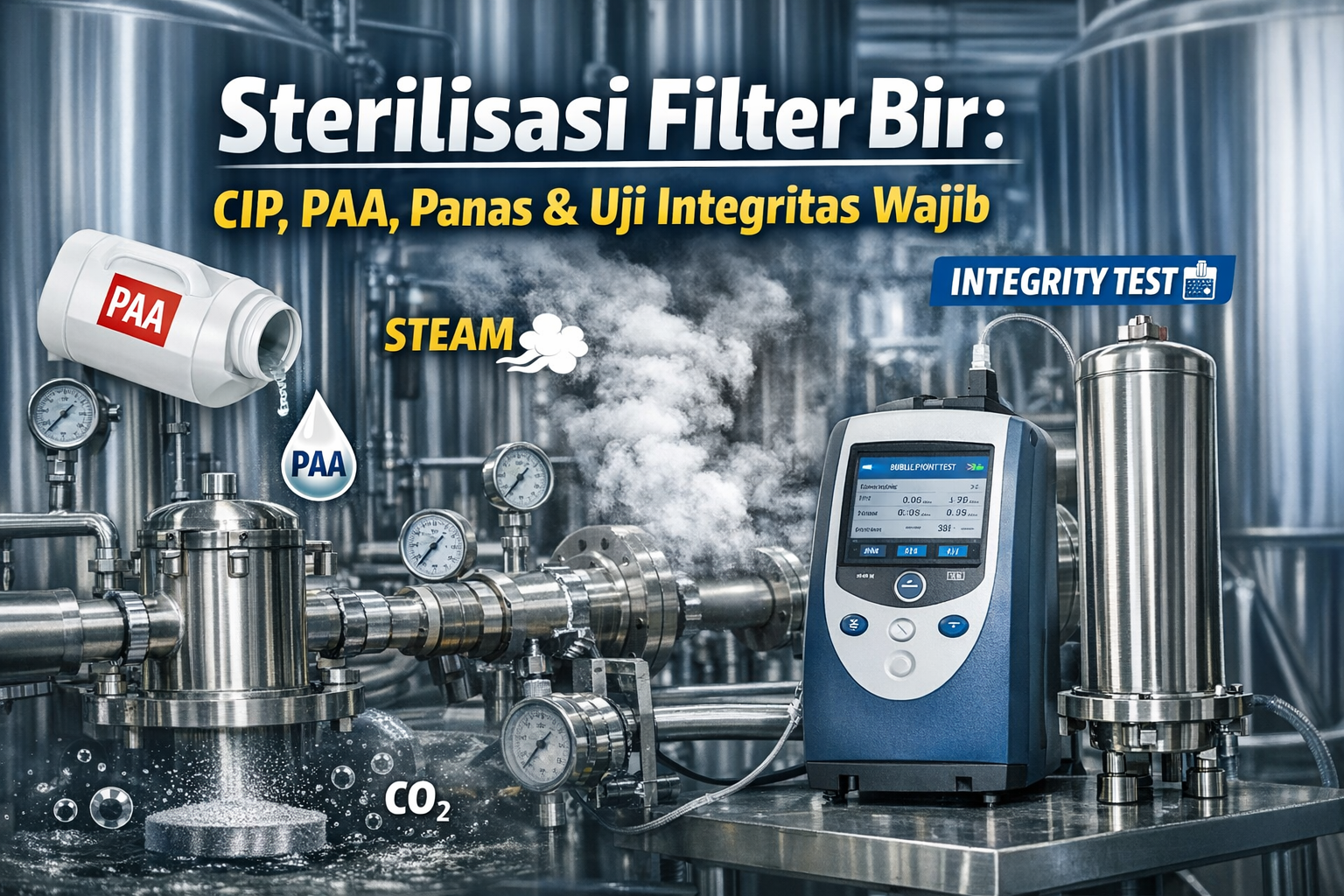
When heat cannot be used (plastic parts, delicate membranes), chemical sanitization is essential. Peracetic acid (PAA) is the industry standard “no‑rinse” sanitizer in breweries (Asian Beer Network; Alliance Chemical). It’s a broad‑spectrum oxidizer effective from 0–40 °C and across pH 1–7.5, and it breaks down to water, oxygen, and acetic acid (source; source).
Typical usage is 0.01–0.1% (100–1000 ppm) PAA with ≥10–15 min contact time. Laing et al. demonstrated ~0.05% PAA (1% of a 5% stock) for ≥10 min as an effective final sanitization step (ResearchGate). Another source recommends ~120–150 ppm for 1–10 min (ProBrewer; Alliance Chemical). Because PAA degrades, solutions are refreshed — often daily — to maintain concentration (ProBrewer).
After PAA, equipment must be fully drained (or rinsed with sterile water or CO₂) to avoid oxidizing the next beer; verifying no strong PAA odor remains is cited as good practice (Asian Beer Network). PAA is certified for use even in organic brewing, with no harmful residue (Asian Beer Network). To standardize sanitizer make‑up and contact times, utilities teams often rely on programmable dosing and supporting gear — the domain of supporting water‑treatment ancillaries.
Carbonation system hygiene
CO₂ supply lines, carbonation stones, and carbonators need regular sanitation. Gas lines don’t carry beer, but residual moisture or biofilms can harbor bacteria/yeast. Carbonation tanks can be cleaned with the same CIP loop as fermentation vessels; a 600 L carbonation tank was cleaned with caustic CIP and a 100 L rinse in one study (ResearchGate).
Carbonation stones or humidifiers (often stainless) are sanitized in place or soaked. If heat‑sterilizable, stones can be immersed in boiling water or autoclaved. Otherwise, they are typically soaked in PAA/H₂O₂ solution — many craft brewers use ~200–500 ppm PAA for 10–30 min — and then flushed. All lines carrying processed beer are flushed with hot water and acid, followed by PAA or another approved sanitizer. Conveyor and filler systems are often CO₂‑purged; allowing food‑grade CO₂ to flow through cleaned lines briefly can inhibit microbial ingress and dry out lines, acting as an adjunct to sanitation. Note: CIP flow for CO₂ gas lines can’t use liquid; such lines are often cleaned via manual protocols or sterilized gas flush. Where sterile gas filtration is installed, rugged housings (e.g., for pressurized service) are common, such as steel filter housings.
Filter integrity testing: bubble‑point and pressure‑hold
Membrane and cartridge filters — especially sterile filters on finished beer or process gases — must be routinely integrity‑tested after cleaning to ensure no undetected damage (Alfa Chemistry; Kumar Filter). In a bubble‑point test, the wet filter is pressurized with gas until the first continuous stream of bubbles appears in an effluent liquid; this pressure correlates to the largest pore size (Kumar Filter; same source).
In pressure‑hold or forward‑flow tests, upstream pressure is set and air diffusion rate monitored — a leak or higher‑than‑expected flow indicates compromise (Alfa Chemistry; same source). Water‑intrusion tests (wetting with alcohol) can be used for hydrophobic membranes (Alfa Chemistry). In practice, technicians often do a bubble‑point on new filter cartridges and a pressure‑decay/forward‑flow check after CIP or after each batch to verify integrity. For breweries standardizing consumables, the filter elements referenced here include common cartridge filters.
Regular testing is critical: sterile filtration only prevents spoilage if filters are intact. Pentair reports “regular and frequent integrity testing of the microfilter systems” is an essential quality‑control step (Pentair). If an integrity test fails, the filter must be inspected or replaced before further use. Modern portable testers (e.g., aerosol‑based challenge systems) can yield rapid pass/fail results without special skills (Pentair). For carbonated beverage gases (CO₂, compressed air), similar sterile filters should be tested, since contaminated gas can also spoil beer. When specifying housings for these sterile elements, breweries typically turn to sanitary designs; see examples like stainless cartridge housings.
Documentation, validation, and regulatory context
Breweries are advised to implement validated CIP cycles for filtration systems, with documented temperature, flow, chemical concentration, and time (CSI Designs; Alliance Chemical). Proper CIP minimizes microbial biofilms and spoilage risk; beer spoilage organisms can grow in a nutrient‑rich wort environment (Brewer World).
Laing et al. reported that optimizing CIP — 2% caustic for 35 min, a 100 L rinse, then ~0.05% PAA for 10 min — achieved ATP‑clean results (<30 RLU) and could save >£1000/year in water, chemical, and heating costs for a microbrewery (ResearchGate; ResearchGate). Protocols should specify flow rates (≥1.5 m/s in pipes, per Christeyns), temperatures, concentrations, and contact times proven to achieve >5–log microbial reduction. After sanitizing cycles, every sterilizing filter must be integrity‑tested (e.g., bubble‑point or pressure‑decay) to verify no breach (Alfa Chemistry; Kumar Filter).
Regulatory trends underscore the direction of travel: Indonesia is moving toward mandatory national standards (SNI) for alcoholic beverages (BSN). For breweries formalizing the hygiene chain end‑to‑end, standardized filter elements and housings help — a role served by equipment categories like cartridge filters.
Sources and metadata
- Laing et al., “Investigating Cleaning in Place (CIP) … UK Microbreweries,” Journal of Brewing and Distilling 10(1):17–28 (May 2021) (www.researchgate.net) (www.researchgate.net). (Peer‑reviewed; data on CIP protocols, ATP cleanliness, PAA sanitization, cost‑savings in microbreweries.)
- CSI Designs, “Clean‑in‑place: How CIP is Used in Breweries” (Aug 29, 2019) (www.csidesigns.com). (Industry article; outlines brewery CIP steps and design considerations.)
- Alliance Chemical, “Brewing Perfection: How CIP … Brewers & Distilleries” (Blog, Feb 13, 2025) (alliancechemical.com). (Chemical supplier blog; summarizes CIP vs SIP sanitization and dwell times.)
- Asian Beer Network, “Brewery Chemical Cleaning Quick Guide” (Blog) (www.asianbeernetwork.com) (www.asianbeernetwork.com). (Secondary industry source; info on PAA efficacy and breakdown in brewing.)
- Tiantai Brewery Equipment, “Can I sterilize my fermentation tank with steam?” (Blog, July 6, 2022) (www.microbrewerysystem.com) (www.microbrewerysystem.com). (Brewing equipment manufacturer Q&A; cautions on steam use and provides steam‑SIP recommendations.)
- Christeyns “Cleaning and Disinfection in the Beverage Industry: CIPs and Peroxide/Peracetic” (2021) (www.christeyns.com). (Industry whitepaper; CIP flow velocity requirements (≥1.5 m/s) to achieve turbulent cleaning.)
- Pentair (Haffmans) Case Study “Bitburger Brewery, Germany – Sterile Filter Integrity Testing” (online) (foodandbeverage.pentair.com) (foodandbeverage.pentair.com). (Equipment vendor; stresses 100% contamination‑free filtration and need for frequent integrity testing in brewing.)
- Alfa Chemistry “Integrity Testing for Food and Beverage Filters” (Webpage) (filtration.alfa-chemistry.com) (filtration.alfa-chemistry.com). (Filter supplier; explains non‑destructive integrity tests – forward‑flow, pressure‑decay – for sterile/microfiltration.)
- Kumar Filter blog, “Bubble Point Filter Integrity Test” (Webpage) (kumarfilter.com) (kumarfilter.com). (Filtration company; defines bubble‑point test as standard for sterile filters in pharma/food/bev.)
- BSN (Indonesia Standardization Agency), “Susu dan Minuman Beralkohol Bakal Wajib SNI” (Mar 31, 2016) (bsn.go.id). (News; notes movement toward mandatory SNI (national standards) for alcoholic beverages, implying quality compliance requirements.)