

Industry: Semiconductor | Process: Photolithography
A speck you can’t see can sink a $20,000 wafer. In 10 nm‑class devices, even a 1 nm particle can be fatal, which is why leading fabs stack up hundreds of cleaning steps — often more than 200 per wafer — between critical processes (siliconsemiconductor.net). The economics reflect the stakes: the wafer‑cleaning equipment market was about $10.1 billion in 2023 and is projected to hit $16.5 billion by 2028 (CAGR ~10.4%) (marketsandmarkets.com), while photomask‑cleaning tools totaled roughly $2.13 billion in 2024 and are expected to reach ~$3.5 billion by 2035 (CAGR ~4.6%) (wiseguyreports.com).
The risk is not just financial. Wet‑process wastes are tightly regulated. In Indonesia (and globally), semiconductor wet process wastes are classified as hazardous (“B3”) if they contain dangerous reagents; Government Regulation No. 22/2021 mandates that “every person that produces B3 waste must carry out the management of B3 waste,” which in practice means neutralizing acids/bases, capturing particulates, and treating effluents under permits (scribd.com). That pressure is changing how fabs think about both chemistry and the mechanics of clean.
Baseline wet chemistries (RCA and Piranha)
The backbone is still the RCA sequence — standardized wet cleans that remove organics, particles, and metals. SC‑1 (Standard Clean 1) is a mix of NH₄OH:H₂O₂:H₂O in ~1:1:5 by volume at ~70–80 °C; the ammonia lightly etches SiO₂ under particles while hydrogen peroxide oxidizes organics, lifting residues (alliancechemical.com). SC‑2 (HCl:H₂O₂) in ~1:1:6 at ~70–80 °C targets ionic and metallic contaminants (alliancechemical.com). With megasonic assist (high‑frequency acoustic agitation; see below), SC‑1 has demonstrated ~99% removal of 60–70 nm polystyrene‑latex tracer particles in under 10 minutes (researchgate.net).
For stubborn organics, Piranha etch (concentrated H₂SO₄:H₂O₂, ~3:1 to 7:1 by volume) self‑heats to ~100–150 °C and rapidly oxidizes resist and polymer, regrowing a fresh oxide; its oxidizing byproducts are essentially water and O₂ (alliancechemical.com) (alliancechemical.com). But Piranha and HF dips are aggressive — capable of removing microns of oxide or attacking metal layers — so fabs carefully limit their use, tuning ratios, temperature, timing, and tool format (single‑wafer vs. batch) to balance removal vs. damage.
Megasonic agitation and feature safety
To pry off the smallest particles without scouring delicate features, fabs layer in megasonic cleaning — piezoelectric transducers drive 0.8–2 MHz acoustic fields in the bath, creating tiny cavitation bubbles. The collapse of these bubbles produces micro‑jets that dislodge particles a rinse can’t (modutek.com). Crucially, higher frequency yields smaller, gentler bubbles; operating above ~950 kHz is common to avoid damaging fine patterns (modutek.com). Modern single‑wafer systems often spin the wafer during sonication for uniform energy delivery (siliconsemiconductor.net).
The payoff is documented. Bakhtari et al. showed ~99% removal of 63 nm PSL particles from Si wafers (with or without a 4 nm cap) in under 10 minutes of megasonic cleaning (researchgate.net). Busnaina et al. (1995) found SC‑1 chemistry further enhances megasonics — NH₄OH slightly etches under particles and high pH electrostatically repels them (researchgate.net). Vendors now tune transducers — for example, Space‑Altered Phase Shift (SAPS™) and Timely Energized Bubble Oscillation (TEBO™) — to maximize uniformity and minimize cavitation damage (siliconsemiconductor.net) (modutek.com). ACM Research’s TEBO method prevents bubble collapse — which can pit exposed silicon — enabling “successful defect removal without damage to sensitive patterns” such as high‑aspect‑ratio fins and 3D NAND trenches (siliconsemiconductor.net).
In practice, combining SC cleans and megasonics drives particle counts toward zero; vendor data implies wafer‑rejection rates drop to parts‑per‑billion particle levels while reducing wet‑chemical usage (modutek.com) (researchgate.net). At 300 mm and beyond, fabs report that moving from manual batch cleans to single‑wafer megasonics can cut defect densities by orders of magnitude and boost throughput via faster drain/rinse cycles (modutek.com) (alliancechemical.com). MarketsandMarkets ties this performance need to the >10% CAGR outlook for cleaning equipment (marketsandmarkets.com).
Ozone, dry cleans, and niche tools
“Green” and dry methods are rising alongside RCA and megasonics. Ozone‑based cleans dissolve ozone in DI water (sometimes alongside a mild acid rinse) to oxidize organics without strong acids; one advanced ozone process removed carbon residues, cut particle counts, and “reduced the use of expensive and toxic chemicals,” improving yield and throughput (modutek.com). At 4–10 °C, ozone + DI “Coldstrip” oxidizes organics to CO₂, leaving wafers nearly particle‑free; these tools are faster and require less footprint than conventional wet benches (modutek.com).
Dry or waterless options include supercritical CO₂ cleaning (often with polar additives), UV/ozone or remote oxygen plasmas for ashing organics on unpatterned surfaces, and electrostatic “air knife” and CO₂ “snow” sprays for particle removal. Each is niche, but they give process engineers additional dials to turn during full cleanroom designs.
Across methods, feature preservation is the hard constraint. High‑frequency megasonics, cold ozone, and short HF dips are all selected to avoid etching or erosion. Post‑clean inspections confirm critical dimension changes at only fractions of an angstrom — within spec — and SPIE mask research has shown tailored alkali‑rich mixes can achieve nearly “film loss free” results on EUV masks (absorber CD shift ≈0.02 nm, reflectivity change <0.005%) (researchgate.net) (researchgate.net). Fabs sweep clean tools with test vehicles; any chemistry or acoustic setting that measurably shifts line width or oxide thickness is discarded. Techniques like TEBO explicitly minimize shear on features (siliconsemiconductor.net), and chemistries are tailored — using ultra‑clean reagents and anti‑free‑radicals — to avoid micro‑masking or corrosion.
Photomask cleaning constraints (EUV included)
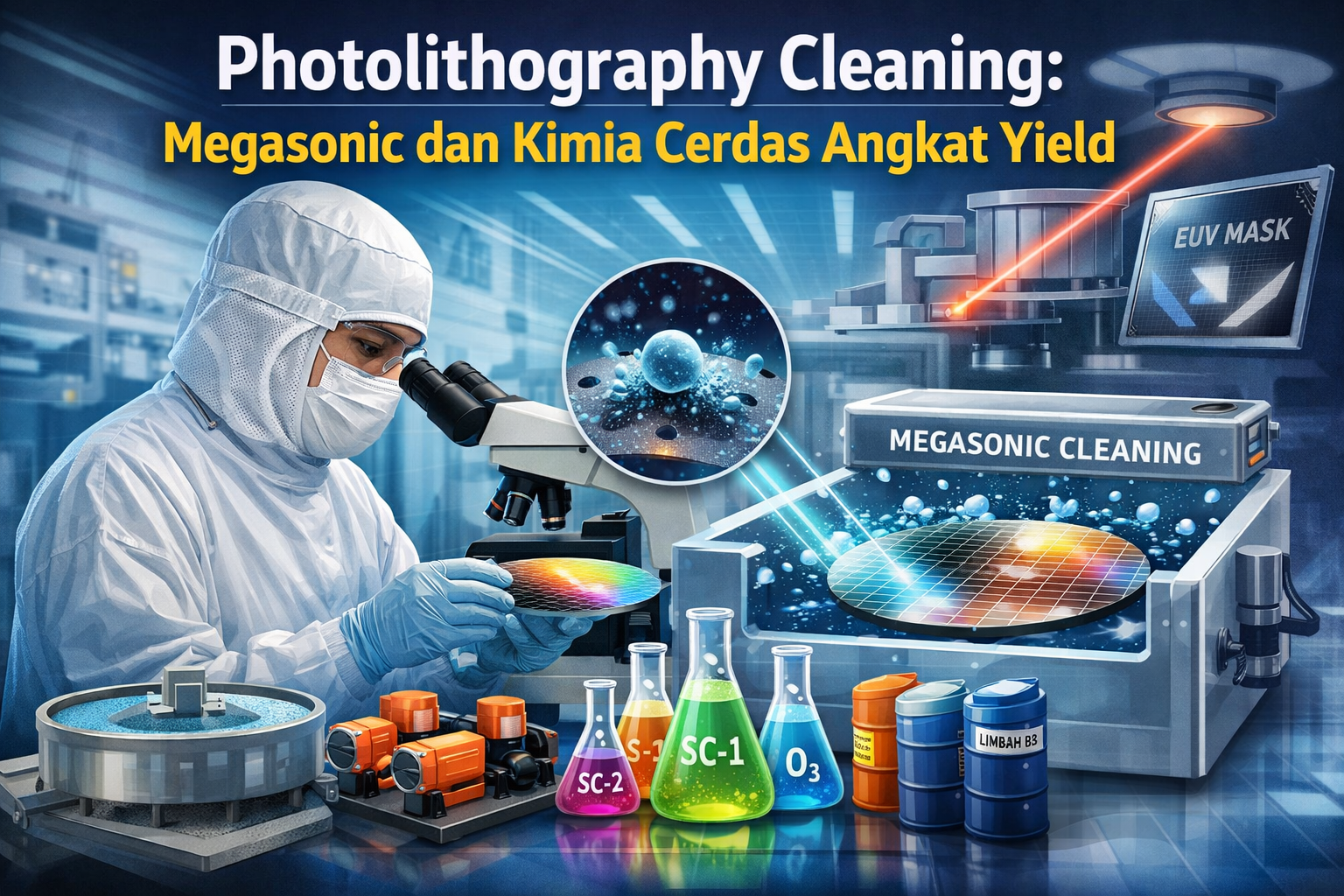
Photomasks, especially EUV reticles with Mo/Si reflector stacks, cannot tolerate nanometers of dimensional drift. Cleans must pull off resist residue, dust, pellicle glue, and airborne molecular contaminants without etching. Solvent stripping (e.g., SPM — sulfuric peroxide mix) or proprietary strippers are used to remove resist, sometimes alongside low‑power ultrasonics or megasonics; SPM is used cautiously on bare quartz and limited or replaced for multi‑layer masks.
Alkaline cleans (often diluted NH₄OH‑based mixes, sometimes with surfactants) target organics for e‑beam mask smears; ultra‑pure SEMI‑grade H₂O₂ and NH₄OH are used to ensure no ionic residues remain (alliancechemical.com) (alliancechemical.com). For quartz/ARC layers, SC‑1 is often safe; for metallic absorber layers, SC‑2 or metal‑complexing additives are favored.
Low‑acid/oxidant pathways matter for EUV. Conventional acid cleans can cause “severe film loss of Ta‑based absorber layers,” whereas new alkaline/additive formulas screened via combinatorial chemistry delivered high carbon‑contaminant removal with almost zero film damage (researchgate.net). Electrolyzed‑water methods (pure H₂O/O₂ mixtures) have been adopted as standard in some fabs for EUV reticles; one Korean memory fab suite reports using only electrolyzed anode/cathode water — offering cleaning power comparable to chemistries but with purely water‑based reagents (lux.spie.org).
As with wafers, single‑wafer megasonic tools and ultra‑purified IPA spray can rinse particles off masks, with frequencies and pressures tuned lower to avoid damage. Standards are unforgiving: any mask with more than one killer‑sized defect per reticle is often rejected, and modern shops routinely hit <0.1 defects/cm² post‑clean, backed by high‑resolution inspection.
Regulatory handling and plant integration
Compliance shapes the clean. In Indonesia, Government Regulation No. 22/2021 requires B3 waste producers to manage that waste — meaning neutralize acids/bases, capture particulates, and treat effluents under stringent permits (scribd.com). Facilities address this with engineered systems and supporting equipment for water treatment integrated into the wet benches and drain‑to‑treatment loops.
Controls, dosing, and metrics
Implementing these cleans requires coordination of chemistry, fluid dynamics, and controls. Equipment must precisely dose and mix chemicals (to SEMI‑grade purity), maintain bath temperature, scrub patterns (brushes or sprays for wafers, laminar spray for masks), and apply megasonic power under tight control. Real‑time monitoring (turbidity meters, particle counters) guides on‑the‑fly tweaks; controllers may modulate ultrasound power or add surfactants if removal slows. That precision extends to hardware choices, including accurate chemical dosing components to hold ratios like SC‑1’s ~1:1:5 and SC‑2’s ~1:1:6 at temperature.
Selection is data‑driven. Key metrics include post‑clean particle counts (ideally <1 particle ≥ 20 nm per wafer), allowable surface roughness change (angstrom‑scale), and mask reflectivity loss (percent delta on multilayers). Vendors benchmark results with claims such as “100× reduction in particles ≥50 nm vs. standard clean” or “≤0.01 nm SiO₂ etch per cycle,” helping fabs justify capex. Empirically, moving from manual wet benches to automated megasonic SC‑1/SC‑2 flows has yielded ~90% defect reductions and uptime gains (per equipment vendors), and a 50% particulate‑defect cut can double effective wafer yield at advanced nodes.
Net‑net, modern photolithography cleaning blends traditional chemistries (NH₄OH/H₂O₂, HCl/H₂O₂, H₂SO₄/H₂O₂) with advanced methods (megasonic cavitation, ozone‑injected DI baths, electrolyzed water) to achieve near‑zero contamination — a prerequisite as devices shrink below 10 nm (siliconsemiconductor.net). That imperative underpins the >10% CAGR for wafer‑cleaning equipment (marketsandmarkets.com) and ongoing photomask‑clean investment (wiseguyreports.com).