
Automotive plants battling high‑COD, oily wastewater are turning to advanced oxidation processes that generate hydroxyl radicals to crack recalcitrant organics — often at a fraction of haul‑away or incineration costs. Recent trials report 40–60% COD cuts per pass and sharp gains in biodegradability, with water reuse on the table.
From metal forming and plating to painting and degreasing, automotive production creates high‑COD (chemical oxygen demand) oily wastewater loaded with hydrocarbons, surfactants, and toxic metals that shrug off conventional biological treatment. These “recalcitrant” organics — think petroleum‑based oils, paint resins, and glycol solvents — can poison microbes and persist in effluent.
Enter advanced oxidation processes (AOPs): Fenton’s reagent (Fe²⁺/H₂O₂) and ozone/peroxide systems generate hydroxyl radicals (•OH), a “powerful, non‑selective” oxidant with an oxidation potential of ≈2.8 V that “reacts very rapidly with most organic compounds,” oxidizing them toward CO₂ and H₂O (IntechOpen; IntechOpen). In practice, these radicals cleave C–C and aromatic bonds in oils and surfactants, fragmenting them into smaller acids and ultimately inorganic end‑products, which can transform biologically inert sludges into biodegradable intermediates (raising BOD/COD ratios; BOD is biochemical oxygen demand measured over five days) and, in some cases, achieve near‑total mineralization (IntechOpen; IWA Publishing).
Radical chemistry and recalcitrant organics
Biological resistance stems from molecular stability in compounds like polyaromatics or chlorinated phenols. AOPs overcome this through radical chemistry: Fenton’s reagent instantaneously produces •OH that indiscriminately oxidizes aromatic rings and alkanes, while ozone in water — especially with added H₂O₂ (“peroxone”) — forms chain‑peroxide species and •OH that attack recalcitrant moieties (IntechOpen).
Reviews emphasize AOPs were developed to oxidize non‑biodegradable organics, including persistent industrial solvents, to harmless CO₂/H₂O — achieving near‑complete mineralization when dosing, contact time, and catalysts are optimized (IntechOpen; IntechOpen). Fenton has been shown to destabilize oil emulsions and degrade petroleum ethers in water, and ozone readily consumes double bonds and phenolic groups in solvents (US EPA).
Performance on high‑COD automotive streams
Empirical results match the chemistry. A 2025 Fenton pretreatment trial on automotive paint/filter wastewater (high COD with heavy metals) reported ~50% COD removal under optimal conditions — 0.58 g/L Fe²⁺, H₂O₂:COD 0.58 mol/mol, 30 minutes — and a dramatic biodegradability lift: sludge inhibition fell from 44% to 9% after treatment (Springer; Springer).
Pilot‑scale ozonation of oily “tank‑truck cleaning” waste, a solvent/oil concentrate, achieved up to 56% COD removal and boosted the BOD₅/COD ratio to >0.54; the study concluded “ozonation was feasible to remove recalcitrant COD,” and the ozonated effluent became amenable to subsequent biological treatment, enabling water reuse (IWA Publishing).
Bench‑scale reports find Fenton on diverse industrial effluents often achieves roughly 40–90% COD reduction, dose‑dependent, with one study reaching 96% COD removal from a tobacco wastewater in jar tests (US EPA). In automotive effluents that typically start in the thousands of mg/L COD, cutting even half can approach regulatory discharge levels (often <100–300 mg/L COD). AOP pretreatment can convert a biologically “dead” effluent into one with significant biodegradable fractions (IWA Publishing; Springer), whereas incineration or off‑site disposal would simply eliminate organics outright but at much higher cost.
Cost–benefit: AOP vs incineration and disposal
AOPs need on‑site equipment (oxidant generators, reactors, mixers) and continuous chemical/energy input. Large‑scale ozonation capex lands “in the millions,” with annual O&M often in the “hundreds of millions” of dollars, though per‑unit costs drop as flow increases (ITRC). One survey reports ozone‑based treatment costs roughly $0.10–0.50 per m³ of water treated (ITRC).
For peroxide systems, heavily polluted water typically demands ~0.5–1.0 kg H₂O₂ per m³, implying chemical costs on the order of $0.30–1.00/m³. At a mid‑size 100 m³/day plant, OPEX thus sits on the order of a few thousand dollars per month, excluding electricity and maintenance.
Off‑site disposal charges pile up quickly. In Indonesia, hazardous organic wastes are classified as B3 (very hazardous) and handled by specialized contractors; a cost survey in East Java found stabilized hazardous waste landfill fees of about USD 380/ton, direct landfill $175/ton, and fuel‑blending $425/m³, with weighted averages ~$330/ton overall (ResearchGate). Using the conversion 1 ton ≈ 1 m³ for dense sludge, that’s ~$0.33/kg or ~$0.33/L of waste — orders of magnitude higher than AOP’s per‑liter treatment costs. Disposing 10 m³ of oily concentrate (~10 tons) could cost ~$3,300.
On‑site incineration avoids trucking but is capital‑ and energy‑intensive. A state‑of‑the‑art incinerator (e.g., Indonesia’s PT PPLI facility) is a multi‑million‑dollar complex that “destroys waste and the pollutants it contains” — from oil/paint sludges to solvents — via high‑temperature combustion, with significant fuel demand and flue‑gas scrubbing, CO₂ emissions, and potential air toxins in play (PPLI).
Net benefits, drawbacks, and hybrid strategies
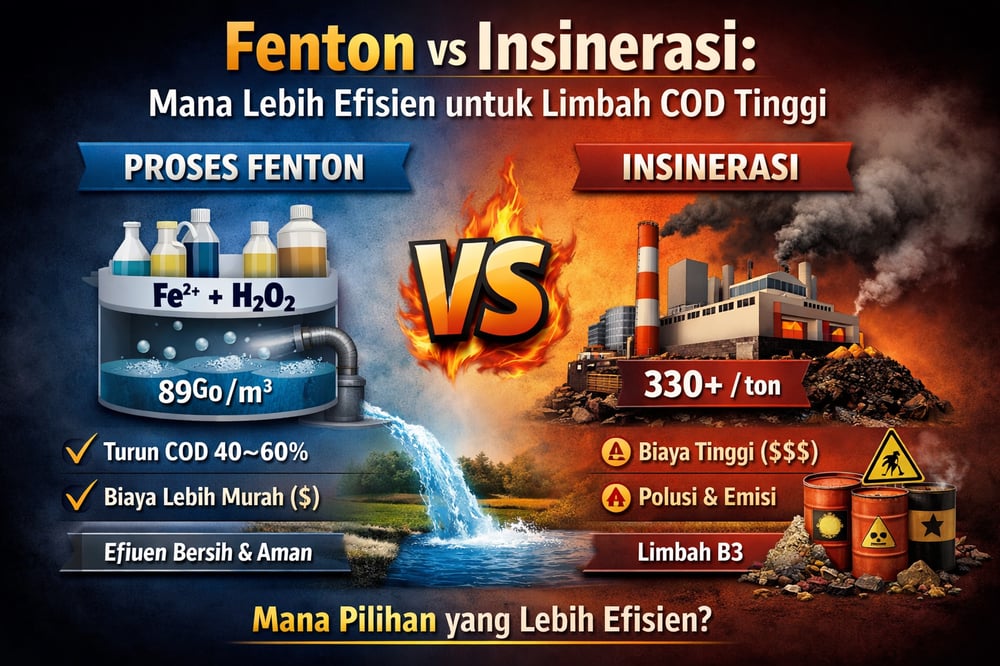
AOP pivots wastewater from a disposal liability to a treatment pathway: treated water can often be discharged or reused on‑site, saving fresh water and disposal fees. In the tank‑truck example, the authors noted their ozonation + biological process “provides a useful solution for ROC streams…making water reuse possible” (IWA Publishing). One analysis of Fenton pretreatment also reported a 6.6–16.6% cut in life‑cycle CO₂ emissions versus conventional coag‑floc pretreatment (Springer).
There are trade‑offs. Fenton produces iron sludge and leaves residual oxidant; systems require careful pH control and oxidant safety. Incineration yields residual ash/char requiring disposal, with potential emission of dioxins or NOₓ if not perfectly managed. Disposal or incineration shifts environmental risk to another site; AOP contains it on‑site.
In cost terms, AOP pretreatment typically runs $0.1–1.0 per m³ of wastewater (ITRC) versus hundreds of dollars per ton for off‑site handling (ResearchGate). For highly concentrated oily wastes, volumetric AOP treatment — possibly combined with volume concentration — usually comes out cheaper than hauling, while reducing regulatory liability by destroying hazardous organics in situ. Incineration is effective but only practical at large scale given its massive capital/energy cost.
A hybrid approach often makes sense: use AOP to partially oxidize and detoxify the waste, then send any inertified residue for disposal or modest incineration to minimize the truly “hazardous” volume.
Equipment integration for AOP trains
Fenton’s reagent requires accurate chemical addition; plants specify metering gear such as a dosing pump for hydrogen peroxide and iron salts to control the H₂O₂:COD ratio and reaction time (/products/dosing-pump).
Free oil is typically separated upstream of oxidation in automotive wastewater trains using primary systems; categories include screens and skimmers designed for physical separation (/products/waste-water-physical-separation).
Dedicated oil separators help cut free oil to low ppm levels before radical chemistry takes over, reducing fouling and improving contact (/products/oil-removal).
Fenton’s iron hydroxide sludge and oxidized particulates are commonly settled before downstream steps; compact lamella plates can reduce footprint compared to conventional basins (/products/lamela-settler).
Because AOP boosts biodegradability (e.g., BOD₅/COD >0.54 after ozonation in the pilot), biological polishing becomes viable; moving‑bed bioreactors provide a resilient biofilm platform for that phase (/products/moving-bed-bioreactors-mbbr).
Where reuse is the goal, combining biological treatment with membrane separation can produce high‑quality effluent suitable for internal loops, aligning with the studies’ water‑reuse pathway (/products/membrane-bio-reactors-mbr).
Bottom line for automotive plants
Advanced oxidation — Fenton, ozone/H₂O₂ — breaks the backbone of inert organics in oily automotive waste streams, delivering large COD/C‑TOC reductions (often 40–60% per pass) and unlocking biological follow‑on steps at a cost that undercuts hauling or incineration by wide margins (Springer; IWA Publishing; ITRC; ResearchGate). While oxidant costs and iron sludge management are real, preventing “truckloads of hazardous sludge” in the first place can be economically and environmentally worthwhile — especially as organic concentrations rise.
Sources: Ullah et al. (2025) on Fenton for automotive rinse waste (Springer); Poelmans et al. (2023) on pilot ozonation of oil‑laden concentrates (IWA Publishing); Krystynik (2021) AOP chemistry (IntechOpen; IntechOpen); US EPA AOP handbook (US EPA); cost analyses (ITRC); and Indonesian waste regulation/costs (ResearchGate; PPLI).
