

Industry: Aquaculture | Process: Solid_Waste_Removal_&_Sludge_Treatment
Sludge is the unglamorous byproduct of faster‑growing fish and tighter effluent rules. And buyers are being forced to choose: geotextile bags that dry passively for pennies, screw presses that run 24/7 on minimal power, or centrifuges that wring out a few extra percentage points of dryness at a steep price. Field and lab data show geotextile bags concentrating wastes to ~30% dry solids (DS, the mass fraction of solids after all water is removed) in less than a week (www.globalseafood.org), screw presses delivering ~20–25% DS continuously at roughly 20 Wh/kg of dry solids (www.mivalt.cz), and decanter centrifuges typically at ~25–30% DS but using ~200–250 Wh/kg in many cases (www.mivalt.cz).
The kicker: specialty polymers (high‑molecular‑weight flocculants that cluster fine particles) at 15–20 mg/L in jar tests often drive ~99% total suspended solids (TSS) capture from recirculating aquaculture system (RAS) streams (www.researchgate.net). In practice, that typically corresponds to ~1–2 mg of polymer per gram of sludge total solids (TS), and polymer can boost cake dryness by several percentage points for any of the three methods.
With stricter pond and RAS effluent standards — including new rules in Indonesia — dewatering has become a purchasing decision with real payback. The aquaculture sludge management systems market reached roughly $2.0B in 2024 and is growing ~7.4% annually (growthmarketreports.com).
Geotextile bag dewatering (passive drainage)
Geotextile “geobags” are large woven polypropylene tubes that accept pumped RAS effluent or sludge and let water drain by gravity through the fabric; evaporation continues drying over days to weeks. In a demo aquaculture system, bags raised solids to ~30% “cake” in about one week (www.globalseafood.org). Bench‑scale tests with municipal sludge showed nonwoven tubes reaching up to ~60% solids after 7 days — and higher if left longer (www.mdpi.com). Typical outcomes are >20–30% TS, adequate for landfill or compost, with very dry solids (>60%) possible after extended curing.
Cost and complexity are minimal: bags are “tens–hundreds of USD” each and require almost no power or fuel (www.globalseafood.org). They deploy flexibly (even mobile), need little maintenance, and help prevent odor or wastewater runoff. Downsides include slow throughput, significant land area, manual emptying or replacement, and weather‑dependent rates — rain slows and sun/heat accelerate drying. In tropical climates like Indonesia, evaporation can significantly boost drying, and one trial enriched bags with cultured soil microbes (biofloc) to hit 20–30% solids in ~5–7 days (www.globalseafood.org).
Flocculants dramatically help. Dosing around 1.7 mg of dry polymer per gram of TS roughly doubled efficiency in lab tubes: ~60% solids with polymer versus ~40% without (www.mdpi.com; www.mdpi.com). Even 0.5–2 mg/g TS showed gains. Typical aquaculture effluent doses are about 15–25 mg/L in the liquid phase (www.researchgate.net), which works out to ~1–2 mg/g TS and aligns with the bench optimum; high‑charge cationic polyacrylamides are common. With polymer, geobags consistently yield ~40–60% cake solids (www.mdpi.com; www.mdpi.com) and can evaporatively dry to >90% if stored, versus ~20–30% without conditioning (www.globalseafood.org). Many farms meter polymer to the feed using accurate chemical systems such as a dosing pump, and source liners, hoses, and frames as supporting equipment. When polymers are specified, buyers often standardize on in‑stock flocculants to simplify procurement.
Screw press dewatering (continuous compression)
Screw presses (also called auger or “volute” presses) squeeze sludge through a cylindrical screen with a slowly turning helical screw that forces material along a narrowing nozzle. They process a few to tens of cubic meters per hour (m³/hr) and run 24/7 with automated feed. Modern units are compact floor‑mounted systems with low noise/vibration (about 60–70 dB) and motors typically only a few kilowatts (www.mivalt.cz).
Dryness is reliable but modest. Typical cakes are roughly 20–30% DS, and digested or stabilized sludges generally top out near ~25% DS (www.mdpi.com). A high‑efficiency volute press raised 2% DS feed to ~18–20% DS in one comparison (www.mivalt.cz), and a municipal case study saw mid‑20% DS after replacing a 13% DS belt press (www.wwdmag.com). In formula‑like terms, screws commonly add ~15–18 percentage points to raw sludge (e.g., 2%→18%) (www.mivalt.cz; www.wwdmag.com). A head‑to‑head analysis suggests screws and centrifuges sometimes differ by only ~1–2% DS (example: 2%→18% with a screw vs 2%→20% with a centrifuge) (www.mivalt.cz; www.mivalt.cz).
Energy demand is a standout: about 20 Wh per kilogram of dry solids — roughly 10× lower than a typical centrifuge at ≥200 Wh/kg (www.mivalt.cz). Polymer is usually mandatory; cationic PAM at around 15–30 mg/L aggregates fines, raises output dryness by 5–10 percentage points, and prevents solids from passing the screen. Maintenance and longevity favor screws: slow operation and simple mechanics mean ~10–15 thousand hours of service life (~10–15 years) with field‑replaceable parts (bearings, flights), while centrifuges often need shop rebuilds and have shorter mechanical life (www.mivalt.cz; www.mivalt.cz).
Capital is mid‑range: a small ~0.5–1 m³/h press costs on the order of tens of thousands of USD, with low O&M and minimal vibration (www.mivalt.cz). Polymer feed is typically automated with a dosing pump to keep dose tight and dryness stable.
Decanter centrifuges (high‑g separation)
Decanter centrifuges spin sludge at roughly 2000–5000 rpm to separate solids by centrifugal force. They’re compact, continuous‑flow systems often marketed for the highest dryness of the three. In biological sludges, typical cake is ~25–30% DS, sometimes >30%, and industrial sludges can reach ~35–45% DS. The EPA characterizes centrifuge cake consistencies from “custard” to “moist soil” (nepis.epa.gov). For aquaculture sludge, published data are scant, but industrial RAS decanters are often marketed at ~20–30% cake; experience suggests centrifuges can exceed screws by a few percentage points (e.g., 20% vs 18% DS as cited in the comparison noted above).
The trade‑off is power and upkeep. Typical energy is ~200–250 Wh/kg DS, and even “energy‑efficient” models run ~60–80 Wh/kg — still ~3–10× more than a screw press for only slightly higher dryness (www.mivalt.cz; www.mivalt.cz). Maintenance is heavier, with bearings and wear parts replaced annually or biannually, often with specialized teardown (www.mivalt.cz), and noise/vibration can reach 100–120 dB — installations are typically sited away from people (www.mivalt.cz).
Capex is steep. A unit sized for ~750 lb/day (340 kg/day) of solids was listed at $215,000 for equipment in 2000, with installation, polymer feed, and enclosure approaching ~$650,000 (nepis.epa.gov). Even small centrifuges today are well over $100,000. O&M costs (power + polymer + labor) are reported at $65–$209 per dry ton of solids (nepis.epa.gov). One advantage: centrifuges recover nearly all free liquid, trimming liquid disposal.
Specialty polymers (flocculants) and dosing ranges
Dewatering polymers are typically high‑molecular‑weight, cationic acrylamide copolymers that “bridge” fine particles into settleable or strainable flocs. In aquaculture sludge jar tests, optimal flocculant dose is commonly 10–30 mg/L; a RAS study achieved ~99% TSS removal from microscreen backwash at 15–20 mg/L (www.researchgate.net). That typically corresponds to ~1–2 mg polymer per gram of sludge TS. Overdosing (>50 mg/L) can cause floc breakup and waste. Synthetic options (polyacrylamides, polyDADMAC) and natural ones (e.g., chitosan) are used; in practice, most RAS operations use synthetic cationics.
Effects show up fast: conditioning reduces viscosity, increases filterability, and boosts cake solids by several percentage points. In one field case, adding polymer to a screw press bumped output from ~13% DS (no fresh polymer) to ~20–25% DS when dose and hardware were optimized (www.wwdmag.com). In geotextile tubes, polymer shortened dewatering time by 30–50% and raised final DS (www.mdpi.com).
Costs are modest relative to energy and labor. Typical polymer pricing is ~$1–$3/kg. At 20 mg/L (20 g/m³), dose cost is ~$0.02–$0.06 per m³ of water; one study estimated ~$4.4–$13 per tonne of feed at 15–20 mg/L dosing (www.researchgate.net). Per dry ton of solids, conditioning often runs ~$12 (easy sludge) up to $80 (difficult sludge) (nepis.epa.gov). Mixing quality and pH control matter, and many presses and centrifuges include automatic “polymer units” to meter dose with a dosing pump. Supplier notes emphasize that polymer dose is a key factor in final dryness and the mineralization of the sludge (www.mivalt.cz). Buyers typically standardize on readily available flocculants to keep O&M predictable.
Cost–benefit comparison and throughput trade‑offs
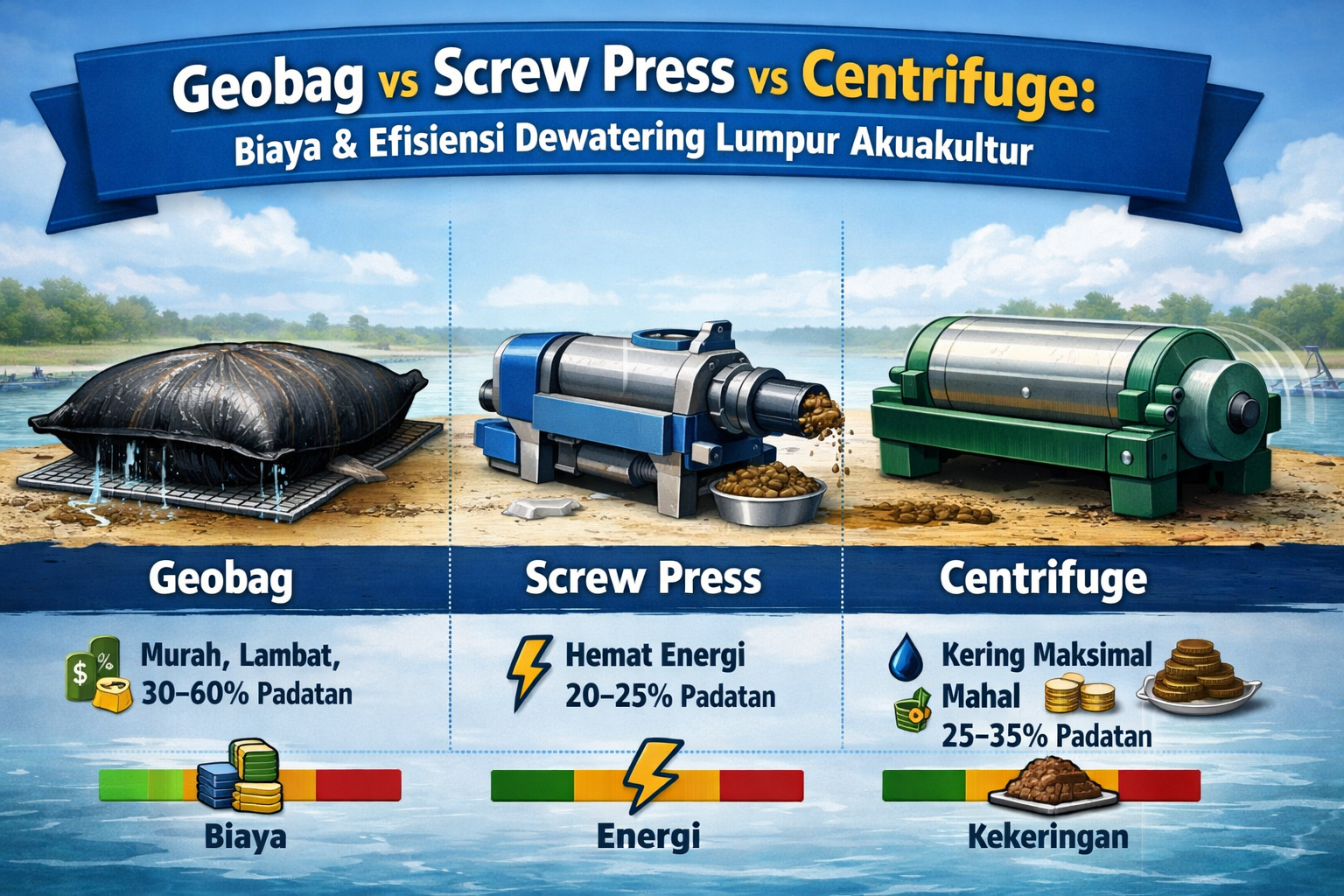
Purchasing decisions hinge on capacity, dryness, capex/O&M, and compliance. Geotextile bags have the lowest capital (bags ~$100–$500 each, pumps ~$), negligible energy, and minimal maintenance; they need land and time (days to weeks) and labor to handle filled bags. Screw presses land in the middle on capital (≈$50K–$150K for a mid‑scale unit), run at ≈20 Wh/kg DS, and process a few m³/hr continuously to ~20–25% DS. Centrifuges carry the highest capital (≥$200K for small units) and energy but offer the highest instantaneous throughput (nepis.epa.gov; www.mivalt.cz).
One quantitative scenario: a farm generates 1 ton/day of wet sludge (20% TS, so 200 kg dry solids). A screw press could concentrate this to ~40 kg dry solids cake/day (at 25% DS), reducing volume from 1000 L to 160 L, with energy use estimated at ~200 Wh/kg × 40 kg ≈ 8 kWh/day. A centrifuge might hit 20% higher DS (say 30%) to yield 67 kg cake, but use ~10× more energy (~80 kWh/day) and far more polymer. Geobags might require ~3–5 bags per week to capture the same 200 kg DS (at 30% each), using negligible power but more operator time.
EPA cost references underscore the spread: a ~340 kg/day centrifuge was ~$215k (equipment) around 2000, with installation + polymer + enclosure approaching ~$650k; O&M ran $65–$209 per dry ton (nepis.epa.gov; nepis.epa.gov). Comparable screw presses are typically in the tens of thousands with ~10× lower power draw (www.mivalt.cz). Disposal costs fall for all methods, and centrifuges and geobags export almost no free water. For practical readiness, operators often bundle hoses, frames, and pumps as supporting equipment for dewatering lines.
The market is clear: stricter standards and social license are pushing investment, and ROI is most sensitive to energy and hauling. Screws often hit a “sweet spot” — relatively low cost, low energy, and modest cake dryness (www.mivalt.cz). Geotextile systems are extremely cheap to deploy and useful for seasonal or emergency dewatering. Centrifuges, while expensive, excel when space is tight and the highest dryness is needed. Polymer conditioning benefits all methods, improving cake dryness by single‑digit percentages per optimized dose at a minor cost increment (www.researchgate.net).
Key data summary and sources
Typical achieved cake dryness is ~30% for geotextile bags (www.globalseafood.org), ~20–25% for screw presses (www.mivalt.cz; www.wwdmag.com), and ~20–30% for centrifuges. Energy use per kg of dry solids is ~20 Wh for a screw press vs. ~200 Wh for a centrifuge (www.mivalt.cz). Polymer doses around ~15–20 mg/L deliver ~99% TSS capture in RAS backwash (www.researchgate.net). Capital runs from <$1,000 per bag to >$200,000 for small centrifuges (nepis.epa.gov; www.wwdmag.com). These figures — backed by field and industry studies (www.globalseafood.org; www.mivalt.cz; www.researchgate.net) — enable direct ROI calculations when combined with local sludge volumes, disposal rates, energy prices, and labor.
Sources include: Ebeling et al., Responsible Seafood Advocate (2011) — geotextile bags at 30% DS in <1 week (www.globalseafood.org); Aparicio et al., Sustainability (2020) — geotextile tubes 60% DS with polymer (www.mdpi.com; www.mdpi.com); Senfter et al., Processes (2023) — screw press ≤30% DS (www.mdpi.com); MIVALT (2023) — screw vs centrifuge energy 20 vs 200 Wh/kg, DS 18% vs 20% (www.mivalt.cz; www.mivalt.cz); EPA Biosolids Fact Sheet (2000) — centrifuge capex/O&M ($215k equipment for 340 kg/d; $65–$209/ton DS) (nepis.epa.gov; nepis.epa.gov); WWD Magazine (2024) — screw press case mid‑20% DS vs belt at 13% (www.wwdmag.com); Ebeling et al., Aquacultural Engineering (2005) — flocculant jar tests, 15–20 mg/L polymer → ~99% TSS removal, ~$4–$13/ton feed (www.researchgate.net); GrowthMarketReports (2024) — aquaculture sludge market ≈$2.0B at 7.4% CAGR (growthmarketreports.com).