

Industry: Fertilizer (Ammonia & Urea)
Process: Ammonia Synthesis Loop
Ammonia synthesis remains one of industry’s biggest energy draws. Globally it consumes roughly 8.6 EJ/year, with plant energy intensities averaging around 41 GJ/ton today. Using best available technology (BAT), modern gas-fed ammonia plants can achieve around 28 GJ/t. For perspective, industry benchmarking shows the global average fell only from about 37.5 GJ/t in 2003 to 36 GJ/t by 2014, still far above the 28–29 GJ/t optimum.
In Indonesia, where ammonia and downstream urea are strategic, recent government mandates emphasize Green Industry standards for ammonia and urea plants. State-owned Pupuk Indonesia is targeting large-scale blue and green ammonia by 2045–2060. In practice, reaching these goals starts with mechanical upgrades and process tuning to cut fuel and power use per ton of ammonia.
Syngas Compression Train Efficiency
In the Haber–Bosch loop, the syngas compressor—handling the feed make-up plus recycle of synthesis gas—is the largest power consumer. Modern designs use multi-stage centrifugal compressors with intercooling. The make-up unit boosts the H₂/N₂ mixture to synthesis pressures, typically 150–250 bar, while the recycle unit restores loop pressure after losses. Synthesis pressures are generally high, at 150 barA or more, with make-up compressors at very high pressure ratios and recycle compressors handling 4–5 times the flow.
To handle these duties efficiently, new plants use high-efficiency centrifugal trains, often integrally geared, instead of older reciprocating machines. Integrally geared, multi-stage impeller trains can achieve isentropic or polytropic efficiencies on the order of 85–90% in large flows, significantly above legacy designs. Some designs even combine multiple duties on one driver—linking feed gas, process air, syngas, and refrigerant compressors into a single turbine/gearbox train—to maximize shaft-power recovery. For the refrigeration compressor, using liquid NH₃ as refrigerant, manufacturers likewise employ multi-stage centrifugal units.
Measured outcomes are tangible. Upgrading old compressor trains or drives can reduce specific drive power by 5–10%. Eliminating excessive suction pressure drop also directly lowers compressor work. In practice, studies show that reducing pressure drop and adding load-reducing chillers can cut syngas compression energy by several percent. Using suction chillers on intermediate syngas stages significantly reduces compressor load. Modern compressors often recover intercooling heat to pre-heat process streams or generate steam, further improving net efficiency.
Reactor Pressure and Conversion Trade-Offs
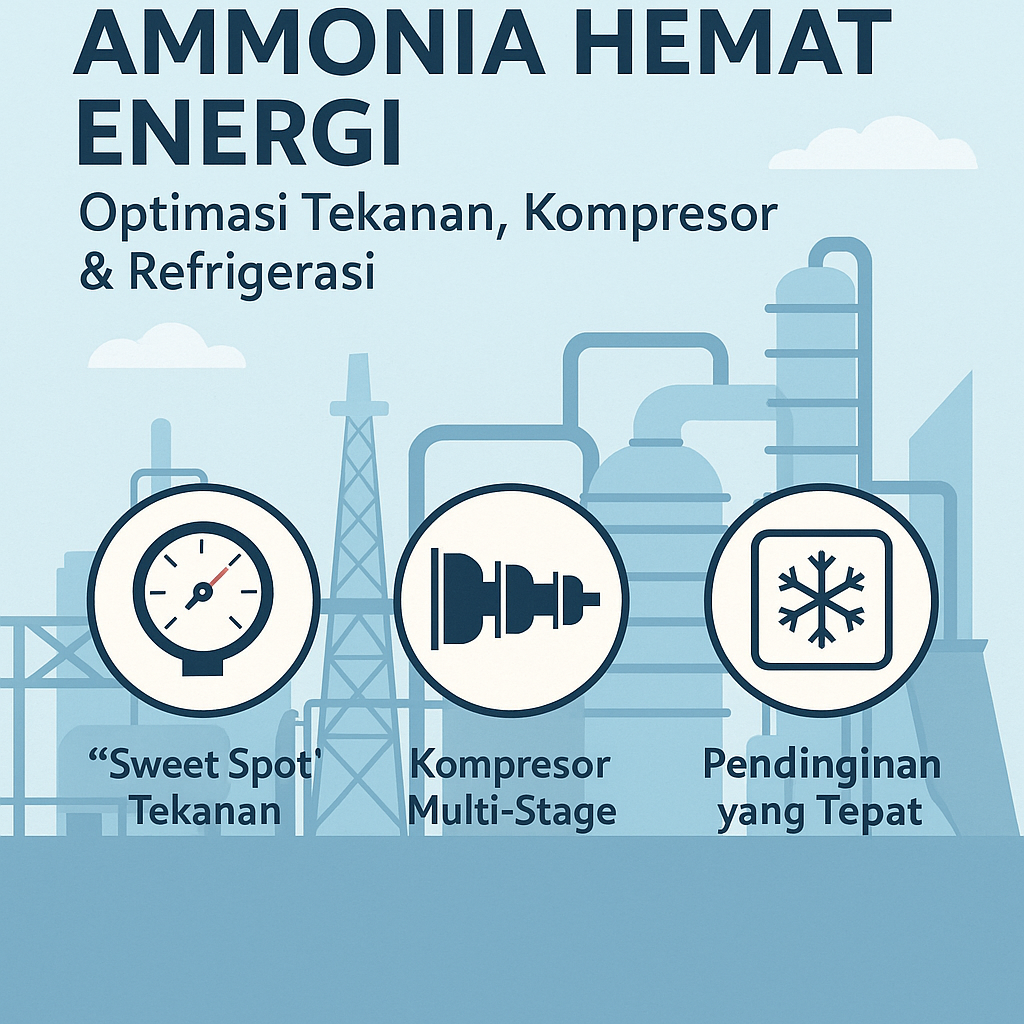
The converter’s operating pressure is a central trade-off. Higher pressure, for example 200–250 bar, shifts equilibrium toward ammonia, raising per-pass conversion and allowing a lower recycle ratio. Moving from 150 to around 200 bar can improve single-pass conversion by several percent, reducing recycle flow by a comparable amount. Upgrading the converter or adding a second stage increases the ammonia concentration out of the converter, reducing the recycle rate and load on the syngas compressor.
Compression work rises steeply with pressure, so beyond around 200–250 bar the incremental efficiency benefits diminish. Typical world-scale plants today operate in the 180–220 bar range. Ultra-high-pressure units above 250 bar exist with ruthenium catalysts, but these require proportionally more drive power.
Benchmarks support the gains. Improving converter conversion by 5% through new internals or catalyst can cut feed recycle by around 10%, roughly saving 1–2 GJ/t in recycle compression and refrigeration duties. By contrast, dropping pressure to an older 120–150 bar regime would increase energy use significantly. Many revamps targeting higher conversion pay back through both lower energy per ton and greater capacity. Case studies report that a high-efficiency converter stage can maintain or increase output with the original syngas compressor by increasing NH₃ removal per pass.
Refrigeration and Condenser Optimization
In the loop, ammonia is separated by cooling the reactor effluent so NH₃ condenses. The refrigeration system and loop condensers dominate this cooling load. Operating condensers slightly warmer, for example raising from –33 °C to –30 °C, reduces refrigeration work, but must balance conversion losses. Conversely, deeper chilling below –33 °C squeezes out more ammonia but can sharply increase refrigeration power. The optimum is usually near ambient-cooling limits for large plants.
Splitting refrigeration into stages, such as a cold intermediate flash and a final liquid–gas separator, allows intercooling, and some systems use a mixed refrigerant approach to improve coefficient of performance. Heat integration is pivotal. Shifting as much condensation as possible into heat exchangers served by cooling water rather than mechanical refrigeration lowers power draw. Increasing the ammonia concentration out of the converter reduces refrigeration duty and shifts more of the ammonia condensing duty to cooling water. In practice, upgrading the converter so more product vapor condenses at warmer temperatures lets existing cooling towers, rather than the ammonia compressor, handle most of the load.
Equipment matters here too. High-efficiency, multi-stage ammonia refrigeration compressors with intercoolers instead of single-stage chillers can cut power. Modern two-stage ammonia refrigeration compressors achieve polytropic efficiencies near 88–90%, compared with around 70% for older screw or vane units. Upgrading to these can reduce the refrigerator’s share of plant power by around 5–10%. Aging plants often have surplus ammonia compressor capacity, so boosting conversion and using waterside cooling often avoids large refrigeration-compressor upgrades. Where cooling towers do more of the duty, utilities teams often rely on routine dosing via a dosing pump and standard cooling-water programs that can include a scale inhibitor and a corrosion inhibitor.
The measured savings add up. Adding a medium-pressure condensate stripper alone to recover boiler feed water heat typically saves about 0.3–0.5 GJ/t. Improvements in refrigeration design or operation, such as optimizing condensing pressure, commonly trim another few percent of total energy. One retrofit saw overall loop power fall by around 3–5% after optimizing condenser pressure and installing an expanded refrigeration stage.
Implementation and Revamp Sequencing
Economics are moving targets, but the capex versus opex trade-off is clear. High-efficiency compressors and internals entail higher capital, so project analysis must quantify energy savings. Given fuel costs and carbon costs, these investments often pay back quickly. Saving 1 GJ/t NH₃ in a 2,000 t/d plant avoids around 5.6 GJ/hr of fuel or about 12,000 MWh/year, figures that justify even multi-million-dollar retrofits. Current regulatory pressures in Indonesia and clean-energy targets strongly favor any efficiency gains.
In practice, revamps start with a detailed process and pressure-drop audit. Engineers target upgrades with high return: reducing syngas pressure drop by streamlining shift reactors or adding interstage chillers, improving heat recovery in the reformer convection section, and fine-tuning purge streams to control inert buildup with minimal NH₃ loss. Raising conversion is a chief goal because upgrading converter internals or adding a booster stage reduces recycle rate and load on the syngas compressor. Similarly, optimizing the refrigeration cycle, for example tuning flash pressures or adding a small expander in the second stage, can yield multi-percent power savings. Where water-treatment support is needed around cooling operations, site teams typically select plant-specific ancillaries to fit local utilities.
Business Outcomes and Data-Driven Control
Every 1% reduction in energy intensity per ton NH₃ translates to significant bottom-line gains. A 5% cut in fuel consumption is equivalent to around $1–2 per ton ammonia, depending on gas price, adding up to millions of dollars annually for a large plant. Data from industry benchmarks confirm this. One study using machine-learning optimization in an existing plant projected $3.9 million per year in energy savings and a CO₂ emission drop of 4.7 t/hr by tuning operating parameters.
The optimization roadmap is consistent across credible sources. Prioritize compressor upgrades, including high-efficiency multi-stage centrifugal systems and integrally geared trains where feasible. Tune loop pressure and operating conditions to hit the sweet spot of conversion versus compression work. Refine refrigeration by re-balancing condenser duty toward cooling water, optimizing flash pressures, and improving compressor polytropic efficiency. These measures can cut ammonia loop energy by on the order of 10–20% for brownfield upgrades, moving from current average performance toward BAT levels.
These data-backed insights support both technical decisions and investment decisions in the ammonia synthesis loop.