

Industry: Aquaculture | Process: Grow
Intensive grow‑out ponds, often spanning multiple hectares, live and die by dissolved oxygen. The frontline tools are mechanical aerators — surface paddlewheels, propeller‑aspirator pumps (venturi/ejector types), and diffused‑air systems — each trading capital cost, energy spend, and mixing behavior for oxygen delivered.
Across peers and decades of tests, the pecking order is stable: propeller‑aspirator units typically push the most O₂ per kilowatt‑hour, paddlewheels sit in the middle, and diffusers trail in common 1–2 m pond depths. That ranking flips in some wastewater setups, but for open ponds, it’s the norm (Boyd and Martinson 1984; Boyd et al. 2021).
What follows: how each machine works, the energy numbers that matter — oxygen transfer efficiency (kg O₂/kWh) and Standard Oxygen Transfer Rate, SOTR (kg O₂/h) — and a step‑by‑step sizing guide that farm owners use to calculate requirements and choose equipment backed by field data and costs.
Aerator types and basic mechanics
Surface paddlewheel aerators use motor‑driven rotating paddles on a horizontal shaft or long‑arm to splash water and drive circulation. Units range from ≤0.75 kW to floating sets ≥5 kW, and are ubiquitous in Asian finfish and shrimp operations.
Propeller‑aspirator pumps (also called venturi aerators or air‑lift pumps) couple a submersible or floating propeller pump (typically 1–5 kW) with a built‑in venturi/ejector, drawing air through a hollow shaft or intake and injecting bubbles into a high‑speed water jet.
Diffused‑air systems push compressed air through hoses and porous diffusers on the pond bottom. As bubbles rise, oxygen dissolves into the water column. These systems require separate blowers/compressors and are more common in enclosed tanks and recirculating aquaculture systems (RAS). They are used in large ponds when depth is sufficient.
Supporting gear — blowers, manifolds, and distribution hardware — often sits in the “ancillary” bucket; many operators standardize these as water‑treatment ancillaries for reliability and service continuity.
Energy efficiency and oxygen transfer metrics
The core yardsticks are oxygen transfer efficiency (kg O₂ per kWh consumed) and SOTR (kg O₂ per hour under standard test conditions). In comparative field work, propeller‑aspirators usually lead. Boyd and Martinson (1984) reported 0.4–2.2 kW propeller‑aspirators delivering about 1.73–1.91 kg O₂/kWh at 20 °C in clean water starting at 0 mg/L DO (source).
In the same study, a surface spray/splash aerator (akin to paddle designs) transferred only 1.34–1.41 kg O₂/kWh, while a diffused‑air setup was around 1.08 kg O₂/kWh (source). That put the aspirator roughly 30–40% ahead of the paddle type in that trial. FAO tests likewise place paddlewheels at ~0.9–1.4 kg O₂/kWh depending on paddle size, shaft speed, and water depth (FAO).
Diffusers in ponds tend to be less efficient in practice. Coarse “perforated‑pipe” diffusers in shallow ponds have logged ~0.23–0.5 kg O₂/kWh (FAO), and fine‑bubble systems around ~1.08–1.1 kg O₂/kWh in standardized tests (Boyd and Martinson 1984), largely because typical pond depths (≈1–2 m) limit bubble contact time (Boyd et al. 2021).
SOTR results track the same theme. In 50 m³ tanks at 30‰ salinity, a 2‑HP (1.49 kW) paddlewheel posted 3.79±0.30 kg O₂/h (≈2.54 kg O₂/kWh) and a propeller‑aspirator 3.62±0.04 kg O₂/h (≈2.43 kg O₂/kWh) (Vinatea & Carvalho 2007). These are maxima; outputs drop at lower salinity or in different depths.
In real ponds, small 1–3 kW aerators frequently deliver ~1.5–3 kg O₂/h each. A modern ~2.2 kW paddlewheel might yield ~1.5–2.5 kg O₂/h, while a ~2 kW aspirator can push ~2–4 kg O₂/h; makers often list OTR ~2–5 kg O₂/h for 2–5 kW machines (source).
Bottom line from pond conditions: paddles run near ~1.0 kg O₂/kWh, propeller‑aspirators about ~1.5–2.0 kg O₂/kWh, and diffusers ≤~1.0 kg O₂/kWh, with coarse bubbles much lower at ~0.3–0.5 kg O₂/kWh (FAO; Boyd and Martinson 1984). That gap implies aspirators can deliver ~30–80% more oxygen per unit of power than paddles under many pond scenarios (source).
How farms calculate aeration needs
Most sizing starts with the oxygen deficit to be corrected overnight. A widely used estimate ties O₂ demand to feed: each kilogram of feed creates about 1.0–1.1 kg of oxygen demand when accounting for fish respiration and bacterial oxidation of wastes (Boyd et al. 2009). A farm feeding 1,000 kg/day would see on the order of ~1,000 kg O₂/day consumed.
Where feed data are scarce, respiration can be approximated from biomass and stocking density: active finfish or shrimp may consume ~30–40 mg O₂ per kg of biomass per hour (temperature‑dependent). Operations typically aim to maintain dissolved oxygen (DO) above 3–4 mg/L at night and >5–6 mg/L at midday (species‑specific). A 1 ha pond at 1.5 m depth (15,000 m³) losing 5 mg/L overnight needs roughly 75 kg O₂ replaced.
Translating that into equipment, the 75 kg O₂ over a ~12‑hour night equates to ~6.25 kg O₂/h. If a 5.5 kW paddlewheel produces ~9 kg O₂/h (≈1.6 kg O₂/kWh), one such unit covers the load; if using smaller 2 kW paddlewheels at ~2.5 kg O₂/h, three units are required (source).
- Estimate daily O₂ demand from feed or yield. A simple rule is 1 kg feed → ~1 kg O₂ (source).
- Account for daylight oxygen input from photosynthesis; at night, assume zero contribution for safety.
- Compute the deficit: (DO drop in mg/L) × (pond volume in m³)/1000 = kg O₂ needed.
- Match aerator output: sum of aerators’ O₂ transfer (kg/h) should meet or exceed the hourly requirement; use vendor OTR/SOTR data.
- Add a margin of ~20–50% to cover fouling, aging equipment, or biomass surges.
Rule‑of‑thumb planning aligns with those calculations: ~1–2 kW/ha for low‑intensity fish ponds and ~15–20 kW/ha for intensive shrimp ponds (source). The heuristic corresponds to ≈500–1,000 kg increase in yield per kW of aeration (source). For a 5 ha intensive shrimp pond, that points to ~75 kW total (e.g., ten 7.5 kW units), while a low‑density catfish pond might run on ~5–10 kW total.
Cost‑effectiveness, reliability, and mixing behavior
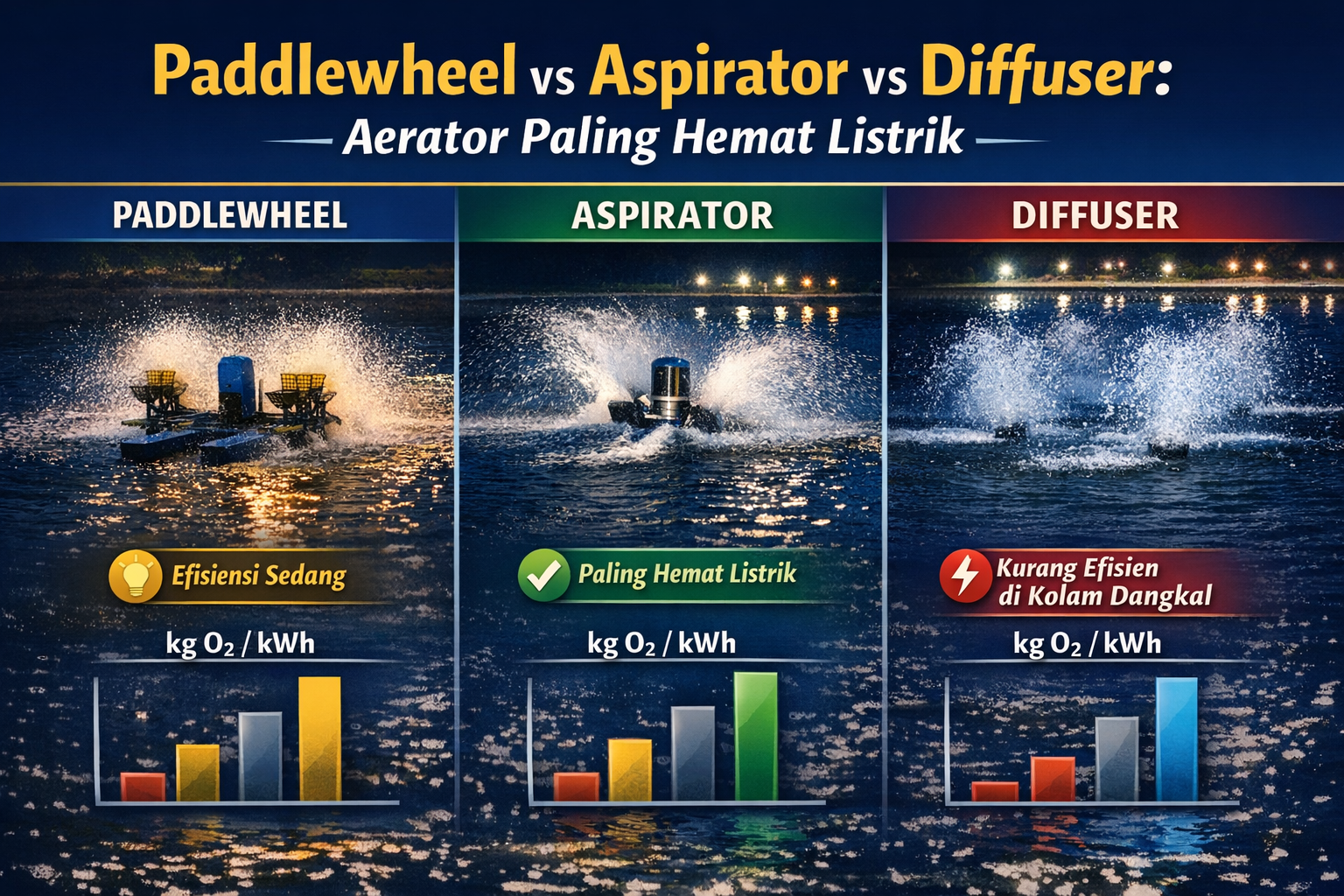
Energy spend per kilogram of oxygen is decisive. At electricity prices of $0.10–$0.15/kWh, a propeller‑aspirator delivering ~2.0 kg O₂/kWh costs ~$0.05–$0.075/kg O₂, while a paddlewheel near ~1.0 kg O₂/kWh costs ~$0.10–$0.15/kg O₂ (Boyd and Martinson 1984). Over years, that gap compounds.
Capital and maintenance profiles differ. Paddlewheels are simple and durable, with few bearings and minimal submerged parts; long‑arm and cage‑mounted units on dykes are proven. Propeller‑aspirators have submerged impellers and seals, with air‑intake components to maintain. Diffused systems require dependable blowers and periodic cleaning or replacement of diffuser stones or membranes, which can be buried by sediment.
Operationally, mixing patterns matter. Paddlewheels excel at surface splash and horizontal circulation. Aspirators inject at depth and can drive vertical turnover. Diffusers oxygenate deeper layers, but rising plumes may move the column slowly. Many farms blend types — multiple paddlewheels for mixing plus a few diffusers — yet Boyd et al. (2021) note that in shallow (≈1–2 m) shrimp ponds, even fine‑bubble diffusers “did not differ greatly” in lab SAE from paddles/venturi, but are less efficient in shallow water because bubbles reach the surface quickly (source).
Reliability and sourcing also shape choices. In Indonesia and similar markets, paddlewheels and simple aspirators are widely made and serviced. With intermittent power, operators often deploy diesel‑driven paddles (common in Myanmar/Thailand) or solar‑hybrid aspirators. Indonesian research highlights sensor‑controlled aeration and solar power cutting energy use by 20–40% (source). Routine upkeep depends on ready access to spares; many standardize on water‑treatment parts and consumables to keep aeration assets online.
A practical selection framework
The oxygen accounting is straightforward. If the pond needs N kilograms of O₂ over the night and each aerator supplies Y kilograms per hour, total Y across all units times hours must cover N. For example, a 2 kW propeller‑aspirator making ~3 kg O₂/h (≈1.5 kg O₂/kWh) introduces ~72 kg/day if run 24 h; for a 200 kg/day oxygen demand, three such units meet the load. The same comparison with 2 kW paddlewheels at ~1.0 kg O₂/kWh yields ~48 kg/day per unit.
That arithmetic aligns with the broader evidence: propeller‑derived aerators tend to be most energy‑efficient, paddlewheels middling, and diffused air least efficient in shallow ponds (unless depth is high), per FAO lab and field studies and Boyd’s trials (FAO; Boyd and Martinson 1984; Boyd et al. 2021).
The operational guardrails are consistent too: maintain >3–4 mg/L DO at night and >5–6 mg/L midday; allow 20–50% capacity margin; and consider combining paddlewheels (for mixing) with aspirators (for high oxygen per kWh), with diffusers added judiciously in deeper zones. Adding automation or solar power can further trim energy use by 20–40% (source).
All figures and statements above are taken from FAO’s aquaculture aeration manual (FAO); Boyd and Martinson’s 1984 tests (source) and Boyd et al. 2021 review (source); Vinatea & Carvalho’s SOTR study (source); Boyd et al. on feed oxygen demand (~1.0 kg O₂ per kg feed) (source); and Indonesian energy analyses (source).