

Industry: Aquaculture | Process: Disinfection_&_Water_Quality_Management
Oxygen is the currency of growth in ponds and tanks. In side‑by‑side metrics, fine‑bubble diffusers transfer oxygen about 2–3× more efficiently per kW than standard paddlewheels, while pure oxygen injection systems can be roughly an order of magnitude more efficient (at much higher capital and oxygen costs). That efficiency gap is why intensive shrimp and fish operators increasingly scrutinize the “O₂ per kilowatt-hour” delivered by their gear — not just the sticker price.
The engineering anchor for these comparisons is standard aeration efficiency (SAE, kg O₂ transferred per kW·h), measured under “clean water” conditions, and reported alongside standard oxygen transfer rate (SOTR) and standard oxygenation efficiency (SOE). Dissolved oxygen (DO) targets drive real operations, but design begins with these standardized baselines.
Surface paddlewheels: simple hardware, high energy
Paddlewheel (mechanical surface) aerators agitate the surface to entrain air. Reported SAE typically ranges about 0.5–2.0 kg O₂/kW·h, with well‑designed paddles under ideal tests reaching roughly 1.5–2.0 kg O₂/kW·h (globalseafood.org). In field conditions, actual O₂ transfer often falls to 40–60% of SAE because of water temperature, salinity, and existing DO (globalseafood.org).
On shrimp farms, Boyd observed power densities around 18–27 kW/ha (24–36 hp/ha), running ~20 hours per day; over a 100‑day crop that added up to ~36,000 kWh (2lua.vn). At ~$0.10/kWh, that’s roughly $3,600/ha in electricity — translating to ~$0.41–0.53 per kg shrimp just for aeration (2lua.vn). Capital outlay is low (a 1 hp unit on the order of a few hundred USD; typical price range ~USD 200–1000 per unit), but deep oxygen penetration is limited and long‑arm designs common in Asia have lower efficiency; shorter arms and optimized paddles improve transfer (globalseafood.org).
Fine‑bubble diffusers: higher SAE, deeper mixing
Diffused aeration systems use blowers and submerged membrane diffusers to create small bubbles (about 1–5 mm), boosting air‑water contact area. Typical SAE for fine‑bubble systems is roughly 2.0–2.5 kg O₂/kW·h at 20 °C and an initial 0 mg/L DO — about 1.5–3× paddlewheel values (researchgate.net). In Boyd’s trials, a shallow‑depth, moderate air‑flow setup achieved SAE ≈2.0–2.5 kg/kW·h (researchgate.net).
Bubble size matters for dissolution: “medium” bubbles yielded about 5–6% oxygen dissolution, and coarse bubbles only ~3.5–5%, versus much higher performance when fine bubbles dominate (FAO). Practically, a 2–3 kW blower can transfer on the order of 4–6 kg O₂ per hour, whereas a similar‑power paddlewheel does roughly ~1–2 kg. Blowers often cost ~$500–$1500 for industrial models, and diffuser membranes are tens of dollars each (commonly ~$30–50 per diffuser), with the trade‑off of higher upfront cost and periodic cleaning. The energy per unit oxygen can be lower than paddlewheels, and microbubble diffusers are increasingly adopted in intensive recirculating aquaculture systems (RAS) and some pond systems.
Pure oxygen injection: oxygen cones and injectors
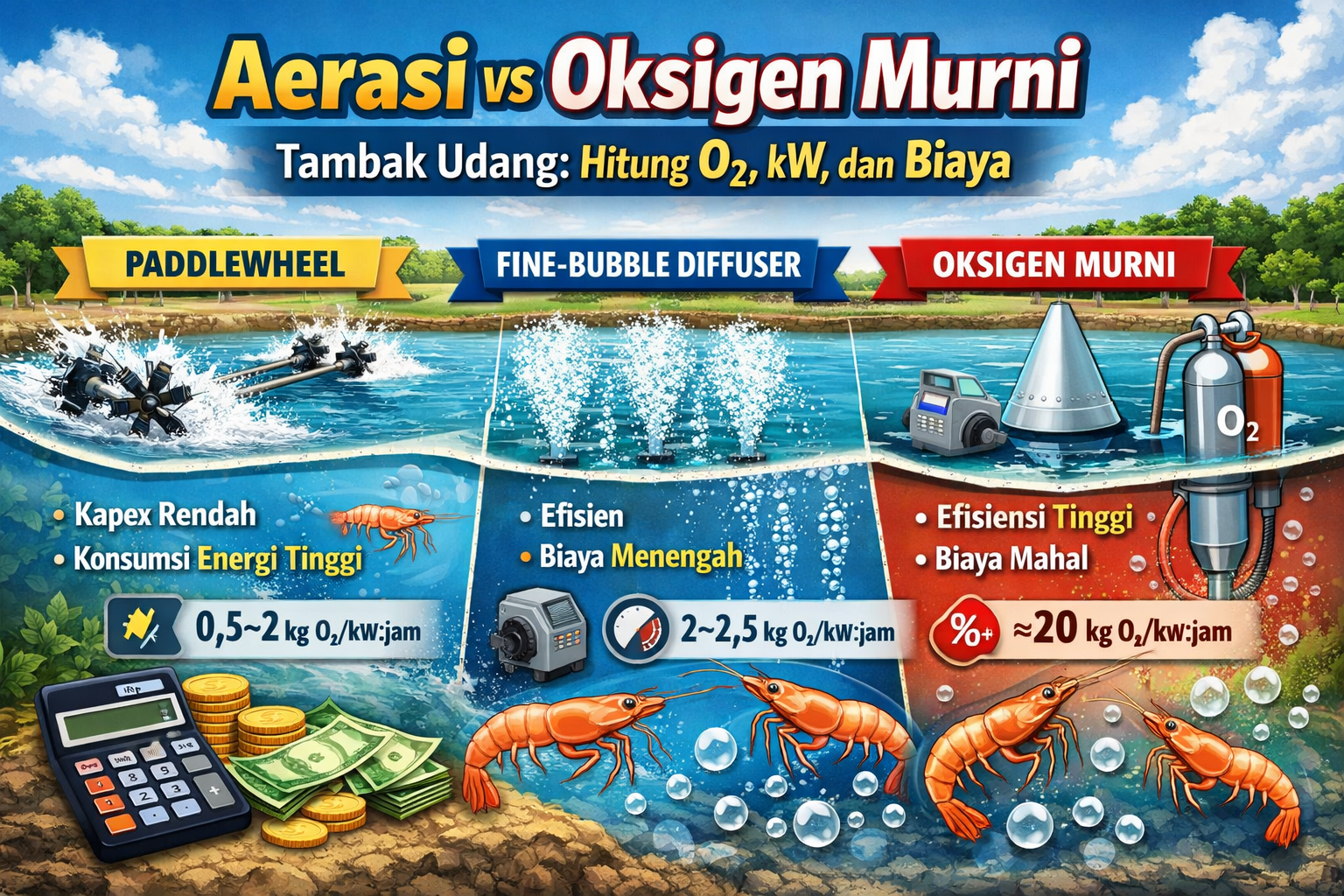
Injecting pure oxygen into culture water sharply increases the concentration gradient, enabling very high transfer rates. FAO notes that by the application of pure oxygen, fish load is no longer limited by air transfer; the advantage is high mass transfer and low energy requirement (FAO). One O₂ cone system delivered about 10 kg O₂ per hour while using only ~0.5 kW of power — roughly 20 kg O₂/kW·h — an order of magnitude above diffused air and ~20× typical paddlewheel output (patents.google.com).
Capital is high: an oxygen supply (liquid O₂ tanks or on‑site generator) plus mixing device (conical dissolver, injector, or venturi; many designs are akin to “Speece cones”) can run to the tens of thousands of USD. Operating cost depends on O₂ usage (e.g., ~$0.5/kg industrial O₂; at 10 kg/h that’s ~$5/h). The payoff is density: reports suggest fish loads per 1000 L can rise from ~50 kg to ~80 kg using oxygen cones in RAS (waterco.com.my).
Energy and cost baselines (field numbers)
In the shrimp case above, ~36,000 kWh per hectare over 100 days at ~$0.10/kWh implied ~$3,600/ha in electricity and ~$0.41–0.53/kg shrimp for aeration (2lua.vn). A diffused system might halve energy use for the same oxygen addition (with added CAPEX for compressors and diffusers). A pure‑O₂ system could use only ~0.5 kW to supply ~10 kg O₂/h (patents.google.com) — trivial electricity — but would incur the O₂ fuel cost.
Design basis: calculating oxygen demand
Oxygen demand scales with feed. A practical rule for warmwater aquaculture is roughly 1.25 kg O₂ consumed per kg of feed applied, reflecting respiration and aerobic decomposition of waste (globalseafood.org). Boyd’s stoichiometric analysis of shrimp ponds yields ~1.245 kg O₂ per kg feed (globalseafood.org), and a design factor of ~1.2–1.3 kg O₂/kg feed is reasonable for general use (globalseafood.org).
Example: 1000 kg of feed over a cycle implies ~1250 kg of O₂ demand. If supplied over 100 days at 20 h/day of aeration, the average is ~0.625 kg O₂ per hour. Engineers then account for night‑time minima and post‑feeding peaks with a safety margin; designing for ~30–50% above the average is common practice in such calculations. In summary:
- Estimate daily O₂ need = feed (kg/d) × 1.25 (kg O₂/kg feed).
- Divide by aeration hours per day to get required kg O₂/h.
- Ensure redundancy by adding capacity or run‑time for stress events.
Sizing and selection: matching SOTR to demand
Once demand is set, select equipment by its rated O₂ output. Manufacturers quote SOTR (kg O₂/h under standard conditions) or SOE (efficiency, kg O₂/kW·h). If a 2 kW paddlewheel has an SOTR of ~1.0 kg O₂/h at standard conditions and the pond needs ~2 kg O₂/h net, two units are indicated; in real water, applying a conservative factor (e.g., targeting only 40–60% of SAE) is prudent (globalseafood.org). Fine‑bubble systems are often rated around ~2.0–2.5 kg O₂/kW·h (researchgate.net), and oxygen cones are sized by O₂ capacity (e.g., ~10 kg/h in the cited example).
Energy‑efficiency vs. quantity is the trade: fine bubbles yield about ~9–10% oxygen dissolution compared with ~3.5–5% for coarse bubbles (FAO). In energy terms, a best‑case diffused system at ~2.5 kg O₂/kW·h (researchgate.net) is about 2–3× a typical paddlewheel at ~0.8–1.0 kg O₂/kW·h (globalseafood.org) and ≈10× a poor paddle design.
Unit economics: electricity vs. oxygen
When electricity is expensive relative to fish value, higher‑SAE aeration or O₂ injection can pay off; when capital is constrained, low‑cost paddlewheels dominate despite higher operating cost. A practical comparison is to compute the kWh required = (feed demand × 1.25 kg O₂/kg feed) ÷ SAE, then multiply by local electricity rates (2lua.vn; researchgate.net). In deeper or higher‑density ponds, a single 2–5 kW blower can support many diffusers (often 10+), whereas the same area might need multiple 2–3 kW paddlewheels. For very high‑density RAS or hatcheries, a ~10 kg/h O₂ cone (~0.5 kW) may replace several paddlewheels, subject to O₂ supply logistics.
Operational targets and compliance
System selection must maintain DO at or above typical operational targets (e.g., DO ≥~5 mg/L mentioned in engineering guidance) and reflect local regulations. The recommendations here include ensuring compliance with Indonesian aquaculture standards (e.g., minimum DO and other water quality limits) and factoring energy costs into profitability calculations (globalseafood.org; FAO).
Ancillary equipment and upkeep
Aeration systems depend on practical ancillaries such as spares, membranes, and support gear; related categories include water treatment parts and consumables and water treatment ancillaries. Where foaming control is required around aeration, related categories include antifoam.
Notes on test conditions and real‑world performance
All performance values above are illustrative. Efficiency ratings (kg O₂/kW·h) assume standard tests in fresh water at 20 °C from 0 mg/L DO. Actual aeration rates under culture conditions are typically 40–60% of these lab‑standard values, and real outcomes depend on temperature, salinity, and existing DO (globalseafood.org). Costs and performance should be obtained from specific manufacturers or verified on‑farm.
Sources and representative data: globalseafood.org; globalseafood.org; globalseafood.org; researchgate.net; FAO; FAO; patents.google.com; 2lua.vn; 2lua.vn; waterco.com.my.