
From raw seawater swings to finished-water compliance, here’s the sensor‑and‑lab plan that keeps salt rejection above 99% and drinking water safe. The approach leans on continuous data, targeted grab samples, and audited procedures.
Desalination is scaling fast — global capacity is expanding ~8% per year, according to industry coverage (ft.com) — and quality control is the quiet workhorse behind that growth. Operators rely on a mix of always‑on sensors and accredited lab tests to protect reverse osmosis (RO, a pressure‑driven membrane separation) and to certify that finished water meets drinking standards, shift after shift.
This plan, built around supervisory control and data acquisition (SCADA, a plant‑wide monitoring and control system), follows water from the intake to the outlet. Every instrument, threshold, and lab method matters — and every excursion is logged, trended, and investigated.
Raw seawater intake monitoring
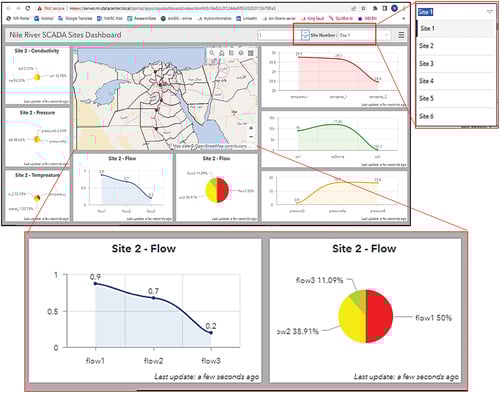
The intake is instrumented for salinity, turbidity, temperature, and pH. Conductivity is tracked continuously as a proxy for total dissolved solids (TDS; open‑ocean levels are ~35,000 mg/L), alongside temperature probes to spot thermal stratification. In‑line turbidity meters (0–1000 NTU range; NTU is a turbidity unit indicating how particles scatter light) sit upstream of pretreatment to detect sediment or algal blooms; values ideally stay <5 NTU under normal conditions (spikes in stormy weather trigger additional clarification). pH sensors hold watch near ~8.0 ± 0.1 to guide lime dosing.
Periodic grab samples — for example, monthly — check trace metals (Fe, Mn, Cd, As, etc.) and algal toxins that can foul membranes. Advanced, integrated nodes are emerging: one recent multisensor unit couples turbidity, temperature, and conductivity and adds optical coliform detection for continuous intake monitoring (arxiv.org). Reliable raw‑water data lets pretreatment be adjusted in real time to protect downstream membranes.
Pretreatment turbidity and filter ΔP
Pretreatment — coarse/fine filtration, flocculation, sedimentation, or ultrafiltration (UF, a membrane barrier for sub‑micron particles) — is tuned to deliver a low particle load to RO. Turbidity and differential pressure (ΔP, pressure drop across a unit) are the lead indicators. Turbidity meters after each filter stage should show >90–95% removal, driving turbidity to <0.5 NTU before RO. A rising ΔP across media or cartridge filters signals clogging; automated backwash or filter change is triggered when ΔP exceeds setpoints.
Operators also record spigot flows and chemical dosing rates; coagulant or antiscalant pump outputs are logged to confirm the intended dose rate, often via a dedicated dosing pump. Labs measure Silt Density Index (SDI, a fouling propensity test) or modified fouling index (MFI); SDI<3 is a common target. After ultrafiltration pretreatment, studies report weirless turbidity <0.05 NTU and SDI ~1–2, which supports stable RO operation. Real‑time SCADA trends of turbidity and ΔP are reviewed daily; sudden spikes — like a media filter breakthrough — trigger immediate action. The outcome is a consistently low‑particle feed, critical for membrane longevity.
RO train pressures, flows, conductivities
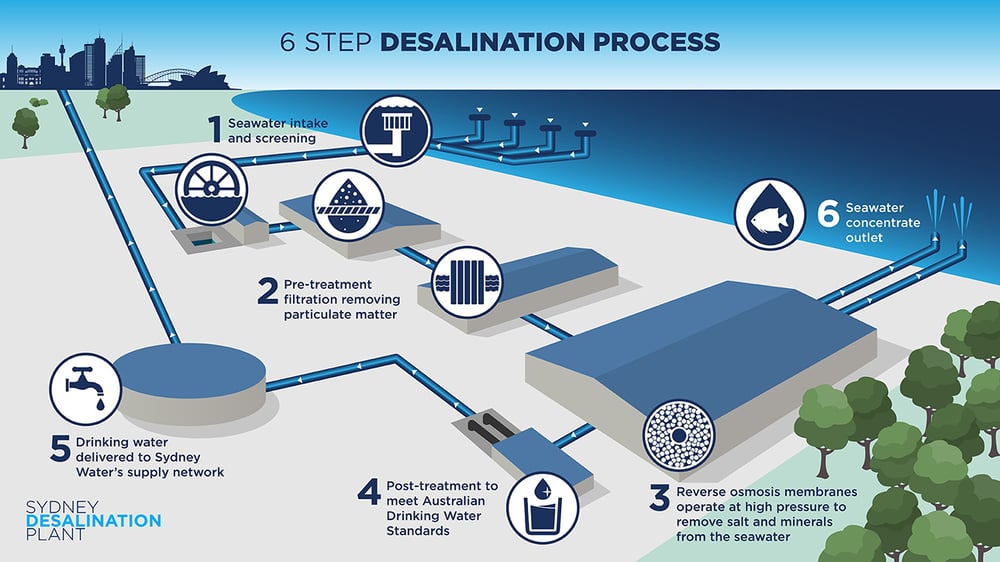
Across seawater RO trains — often configured as SWRO systems — sensors track pressures, flows, and salinity performance. Feed pressure transducers will trend upward if fouling or pump issues rise at constant flow. Flow meters on each stage record recovery ratios (typically 50–60% recovery for seawater plants) and flag abnormal losses. Conductivity probes on feed, permeate, and brine quantify salt rejection; with >99% of salts rejected, permeate conductivity is often <100–200 µS/cm (about <120 mg/L TDS), well below drinking‑water targets.
Inline pH electrodes monitor permeate acidity (RO product is often ~pH 5–6 due to CO₂ behavior) to control post‑treatment pH adjustment. Differential pressure across membrane elements is logged and used to trigger cleaned‑in‑place (CIP, chemical circulation to remove foulants) when preset limits are exceeded. Modern plants add on‑line total organic carbon (TOC, a bulk organic measure) or UV‑Vis sensors on permeate as early warnings for organic breakthrough. All RO data (pressures, flows, conductivities) feed the control system and are trended hourly; stored trends make it possible to detect slow drifts — for example, a 5% decline in salt rejection over a week — prompting preventive maintenance. These instrumentation data ensure each membrane train meets design targets and compliance requirements.
Remineralization, disinfection, storage monitoring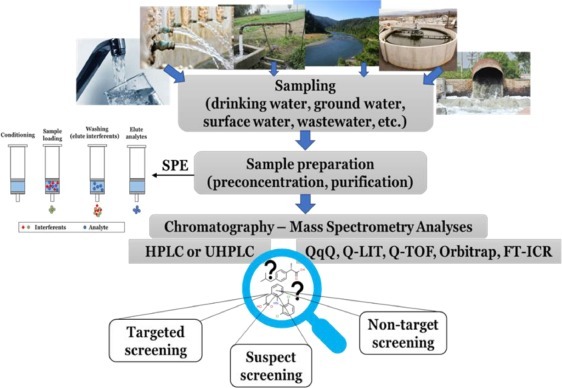
Post‑treatment focuses on remineralization, disinfection, and protected storage. Alkalinity is added — e.g., CaCO₃ or CaCl₂ dosing — to raise pH into the neutral range (7.0–8.5) and to achieve a desirable hardness (WHO notes <1000 mg/L TDS for taste). Inline pH meters and hardness checks (often colorimetric in the lab) verify the adjustment. Free chlorine or chloramine is injected for disinfection; continuous ORP (oxidation‑reduction potential) or amperometric Cl₂ sensors at the outlet maintain a residual, typically 0.2–0.5 mg/L free Cl₂. As a rule, WHO and Indonesian standards require a measurable residual and zero coliforms.
Periodic lab samples — for example, weekly — measure heterotrophic plate count (HPC, a general microbial count) and coliforms; E. coli and total coliforms must be absent per 100 mL. Disinfection byproducts (DBPs) are checked when chlorination is used, with trihalomethanes controlled below regulatory limits (THM4 <100 µg/L). Heavy metals (lead, cadmium, arsenic, chromium, etc.) and nitrate/nitrite are analyzed monthly in certified labs to verify health standards (e.g., WHO: As <10 µg/L, NO₃⁻ <50 mg/L). Finished water temperature is monitored for stagnation control, and stored water is secured with covers to prevent contamination.
Online sensors versus laboratory analysis
The plan balances continuous measurements with periodic laboratory confirmation. Online instruments — turbidity, conductivity/TDS, pH, ORP/chlorine, pressure, and flow — provide second‑by‑second data and alarm on excursions. For example, turbidity sensors with 0.01 NTU accuracy can spot minute increases in particulates (arxiv.org), and conductivity probes detect small salinity changes. High‑frequency data enable rapid responses such as auto‑dosing adjustments or barrier bypass.
Sensors can drift, so lab checks are non‑negotiable. Microbiological parameters (coliforms, HPC) and trace chemistry (metals, pesticides, THMs) have no real‑time analogues; these are tested on weekly to quarterly schedules in an accredited lab. A calibration plan ties the two together: sensors are checked daily or weekly against lab measurements (for example, grab‑sample TDS and pH), and a chlorine sensor is verified against the DPD colorimetric method each shift. In practice, continuous alarms catch acute events (pipe leaks, filter breakthrough), while periodic lab results (zero coliforms, low metals) certify long‑term compliance. Emerging technologies blend both approaches; one prototype sensor node integrates a mini‑spectrophotometer and a coliform detector for near‑real‑time analysis (arxiv.org).
SCADA dashboards, SPC charts, AI trials
All monitoring data feed a SCADA quality‑control dashboard. Automated plots track key metrics — average turbidity, salt rejection, chlorine residual — against high/low limits. Exceedances generate logged alerts and corrective‑action forms. Every change and test result is stored, enabling trend analysis: if historical data show turbidity rarely exceeds 0.3 NTU, a sudden jump flags maintenance. Over months, statistical process control charts (e.g., 95% control limits) help predict membrane fouling or detect efficiency loss.
Calibration logs and standard operating procedures — with labs following ISO/IEC 17025 — are audited regularly. Advanced analytics, including AI‑based anomaly detection, are being trialed to interpret large sensor datasets (ft.com). Success is measured by outcome metrics: production consistently <100 mg/L TDS, 0 CFU/100 mL coliforms (CFU are colony‑forming units), and >99% salt rejection with energy usage near baseline. With the global desalination sector expanding (~8% annually until 2030, per ft.com), rigorous monitoring safeguards public health and operational reliability — avoiding costly unplanned shutdowns.
Sources and standards alignment
Authoritative guidelines and studies underpin this plan. Global reviews note ~16,000 desalination plants worldwide (reuters.com), highlighting the need for standardization and safety. Industry reports emphasize smart sensor integration in water systems (arxiv.org; ft.com). Instrumentation thresholds in this program align with WHO drinking‑water recommendations and Indonesian regulations (e.g., no detectable E. coli, chlorine residual >0.2 mg/L). Data from these sources informed the parameter targets and monitoring strategies described above.
