

Industry: Fertilizer_(Ammonia_&_Urea) | Process: Wastewater_Treatment_(Ammonia_&_Urea_Removal)
Fertilizer production—think ammonia, urea, ammonium nitrate—throws off process condensate loaded with dissolved ammonia (NH3) and urea. Urea readily hydrolyzes to ammonium (NH4+) and bicarbonate (HCO3−), which is why the total nitrogen load can be eye‑watering: often ≥5,000–20,000 mg/L NH3‑N (milligrams per liter as nitrogen), according to peer‑reviewed studies (www.mdpi.com).
Those concentrations are orders of magnitude above typical municipal wastewater and carry well‑documented risks—aquatic toxicity, eutrophication, and ammonia–acid aerosol formation among them (www.mdpi.com; nepis.epa.gov). Regulators are tightening the screws (effluent limits often <10–50 mg/L NH3‑N), and “green ammonia” initiatives now expect plants to recover and remove nearly all soluble nitrogen.
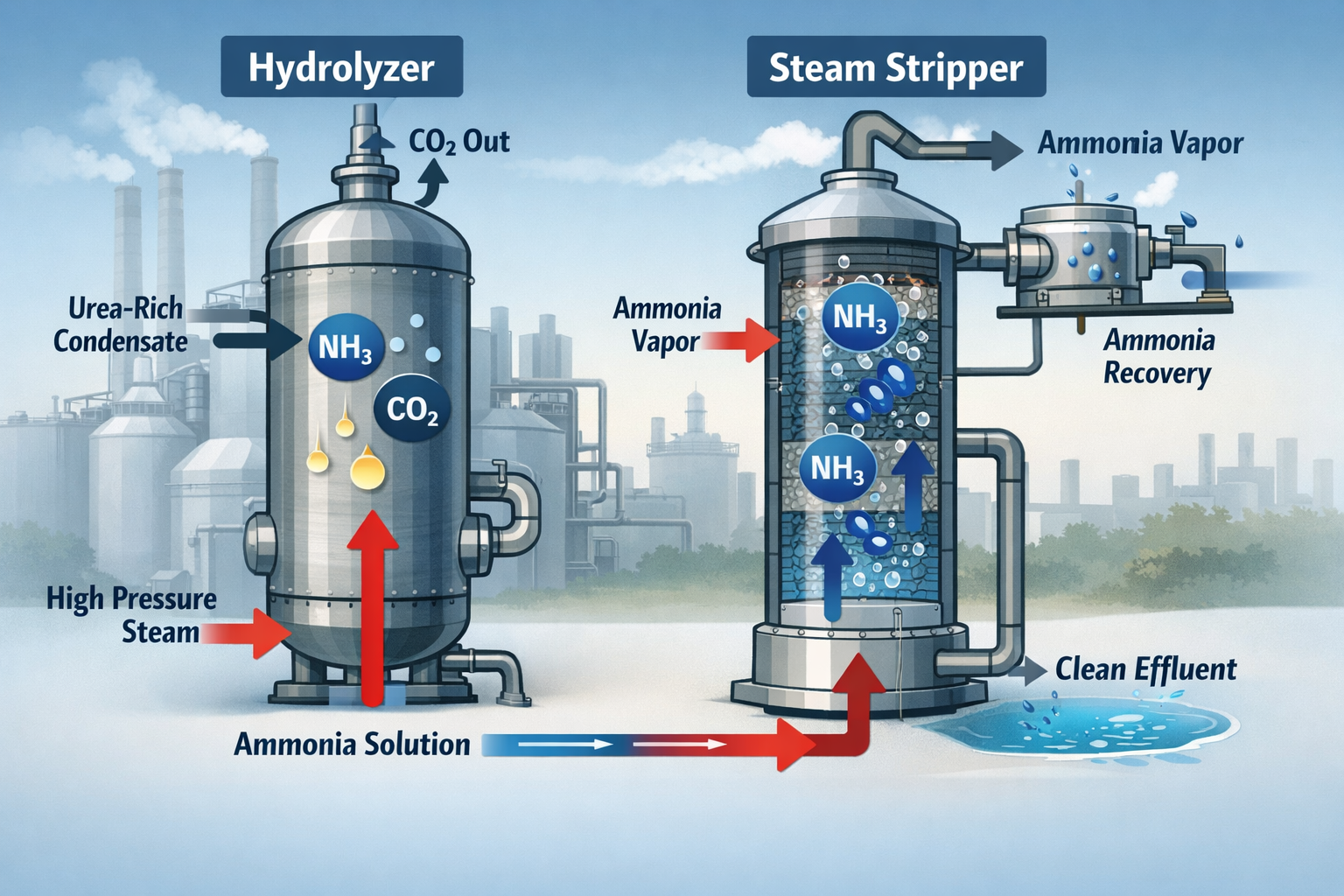
The catch: at multi‑g/L loads (and with residual urea present), conventional biological nitrification is impractical. The practical fix is a two‑stage chemical sequence—first, a hydrolyzer converts urea to ammonia and CO2 with steam and pressure; second, a steam stripper removes high concentrations of ammonia as a recoverable vapor.
Stage 1: Urea hydrolysis reactor
Principle: urea (CO(NH2)2) reacts with water to yield ammonia and carbon dioxide, i.e., CO(NH2)2 + H2O -> 2 NH3 + CO2. In a hydrolyzer, the condensate is heated under pressure with injected steam to drive the reaction.
At 1–2 bar (∼120–140 °C), non‑catalyzed hydrolysis is slow—measured in hours. One study showed complete hydrolysis of a 30 wt% (weight percent) urea solution required ~4 h at 140 °C and 0.4 MPa (megapascal) (pubs.acs.org). Higher pressures/temperatures—or catalysts—dramatically shorten residence time. A 1993 patent describes a two‑zone reactor at 3.8–7.5 MPa with a steam/liquid weight ratio up to ~0.2, achieving essentially full urea conversion in minutes (patents.google.com; patents.google.com), with urea “substantially converted to ammonia and carbon dioxide” (patents.google.com).
Design notes: fertilizer plants typically use high‑pressure steam already on site as the heat source. Moderate steam at ~0.4–0.6 MPa (saturation ~140–155 °C) works with longer contact times; higher pressures (1–5 MPa) cut reaction time to minutes (pubs.acs.org; patents.google.com). With an η‑Al2O3 (eta‑alumina) catalyst at 165 °C, residual urea has been driven below 5 mg/L—over 99.9% conversion (link.springer.com).
Typical continuous contact time is 1–5 minutes in a countercurrent reactor when well‑heated and pressurized (patents.google.com). Smaller plants may use a batch/autoclave approach; larger units favor falling‑film or bubble columns with internal heat exchangers. Adding 10–20% new steam by weight is common to supply heat and volatility, and an MW Kellogg design used fresh steam ~0.2× the urea condensate flow (patents.google.com).
Heat recovery is integral: the hot vapor leaving the hydrolyzer contains NH3 and steam and can be recycled (e.g., feeding back into reformers or generators) or used to preheat incoming condensate via heat exchangers. After hydrolysis, virtually all nitrogen sits as dissolved ammonia (NH4+/NH3); urea is eliminated, CO2 is released as vapor, and the effluent pH typically rises to ~8–9—though the next stage requires further pH adjustment.
Stage 2: Steam stripping of ammonia
Principle: pass superheated steam (no external air) countercurrently through a packed column (a tower filled with structured or random media to boost gas–liquid contact), and drive ammonium (NH4+) to free ammonia (NH3) under hot, alkaline conditions. The process functions like a high‑temperature distillation, and the NH3 departs with the steam vapor.
pH is the performance lever. Raise condensate to pH ≥ 11 with caustic (e.g., NaOH or lime). Above pH 10.8–11.5, virtually all ammonium converts to free ammonia (nepis.epa.gov). EPA guidance indicates pH ≈11 supports ~95% stripping (nepis.epa.gov). In practice, plants hold pH with a dedicated control skid, and precise caustic feed is typically delivered by a dosing pump.
Configuration: a countercurrent packed tower of roughly 7–8 m tall and 1–2 m diameter suits moderate flows. Feed water is heated to near‑boiling (70–95 °C) before entering at the top, and high surface‑area packing or trays promote transfer. As a performance yardstick, a 7.3 m tower treating ~28,400 m³/day achieved ~95% NH3 removal at pH 11.5 with 20 °C air stripping (nepis.epa.gov); with steam, comparable systems are expected to strip more efficiently.
Steam flow rates on the order of 0.1–0.2 kg steam per kg wastewater are typical. In a rotating packed bed (RPB, a high‑shear intensification of packed contactors) study, a steam:liquid mass ratio of ~0.175 delivered excellent recovery (www.mdpi.com). Operate near the boiling point; at ~100 °C, NH3 volatility is high. One study found raising liquid feed temperature from 25 to 85 °C (with steam overhead) did not significantly change removal, which stayed ~98% (www.mdpi.com).
Removal efficiency is robust: >90–95% is routine under proper pH and steam rates. EPA tests at pH 11.5 showed ~95% removal (nepis.epa.gov), and modern intensified designs (e.g., RPBs) report >98% (www.mdpi.com). Even at “ammonia‑rich” 5,000–20,000 mg/L feeds, steam stripping has demonstrated very high efficiencies (www.mdpi.com).
Ammonia recovery and handling
The overhead vapor—steam plus NH3—can be an asset. Absorb it in sulfuric or nitric acid to generate ammonium sulfate or nitrate, both valuable fertilizers. Alternatively, condense the vapor to make ammonium hydroxide liquor; in test operations, condensate up to 22.9 wt% ammonia was produced from a 2 wt% feed (www.mdpi.com). If recovery is not required, the NH3‑laden steam must be neutralized (e.g., with caustic scrubbers) or vented through a flare—uncontrolled emissions risk air quality violations.
Performance outcomes tie back to the math: with a properly sized stripper, final ammonia can fall to single‑digit mg/L. For example, 95% removal of a 1,000 mg/L NH3 feed leaves ~50 mg/L; using steam rather than air, removal can exceed 98% (www.mdpi.com). In one bench RPB test, 91→98% removal was achieved simply by optimizing the steam/liquid ratio and agitation (www.mdpi.com).
Integration, sizing, and chemistry
Heat integration is central. Steam for hydrolysis and stripping often comes from existing plant systems (e.g., high‑pressure extraction). Hot effluent streams preheat incoming flows, and plant waste‑heat boilers or economizers can supply the ~0.1–0.2 steam/kg wastewater needed while trimming fuel use.
Mass balance is straightforward: ~100% of nitrogen entering as urea/ammonia appears as ammoniacal gas overhead in the stripper. Column height and diameter scale with throughput and removal targets; EPA design data—e.g., 1–2 gal/min‑ft² hydraulic loading and 20–25 ft of packing—provide guidance (nepis.epa.gov). Pilot tests on a slipstream are recommended for atypical waste concentrations.
Chemical requirements hinge on pH. Stripping 1 kg of NH3 (≈0.85 kg NH4+) generally demands raising pH by about two units, roughly 0.85 kg NaOH per kg NH3‑N. While some NH4+ will strip near neutral pH, >95% removal practically requires ~pH 11–12 (nepis.epa.gov). Strategic recycle of a portion of the recovered, alkaline ammonia can offset caustic use.
Case data and regulatory context
High removal efficiencies are routine. Stripping towers deliver 90–98% NH3 removal when well‑designed; pilot systems show 95%–98% at pH ≈11–12 (nepis.epa.gov; www.mdpi.com). Raw effluents of 1–2% NH3 can be handled; one experiment processed 20,000 mg/L NH3 and concentrated it to a 22.9% solution (www.mdpi.com). Raising the steam‑to‑liquid ratio increased ammonia removal efficiency (ARE) by >10% in tests, reaching ~98% ARE (www.mdpi.com).
Typical effluent levels track with the removal percentage: with >90% removal, residual NH3 can be brought below 200 mg/L in difficult cases, or <50 mg/L with >95% removal. A Lake Tahoe tower (7.3 m tall) treating ∼28,390 m³/day reported 95% NH3‑N removal at pH 11.5 (nepis.epa.gov), and modern continuous‑steam columns are even more effective.
Recovered ammonia is a feature, not a bug. Literature reports condensates of 20–30% NH3 by weight (www.mdpi.com), offering reuse opportunities or conversion to ammonium salts that can offset chemicals and add potential revenue. The industrial scale of the challenge is clear: in 2012, Taiwan’s emissions were ~17,400 tons NH3‑N (www.mdpi.com), and “green ammonia” plus zero‑discharge targets are pushing fertilizer companies to this two‑stage playbook.
Robust design and polishing options
Redundancy is prudent: multi‑tray or double‑pass strippers can ensure >98% removal during upsets. A pH control skid and an off‑gas scrubber are standard risk controls; utilities, controls, and scrubbers are often packaged as wastewater ancillaries.
Materials matter. Ammonia and carbonate species can be corrosive; stainless steel and coated internals are typical in hydrolyzers and strippers. Continuous monitors for NH3 in influent and effluent (with pH conditioning) help verify >99% mass balance closure, while steam flow and temperature gauges keep the stripper on spec.
Compliance is local. Final treated water should be tested against site permits (e.g., Indonesia’s Class I/II industrial wastewater limits). If required, a small ammonia polishing step can knock out the last few mg/L: ion exchange systems are commonly applied, and a modular ion exchange unit with appropriate ion‑exchange resin can be added. Some plants alternatively opt for biological polishing (e.g., nutrient removal) when broader nitrogen species must be managed.
Why the two‑stage train sticks
In practice, the steam hydrolyzer plus steam stripper sequence addresses soluble nitrogen as urea and ammonia almost completely. It does not oxidize organic nitrogen or nitrates, but fertilizer condensates are typically low in COD (chemical oxygen demand) and high in inorganic nitrogen, making this method sufficient for compliance. The approach has become a standard solution for high‑strength ammonia wastewaters, balancing regulatory compliance with resource recovery, as supported by EPA technology reviews (nepis.epa.gov; nepis.epa.gov), engineering studies (link.springer.com; www.mdpi.com), and industry patents (patents.google.com; patents.google.com).