

Industry: Aquaculture | Process: Feeding_Systems
In an industry where feed accounts for 60–80% of production costs, how farms feed fish and shrimp can make or break margins. Traditional timer-based feeders drop rations on a fixed schedule — a rigid approach that amplifies over- or under-feeding when appetite ebbs and flows. Overfeeding pushes costs up and water quality down; excessive feed elevates pond pollution and management costs, as outlined by Kaushik (2000) (c.coek.info).
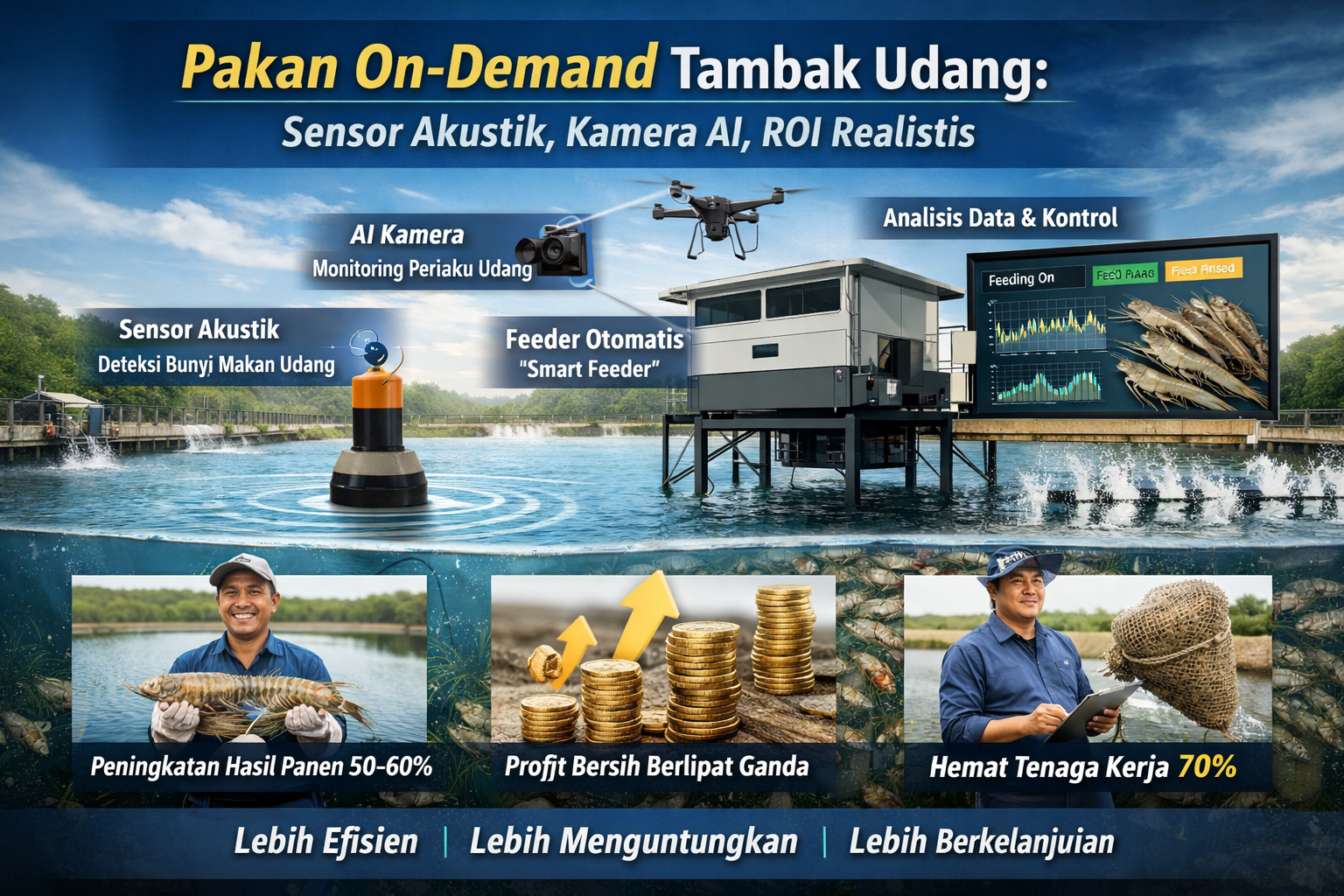
Automated “smart” feeders flip the script: acoustic sensors listen for appetite (shrimp jaw clicks), and camera or surface-motion systems watch fish behavior, then adjust in real time. Reviews note these systems “optimize growth, reduce feed waste, and enhance overall efficiency” versus manual or timer-based routines (doaj.org). Early deployments are delivering hard savings: an AI vision pilot in Malaysia cut manual feeding time by 70% and reduced feed waste by 20% (searca.org).
Traditional and sensor-based feeding
Timer-based feeders are simple to run but feed regardless of appetite signals. Sensor-led systems feed when animals are actively eating and halt when they stop, minimizing leftovers. In practice, this means responding to shrimp jaw clicks or fish surfacing patterns instead of the clock. The result: smaller, more frequent portions that are consumed quickly — less leaching, less waste (c.coek.info).
Growth, FCR, and waste outcomes
Controlled trials show the production upside. In pond‑cultured Pacific white shrimp, switching from twice‑daily hand feeding (Standard Feeding Protocol, SFP) to multiple automated feedings drove final shrimp weights from 19.7 g (2×/day SFP) to 32.0 g with an acoustic “feed-on-demand” system (c.coek.info). Yield climbed from ~4,843 kg/ha to 7,430 kg/ha — roughly a 50–60% harvest increase per area (c.coek.info), and partial farm profit (shrimp value minus feed cost) roughly doubled from ~$27,844/ha to ~$56,846/ha (c.coek.info).
Feed conversion ratio (FCR, feed per unit weight gain) is not guaranteed to plunge. In the same trial, survival and FCR were statistically unchanged at ~1.1–1.2 across treatments (c.coek.info). A moderate increase in feed frequency (Timer 6×/day) slightly improved FCR (1.07 vs. 1.13), whereas the extensive acoustic feeding (highest feed amount) delivered FCR ~1.24 (c.coek.info). More feed was used overall — from ~5,250 to 9,002 kg/ha — but it translated into more and larger shrimp rather than waste, enabled by a higher daily feeding rate spread over six feedings (c.coek.info) (c.coek.info).
Waste and water quality moved in the right direction. Delivering feed 4–6 times/day led to fewer low‑oxygen events — a proxy for lower organic load — versus less frequent schedules (c.coek.info). In Malaysia’s AI‑enabled case, farmers reported ~20% less feed waste and 70% less feeding labor (searca.org).
Even small FCR improvements matter at scale. Models for Mediterranean sea bass farms assumed up to a 5% FCR improvement from centralized auto‑feeders (onlinelibrary.wiley.com). Industry estimates note that a 5% FCR improvement can pay for the system within a few years (fishfarmfeeder.com) (onlinelibrary.wiley.com).
Costs, savings, and payback
Upfront costs matter — and so does the return. Advanced feeders often run $1,000–$3,000 per unit, plus software in some cases. A four‑pond acoustic setup carried ~$15,920 in initial hardware and ~$1,725 in annual licensing (c.coek.info). In the referenced shrimp trial, the system’s yield advantage translated into a per‑hectare revenue gain of about $28,000 versus hand feeding (c.coek.info) (c.coek.info).
Economic modeling backs the trend line. For European sea bass (floating cages), auto‑feeders raised net operating profit across farm sizes: by €383,600/year (15%) for large farms (2,500+ t/yr, tonnes per year), and by ~€31k/year and €7.9k/year for medium (1,100 t/yr) and small (413 t/yr) farms, respectively (onlinelibrary.wiley.com). Payback periods often land under five years. Industry advice is to target a three‑year payback: if cumulative feed and labor savings over three years match or exceed the purchase cost, the investment is justified (fishfarmfeeder.com).
Two levers dominate: feed and labor. Many analyses assume a 1–5% feed‑efficiency gain or at least a 5% feed reduction (onlinelibrary.wiley.com) (fishfarmfeeder.com). With feed often ~$1.00/kg or more, each saved kilogram drops straight to the bottom line. Labor‑wise, a centralized automated feeder can be run by a single person, whereas fixed feeders may require many attendants (fishfarmfeeder.com). The Malaysian pilot’s 70% labor cut underscores the point (searca.org).
Species and life‑stage fit
Acoustic systems are proven in shrimp, but animals must be large enough to trigger sensors: above ~2 g, and optimally >5 g (c.coek.info). Finfish like tilapia or catfish may be better served by sight‑based or buoy/surface‑motion sensors. The Malaysian AI vision pilot gauged biomass to adjust feeding (searca.org), while commercial systems often use simpler IR (infrared) or water‑surface‑motion inputs.
Water conditions and clarity
Acoustic systems work best in relatively quiet water; heavy aeration can mask shrimp clicks. Camera systems need clear water and adequate lighting; turbid ponds may favor hydrophones (underwater microphones) or sonar‑style methods. Clear‑water operations intersect with filtration categories such as ultrafiltration, though the feeding sensors themselves drive the appetite signal.
Power, connectivity, and ancillaries
Feeder infrastructure needs reliable power and connectivity. Solar/battery units exist but may limit capacity. Some systems integrate data over cellular IoT (Internet of Things); for example, eFishery in Indonesia connects devices via mobile networks (scribd.com). Many farms layer feeder telemetry with water‑quality sensors — pH and DO (dissolved oxygen) — to refine feed algorithms. Farms also standardize the broader utility gear; see supporting categories such as water treatment ancillaries when planning site services.
Cost, scale, and rollout
Small farms can pilot a single automated feeder to test the thesis; larger operators may opt for centralized blowers or networked feeders. Compare vendor feed capacities and throw range, and calculate ROI assuming only 5% feed savings plus any labor savings — a conservative starting point. Enterprise budgeting tools (e.g., Nichols & Allen 2013) help track the deltas in feed, labor, and growth.
Operational controls and safeguards
Calibration is essential. Align the system with local feed size and animal behavior, then watch the first days closely to ensure feeders stop when feeding ceases. Many systems enforce safe daily feed caps to prevent runaway dosing. Keep feed‑tray checks or manual spot‑feeds during ramp‑up, and use production data to refine thresholds so wind‑driven ripples are not misread as appetite.
Regulatory and traceability context
While few jurisdictions mandate feeder types, many regulate effluent and waste discharges. Automated feeders support compliance by reducing organic input. In Indonesia, managing feed efficiency aligns with government goals for sustainable aquaculture (no specific bans are cited, but waste discharge limits apply). Smart‑system traceability can aid certification or farm management programs. For adjacent equipment planning, farms review wastewater ancillaries as part of site compliance.
Case results and practical takeaways
Results tend to rhyme: FCR may stay flat or improve slightly, while yields jump. A semi‑intensive shrimp upgrade to on‑demand feeding reported no FCR loss but a 60% production gain (c.coek.info). The Malaysian AI pilot delivered 70% less labor and ~20% less feed waste (searca.org).
Summary of best practices
- Match sensor to farm: acoustic feeders for shrimp (above PL size), vision/IR for clear‑water fish, timed feeder enhancements with appetite sensing for murky waters.
- Plan feed budget: calculate expected feed savings (1–5%) and labor savings, compare to equipment cost. Target payback ~3 years (fishfarmfeeder.com).
- Monitor and adjust: use feed trays or cameras initially to verify automated feeds. Refine algorithms to avoid underfeeding or overshooting.
- Integrate with management: incorporate feeder data into dashboards (water quality, growth curves) for holistic optimization.
- Gradual roll‑out: pilot on a subset of ponds or cages, measure FCR and yields, scale up as reliability is proven.
In sum, modern feeding technologies — from acoustic feeders to AI‑vision systems — have been shown to markedly increase production and profitability by matching feed to appetite. Typical ROI analyses and real‑world trials indicate payback in a few years once feed and labor savings are counted (onlinelibrary.wiley.com) (fishfarmfeeder.com). Adopting the right system for species, scale, and conditions can optimize FCR in practice and sharply reduce wasted feed — with attendant environmental benefits (c.coek.info) (searca.org).
Sources: Controlled shrimp pond trials in Aquaculture (2019) compared timer‑based vs. acoustic feeding (AQ1 system), quantifying growth, FCR, yields, and economic value (c.coek.info) (c.coek.info). An economic study (J. World Aquacult. Soc. 2023) analyzed ROI for automatic feeders in sea bass farms (onlinelibrary.wiley.com) (onlinelibrary.wiley.com). Supporting context on labor and feed waste reductions appears in SEARCA reporting and vendor ROI notes (searca.org) (fishfarmfeeder.com).