

Industry: Landfill | Process: Wastewater_Treatment
There is nothing “dilute” about some landfill leachates. Studies report sodium up to ~10,900 mg/L and ammonium ~13,000 mg/L in tropical sites, with electrical conductivity (EC, a salinity proxy) ranging 3–41 mS/cm (pmc.ncbi.nlm.nih.gov). In Indonesia, the rulebook centers on organics—Permen 59/2016 sets BOD (biochemical oxygen demand) ≤150 mg/L and COD (chemical oxygen demand) ≤300 mg/L—without explicit salt limits (www.researchgate.net).
Salt matters biologically: biogas production drops above ~35 mS/cm (≈22 g/L), and conventional treatment strains under that load (pmc.ncbi.nlm.nih.gov). The design choice is stark—either acclimate microbes to the salinity, or remove the salts physically with membranes and, if needed, zero liquid discharge (ZLD). For operators standardizing around membranes, integrated membrane systems have become the technical anchor.
Salt‑tolerant biological consortia
Biology can work if the community is halophilic or halotolerant (salt‑loving/tolerant) and carefully acclimated. Salt‑tolerant consortia (e.g., Pseudomonas, Bacillus spp.) delivered ~80% COD reduction at 8% NaCl (≈80,000 mg/L) in tannery‑like effluent, whereas ordinary sludge lost efficiency above ~8,000 mg/L salt (pmc.ncbi.nlm.nih.gov) (pmc.ncbi.nlm.nih.gov).
Reactor selection does the heavy lifting. Membrane bioreactors (MBR, biology coupled with membrane solids separation) or long‑SRT sequencing‑batch reactors (SBR, time‑sequenced fill–react–settle cycles) help retain slow, salt‑stressed biomass. Rapid salinity jumps of just 0.5–2% can halt microbial activity, so shocks are a known failure mode (pmc.ncbi.nlm.nih.gov). Where engineers choose packaged units, platforms such as membrane bioreactors (MBR) or a sequence batch reactor (SBR) provide the needed solids retention.
Constructed wetlands and evapotranspiration beds
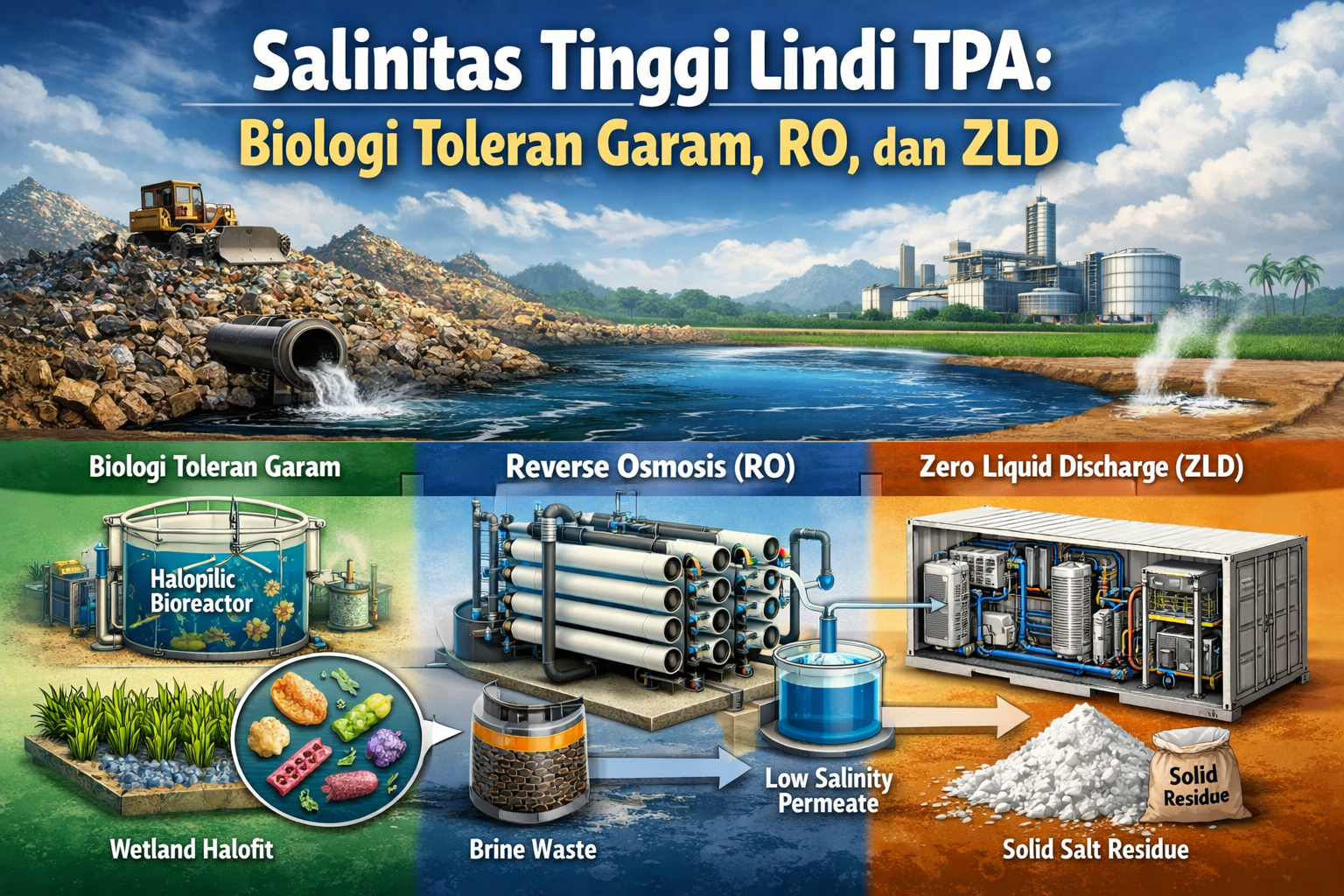
Halophyte‑planted wetlands offer low‑energy polishing, and reviews note salt‑tolerant plants can treat saline wastewater with high efficiency (www.sciencedirect.com). Willow/halophyte evapotranspiration (ET) beds have been modeled: in a humid climate, landscaped area may need ≈0.5–0.7× the collection area, and a wetland ET/rainfall ratio ≥1.5 supports ZLD‑like performance (www.sciencedirect.com).
Energy savings and useful biomass are positives, but land requirements are large and climate dependency is material (www.sciencedirect.com) (www.sciencedirect.com). And even acclimated systems slow as TDS climbs past 10–20 g/L; kinetics lengthen and organics removal can stall at very high salinity (pmc.ncbi.nlm.nih.gov).
Reverse osmosis desalination performance
Reverse osmosis (RO, a pressure‑driven membrane that rejects ions) strips out dissolved salts and most organics. Pilot studies report ~95–97% salt rejection. In one tubular RO test, a leachate at 8,975 mg/L TDS yielded permeate at 348 mg/L (≈96.1% removal), with COD and metals similarly reduced (~97% COD removal), meeting discharge standards except for ammonium, which passes through and typically needs separate removal (www.scielo.org.za) (www.scielo.org.za). In practice, RO produces permeate with TDS <300–500 mg/L from feeds of several g/L.
Typical recovery is 70–80% permeate, leaving a 20–30% brine with >90% of the salts for downstream management. High‑salinity feeds demand high‑pressure membranes (80–100+ bar). For small flows, “ship‑in‑a‑box” containerized RO modules are used. Plants standardize on brackish-water RO for moderate salinity, and upgrade toward sea-water RO when osmotic pressures climb.
RO economics and operations
Costs are non‑trivial. A full‑scale Brazilian landfill RO (50 m³/h) carried ~US$1.4 million CAPEX and OPEX of US$0.13–0.27 per m³·yr, averaging about US$8.6 per m³ over 20 years (journals.sagepub.com). In South Africa, a 250 m³/d tubular RO was estimated at ZAR1.95 million CAPEX and ZAR11.45/m³ O&M—on the order of US$7–8/m³ (www.scielo.org.za). RO is often cited as the “best available technology” for salt removal, yielding nearly pure water (www.scielo.org.za), but membranes foul on organics/humics unless pretreated, energy demand runs ~1–3 kWh/m³, and a brine concentrate remains for handling.
To manage variable flows or temporary needs, utilities increasingly deploy containerized units; rental fleets of containerized systems such as rental units make RO capacity portable during peak leachate seasons.
Zero liquid discharge (ZLD) pathways
When permits, receiving waters, or site constraints make brine discharge untenable, ZLD closes the loop by evaporating or crystallizing all water. In these trains, RO concentrate feeds thermal concentrators or specialized systems; vapor is condensed and salts precipitate as solids (NaCl, gypsum, or other salts) for disposal. Industry guidance describes brine concentrators plus crystallizers that “turn the brine into highly purified water and solid dry product ready for disposal” (www.lenntech.com). Natural evaporation ponds or evapotranspiration wetlands can contribute in favorable climates, though mechanical/thermal steps are usually required for full recovery.
The energy math is blunt. Classical distillation needs ~2,200 kJ per kg of water removed, while a novel pipe‑freeze crystallizer reported ~330 kJ/kg—around seven times lower (pmc.ncbi.nlm.nih.gov). Multi‑effect evaporators commonly draw ~10–30 kWh/m³ of water; pilot freeze crystallization reported ≈171 kWh/ton of ice (water) (pmc.ncbi.nlm.nih.gov). By contrast, RO uses ~1–3 kWh/m³.
Freeze crystallization case study
A South African “pipe freeze crystallization” pilot treating hazardous leachate (8,750 m³/yr) demonstrated high recoveries: freezing 302 L of brine yielded 102.9 kg Na₂SO₄ crystals; freezing 273 L produced 118.7 kg of high‑purity ice (clean water) (pmc.ncbi.nlm.nih.gov). That equated to ~0.43 kg water per liter of leachate and ~0.34 kg salt per liter, and was 40% more cost‑effective than conventional evaporation (pmc.ncbi.nlm.nih.gov).
System designs range from large‑area ponds (with leak risks) to compact, containerized evaporator/crystallizer modules that treat limited flows on‑site. Natural solutions persist: models indicate a willow ET bed sized at ~0.6× the waste area can achieve ZLD over years, with ample storage and land (www.sciencedirect.com). The trade‑off is clear—ZLD eliminates all liquid discharge (only solid salts remain) at the cost of high CAPEX/OPEX.
Outcomes and compliance lens
After RO and crystallization, solids are largely mineral salts (NaCl, gypsum). From a permit standpoint, ZLD meets any salt (and organic) discharge limit by design—there is no liquid effluent. Energy use rises sharply, and salt cake handling becomes the final logistics step. In chloride‑stringent, permit‑driven scenarios, ZLD is often the only compliant path without discharge.
A containerized Zero‑Liquid‑Discharge (ZLD) wastewater treatment plant (modular evaporator/crystallizer) captures all leachate water as condensate and leaves solid salts for disposal (www.lenntech.com).
Sources: Recent technical studies and reviews are used throughout (www.scielo.org.za) (journals.sagepub.com) (pmc.ncbi.nlm.nih.gov) (pmc.ncbi.nlm.nih.gov). Indonesian regulations and local data (Permen 59/2016) are cited for context (www.researchgate.net), while international research provides performance numbers for biological and membrane processes (pmc.ncbi.nlm.nih.gov) (www.sciencedirect.com). Each treatment option’s capacities, costs and limits are supported by data from peer‑reviewed and industry sources (www.scielo.org.za) (journals.sagepub.com) (pmc.ncbi.nlm.nih.gov) (pmc.ncbi.nlm.nih.gov).