

Aquaculture intake lines live in seawater, UV, and biofouling — a trifecta that eats metal for breakfast. The winning playbook pairs inert plastics and composites with coatings and cathodic protection so critical infrastructure lasts decades, not years.
Industry: Aquaculture | Process: Water_Source_&_Intake_Treatment
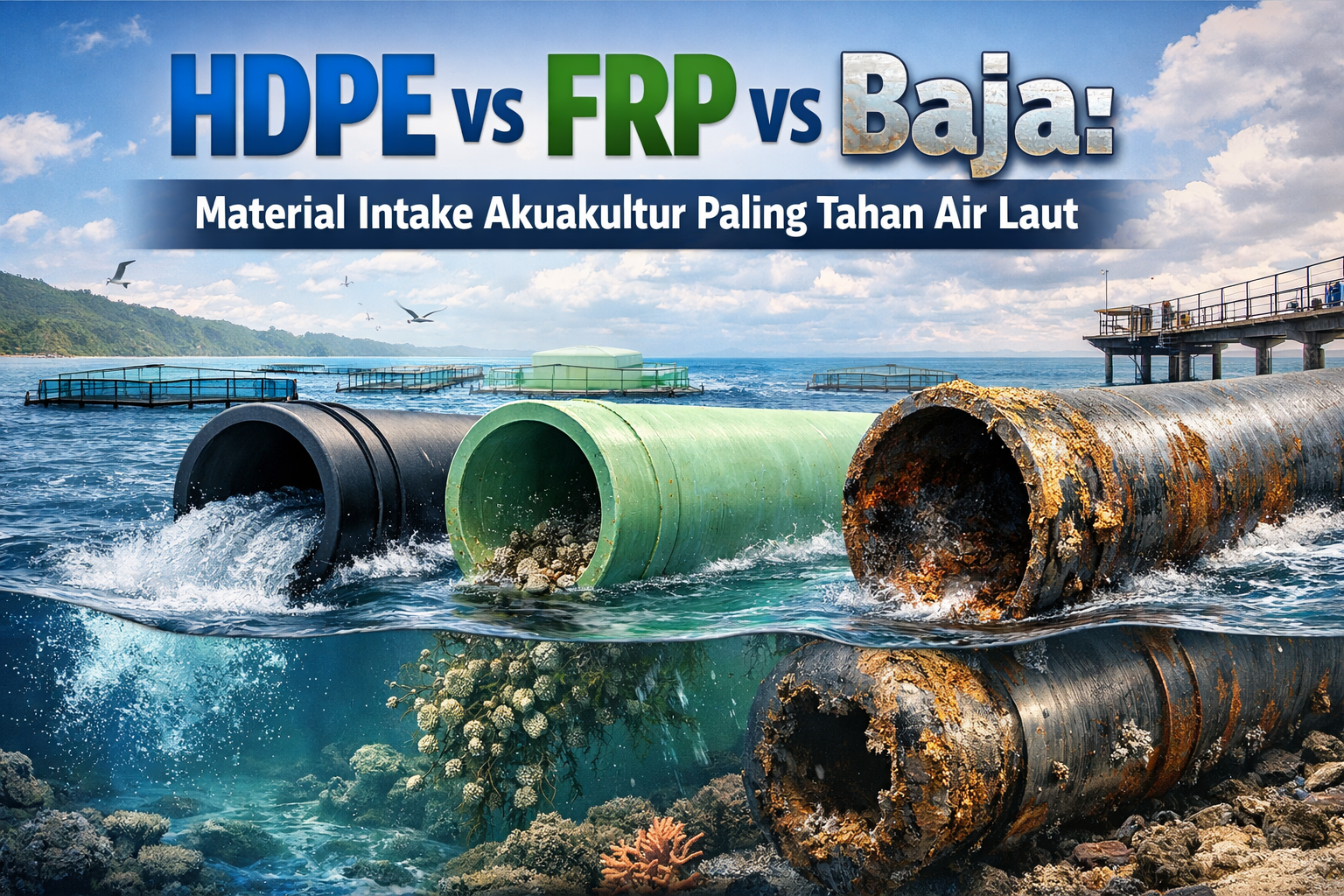
Marine intakes are an endurance sport. Salinity, biofouling, and sunlight punish materials daily, and that makes the material choice for intake pipelines a budget decision as much as an engineering one. Plastics (PVC, HDPE) and composites (FRP) don’t corrode in seawater; metals do — unless they get serious protection. The trade-off is durability versus cost and weight, with plastics usually winning on total life-cycle cost.
Industry guidance highlights the split: PVC and HDPE resist acids, solvents and UV, with PVC cited as lasting more than 50 years in service (sinopipefactory.com) and HDPE widely documented for long service life (hz-marine.com). FRP (fiberglass-reinforced plastic) is engineered for corrosion resistance and typically runs two to three decades depending on resin (cbrofiberglass.com; hbrunlinhb.com). Metals such as 316L stainless, copper‑nickel, and duplex steels offer strength but demand coatings and cathodic protection to avoid pitting, crevice, and galvanic attack.
PVC pipelines: low cost, long service
PVC (polyvinyl chloride) is inert and smooth — its roughness is about ~0.009 — and it does not rust or leach heavy metals (xdfpipe.com). In aquaculture plumbing, common diameters are Ø110–200 mm with pressure ratings of 0.63–1.0 MPa (megapascal, a pressure unit) (xdfpipe.com). Industry sources place PVC systems at 50+ years of life under normal conditions (sinopipefactory.com; sinopipefactory.com). It’s relatively inexpensive, needs no corrosion coatings, but it is rigid (handling and diameter limits) and susceptible to UV degradation if unprotected outdoors — modern formulations include UV stabilizers.
Where intake heads rely on debris barriers, facilities often select intake screens; automated options such as an automatic screen align with the PVC approach by reducing maintenance at the front end.
HDPE in open water service
HDPE (high-density polyethylene) is flexible, impact-resistant, and highly resistant to seawater, chemicals, and UV (Frontiers in Marine Science; hz-marine.com). It is generally lighter and more cost‑effective than metal pipe (hz-marine.com) and is already a “gold standard” in marine aquaculture for cages, intakes, and mooring because of its durability. Typical design life is 50 years, with some buried potable water applications expected to exceed 100 years (hz-marine.com), and coastal projects have credited HDPE with “high durability up to 50 years” (hoasengroup.vn).
HDPE is non‑toxic, does not corrode or impart contaminants, and installs quickly via fusion welding with leak‑free joints that reduce installation and maintenance cost (hz-marine.com). Long‑term failure modes include exterior abrasion or slow environmental cracking, but these are rare in water service when quality resin (PE100 grade, a high‑strength polyethylene specification) is used.
FRP composites in seawater
Fiberglass‑reinforced plastic (FRP) — a glass fiber reinforced composite using polyester, vinylester, or epoxy resin — offers excellent seawater resistance. It does not rust and, if properly made, forms no fouling‑enhancing charging layers (tencom.com). Industry estimates place FRP piping life at roughly 20–30 years in marine exposure (cbrofiberglass.com; hbrunlinhb.com), with some vendor claims reaching 30–40 years but a conservative value of ~20–25 years under heavy use (same sources). It is heavier and stiffer than HDPE, often cheaper than exotic alloys, dimensionally stable in strong currents, and requires minimal maintenance due to near‑zero corrosion. Drawbacks include potential UV or mechanical fatigue over decades; it performs best where mechanical impacts are limited or where coatings/liners protect it.
For high‑pressure sections and chemical resistance, FRP housings are a common choice; in those cases, facilities pair composite housings such as a fiberglass filter with corrosion‑resistant piping.
Corrosion‑resistant alloys and budget impact
Metals in seawater include austenitic stainless steels (e.g., 316L), duplex steels (e.g., UNS S31803), copper‑nickel (90/10 or 70/30 CuNi), titanium, and aluminum bronze. These alloys can perform well if designed correctly — 316L is pitched as resistant to acids/alkalis and is widely used in saltwater plumbing (Frontiers in Marine Science) and CuNi is a traditional marine alloy. In practice they still need protection to prevent pitting, crevice corrosion, and galvanic attack. Initial cost is far higher — often several times that of plastics — and a 316L line may cost an order of magnitude more per meter than HDPE of the same size. Well‑protected, such alloys can last 30+ years.
Where stainless housings are required around intake polishing equipment, engineers often specify 316L hardware; an example is a 316L stainless steel cartridge housing in saline contact points.
Baseline lifetimes and relative costs
Without extra protection, baseline lifetimes are roughly: PVC ≈ HDPE ≈ 50+ years; FRP ≈ 20–30 years; and bare metal ≈ 10–20 years (subject to alloy). PVC pipes in civil service are widely cited to last “more than 50 years” (sinopipefactory.com). HDPE’s expected life is 50–100 years (hz-marine.com). FRP comes in at two to three decades (hbrunlinhb.com; cbrofiberglass.com). Material costs generally scale inversely: PVC and HDPE are cheapest per unit length (HDPE is comparable or slightly more than PVC), FRP is mid‑range, and corrosion‑resistant steel or alloy lines may cost 3–10× more even without coatings. Plastics also avoid ongoing painting or anode replacement costs; metal lines incur those expenses. For context, data for piping materials in potable water projects show HDPE outperforming copper or steel in expected life, with copper‑nickel and duplex steels falling into a higher‑end category beyond that chart’s scope (hz-marine.com).
Protective coatings: thickness and performance
Coatings are the first line of defense for metals and also used on FRP. High‑performance linings — fusion‑bonded epoxy, vinyl ester, polyurethane — create films thicker than 100 µm that electrically isolate steel from seawater. Standard potable‑water pipelines often use about 400 µm epoxy linings expected to last 20–30 years before recoating. Intact coatings can reduce corrosion rate by 90–99%. The cost of coating (material plus labor) typically runs 10–20% of pipe cost but can extend service life by decades. If coatings fail (cracks, holidays), localized corrosion can occur unless cathodic protection is also applied.
In high‑pressure duty where metallic housings are unavoidable, sites pair coatings with robust hardware such as a high‑pressure steel filter housing to manage differential pressure without sacrificing protection.
Cathodic protection systems (CP and ICCP)
Cathodic protection (CP) is an active corrosion‑prevention method for submerged metals. Sacrificial anode CP — usually zinc or aluminum — is common for smaller structures. Anodes are sized to corrode preferentially; typical designs aim for anode lifetimes of 15–30 years, matching the intended service interval (cathwell.com). Fixed harbor and subsea structures use sacrificial systems with design lives of 15–30 years (same source). Alternatively, impressed‑current CP (ICCP), which uses an inert anode and a DC power source, protects large or complex systems such as intake tunnels; with proper control, it can run indefinitely.
CP can cut corrosion current nearly to zero, making steel behave as if it were resistive. The impact is stark: an uncoated steel might survive only ~5–10 years in seawater, but with coatings plus CP it can reach 30+ years.
Measured outcomes and adoption trends
The combination of inert materials and active protection delivers quantifiable results. A seawater intake using FRP (20‑year life) might require replacement after two decades, whereas an equivalent steel line with epoxy and CP can last at least 30–40 years before major refurbishment. HDPE lines often run for 20–30+ years without significant maintenance. Lifecycle cost analyses — installation, maintenance, replacement — consistently show plastics (HDPE/PVC) having lower total cost of ownership for saline water service (hz-marine.com). Regulatory and field reports note growing adoption of HDPE cages/piping in SE Asia precisely because of greater durability (storm resistance, no rot) and lower maintenance, as opposed to traditional wood or untreated steel designs (hoasengroup.vn; hoasengroup.vn).
Design takeaways and equipment choices
For marine aquaculture intakes, HDPE and PVC are first choices for long intake conduits because of corrosion immunity and 50+ year life (sinopipefactory.com; hz-marine.com). FRP fits where higher stiffness is needed (e.g., high‑pressure filters) and a moderate 20–30 year lifespan is acceptable (cbrofiberglass.com; hbrunlinhb.com). Exposed metal (screens, valves) should be specified in marine‑grade alloys (316L, CuNi, or duplex) plus heavy‑duty coatings and a planned CP system — these ensure multi‑decade operation at higher upfront cost.
On components, many operators standardize composite housings where possible — for example, a PVC‑FRP cartridge housing — and reserve metallic internals for critical points. Where stainless or FRP housings are already in the spec, a balanced bill of materials often includes supporting items from water‑treatment ancillaries to simplify maintenance logistics.
Analytical design should quantify expected material costs, coating and CP expenses, and align these with targeted life (e.g., 30–40 year design life). Using data‑driven comparisons — PVC/HDPE ~50–100 year life (sinopipefactory.com; hz-marine.com) versus FRP ~20–30 years (hbrunlinhb.com; cbrofiberglass.com), and anode life ~15–30 years (cathwell.com) — engineers can predict replacement intervals and maintenance budgets with confidence.