

Industry: Nickel_Mining | Process: Froth_Flotation
Nickel sulfide ores (pentlandite, violarite, etc.) are floated to produce Ni–Cu—and often PGM—concentrates. Modern plants typically achieve ~85–90% Ni recovery with bulk sulfide flotation after grinding to ~–150 μm (sciencedirect.com). Global Ni supply (~3 Mt/year) is >50% from Indonesia (primarily laterites), but sulfide flotation remains crucial where Ni is locked in mixed sulfides (nickelinstitute.org).
Optimizing the reagent suite—collectors that hydrophobize target Ni sulfides, depressants that keep iron sulfides and silicate gangue at bay, and frothers that stabilize the froth—is where recovery and grade are won. Collector choice is based on mineralogy (Cu/Ni/Co vs Fe-sulfide content), depressants target gangue minerals (pyrite, pyrrhotite, silicates etc.), and frother dosage is tuned to generate a stable froth; environmental and regulatory constraints (especially on cyanide use) also influence reagent selection (sciencedirect.com) (cyanidecode.org) (iea.org).
Selective collector chemistry and dosing
Thiol-based collectors dominate: xanthates (e.g., potassium amyl xanthate, PAX) and dithiophosphates (DTP) or dithiophosphinates, often supplemented by thionocarbamates/thiocarbanilides. Xanthates are powerful but not highly selective—PAX will float pyrite and pyrrhotite if over-dosed. Using shorter-chain xanthates can improve selectivity (sciencedirect.com).
At Raglan, a Canadian Ni–Cu–PGM operation, running PAX produced ~16% Ni concentrate at ~86.8% recovery; switching to sodium isobutyl xanthate (SIBX) raised Ni recovery by ~1% (and Cu/PGE recoveries by several percent) (sciencedirect.com). Other collectors add selectivity or recovery: dithiophosphates (e.g., diethyl or diisobutyl dithiophosphate such as Aero 3501, an amyl DTP) tend to preferentially float Ni/Cu minerals over iron sulfides. In Zimbabwe’s Trojan concentrator, adding an amyl dithiophosphate plus SIBX in scavenger cleaning improved middlings Ni and Cu recovery over PAX alone (sciencedirect.com).
Thionocarbamates are another lever: in one test, a thionocarbamate collector achieved a much higher Ni recovery (~76.8%) than PAX (33.2%) (patents.google.com). Mixed-collector systems are common to balance strength and selectivity; South African PGM plants found the best Ni/Cu→Pt separator recovery at ~1 part xanthate to 2 parts DTP by mass (sciencedirect.com).
Collectors are typically used at low doses (on the order of 25–100 g/t of ore); excessive dosing of strong collectors can bring up unwanted pyrite and waste material. Low-dose regimes put a premium on accurate chemical dosing hardware; operations that standardize on precise metering often turn to dedicated equipment such as a dosing pump.
Depressants for pyrite and pyrrhotite control
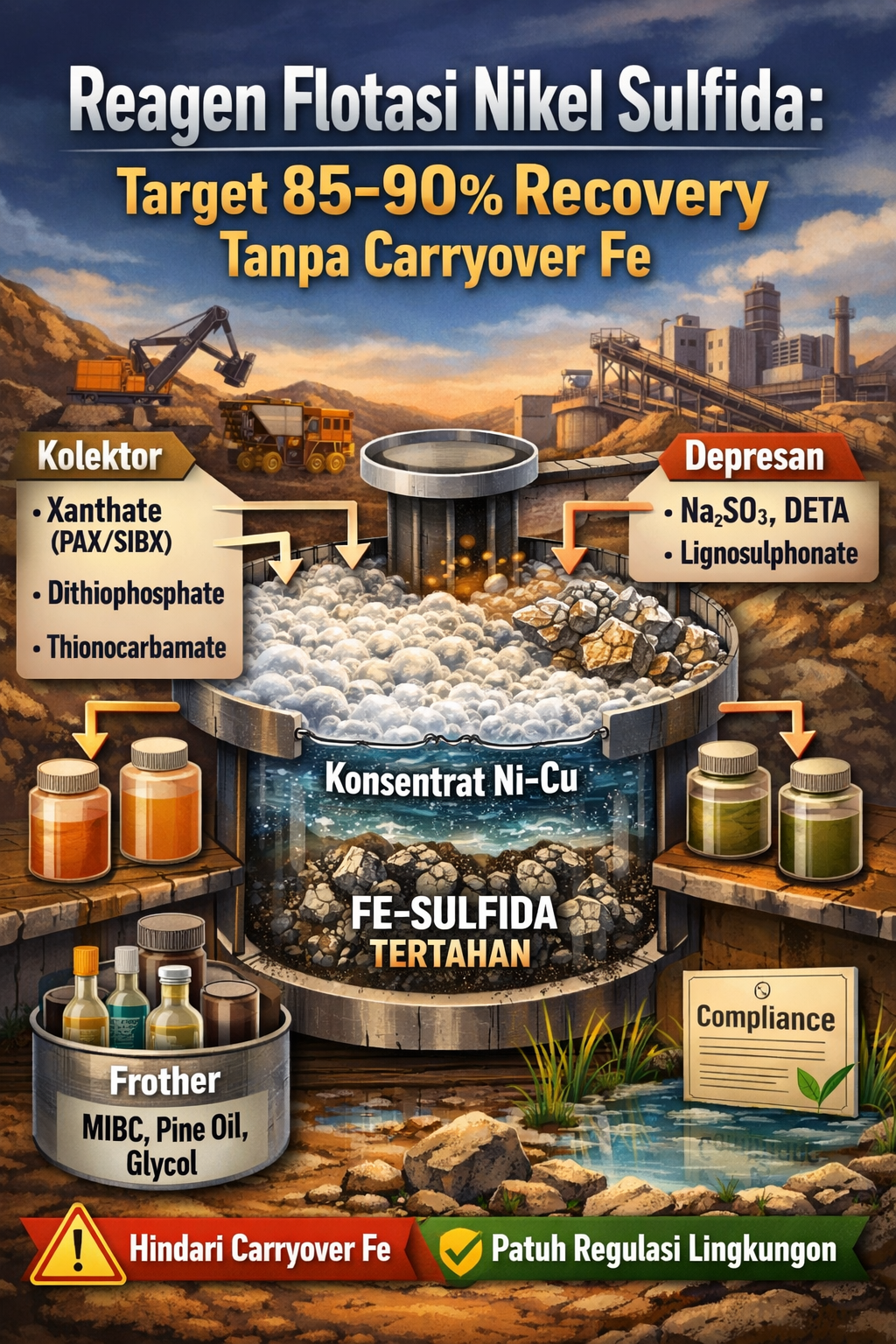
Unwanted Fe-sulfides—pyrite (FeS₂) and magnetic pyrrhotite (Fe₁₋ₓS)—and silicate gangue are held back with depressants. Common choices include sodium cyanide, sodium sulfide (Na₂S) or bisulfide (NaHS), high-pH agents like lime (CaO), polymeric starches or dextrins, and lignosulphonates. Multi-reagent schemes are typical for synergy (trea.com).
A proven scheme for Cu–Ni sulfide ores uses staged treatment: (1) sodium sulfite or bisulfite (Na₂SO₃/HSO₃⁻) followed by (2) a polyamine such as diethylenetriamine (DETA) or a polymer such as polyacrylate. The sulfite first pre-activates or partially oxidizes pyrrhotite, and the polyamine cleans up residual pyrite surface activity. Classic regimens use 50–400 g/t of sodium sulfite plus tens of g/t of polyamine (trea.com) (trea.com).
Recent work highlights multi-depressant synergies. A “baseline” scheme of 50 g/t DETA + 200 g/t Na₂SO₃ depressed pyrrhotite acceptably; by adding 50 g/t of a calcium lignosulphonate (LignoTech D-912) and reducing DETA to only 15 g/t (with 200 g/t Na₂SO₃ unchanged), the flotation performance (Ni/Cu recovery and pyrrhotite depression) was maintained—representing >50% savings in polyamine usage. Without lignosulphonate, 50 g/t DETA was needed for the same depression (trea.com) (trea.com).
Specifics matter: sodium cyanide is very effective on pyrite (forming ferrous ferrocyanide) and is used in some Ni/Cu plants, though its use is heavily regulated (cyanidecode.org). Lime addition to raise pH to ~10–11 generally suppresses pyrite and pyrrhotite surface activity. In some circuits carboxymethylcellulose (CMC) or starches/guar are added to depress slimes and silicate gangues (trea.com).
Frother selection and water chemistry effects
Frothers—foam stabilizers—let Ni-laden bubbles reach the surface. Common choices include MIBC (methyl isobutyl carbinol), pentanol, pine oil, tert-butanol, and polyglycol ethers (e.g., Dow 200/250 series). They are dosed at ~20–60 g/t to generate fine bubbles. One flotation test used a 1:1 mix of MIBC and pine oil at 50 g/t; another used ~60 g/t of a mixed glycol frother. Heavier “cresylic”-type frothers may be used at higher doses (e.g., 100–150 g/t) for very fine feeds. MIBC and glycols tend to produce fine bubbles and stable froth that capture fine pentlandite and chalcopyrite; pine oil tends to give coarser froth, which can help wash out gangue (patents.google.com) (patents.google.com).
Water chemistry is not background noise. Divalent ions (Ca²⁺, Mg²⁺) and sulfate greatly stabilize froth: salt solutions containing Ca²⁺ or Mg²⁺ gave higher foam height and slower drainage than Na⁺ solutions; adding Ca²⁺ or Mg²⁺ raised water recovery in a froth flotation test, whereas Na⁺ gave lower recovery (mdpi.com). In practice this means hard mining water or recycled process water often produces a denser, longer-lasting froth. Controlling water hardness/pH can enhance floater performance—and is one reason many concentrators consider upstream hardness control with a softener. Stable froth (with small bubbles and slow coalescence) is generally desired for Ni sulfide, since it directly correlates to higher Ni recovery (mdpi.com).
Environmental and regulatory constraints
Reagent choice is constrained by law and license. Indonesia’s mining rules (MOEF Reg. 5/2022) require pollutant loads in mine effluent to be controlled, often via constructed wetlands or other treatments (iea.org). Indonesian operations have adopted the International Cyanide Management Code—PT J Resources’ Bakan Mine is certified compliant—underscoring that any cyanide-based depressant scheme needs full detoxification and control (cyanidecode.org).
In practice, many Ni concentrators minimize cyanide use (favoring alternatives like Na₂SO₃/DETA) or ensure total cyanide in tailings is below regulated limits. Wastewaters must meet pH, metal and cyanide limits per national law. That reality often favors greener depressants (e.g., lignosulphonates, starches) and mandates robust tailings treatment; standard coagulation programs with a coagulant are regular features alongside compliance systems described in regulation (iea.org) (cyanidecode.org).
What the data says, in one place
Recent flotation research and industry reports describe reagent regimes for Ni sulfides (sciencedirect.com) (sciencedirect.com) (trea.com) (mdpi.com). Indonesian mining regulations confirm the need for treated effluents (iea.org) (cyanidecode.org). Each citation’s line range is shown above. (All figures and performance data are drawn from the cited sources.)