

Industry: Nickel_Mining | Process: Leaching
In nickel, chemistry still sets the pace. Under boiling sulfuric acid at ~95–100 °C, one Indonesian study pushed recovery to 96.4% at 1.0 M H₂SO₄ (molar concentration; moles per liter) in 5 hours (researchgate.net). Turn up the heat and acid and the kinetics jump again: at 100 °C with 7 M acid, another study reported 97.2% extraction; at 80 °C with 5 M, it was only ~51% (researchgate.net).
At commercial scale, high-pressure acid leaching (HPAL) pushes conditions to extremes—≈240–270 °C, near ~250 °C under ~30–50 bar—trading energy and corrosion-proof kit for speed and >90% dissolution (researchgate.net). Atmospheric “tank leach” has to make do at 95–100 °C (boiling), and takes longer. Either way, operators live and die by acid concentration and temperature control.
There is another way: specialized bacteria can oxidize nickel sulfides, generating acidity and ferric iron in situ. It is slower but can be cleaner. In Finland, Terrafame’s mixed-culture biomining recovered 29,600 tonnes of Ni in 2019—about 1.2% of global nickel production (pmc.ncbi.nlm.nih.gov). A verified lifecycle analysis found its nickel sulfate route generated only ~32% of the CO₂ per kg Ni compared to conventional smelting (≈68% reduction; pmc.ncbi.nlm.nih.gov).
Acid concentration and temperature control
Across lab and plant studies, nickel dissolution rises monotonically with sulfuric acid concentration. “The concentration of sulfuric acid increased nickel recovery,” one study reported, with over 96.4% Ni at 1.0 M H₂SO₄ at 95 °C in 5 hours (researchgate.net). By contrast, lower-strength leaches (≈0.2–0.6 M) often returned <50–60% recovery. In one factorial experiment on an Iranian saprolite, Ni extraction jumped from ~51% at 80 °C with 5 M acid to 97.2% at 100 °C with 7 M (researchgate.net).
Temperature is a force multiplier. Raising temperature from 80 °C to 100 °C under strong mineral acids can nearly double extraction (from ~51% to ~97%; researchgate.net). At atmospheric pressure, keeping reactors at ~95–100 °C still demands hours and high acid; 83% Ni was achieved in 4 hours at 95 °C with 5 N H₂SO₄ (researchgate.net). Each 10–20 °C rise in leach temperature can significantly increase Ni yield; running cooler (<80 °C) or under-heated extends time and undercuts recovery. To stabilize free-acid setpoints in practice, plants may rely on accurate chemical dosing hardware; operational teams often reference equipment such as a dosing pump when discussing pH and acid addition control.
HPAL operating window and acid strength
Commercial HPAL circuits for laterites operate near ~250 °C and ~30–50 bar, which accelerates reaction rates and helps overcome passivation by Fe/Al phases (researchgate.net). Industry summaries cite temperatures ~250 °C, pressures ~30–60 bar, high acid doses (often ≥100 kg H₂SO₄ per tonne ore), and titanium-lined reactors to resist corrosion (nickelinstitute.org; researchgate.net). Free-acid concentrations in the autoclave are typically held around 60–200 g/L H₂SO₄ (roughly 0.6–2 M) via counter-current acid addition and neutralization.
The benefits and costs are linked: higher temperature boosts kinetics and Ni recovery (HPAL often reports ~94–96% Ni extraction; Moa Bay/PHPAL plants), but also increases acid consumption by dissolving more Fe/Mg/Mn. Operators add excess sulfuric acid—often 150–200 kg H₂SO₄ per tonne ore—to account for neutralizing gangue, then neutralize after leaching. Overly aggressive conditions raise costs and scaling; plant utilities sometimes discuss mitigation, including the use of a scale inhibitor, when addressing scaling risk in downstream circuits.
Bioleaching microorganisms and oxidation paths
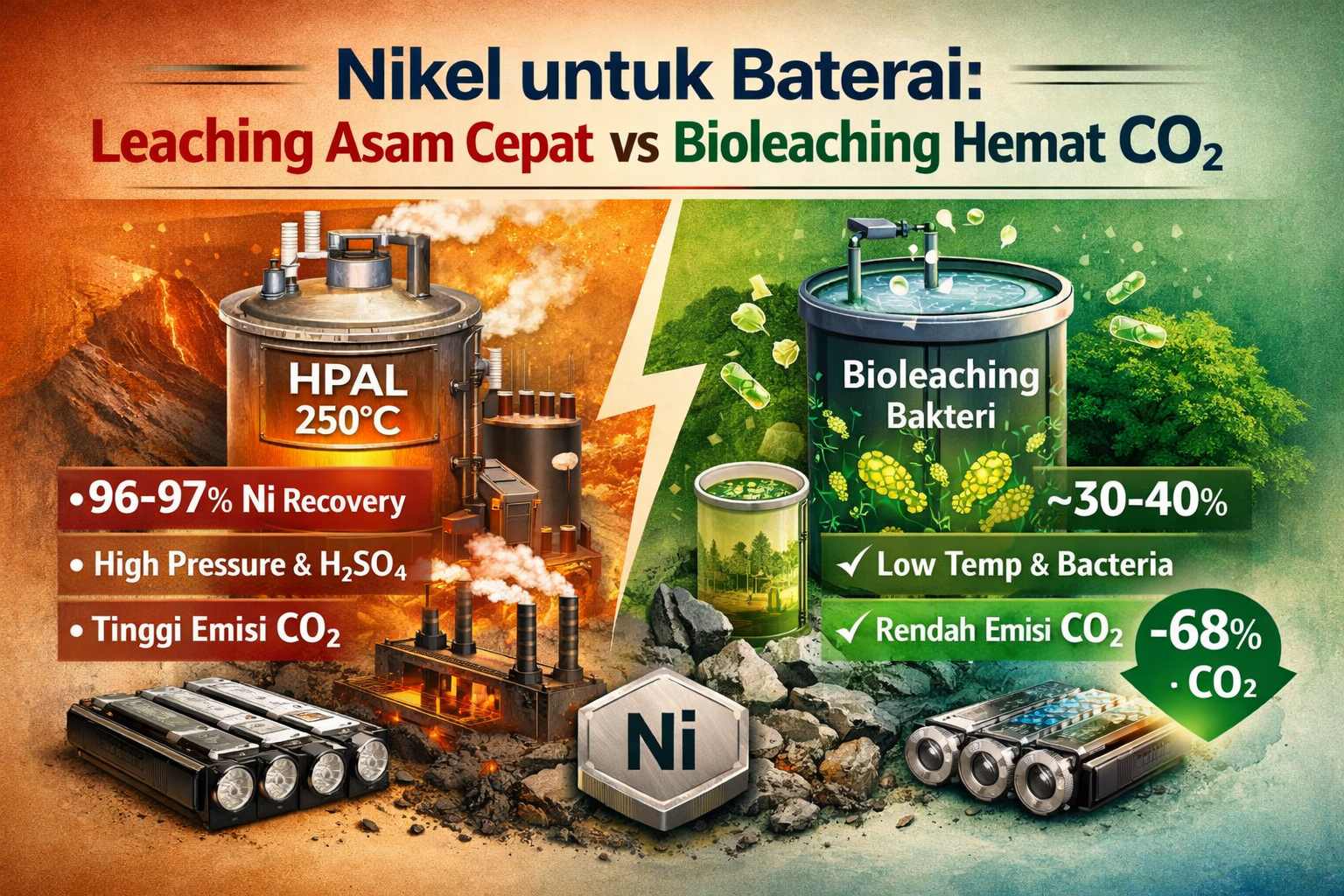
Bioleaching dissolves nickel by microbial oxidation of sulfide minerals, generating ferric iron (Fe³⁺) and sulfuric acid that solubilize Ni. Acidophilic bacteria—including Acidithiobacillus ferrooxidans, A. thiooxidans, and Leptospirillum ferrooxidans—are chemolithoautotrophs that grow at low pH (e.g., A. ferrooxidans can grow at pH <3) and oxidize Fe²⁺ to Fe³⁺ and sulfide sulfur to SO₄²⁻, maintaining a low pH that drives metal leaching (ncbi.nlm.nih.gov; ncbi.nlm.nih.gov).
Case studies span microbial lifestyles. At Terrafame (Finland), a mixed culture bio-oxidized a Cu–Ni–Co concentrate; over a 2019 campaign, 29,600 tonnes of Ni were recovered by heap/tank bioleaching—about 1.2% of global production (pmc.ncbi.nlm.nih.gov). A heterotrophic strain, Burkholderia sp., bioleached a Brazilian laterite by metabolizing glucose to organic acids and chelating compounds; in 42 days, 87% of the ore’s Ni was solubilized under optimal conditions (link.springer.com). A neutrophile, Guyparkeria halophila (formerly Thiobacillus halophilus), oxidized sulfur at around neutral pH (~7) when coupled with formic acid, generating biosulfuric acid more gently; after 43 days, ~1,116 mg/L Ni (≈69.8% of available Ni) was extracted with formate-boosted G. halophila versus 35.4 mg/L (≈2.2%) without formate (ncbi.nlm.nih.gov).
Rates, yields, and campaign timing
The patterns are consistent: bio‑oxidative processes can dissolve Ni when enough acidity—biogenic or added—is present; specialized bacteria are required to overcome Ni toxicity and sustain oxidation; and leaching rates are typically slow (weeks to months) even when yields become significant. In the neutrophile study, formic acid addition greatly enhanced both bacterial activity and Ni release (≈69.8% vs ≈2.2%; ncbi.nlm.nih.gov). In practice, bio‑recovery rates (Ni/kg·day) are much lower than acid leach, which routinely delivers ~80–95+% Ni extraction under optimal chemical conditions (HPAL ~94–97%; atmospheric leach 83–96% at 90–100 °C with strong acid; researchgate.net; researchgate.net).
Acid consumption, residues, and effluents
High acid concentrations in chemical leaching increase metal yields but also dissolve more Al, Mg, and Fe, producing voluminous residues. Managing acid-neutralizing reactions—e.g., lime addition to remove excess H₂SO₄—is capital‑intensive. Bioleaching generates acid in situ and may require supplementation (e.g., formic acid in the G. halophila tests), and can produce toxic effluents if not contained; microbes tend to self‑limit as metals drop. Where plants discuss residue handling, solids-separation steps often enter the conversation; equipment categories such as a clarifier are commonly cited in water and residue management planning. For pretreatment of recycle streams, operations teams also reference membrane pretreatment methods like ultrafiltration when discussing suspended solids control ahead of polishing stages.
Capital intensity and operating complexity
Neither leaching pathway is trivial. HPAL demands high-pressure vessels, steam, corrosion-resistant linings, and precise acid control at scale (~250 °C; ~30–60 bar; high acid doses, often ≥100 kg H₂SO₄ per tonne ore; nickelinstitute.org; researchgate.net). Atmospheric leaching still runs near‑boiling acid in agitated tanks (~95–100 °C). Bioleaching works at ambient pressure and moderate temperatures (≈20–50 °C) but needs pH control (~1–3 for acidophiles) and aeration. A basic plant-utilities note: support packages for water handling are often bundled under water treatment ancillaries in project scopes.
Environmental profile and adoption trends
Bioleaching’s environmental case is strong: at Terrafame, the nickel sulfate biomining route produced only ~32% of the CO₂ per kg Ni vs conventional processing (~68% reduction; pmc.ncbi.nlm.nih.gov). Still, global biomining of nickel remains small at ~1.2% of world Ni (≈29,600 t of ≈2.5 Mt/year; pmc.ncbi.nlm.nih.gov). Acid leaching dominates capacity: Indonesia hosts dozens of HPAL projects (e.g., Weda Bay, Sulawesi) following export bans on raw ore. Indonesian bioleaching of nickel is mostly at R&D stage (e.g., studies on native fungi/bacteria), and internationally, only a few plants produce nickel via microbial routes. Advances such as neutrophilic bioreactors or mixed cultures may broaden applications over time.
Bottom line: fit the tool to the ore
Conventional acid leaching—especially HPAL—remains the benchmark for nickel recovery from laterite and sulfide ores thanks to high extraction and throughput. The key levers are maintaining the optimal acid concentration and a high temperature profile: below ≈0.5–1 M acid, >50–60% extraction is rarely achieved; at ~95–100 °C with strong acid, lab tests have reached 83–96% Ni; at ~250 °C in HPAL, >90% and ~94–97% are routine (Moa Bay/PHPAL plants included; researchgate.net; researchgate.net; researchgate.net). Bioleaching, driven by specialized bacteria, can reach ~70–90% in lab timelines of weeks (e.g., ~69.8% with formate‑boosted Guyparkeria halophila; 87% in 42 days with Burkholderia) but at much slower rates (ncbi.nlm.nih.gov; link.springer.com). The choice is economic and environmental: heavy capital and energy with chemical leaching and careful pH/temperature control, or biological control with lower energy and a smaller CO₂ footprint.