

Industry: Nickel_Mining | Process: Leaching
Nickel supply and acid demand
Rising EV and battery demand have sharply expanded nickel laterite processing. World nickel output grew >8%/yr to ~3.4 Mt in 2023 (www.bcinsight.crugroup.com). Indonesia now generates ~60% of global nickel, almost entirely via sulfide or HPAL processes (HPAL: high‑pressure acid leach) (www.bcinsight.crugroup.com).
This boom has driven sulfuric acid demand from ~5 million tonnes/year (2022) to a forecast ~17 million t/a (tonnes per annum) by 2027 (www.bcinsight.crugroup.com). At typical unit costs (~USD 100–150/t), acid is a major operating expense. Thus even modest savings (e.g. 10–20%) translate to multi‑million‑tonne reductions in acid use and tens of millions in savings. In HPAL, excess acid is later neutralized (e.g. with limestone) and expelled as gypsum, so minimizing excess acid also cuts waste and neutralization costs.
In practice, typical HPAL acid consumption is on the order of 0.2–1 t H₂SO₄ (sulfuric acid) per tonne ore, depending on ore type, versus ~0.6–0.8 t/t in atmospheric leach processes (as illustrated below) (www.mdpi.com).
Ore mineralogy and acid balance
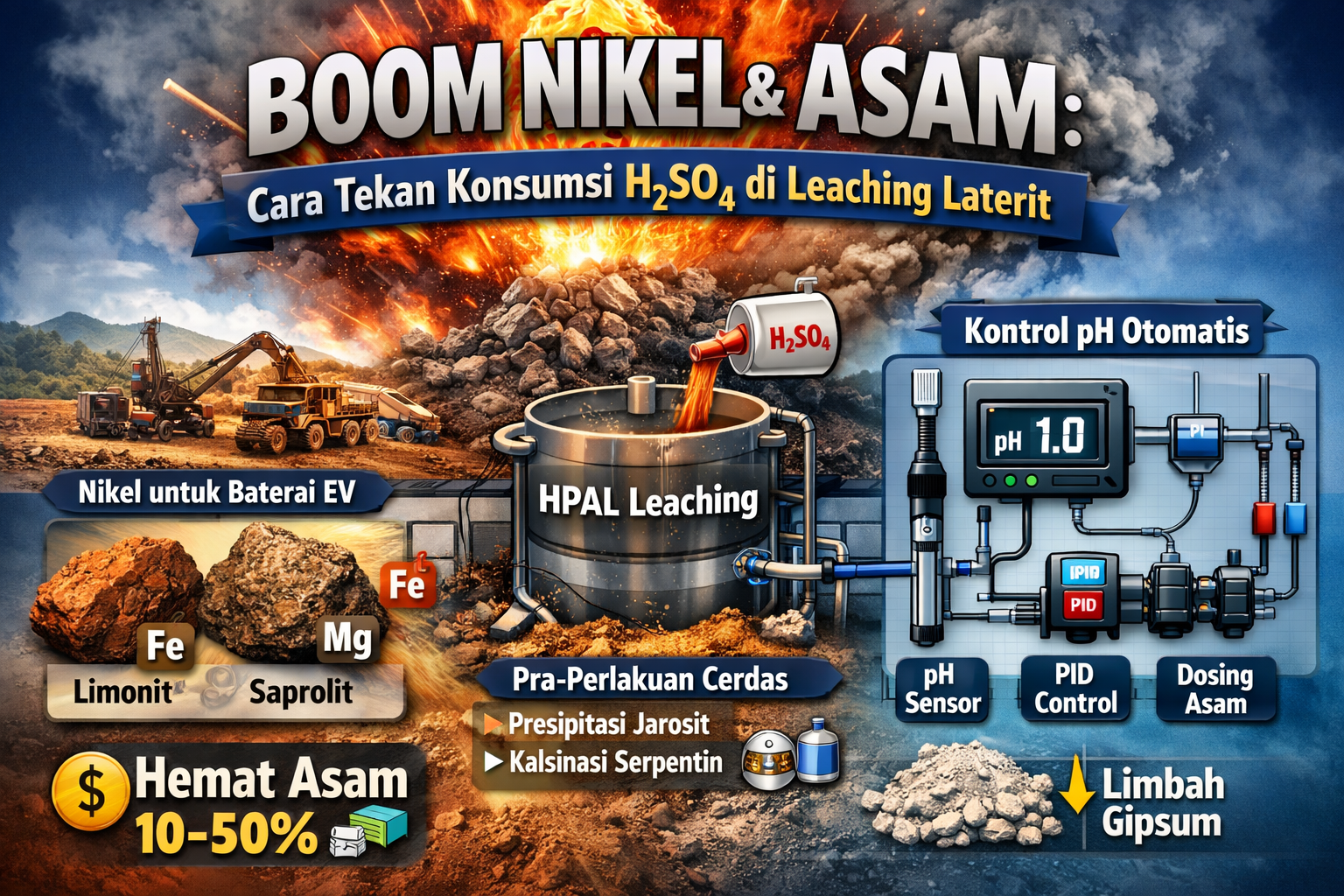
Laterite ores vary widely in acid‑consuming gangue (gangue: non‑valuable minerals in ore). Limonitic ores (high Fe, goethite/hematite) trap Ni in iron oxides; saprolitic/serpentinic ores (high Mg, silicates) trap Ni in silicates. Acidization dissolves host minerals as well as Ni, so gangue chemistry dominates acid consumption.
In one study of Greek laterites, the limonitic sample (LAI) consumed proton equivalents largely on Fe and Al, while the saprolitic sample (LK) consumed most acid on Mg — specifically, “main acid‑consuming metals in LAI are iron and aluminum… acid consumption in LEV [another limonite] is mainly caused by iron, but in LK [Mg‑rich saprolite] the main acid‑consuming metal is magnesium” (www.mdpi.com).
In practice, neutralizing one mole of serpentine (Mg₃Si₂O₅(OH)₄) consumes about 6 moles H⁺, versus 3 H⁺ per mole Fe₂O₃ (goethite) — thus Mg‑rich ores can nearly double the acid demand of Fe‑rich ones. High Al (clays, gibbsite) and any carbonates (rare in laterites) also buffer acid. Industry experience confirms: ores with high MgO or serpentine content “are unsuitable due to the high sulfuric acid consumption” (www.mdpi.com).
In one bench‑scale experiment, Ni extraction from a mixed laterite required ~600–800 kg acid per tonne ore at pH ~0.5, whereas a comparable test on a Mg‑rich saprolite used far more acid for the same Ni recovery (www.mdpi.com) (www.mdpi.com).
Jarosite recycling of acidity
Pre‑treatments targeting gangue can greatly cut acid needs. A proven method is jarosite precipitation (jarosite: iron sulfate hydroxide solid) or selective neutralization of iron. Miettinen et al. demonstrated a two‑stage process: first leach Fe‑rich limonite at low pH, then precipitate its Fe as jarosite (NaFe₃(SO₄)₂(OH)₆) by adding silicate ore. The jarosite reaction generates acid (Fe³⁺ + SO₄²⁻ + OH⁻ → jarosite + H⁺), which is then used to leach Ni from the silicate fraction. This regenerated acid reduces net consumption.
In their tests acid use fell from ~“0.6–0.8 kg acid/kg ore” in a straight leach down to ~0.4 kg/kg with the combined iron‑jarosite route — a 30–50% reduction (www.mdpi.com). The result was only ~1.5–3% Fe dissolution (vs 15–80% before) (www.mdpi.com), saving acid that would otherwise neutralize dissolved iron.
Other pretreatment approaches include dry roasting or calcination of serpentine to remove structural water and form MgO (which can be leached separately), and liming of high‑Mg ores (precipitating Mg²⁺ before the main leach). In China, “hydrate‑cleaning” by NaOH has been studied to remove Mg/Ca before acid leach. Oxidative or reductive pretreatments (e.g. ferrous sulfate addition, hydrogen peroxide) can also convert goethite to magnetite or hematite, reducing acid demand. These steps add cost/capex, but for very Mg/Fe‑rich or low‑grade ores they can improve overall acid efficiency.
Online pH and control loops
Modern plants rely on continuous sensors and control loops to minimize acid overshoot. On‑line pH meters (pH: acidity; sensors include glass electrodes or ISFETs) provide real‑time acidity measurements. In practice, pH probes are mounted in agitators/buffers and connect to digital transmitters/PLCs (PLC: programmable logic controller). These feed PID controllers (PID: proportional‑integral‑derivative) that modulate acid‑addition pumps. In production, acid metering is often executed by dedicated equipment such as a dosing pump to maintain tight setpoints.
For example, in a recent lab‑scale laterite leach, a Mettler–Toledo T70 automatic titrator was used as the dosing system, with Van London Phoenix pH electrodes and a Consort C3040 analyzer monitoring pH/ORP online (ORP: oxidation‑reduction potential) (www.mdpi.com). The setpoint was held precisely (e.g. ±0.05 pH units) by adjusting acid flow. Similarly, industry uses pH transmitters (Endress+Hauser, ABB, Yokogawa, etc.) to feed acid metering pumps under PLC or DCS control (DCS: distributed control system). Continuous control avoids large pH swings: operators maintain leach pH in the optimal zone (commonly pH 0.5–2 for sulfates) so acid is consumed only as needed.
Other analyzers can assist. On‑line ORP probes can indicate Fe²⁺/Fe³⁺ balance, guiding reductant additions; conductivity meters track total dissolved salts (related to acid concentration); and periodic lab ICP (ICP: inductively coupled plasma) or ion chromatography can verify sulfate build‑up. According to instrumentation vendors, “control of pH is essential for optimizing the efficiency of leaching processes” (gaotek.com). In practice, a tightly controlled leach often uses feedforward rules (e.g. acid dose proportional to ore feed rate) and feedback adjustment: if pH creeps above setpoint it signals acid shortfall, or if it drops suddenly an acid surge is indicated. Advanced plants may apply cascade/predictive control or soft sensors, but even simple two‑point on/off dosing can give large gains. Crucially, regular calibration and maintenance of probes (to avoid drift) is a standard requirement.
Economic outcomes and metrics
Effective pH control and pretreatment have tangible benefits: acid savings, cost reduction, and higher yields. The jarosite scheme cited above cut acid usage by roughly half (www.mdpi.com). In heap or tank leaching, implementing tight pH loops can similarly lower acid consumption by 10–40% (project dependent). For example, a 30% acid saving on a 100,000 tpa plant corresponds to roughly 9,000 tpa H₂SO₄ — about US$1M/yr at $110/t, solely in reagent.
Globally, with Indonesia’s sulfuric acid needs projected at 17 Mt/y (www.bcinsight.crugroup.com), even a 5–10% reduction (≈0.8–1.7 Mt) equates to hundreds of millions in avoided costs and reduced environmental discharge.
Real data back this up. In the cited study, direct acid leaching of laterite consumed 0.6–0.8 kg acid/kg ore, whereas the jarosite‑assisted process consumed only ~0.4 kg/kg (www.mdpi.com). Other trials have shown that moving the leach pH from ~0.3 to ~1.5 (less aggressive) cuts acid use by >50% for some ores, at the cost of somewhat slower Ni kinetics. Operations balance this trade‑off by controlling temperature, particle size, and Fe(II) addition to speed leach at higher pH, while keeping acid inputs in check.
In summary, optimizing acid consumption in nickel leaching rests on (a) understanding ore mineralogy (quantifying Fe, Mg, etc. that will neutralize acid), (b) using pretreatments or staged leach/precipitation to remove those acid drains (as demonstrated by Miettinen et al. (www.mdpi.com)), and (c) employing continuous pH monitoring with automated control to add only the acid needed. Together, these measures — backed by metallurgical testing and plant data — can typically reduce acid usage by tens of percent, translating directly to lower operating costs and waste treatment requirements.
Sources: Industry reviews and experimental studies on laterite leaching (www.mdpi.com) (www.mdpi.com) (www.mdpi.com) (www.bcinsight.crugroup.com) (www.bcinsight.crugroup.com); instrumentation/applications literature (gaotek.com) (www.mdpi.com); market reports on nickel and acid demand (www.bcinsight.crugroup.com) (www.bcinsight.crugroup.com).