

Industry: Nickel_Mining | Process: Tailings_Thickening_&_Disposal
Nickel mining’s waste problem is measured in scientific shorthand and colossal tonnages. Tailings volumes run on the order of 10^8–10^9 t/yr globally (www.statista.com), with recent figures around ≈228 Mt/yr (Statista 2025: www.statista.com). Even iron‑rich laterite residues (limonite/goethite) can host the chemistry that drives acid mine drainage (AMD, acidic water from sulfide oxidation). Indonesian laterite HPAL (high‑pressure acid leach) feedings come in at ≈41% Fe (magnetite/goethite) and the leach residues have “significant sulfur content” after acid leaching (www.researchgate.net; www.researchgate.net).
Sulfidic Ni ores add more fuel: Sudbury Cu–Ni tailings often hit ~9–18 wt% S, and long‑exposed piles there generated strongly acidic (pH<5) porewaters loaded with Ni, Fe and more (journals.asm.org; journals.asm.org). That’s why two numbers — acid production potential and neutralization potential — steer everything from tailings thickening and disposal to whether a water cover or alkaline blend is non‑negotiable.
On the thickening and water‑recovery side, operators often integrate clarification hardware to manage return water from tailings facilities; in practice, that can include in‑plant units such as a clarifier to remove suspended solids prior to recirculation.
ABA and NAG: the go/no‑go chemistry
Acid–Base Accounting (ABA) frames the risk in three steps: maximum potential acidity (MPA, sometimes called acid production potential or APP), neutralization potential (NP), and their difference, net neutralization potential (NNP = NP – APP). MPA is calculated from total sulphur using a standard conversion: 1 wt% S ≈ 30.6 kg H₂SO₄ per tonne (MPA in kg H₂SO₄/t = S%×30.6; mineclosure.gtk.fi). NP is determined by acid titration of the tailings matrix (acid‑consuming carbonates), and classification hinges on NNP or the NP:MPA (NP:AP) ratio.
How predictive is that ratio? Skousen et al. reported that NP:MPA <1 generally correlates with acid drainage and that ratios >2 almost always yielded neutral/alkaline drainage — ~96% predictive accuracy across 56 sites (www.researchgate.net; www.researchgate.net). In practice, tailings with NNP<0 or NP:AP<1 are treated as potentially acid‑generating unless field and kinetic data say otherwise (same source). For lab titrations, precise reagent addition helps control error — field teams often rely on metered chemical feed equipment such as a dosing pump for consistency.
ABA is now commonly paired with the Net Acid Generation (NAG) test, which oxidizes sulfides with hydrogen peroxide to measure a direct acidity outcome. In the single‑addition NAG, 2.5 g of <75 µm tailings reacts overnight with 250 mL of 15% H₂O₂; the boiled‑off solution yields a “NAGpH” and titratable acidity (mineclosure.gtk.fi). By AMIRA criteria, NAGpH<4.5 indicates a “potentially acid‑forming” (PAF) sample (mineclosure.gtk.fi), so sites tag materials as non‑acid‑forming (NAF) or PAF using NP:AP and NAG in tandem.
Static thresholds and field reality
As a first screen, static tests flag risk: any tailings with NNP<0 or NAGpH<4.5 is typically flagged as acid‑forming (mineclosure.gtk.fi). In Sulphidic Ni tailings like Sudbury’s (9–18% S), laboratory ABA/NAG on un‑capped material would yield strongly negative NNP and NAGpH≪4.5 — consistent with observed pH<5 porewaters (journals.asm.org).
Conversely, in the same area, tailings overlain by an alkaline cover showed near‑zero net acid generation and neutral pH (journals.asm.org). Practitioners also cross‑check classification logic (“NAGpH>4.5 and negative NNP” = safe; “NAGpH<4.5 and positive NNP” = PAF: mineclosure.gtk.fi). Tailings from Indonesian limonite after HPAL may contain residual sulfuric acid and iron sulfides (so ABA/NAG is required), and any Ni tailings with NNP/(tonne CO₂ equivalence) <0 would be expected to generate acid drainage unless mitigated.
Kinetic confirmation and columns
Static tests can mislead if sulphur sits in non‑reactive minerals (e.g., gypsum) or if NP is tied up in weak carbonates. That’s why kinetic tests — humidity cells or column leach tests — inform tailings storage design. Multi‑year leach cell trials (e.g., in Liberia and elsewhere) have revealed trends that static tests missed; a minimum ~6‑month column under relevant climate (rainfall, temperature) is recommended to confirm static predictions (www.researchgate.net). Robust nickel tailings programs measure total S, soluble sulphur species, NP (carbonates), run NAG, and operate kinetic leach tests to quantify acid‑generation potential.
Co‑disposal and alkaline blending
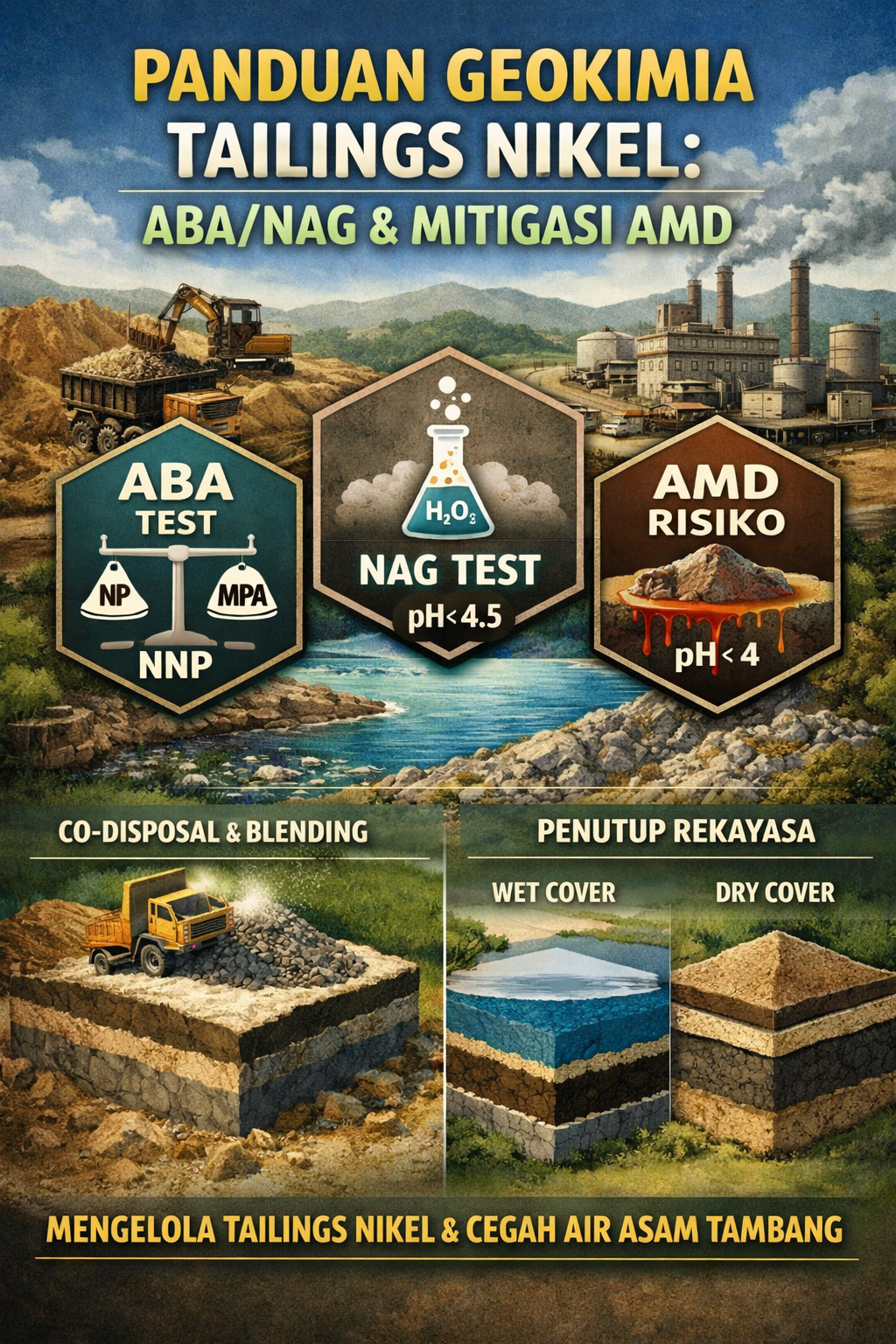
For tailings flagged PAF, co‑placement with neutralizing rock or alkaline wastes is a direct chemical countermeasure. Blending with limestone or lime‑rich waste rock can consume acidity; in practice, adding as little as ~10–20% carbonate material by mass can drastically cut ARD. In one documented case, covering sulphidic tailings with only 15% alkaline phosphate waste reduced peak acidity from ~3,200 mg CaCO₃/L to ~280 mg/L (≈90% reduction) and sulfate from 4,900 to 480 mg/L (ncbi.nlm.nih.gov).
Mixtures of tailings with coarse waste rock (often wetter and calcite‑bearing) raise saturation and significantly limit oxygen ingress (mineclosure.gtk.fi). Designs that co‑dispose thickened tailings with potentially acid‑generating waste rock are gaining ground; one facility in Colombia is purpose‑built for this (knightpiesold.com). Such engineered masses reduce foundation seepage and let waste rock act as an oxygen/alkaline buffer. Co‑disposal inherently keeps tailings moist (limiting O₂) and mixes in inert fill, lowering liquefaction risk and acid potential (mineclosure.gtk.fi). Where footprint is tight, compact sedimentation steps upstream can help manage water circuits using equipment such as a lamella settler.
Engineered cover systems
Physical source control focuses on keeping air and water out. Nicholson et al. showed a fine‑textured, moisture‑retaining cap can “reduce oxygen diffusion coefficients and rates of acid generation by up to four orders of magnitude” (cdnsciencepub.com). Capillary‑barrier designs (fine layer over coarse) hold porewater near saturation, throttling O₂ diffusion.
Wet covers (subaqueous) create a natural oxygen seal: water’s O₂ diffusion coefficient (~8×10^–12 m²/s) is ≈10^–4 that of air (ncbi.nlm.nih.gov), and models show a 1–3 m water cover can reduce sulfide oxidation rates by ~99% versus exposed tailings (ncbi.nlm.nih.gov). At Savage River (Tasmania), a ~1.5 m water cover limited oxidation to the top ~5 cm (ncbi.nlm.nih.gov). Where water is reclaimed for reuse or discharge, pretreatment options such as ultrafiltration can be integrated ahead of downstream polishing or reuse schemes.
Dry covers run from simple to multi‑layer. Monolayers (compacted clay or limestone fines) are simple but can crack; multi‑layer capillary barriers (fine silt/clay plus a coarse drainage layer) are more robust and are typically ≥0.5–1 m thick and low‑permeability. Even a monolayer of desulfurized tailings has shown ~75–82% oxidation reduction (ncbi.nlm.nih.gov), and adding alkalinity helps: a 15% alkaline‑cap mix suppressed acidity by ~90% (same study: ncbi.nlm.nih.gov). North America’s MEND work has documented order‑of‑magnitude cuts in O₂ flux using natural‑material covers.
Organic covers and phytostabilization add biological and moisture benefits. At a Ni–Cu tailings site, a dual cover (2 m desulfurized tailings + 0.5 m municipal compost) maintained fully neutral pH and low metals in underlying tailings (journals.asm.org), whereas exposed tailings produced pH<5 waters (journals.asm.org). Stabilization covers go further by chemically binding sulfides: geopolymer top covers (lime/alkali plus slag) can “encase” sulfides in calcium silicate gel, reducing metal leaching by >90% and yielding >92% reduction in heavy‑metal leachability (Cd, Fe, Mn, Zn) in lab trials (ncbi.nlm.nih.gov). Durability (e.g., sulfate attack) and cost remain considerations.
Climate, HPAL growth, and Indonesian constraints
Cover systems must match climate. In humid tropics, pore saturation is easier, but monsoon rains demand high‑capacity drainage layers; in arid zones, evapotranspiration designs are favored. Indonesia’s monsoon climate can favor wet covers but also raises erosion and seismic risks. Thickened or paste tailings (reduced water content) help by creating more erosion‑resistant beaches, but final covers are still required.
HPAL expansion matters for waste volumes: the process generates ≈1.4–1.6 t tailings per tonne of nickel produced (www.argusmedia.com). In Indonesia, regulators have rejected ocean disposal proposals (news.mongabay.com), pointing toward on‑land containment that blends source control and neutralization. Operators typically backstop these strategies with monitoring of tailings porewater chemistry and adaptive mitigation.
What the numbers imply for design
The data‑driven bottom line is straightforward. Any Ni tailings flagged as PAF by ABA/NAG should be neutralized or placed under a source‑control cover. Well‑implemented covers — water or dry — have been shown to cut O₂ diffusion by ~10^4 and acid flux by >99% (cdnsciencepub.com; ncbi.nlm.nih.gov). Modest additions of alkaline reagents can dial down acidity by an order of magnitude or more (ncbi.nlm.nih.gov). In operations, the water side of these systems is supported by standard gear — for example, water‑treatment ancillaries that integrate with monitoring and treatment skids — but the controlling levers are still S%, NP, and oxygen flux.
Methods, case studies, and data sources
Published papers and reports underpin these recommendations. Skousen et al. (2002) showed ABA ratios predict post‑mining drainage quality (www.researchgate.net). The GTK/VTT Mine Closure series documents NAG methods and co‑disposal benefits (mineclosure.gtk.fi; mineclosure.gtk.fi). Engineering studies (e.g., Si et al. 2023) quantify cover performance on oxygen flux and acidity (cdnsciencepub.com; ncbi.nlm.nih.gov).
Case studies pin the chemistry to outcomes: Chen et al. (2024) on Sudbury Ni tailings (journals.asm.org) and Kawigraha et al. (2021) on Indonesian HPAL residues (www.researchgate.net). Industry data and policy context — Argus on HPAL’s tailings yield and Mongabay on ocean disposal rejections — frame the scale and constraints (www.argusmedia.com; news.mongabay.com). Statista provides the macro numbers (≈228 Mt/yr) for global Ni tailings (www.statista.com).