
Recycling process water saves millions of liters, but ore‑borne ions and organics build up, depressing nickel recovery. Case data show a small bleed and targeted treatment like DAF can lift rougher‑scavenger recovery by 2.6 percentage points.
Modern nickel concentrators routinely recycle 80–95% of their process water to curb freshwater use (MDPI; SCIRP). The Kevitsa Ni–Cu–PGE plant in Finland deliberately pushes that to >95% (MDPI). But high recycle ratios make the circuit a closed chemistry loop: ore‑borne salts, metal ions and residual reagents accumulate, changing how froth flotation (a bubble‑based mineral separation method) actually performs.
Measured data from Kevitsa’s nickel circuit underline the point. Recycled water showed conductivity ≈2,300 µS/cm (∼1,400 mg/L total dissolved solids, TDS) and high alkalinity at pH ≈9.5 (MDPI). Dissolved Ni and Cu were on the order of 0.1–0.3 mg/L pre‑treatment (MDPI; MDPI), with silica fines ~5–7 mg/L (MDPI). Thickener overflow turbidity averaged ~96 NTU (nephelometric turbidity units) before treatment and fell to 20 NTU after dissolved‑air flotation (DAF, a microbubble clarification method) (MDPI).
Regulators are paying attention. In Indonesia, guidance highlights mine effluents with high total suspended solids and elevated nickel (Nikel.co.id). PermenLH No.9/2006 requires wastewater discharges not to exceed prescribed quality standards (Nawasis).
Contaminants and surface effects
Fines and clays, especially serpentine group silicates, produce hydrophilic “slime coatings” that block collector adsorption on sulfides. Serpentine (Mg₃Si₂O₅(OH)₄) often carries positive charge opposite to pentlandite, promoting such coatings and cutting Ni recovery (MDPI; MDPI).
Trace metal ions matter too. At flotation pH (~9–11), Fe²⁺, Ni²⁺ and Cu²⁺ precipitate as hydroxides, passivating sulfide surfaces and making them less hydrophobic, which lowers recovery (MDPI). Over time these metals can build to tens or hundreds of ppm; in Kevitsa water they were ~0.3 mg/L Ni and ~0.2 mg/L Cu (MDPI; MDPI).
Sulfur species add another drag. Sulfide oxidation generates thiosulfate and related ions that chemically compete with xanthate and carbonate collectors; lab and plant work show they “affect negatively on collector adsorption on sulphide minerals,” depressing pentlandite recovery (MDPI). Kevitsa’s recycled water held dissolved sulfur near ~250 mg/L (likely as thiosulfate) (MDPI), and its removal by treatment correlated with better flotation (MDPI; MDPI).
Hardness and alkalinity also drift upward in closed circuits as lime/carbonate accumulate. Calcium can precipitate or form surface films; a review flags calcium’s complicating role in xanthate adsorption (ResearchGate). Residual organics from frothers/collectors can destabilize froth and hurt separation efficiency, as industry reviews warn (MineralProcessing.co.za).
Measured impacts on recovery
Kevitsa’s own data are unambiguous: recycled nickel‑circuit water—although it made up less than 10% of total water addition—had a negative impact on nickel recovery (MDPI). Bench tests replacing fresh make‑up with increasing thickener overflow systematically shifted the Ni+Cu grade vs Ni recovery curves to lower values (SCIRP).
Cleaning up the water reversed that trend. Using DAF‑treated water (instead of raw recycle) delivered a 2.6 percentage‑point absolute gain in rougher‑scavenger Ni recovery and a slight grade lift of +0.06% (MDPI). The economics penciled in: even such a marginal improvement paid back the treatment investment (MDPI).
Water chemistry and reagents
Collectors such as xanthates (surface‑active chemicals that render mineral particles hydrophobic) need clean, oxidized mineral surfaces. Slime coatings and metal hydroxide films reduce active sites and force higher dosing; at Kevitsa, DAF‑treated water improved xanthate adsorption, indicating better utilization (MDPI; MDPI). In practice, a contaminated circuit often needs 10–50% more collector to maintain recovery (industry reports indicate incremental dosing when recycle load is high, though exact values vary). High oxidation/deoxidation or dissolved oxygen swings can also alter collector chemistry.
Frothers (alcohols/glycols that stabilize bubble films) are sensitive to residual organics: recycled frother can cause “froth instability,” large bubbles or “knife‑like” froth, and remedial defoamers add cost (MineralProcessing.co.za). Depressants and pH modifiers such as lime concentrate within closed loops; Kevitsa adjusted DAF feed to pH 9 using Ca(OH)₂ while managing already alkaline circuit water (MDPI).
Redox potential (often measured as ORP) and ionic strength shift with recycle. Reviews note seawater’s high ionic strength depresses some sulfide flotations (e.g., molybdenite), implying high‑salt recycle water can hinder gangue rejection and increase slime entrainment. “Flotation performance depends on water quality,” and high‑organic or saline waters can decrease recovery and cause froth issues (SCIRP; MineralProcessing.co.za).
Bleed streams and treatment trains
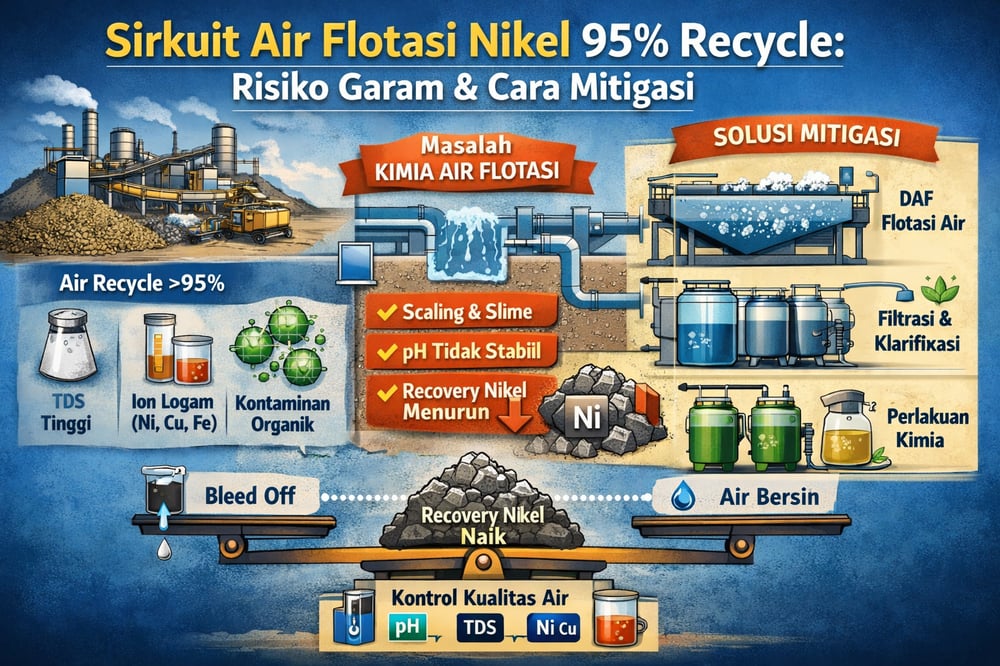
Most concentrators install a bleed (blowdown) stream—pumping out a fraction of recirculating water (often 1–5% of total flow) from points like thickener overflow—to cap contaminant build‑up, with fresh make‑up balancing volume. Operators commonly tie bleed rates to TDS, calcium, or COD thresholds; mitigation advice includes “partial bleed‑off, filtration, [and] chemical polishing” (MineralProcessing.co.za).
Bleed water needs treatment. Solid–liquid separation is the first anchor: Kevitsa used dissolved‑air flotation to remove ultrafines, hydroxide flocs and entrained organics (with coagulant addition) (MDPI; MDPI). In trials, DAF removed >90% of suspended solids and cut dissolved metals roughly in half (MDPI). Plants deploying a DAF unit on even a minor bleed—Kevitsa treated <10% of flow—saw the 2.6‑point Ni recovery lift referenced above (MDPI). Others pair a clarifier with downstream filters or presses; cartridge polishing is common with a cartridge filter.
Chemical treatment complements separation. Lime or sulfide dosing at controlled pH precipitates dissolved Ni/Cu; oxidants or coagulants bind organics ahead of flotation or DAF (MDPI). Plants typically meter these via a dosing pump and select chemistry such as coagulants based on jar testing.
For high‑recycle or arid sites, advanced treatment can be justified. Ultrafiltration removes colloids prior to polishing; ion exchange scrubs metal ions; reverse osmosis or electrodialysis reduce dissolved salts—some studies even recommend vacuum membrane distillation or RO in high‑salt circuits (SCIRP). Practical options include ultrafiltration as pretreatment and modular RO/NF systems if salt control is critical. Metal ion polishing can be targeted with ion exchange. Biological oxidation of residual organics is less common in minerals processing but can be applied to bleed streams; where reuse quality is needed, plants consider membrane bioreactors.
Selective treatment strategies
Not every stream needs the same treatment. A recommended sequence is to analyze recirculating streams for Ca, thiosalts, sulfate, total carbon and TDS (a CanmetMINING‑style holistic assessment), then run bench flotation with blends of fresh and recycle water to quantify impacts (SCIRP). Kevitsa targeted only nickel‑thickener overflow—a minor stream—rather than all water, a selective approach that still delivered a payback (MDPI; SCIRP). In some concentrators, diverting the entire tailings thickener overflow through a treatment plant may be required if metal loading is high.
Reagent control under recycle
When thickener overflow is recycled without treatment, the nickel recovery curve shifts downward versus fresh‑water baselines (SCIRP). Collector dosage is often raised 10–30% in high‑recycle water to compensate for scavenging by slimes and dissolved ions (no direct citation, but consistent with practice). Froth behavior can become erratic—residual organics or low pH (high CO₂) may produce coarser, wetter froth; trimming frother can crash froth, and sampling often ties carryover dips to COD spikes. Stable, treated water avoids these swings.
Depressant and pH demands are also fluid. Nickel plants using lime or cyanide starch to depress pyrrhotite see consumption drift with recycle; if basin pH rises beyond design, lime usage increases. Operators frequently report rising lime consumption as recycle increases unless a bleed resets chemistry.
Overall, clean water reduces reagent costs and improves metal recovery. Kevitsa observed not just higher Ni grade/recovery but a more stable froth response after water cleanup (MDPI; MDPI). By contrast, ignoring water contaminants decreases recovery and grade while lifting reagent bills. Benchmarks exist: cutting Ca in flotation water from 200 mg/L to 50 mg/L improved molybdenite recovery by ~5% at Taiwan’s Nanzih Copper Mines—an analogy for nickel circuits (SCIRP).
Regulatory alignment in Indonesia
Indonesian plants face clear regulatory lines: effluents often show high TSS and elevated Ni, and discharges must meet PermenLH No.9/2006 quality standards (Nikel.co.id; Nawasis). In context, Indonesian standards typically limit Ni in effluent to sub‑ppm levels; even the ~0.3 mg/L range seen in Kevitsa’s raw recycle would be non‑compliant unless treated (MDPI; MDPI).
Operating recommendations and KPIs
Monitoring: Track pH, conductivity/TDS, calcium, Ni, Cu, COD/TOC and turbidity across recirculating streams, and sample across a full year to capture seasonal variability (SCIRP).
Bleed control: Tie bleed initiation to analytical limits—e.g., when TDS or dissolved Ni approaches 50–80% of discharge limits—to prevent excursions and simplify compliance (MineralProcessing.co.za).
Treatment: Use a dedicated plant—coagulation and a DAF or a clarifier with downstream polishing—to remove residual Ni/Cu and solids before discharge or reinjection (Nikel.co.id; Nawasis). Where reuse and salt control are goals, evaluate RO/NF trains after UF pretreatment.
Reagent optimization: Re‑tune depressant/collector programs as water chemistry shifts; periodic in‑house flotation on fresh/recycle blends is advisable to recalibrate doses (SCIRP).
KPI balance: Beyond ~95% recycle, Kevitsa saw that even a ~10% recycled fraction (cycles‑of‑concentration ~20×) began to hurt Ni performance; Indonesian plants should test whether pushing recycle above ~90% causes measurable recovery loss and consider diverting that fraction to treatment (MDPI).
The through‑line is consistent: maximize volume recycle, but actively bleed and treat to control chemistry. Data‑driven thresholds for ions and organics, plus targeted clean‑up, stabilized Kevitsa’s flotation response—and similar ~2–3 percentage‑point Ni recovery gains can offset the capex/opex of treatment (MDPI; MDPI). That approach also aligns with Indonesia’s discharge standards and enforcement trajectory (Nikel.co.id; Nawasis).
