
In Indonesia’s laterite belts, rainfall of 2,000–3,000 mm/year and shallow water tables turn open pits into swimming pools. The only way to keep mining is to move a lot of dirty water and clean it before release — reliably, and to code.
Tropical laterite nickel mines face relentless inflow. In places like Sulawesi, open pits flood quickly under ~2,000–3,000 mm per year rainfall and shallow groundwater, compromising access and wall stability (info.burnsmcd.com) (apnews.com).
One miner’s scale hints at the stakes: PT Vale Indonesia channels all runoff and seepage to treatment before discharge, using about 7.56×10^6 m³/year — roughly ≈107 m³ per tonne Ni (vale.com). Yet local monitoring has documented rivers near Sulawesi mines turning murky, with hazardous Ni, Pb, and Cd detected in some samples (apnews.com).
Designers must size for volume and quality. Under heavy rain, one Sulawesi pit modeled peak runoff at ~9,230 m³/h (≈2.6 m³/s) (journal.itny.ac.id). That flow carries fines: modeling showed an inflow TSS (total suspended solids) near ~8 mg/L entering a sediment pond, with a properly sized clarifier removing ~78% TSS (journal.itny.ac.id). In the field, however, loads can be far higher; a Pomalaa tributary measured ~190 mg/L TSS — above the 100 mg/L processing limit — while dissolved nickel was much lower (~0.01–0.04 mg/L) (researchgate.net) (researchgate.net). Bottom line: suspended solids drive risk; metals are typically minor but regulated.
Regulatory discharge requirements
Indonesia’s Ministry of Environment sets strict effluent limits for nickel mines: pH 6–9; TSS ≤200 mg/L for mining or 100 mg/L for processing; Ni ≤0.5 mg/L; and low Cu, Co, Cr, Pb, among others — per Permen LHK 09/2006 (nikel.co.id) (vale.com). Non-compliance risks fines or shutdowns (nikel.co.id).
Dirty‑water pumps and abrasion resistance
Dewatering systems must move large, gritty flows. Clear-water pumps (turbine or clean-water centrifugal) are efficient but intolerant to grit (info.burnsmcd.com). Nickel pits generally require “dirty-water” systems designed for fluctuating inflows and solids (info.burnsmcd.com).
Rugged submersible or vertical pumps with hardened internals are standard. Weir Minerals’ Warman SSB-A (a slurry/sludge submersible) is built for abrasive duty, handling up to ~60% solids by volume using high-chrome Ultrachrome A05 wear parts (casing, impeller, wearplates), enabling continuous muddy service without clogging (miningweekly.com) (miningweekly.com).
Mobility, piping, and redundancy
As mine plans shift, skid-mounted pump sets enable quick repositioning and adaptability (info.burnsmcd.com). HDPE discharge lines are favored for impact resistance and smooth bores to reduce abrasion (info.burnsmcd.com).
Automation — including level-probe auto-start and overload/run-dry protections — and redundancy via multiple sump pumps plus spares are central to handling peak events. Designers also allow for rare surges (“100‑year storms”) with oversized sumps or controlled pour-over. Trash racks at sumps limit debris.
Stages of lift and floating stations
Shallow sumps often use robust submersibles; deeper drawdown can shift to vertical turbine or surface centrifugal pumps. In extreme inflows, floating pump stations on pontoons keep intakes aligned with water levels; one Brazilian iron-ore pit deployed vertical/axial pumps on a pontoon platform (mining-technology.com). As pits deepen, inflows generally rise, often requiring perimeter wells or wellpoint arrays to pre-drain groundwater (mining-technology.com).
Costs vary widely — from tens to hundreds of USD per cubic yard drained — depending on depth and geology, while the cost of pump failure (lost access, safety risk) is higher (info.burnsmcd.com).
Coarse pretreatment and screening
All pumped water routes through treatment before discharge. Coarse pretreatment starts with trash screens and grit removal to protect downstream equipment; quiescent zones or air scouring can drop out coarse sands. In many plants, engineered primary systems such as automatic screens or the broader waste-water physical separation step remove debris larger than a few millimeters.
Primary clarification and detention time
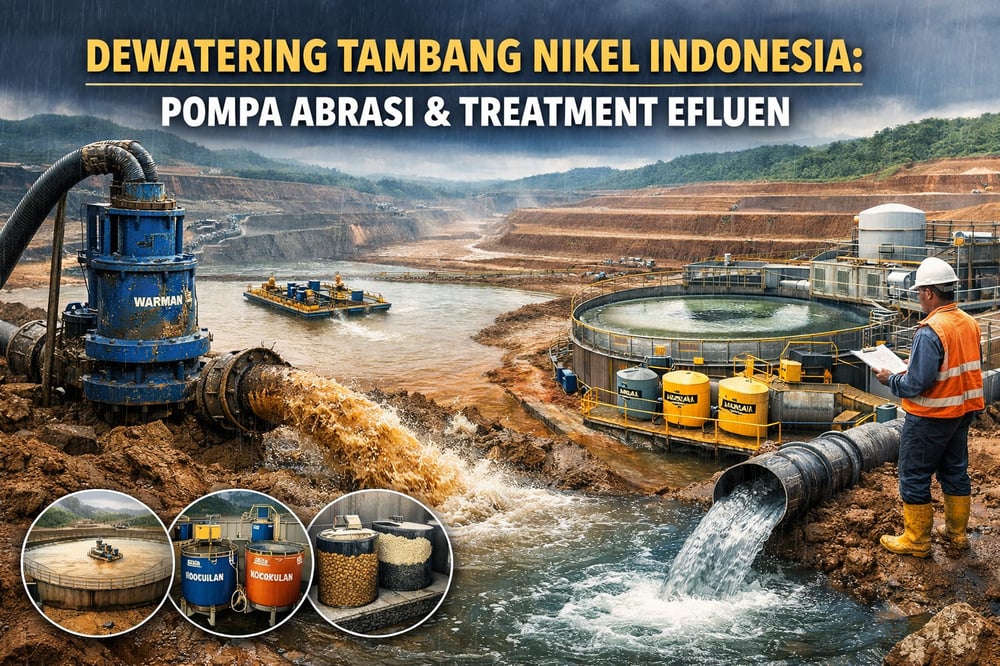
Settling basins or clarifiers take over next. With flocculant addition, gravity separation removes fine solids; mining operations often use long HRT (hydraulic retention time) of 24–48 hours to settle most TSS (journal.itny.ac.id) (mdpi.com). At one nickel site, modeling showed ~78% TSS removal for an ~8 mg/L load in a properly sized pond (journal.itny.ac.id).
Compact units such as a clarifier or a lamella settler can achieve similar separation with less footprint, while settled sludge is periodically dredged.
Chemical coagulation and flocculation
Coagulants such as ferric chloride or alum and polymer flocculants accelerate aggregation and settling, and can begin precipitating some metals (mdpi.com). Controlled dosing is typically handled by a dosing pump to maintain target dose and pH.
Many mines prefer liquid coagulants like PAC (polyaluminum chloride) for turbidity control, paired with high-molecular-weight flocculants to boost clarifier efficiency by 30–50% (flocculant performance per product description).
pH neutralization and metal precipitation
If inflow is acidic (pH <6), a neutralization reactor is added. A limestone (CaCO₃) or lime [Ca(OH)₂] system raises pH and precipitates metals. The CSIR-designed South African nickel leachate plant used a fluidized-bed limestone neutralizer with ~60 g/L slurry, simultaneously precipitating metals and generating gypsum (researchgate.net). Simpler plants dose caustic lime to pH ~8–9 to drop Fe and other metals as hydroxides; biological oxidation (Fe²⁺→Fe³⁺ by bacteria) can precede neutralization to enhance Fe removal (researchgate.net).
Secondary clarification and polishing filters
Post-neutralization, a secondary clarifier settles metal hydroxide sludges (e.g., Fe(OH)₃, Al(OH)₃) and gypsum; this step can remove 90%+ of dissolved metals. In the CSIR nickel plant, gypsum crystallization was integrated due to high sulphate (researchgate.net).
Final polishing often uses dual-media filters — for instance, sand filters to capture 5–10 µm particles followed by anthracite media to improve turbidity removal — and activated carbon if organics or residual reagents are present. An equalization basin stabilizes effluent TSS and pH before discharge. In some cases, constructed wetlands or vegetated clarifiers provide gentle polishing of trace species; studies note limited Ni uptake by wetlands, but they can trap residual solids and oxidize metals (observation per paper).
Sludge handling and upkeep
Clarified sludges are thickened and dewatered (e.g., vacuum filters or filter presses) for disposal in tailings or landfills; some experimentation exists on reuse in cements or backfill (note per paper). Sludge volumes can reach 1–10% of influent volume, requiring secure storage and scheduled dredging/hauling.
Operators plan maintenance cycles for ponds and basins; one study highlighted de‑silt intervals with a maximum of every 10 months (journal.itny.ac.id). Supporting skids, valves, and controls are typically packaged as water treatment ancillaries to standardize upkeep.
Treatment performance and example sizing
Well-designed sedimentation removes >50–80% of TSS; with coagulants/flocculants, several-hundred mg/L TSS can be reduced to ≪50 mg/L (journal.itny.ac.id) (mdpi.com). Heavy metals precipitate effectively via pH control; laboratory studies report >90% removal by conventional precipitation (mdpi.com).
Illustrative sizing: at 10,000 m³/d and 200 mg/L TSS, a 2‑day pond holds ~20,000 m³ with area ~6,000 m² (3.3 m depth). If 80% of solids settle, effluent TSS is ≈40 mg/L; a polishing step or dual clarifiers can take it below 10 mg/L. If Ni were 1 mg/L, raising pH to ~10 precipitates ~90–95% as Ni(OH)₂, yielding <0.1 mg/L in effluent (mdpi.com). These numbers are indicative; actual design must follow site tests.
Compliance, monitoring, and reuse
Effluents must meet the pH, TSS, and metal limits noted above before discharge (nikel.co.id). PT Vale reports continuous monitoring of effluents into Lake Matano, targeting compliance with Ministry standards (vale.com), while Indonesia’s regulators have intensified enforcement, including fines and permit reviews for non‑compliance (reuters.com).
Untreated mine waters commonly breach TSS limits during storms — the Pomalaa case recorded ~190 mg/L versus 100 mg/L — while metals like Ni were far below limits (~0.01–0.04 mg/L versus 0.5 mg/L), reinforcing a focus on solids removal and pH control (researchgate.net) (researchgate.net) (nikel.co.id).
Investment in dewatering and treatment avoids shutdowns and enables reuse. Vale’s reduction in water-use intensity to ≈107 m³ per tonne Ni reflects recycling after treatment (vale.com). International experience shows modern paste or thickened tailings systems can deliver decanted water at TSS <20 mg/L; with careful design, nickel mines can meet and outperform benchmarks (mdpi.com).
Planning considerations for mine designers
Best practice aligns on several points: quantify water loads via hydrogeology and rainfall; combine wellpoints/bores with robust sump pumping and HDPE discharge lines sized for seasonal peaks (info.burnsmcd.com) (mining-technology.com); implement coarse removal before treatment; build multi‑stage treatment sized for peak flow (e.g., 2‑day retention, chemical dosing for flocculation); neutralize and precipitate metals via pH control, as demonstrated in the CSIR nickel project (researchgate.net); and automate monitoring to keep discharge within permit limits.
Peer‑reviewed reviews corroborate the approach: gravity settling plus chemical coagulation addresses fine solids effectively, and heavy metals are readily removed as hydroxides under proper pH control (mdpi.com) (mdpi.com).
Technical anchors that pay off
Two pillars underpin reliable discharge compliance: wear‑resistant pumps and piping for abrasive slurry (miningweekly.com) (info.burnsmcd.com); and a comprehensive treatment regime — from flocculation and sedimentation to filtration — to polish effluent (mdpi.com).
To standardize these steps, operators often rely on modular units like a tube settler for capacity boosts, or upgrade filter trains with robust housings and consumables for sustained performance. The objective is simple: meet Indonesia’s standards (Permen LHK 09/2006, TSS ≤200/100 mg/L; Ni ≤0.5 mg/L; pH 6–9) before release (nikel.co.id).
