

Industry: Nickel_Mining | Process: Extraction
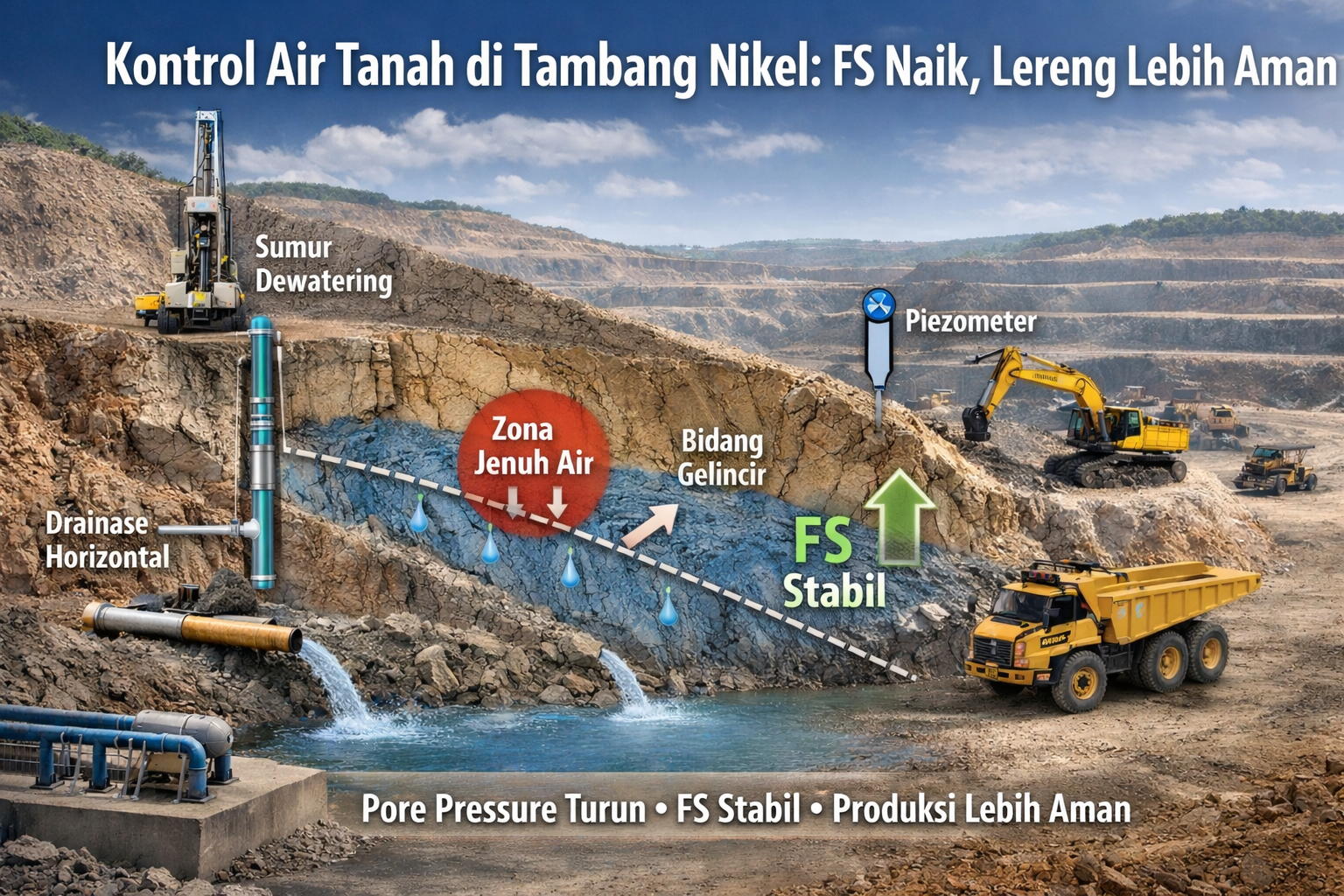
In nickel mining, one variable quietly rewrites the geotechnical playbook: water. Pore pressure in fractures and soils adds weight, lowers effective stress, and strips away shear strength. As one review puts it, “Water pressure, acting within discontinuities in the rock mass, reduces effective stresses with a consequent reduction of shear strength” (pdfcoffee.com).
The physics is textbook Coulomb: shear strength along a potential failure plane is c + (σ–u)·tanφ, where σ is normal stress and u is pore pressure. Lower u by dewatering and you raise σ′ = σ–u — the effective stress that actually resists sliding (www.mdpi.com) (pdfcoffee.com). Case studies echo the mechanism: groundwater “opens up cracks” and significantly reduces normal stress and friction on potential failure planes (www.mdpi.com) (www.mdpi.com).
Unmanaged groundwater from rainfall, inflow or perched aquifers can drop a slope’s factor of safety well below target. In one headline‑grabbing example, Indonesia’s Grasberg mine saw “massive landslide” events mobilize 2.3 million tonnes of rock after heavy rain raised the water table (www.mdpi.com).
Groundwater loading and effective stress
The destabilizing role of water is not abstract. Modeling and field data quantify it. In a multi‑aquifer open‑pit simulation, dewatering lowered water levels by 155–163 m, but hydrostatic pressures still reduced computed slope safety factors by 5–12% across benches (pmc.ncbi.nlm.nih.gov). When two aquifers impinged on the sliding surface, the factor of safety dropped by ~11.9% versus a dry analysis (pmc.ncbi.nlm.nih.gov). A slope contacting three aquifer layers saw up to –16.3% FS due to pore pressure (pmc.ncbi.nlm.nih.gov).
Finite‑element work in Indonesia’s coal sector tells the same story: groundwater reduced one pit wall’s FS to as low as 0.65, versus 1.3+ desired (journal.uir.ac.id). The unstable condition tied back to hydraulic heads of 76–108 m above sea level seeping to the pit face (journal.uir.ac.id).
Empirical syntheses are blunt: once water is accounted for, slope safety can plunge by 5–16% (pmc.ncbi.nlm.nih.gov) (journal.uir.ac.id). In West Kutai (Kalimantan), researchers calculated total displacements of ~0.019 m on the low wall under groundwater conditions, with collapse predicted rather than the target 1.3 safety factor (journal.uir.ac.id).
Depressurization methods and monitoring
The fix is geotechnical and hydraulic: lower pore pressure. A widely cited analysis notes that “depressurization using horizontal or vertical wells or drainage galleries is a powerful tool in controlling slope behavior” (pdfcoffee.com). In practice, engineers design dewatering wells, bench drains and surface diversions so shaded slopes stay “dry, stable, and safe” (www.mdpi.com).
Flow rates are material. A case study pit forecasted continuous pumping well outputs of ~50–500 m³/day from different aquifers (pmc.ncbi.nlm.nih.gov), creating a drawdown funnel ~150 m deep (pmc.ncbi.nlm.nih.gov). Horizontal drains up to ∼300 m long can depressurize slopes to roughly half that depth (~150 m) (pdfcoffee.com) (pdfcoffee.com), while vertical wells extend the cone of depression.
One simulation assumed 650 m³/d total pumping from pit wells (pmc.ncbi.nlm.nih.gov), enough to drop the phreatic surface by ~160 m in the model (pmc.ncbi.nlm.nih.gov). Experience — including at Bingham Canyon — shows horizontal bench drains can efficiently depressurize the most critical slopes (pdfcoffee.com).
Surface water control is the other half of the plan: berms, lined ditches and box drains keep runoff off the highwall and away from slope toes. Ni operations in Sulawesi, for example, build dozens of settling ponds and channels to isolate mining water, with inspections in 2022 showing compliance with quality standards (vale.com). Where active solids control is needed, operators commonly turn to industrial clarifiers (clarifier) to remove suspended solids with 0.5–4 hour detention time.
Monitoring is continuous. Field guidance recommends “measuring the change in groundwater level with a piezometer” (instrument that measures groundwater pressure) and “monitoring the seepage flow from the toe drains” to verify control (www.mdpi.com) (pdfcoffee.com). SME literature adds that even moderate pumping “is not necessary to produce large water flows” if pressure is relieved — piezometers will show stabilization even when discharge volumes look small (pdfcoffee.com) (pdfcoffee.com).
Physical separation of debris before pumping down‑slope channels also reduces clogging and sediment load; continuous debris removal units are widely used (automatic-screen), and dual‑media filtration can polish clarified flows when required (sand-silica).
Stability outcomes and design margins
Quantifiable gains follow from good water management. In the modeled multi‑aquifer pit, removing aquifer pressures would recover the 6–12% margin eroded by hydrostatics — roughly an ~11–12% factor‑of‑safety credit where confined heads were present (pmc.ncbi.nlm.nih.gov). In practical terms, that can shift FS from ~0.90–0.95 (unsafe) to at or above 1.3 (typical design) on each bench.
Geometry matters too. Studies report that bench geometry and pumping decisions can increase FS by ~15–20% relative to a wetter condition (journal.uib.ac.id). In one Ni laterite analysis, widening benches from 3 m to 5 m raised FS by ~15–20% (journal.uib.ac.id) — analogous to how lowering water pressures, by reducing γ (unit weight contribution from pore water) and increasing σ′, boosts stability.
Displacements tell the same story. In the Kalimantan study, the high wall saw only ~2 mm movement under existing groundwater — a manageable amount — but the low wall would have moved 19 mm if water pressures were not addressed; after pumping, those deformations would be lower and within design tolerances (journal.uir.ac.id). Industry reviews summarize it plainly: wells and drains “profoundly improve slope capacity” (pdfcoffee.com), enabling deeper pit levels or steeper, yet safe, benches — and fewer halted operations due to unexpected slides.
Regulatory constraints and treatment trains (Indonesia)
In Indonesia — the world’s leading nickel producer — groundwater management is technical and regulatory. A 2023 Ministry of Energy and Mineral Resources decree (291.K/GL.01/2023) requires approval for any groundwater use above 100 m³/month (worldwaterforum.org). By comparison, even a single pump well may yield 10× that amount in a day. A Thar coalfield case designed dewatering wells of 50–500 m³/d each (pmc.ncbi.nlm.nih.gov); in Indonesia’s tropical mines, similar or larger flows are routine. Planning dewatering through an approval process is therefore essential.
Environmental rules also shape designs: retaining clean water in pit sumps avoids downstream contamination, aligning with the 2006 Indonesian wastewater standard for nickel mining. Ni miners like PT Vale reported consuming ~7.56×10^6 m³ of water in 2023 (about 107 m³ per tonne of nickel) (vale.com), and noted that LGS technology is a standard while meeting MOE wastewater Regulation No.9/2006 for Ore Mining Business and/or Activities (vale.com). Where water needs active solids and oils removal to meet such standards, dissolved air flotation units are common in industrial settings (daf), often paired with primary physical separation systems (waste-water-physical-separation).
Geotechnically, Indonesian design codes (e.g., SNI 8460:2017) require safe FS values for slopes, implicitly mandating drainage if groundwater threatens stability. Major Ni mines in Indonesia model groundwater (using tools like MODFLOW) and implement dewatering early in mine life. The pattern is global: open‑pit nickel mines in New Caledonia, the Philippines, and Australia maintain pumping systems and continuously monitor piezometric levels. For Indonesian nickel projects (e.g., Morowali, Weda Bay), where deep laterite benches meet seasonal flooding, failure to dewater risks both geotechnical collapse and regulatory violation.
Supporting equipment around mine‑site treatment plants — from pumps to chemical feed and instrumentation — rounds out the water control toolbox (water-treatment-ancillaries).
Key takeaway: pore pressure is the pivot
Uncontrolled groundwater can cut a pit slope’s usable strength by on the order of 5–15% (as quantified in multiple studies: pmc.ncbi.nlm.nih.gov; journal.uir.ac.id). Conversely, effective dewatering — via wells, drains and surface diversions — restores those percentages of safety and permits steeper, more productive bench designs. Planners should quantify inflows and pore pressures in advance, install appropriately sized pumps, and comply with regulations (e.g., Indonesia’s 2023 groundwater use rule: worldwaterforum.org). In sum, lowering piezometric heads through drainage is “a powerful tool in controlling slope behavior” (pdfcoffee.com) that measurably improves stability and safeguards operations.
Sources and citations
Peer‑reviewed studies and industry reports were used, including recent numerical analyses of pit dewatering (pmc.ncbi.nlm.nih.gov), Indonesian geoscience case studies (journal.uir.ac.id), mining industry best‑practice reviews (pdfcoffee.com) (www.mdpi.com), and official Indonesian regulatory announcements (worldwaterforum.org). All data, figures, and derived outcomes are cited inline for traceability.