

Industry: Nickel_Mining | Process: Extraction
One of the biggest levers for cutting blasting pollution is surprisingly simple: remove nitrates from the explosive itself. Swedish mining R&D shows hydrogen‑peroxide emulsions (HPE, a nitrate‑free “green” explosive) detonate without leaving ammonium nitrate residues and emit virtually no NOₓ, nitrate, or ammonia—while producing ~90% less CO₂ in manufacture than ANFO (ammonium nitrate/fuel oil) (mining-technology.com).
The CO₂ gap is stark: 1 kg of conventional ammonium nitrate (AN) emulsion produces ~2.3 kg CO₂ in production versus only ~0.23 kg for HPE (a 90% reduction) (mining-technology.com) (mining-technology.com).
Field trials back the lab promise: Orica’s “Fortis Protect” low‑nitrate emulsion cut mine‑water nitrate by 79% over four years at a Canadian diamond operation (im-mining.com), while South African emulsion‑maker BME says its advanced cold‑mix emulsions leave only ~0.7% of their original nitrate in water after detonation (mining.com).
Low‑nitrate explosive formulations
Replacing ANFO or AN‑based blends with peroxide‑based or low‑nitrate emulsions can eliminate virtually all post‑blast nitrate loading (mining-technology.com) (mining.com).
Given that roughly 20 million tonnes of AN explosives are used each year, a switch away from AN would sharply cut acid/nitrate runoff (mining-technology.com).
Blast design and detonation efficiency
Even with conventional explosives, smart design matters. Minimizing unused explosive and ensuring full detonation—via precise charging and stemming, electronic delay detonators (to avoid misfires), and optimized burden/spacing—raises detonation efficiency and reduces nitrate release (im-mining.com).
Orica’s Nitrate Risk Reduction framework at Gahcho Kué (De Beers/Orica) sought and identified all sources of blasting nitrate, then adjusted the blast plan to eliminate waste powder and misfires; after adopting best practices and new detonators, nitrate in site water fell ~79% from 2017 to 2023 (im-mining.com).
Industry data underline the stakes: typical ANFO blasts can allow 28% of the AN nitrate to leach into water, but improved blasting practice can cut that to ~2% (mining.com). In practice, careful deck/blast sequencing and plug blasting reduce overbreak and fines where nitrates could concentrate.
Bottom line: proper blast design—complete column loading, reliable initiation, and appropriate timing—minimizes leftover AN salts and reactive fragments, shrinking the pool available to dissolve into groundwater (im-mining.com) (mining.com).
Groundwater monitoring protocols
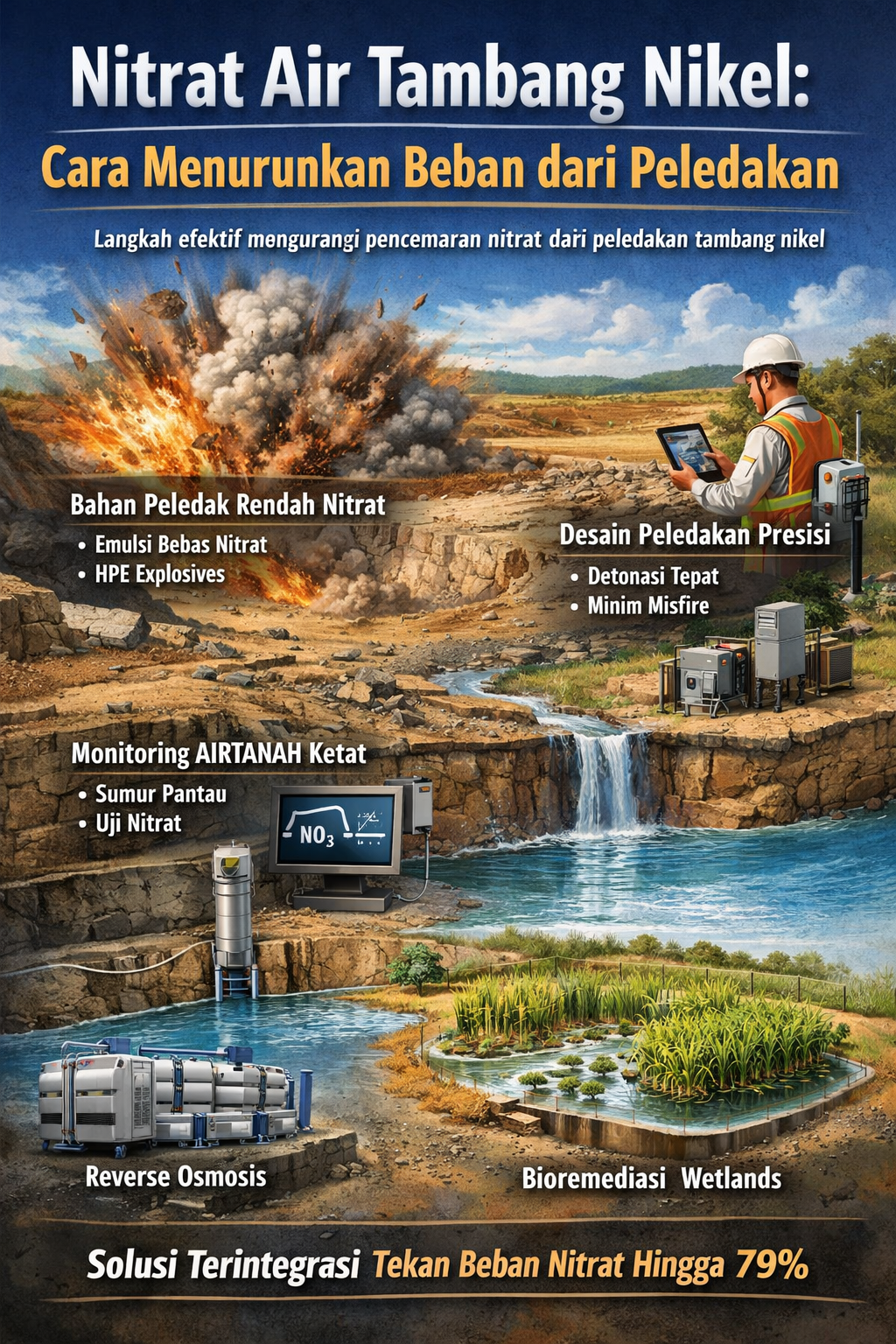
Rigorous monitoring is essential. Mines install groundwater wells up‑ and down‑gradient of blasting zones and sample for nitrate (NO₃⁻), ammonium (NH₄⁺), and nitrite (NO₂⁻); sampling uses ion chromatography or colorimetric assay, and some sites add in‑situ nitrate sensors for real‑time data (im-mining.com).
Measured concentrations can be high: one study found shallow groundwater adjacent to blasting at 5–170 mg‑N/L (milligrams as nitrogen per liter), far above undisturbed aquifers often <1 mg/L NO₃‑N (researchgate.net). In an extreme case (a Burkina Faso underground mine), monitoring found NO₃⁻ up to 1054 mg/L in some mine waters (researchgate.net).
To distinguish sources, stable‑isotope analysis (δ¹⁵N, δ¹⁸O) alongside hydrochemistry can confirm whether NH₄NO₃ blasting is the culprit; a New Hampshire study demonstrated this approach (pubs.acs.org). Comparison against benchmarks—e.g., Indonesia’s drinking‑water limit of ~50 mg/L NO₃⁻—guides when action is needed; frequent monitoring enables early‑warning trend analysis.
Nitrate remediation and containment
If nitrate exceeds acceptable limits, treatment or containment steps follow. Conventional physical/chemical options—reverse osmosis (RO) membranes and ion exchange (IX)—remove NO₃⁻ effectively (mdpi.com), and mines often standardize these within membrane‑based treatment trains such as RO, NF, and UF systems for industrial water.
Pumping contaminated water through an RO unit—such as a brackish‑water RO system with maximum TDS of 10000—strips out nitrates before reuse or discharge (noting energy and maintenance trade‑offs).
Where IX is chosen, complete ion‑exchange systems can be paired with the correct media, supported by appropriate ion‑exchange resins for anion removal (mdpi.com).
Bioremediation offers another route: engineered denitrification—via bioreactors (e.g., wood‑chip beds) or constructed wetlands—converts NO₃⁻ to N₂ gas; a recent review calls complete denitrification using native microbes “sustainable, cost effective, and environmentally friendly” (mdpi.com). Engineered biological units, including aerobic/anaerobic digestion systems, are commonly deployed where biology drives nitrogen removal in wastewater plants.
Plants can also uptake nitrates (phytoremediation), with certain aquatic species removing >90% of nitrate from water over days; in parallel, hydrology management—diverting runoff or ponding and treating seepage water—reduces migration pathways.
Integrated control chain and outcomes
Best practice is a chain of controls: switch to low‑nitrate explosives; design each blast to eliminate misfires and waste; monitor nitrate in wells; and treat or contain any nitrate‑rich water. The data show this works—modern mines report dramatic drops in nitrate, such as a 79% reduction at a Canadian mine (im-mining.com), or BME’s emulsion leaving only 0.7% of nitrate behind (mining.com).
Conversely, failures to control blasts can yield very high nitrate loads (hundreds of ppm), as documented in groundwater adjacent to blasting (5–170 mg‑N/L) and in extreme mine waters up to 1054 mg/L (researchgate.net) (researchgate.net).
By combining advanced explosives, precise blast engineering, and vigilant groundwater management (sampling wells, laboratory analysis, and remediation), nickel mines can meet regulatory limits (e.g., NO₃⁻ <50 mg/L in Indonesia’s drinking‑water standards) and avoid the environmental impacts of nitrate leaching (mdpi.com) (im-mining.com).
Sources: Peer‑reviewed and industry research on explosives and mining environmental control (mining-technology.com) (im-mining.com) (mining.com) (mining.com) (pubs.acs.org) (mdpi.com). Case studies include De Beers/Orica and BME South Africa; reviews cover nitrate pollution, treatment, and regulatory analyses of nitrate in groundwater.