
A three‑stage, modular treatment train—settling with floc, pH‑driven metal precipitation, and final clarification—is letting miners dewater fast and meet tight discharge limits, often from skid‑mounted containers.
When tailings pits fill and pit walls weep, the clock starts ticking. One mining team dewatered 200,000–300,000 m³ in three months using a 10,000 m³/day mobile Actiflo system that dosed ferric sulfate and polymer before microsand clarification—meeting permit standards and accelerating blasting schedules (www.veoliawatertech.com).
The blueprint behind that speed is straightforward: drop out solids first, precipitate metals next, and clarify again to polish. Deployed as containerized “plug‑and‑play” units, capacities scale from 1 m³/h up to 500 m³/h per module, with higher flows achieved by adding further units (www.veoliawatertechnologies.com).
The result is regulatory alignment, including the Indonesian PermenLH 09/2006 limits—TSS (total suspended solids) <100 mg/L at the first stage and nickel (Ni) ≤0.5 mg/L at discharge (pdfcoffee.com).
Primary solids removal (detention 2–6 hours)
Mine dewatering water typically carries sediment, clays, and slimes that must be removed before any chemistry. A settling pond or a clarifier drops out coarse and fine solids with multi‑hour detention—commonly 2–6 hours—so heavier particles gravitate out.
For high flows or tight footprints, lamella (inclined plate) or microsand clarifiers boost settling area dramatically. Compact lamella designs can reduce footprint by about 80% versus conventional clarifiers, and high‑rate systems like Actiflo multiply effective area, trimming footprint by ~5–10× vs open ponds (www.veoliawatertech.com). For a 100 m³/h flow needing 4 hours of detention (≈1,440 m³ volume), an open basin might require ~360 m² at 4 m depth; high‑rate units can cut that by ~90%.
Flocculant addition—polyacrylamide or ferric sulfate plus polymer—is standard. Even low doses (≤10 mg/L) agglomerate colloids and lift TSS removal above 90% (www.veoliawatertech.com). Jar tests (bench trials to optimize dose) should set the recipe; in practice, 1–10 mg/L of coagulant/polymer often delivers 80–95% turbidity/TSS drops. Pairing optimized chemistry with a lamella settler or microsand unit is how Veolia’s 10,000 m³/day mobile system consistently met discharge standards with ferric sulfate + polymer dosing (www.veoliawatertech.com). Typical stage‑one targets are TSS <100 mg/L (Indonesian mine limit) (pdfcoffee.com), with many plants reaching single‑digit mg/L TSS when flocculation is tuned.
On equipment, accurate chemical feed matters: miners often specify a dedicated dosing pump for polymer and ferric feeds, alongside bulk storage and inline mixers. Chemistry staples—flocculants and coagulants—are standard consumables in this stage (flocculants; coagulants).
pH adjustment and metal precipitation (target pH 9–11)
After solids, the job is dissolved metals. Raising pH with lime (calcium hydroxide), NaOH (sodium hydroxide), or similar converts many metals into insoluble hydroxides for removal. As EPSE summarizes: “A common way to precipitate metals is to raise the pH with bases like calcium or sodium hydroxide… At high pH, many metals form poorly soluble hydroxides” (www.epse.fi).
For nickel, practice shows >90% removal requires pH ≈9–10. An effective sequence is two‑step: raise to ~8 to drop Fe/Al first, then to ~9–10 to precipitate Ni/Co as Ni(OH)₂/Co(OH)₂. The core reaction is Ca(OH)₂ + Ni²⁺ → Ni(OH)₂↓ + Ca²⁺. Discharge goals typically aim for Ni <0.5 mg/L (Indonesia’s PermenLH 09/2006 sets Ni ≤0.5 mg/L; the WHO drinking standard is 0.07 mg/L) (pdfcoffee.com), which often means >90–95% Ni removal from raw levels (e.g., from 5 mg/L down by >10×). Monitoring pH and metal assays is non‑negotiable.
Reagent choices: lime slurry is preferred for higher pH setpoints (pH ≥9), with a rough guide of ~1–3 kg Ca(OH)₂ per kg of metal removed, depending on water hardness. An MDPI study found crystalline Ni(OH)₂ forming at pH ≈6.5 with Ca(OH)₂, but environmental waters usually need higher pH for complete removal. Sodium hydroxide or soda ash can be easier in modular plants. Ferric salts (e.g., FeCl₃) or MgO are sometimes added to target specific contaminants; ferric also functions as a coagulant (coagulant). All chemicals are dosed in stirred reaction tanks.
Final clarification and polishing (sludge capture)
Precipitated metal hydroxides become sludge that must be settled and removed. A second clarifier or lamella thickener captures >95–99% of these fines. In design, flow through the clarifier is deliberately low—e.g., <0.5 m³/m²‑min—to favor settling. High‑rate options (a second Actiflo or lamella module) can maintain throughput. Where ultra‑low TSS is required, polishing filters such as sand filters can drop residual turbidity to <5 NTU.
Performance is well documented: effective trains deliver TSS often <10–50 mg/L, and Actiflo systems can achieve <10 NTU even at high loads (www.veoliawatertech.com). Coupled with full metal precipitation, plants meet Ni <0.5 mg/L and Fe <5 mg/L (per Indonesian limits) (pdfcoffee.com). Turbidity and metal assays should validate discharge.
Sludge handling is part of the plan: thickened sludge (often 1–5% solids) is periodically removed and dewatered via filter press or geotextile tubes. Geotextile dewatering has precedent in Indonesia—Solmax reported dewatering 250,000 m³ of tailings slurry in Kalimantan using long geotubes. While beyond the water‑treatment skid, modular projects must include sludge management logistics.
Mobile and containerized delivery (plug‑and‑play)
For remote or temporary dewatering, mobile/containerized packages are increasingly standard. Units ship by truck or ship and are “plug‑and‑play” on site, minimizing civil works and allowing ease of installation (www.veoliawatertechnologies.com). Typical modules cover 1 m³/h to 500 m³/h per unit, and scalability is achieved by adding identical skids in parallel (www.veoliawatertechnologies.com).
Mobility also derisks projects: mobile teams can run “trial” campaigns to prove performance while permanent plants are engineered (www.veoliawatertechnologies.com). As discharge limits tighten (lower TSS, Ni, As), miners can slot in added filtration or ion‑exchange containers to stay compliant with Indonesian PermenLH (Ni ≤0.5 mg/L) and international standards (pdfcoffee.com). For temporary capacity, some operators turn to containerized rental units designed for emergency or short‑term water treatment needs.
The commercial momentum is clear: the global mobile water treatment market is estimated at about $5.84 billion in 2025, projected to $9.33 billion by 2030 (CAGR ~9.8%), with mining among the drivers (www.researchandmarkets.com).
Schematic train and controls (three modular stages)
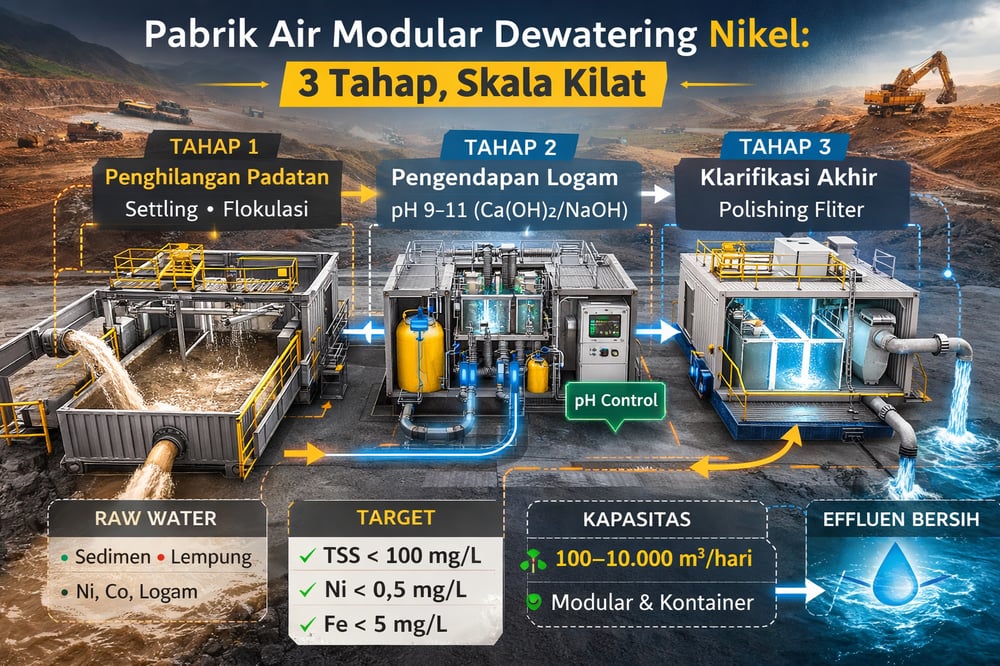
A typical skid‑mounted dewatering kit chains: (a) a grit/sediment basin or lamella tank with a polymer feed (supported by a chemical dosing pump), (b) a mixing/precipitation stage where lime/caustic is dosed into a rapid‑mix tank, and (c) a clarifier tank (often lamella or microsand). Modules come with all piping and pumps; crews make only the onsite connections. Built correctly, this configuration meets Indonesian effluent limits (e.g., TSS <100 mg/L and Ni <0.5 mg/L) (pdfcoffee.com).
Implementation, automation, and outcomes
Flows and sizing stem from field sampling and piloting: expected dewatering rates set the number of modules, while mass balance (e.g., moles of Ni to precipitate) informs lime/caustic demand. Upsizing is straightforward: add parallel skids. Modern packages include on‑board control panels and telemetry; dosing controls hold pH and turbidity targets, and in‑line sensors (pH/ORP/TSS analyzers) verify compliance—critical for remote sites (supporting equipment).
One Western Australia example ran a modular Actiflo package at 10,000 m³/day (~420 m³/h), mixing ferric sulphate and polymer prior to clarification to meet strict discharge permits (www.veoliawatertech.com). Veolia notes mobile services can cover any treatment step—coagulation, filtration, demineralization, metals removal—as part of the regulatory process (www.veoliawatertechnologies.com).
Outcomes from a well‑designed train are consistent: reduce Ni from raw water (often >5 mg/L in tailings effluent) to ≤0.5 mg/L, remove >95% of Fe/Mn/Co, and drop TSS from hundreds of mg/L to <50 mg/L—meeting Indonesian mining water standards.
Financing and deployment economics
Mobile/containerized plants can be leased or rented, turning CAPEX into OPEX—useful for development phases when cash is tight. Operators pay monthly for capacity and can defer permanent builds; faster permit compliance can unlock schedule gains, with mobile units “proving” performance while fixed plants rise (www.veoliawatertechnologies.com).
In summary, a modular, scalable plant for nickel mine dewatering sequences: high‑rate settling (pond/clarifier with floc) → pH‑lime reaction for metals → final clarification to capture hydroxide sludge. Each stage can be containerized. This approach is proven at hundreds of m³/h for pit dewatering and routinely meets stringent TSS/metal limits (www.veoliawatertech.com; www.veoliawatertechnologies.com), aligning business needs (OPEX flexibility, rapid deployment) with environmental obligations.
Sources: Indonesian PermenLH 09/2006 (Ni ≤0.5 mg/L; TSS ≤100–200 mg/L for nickel mines) (pdfcoffee.com); Veolia case studies and technology notes (www.veoliawatertech.com; www.veoliawatertech.com); EPSE metal precipitation primer (www.epse.fi); market analysis (www.researchandmarkets.com).
