
In high‑rainfall open pits—from Indonesia’s laterites to tailings dams—dewatering is the thin line between production and a flooded shutdown. Mining and mechanical engineers are rethinking pump choices, pontoons, and controls to handle variable flows and high heads without failing.
Nickel laterite mining in Indonesia—the world’s largest producer—runs through monsoon weather, deepening pits, and groundwater inflows. In 2023, Indonesian nickel ore output exceeded 175 million tonnes (eastasiaforum.org) and the country’s Ministry of Energy reports vast reserves (eastasiaforum.org). When dewatering systems falter, pit flooding can halt operations and cause catastrophic damage—“wide‑scale flooding of mine sites along with prolonged operational disruption,” warns Mining Weekly (miningweekly.com), echoing North American Mining’s framing of dewatering as the most important task to protect the entire operation (northamericanmining.com).
There is also paperwork: under Indonesia’s Water Resources Law (2019), any commercial water use—including mine dewatering—requires a Water Use Business License (hhp.co.id), and Public Works Regulation 2/2024 tightened licensing procedures for withdrawals (hhp.co.id).
Pump categories and duty ranges
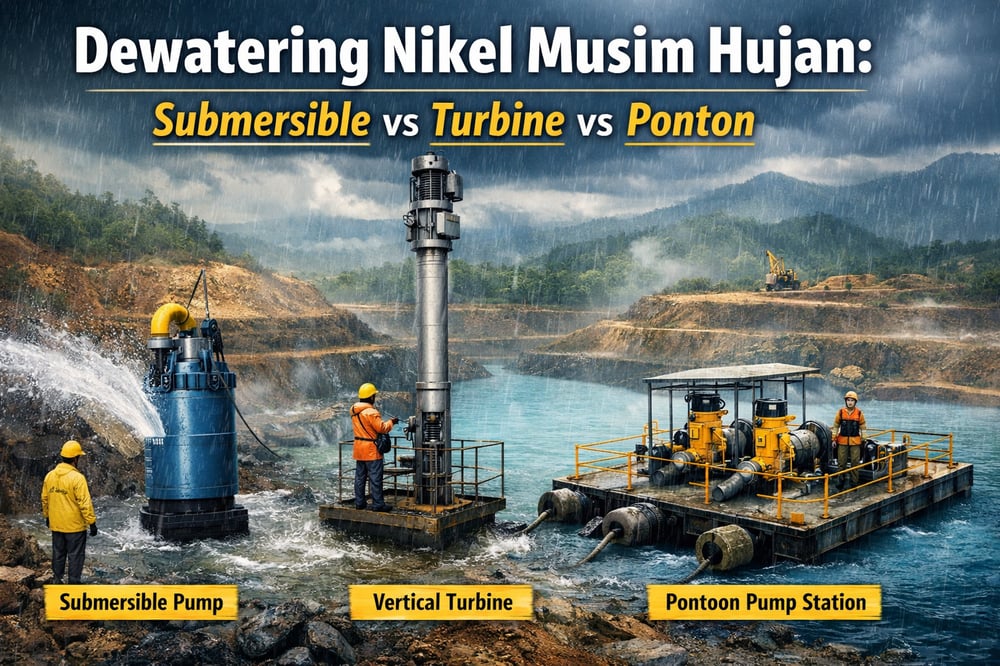
Three workhorses dominate mining dewatering: submersible pumps, vertical turbine (long‑shaft) pumps, and pontoon‑mounted pump stations. Each trades off capacity, head (the vertical lift a pump must overcome), solids handling, mobility, and maintenance.
Submersible pumps: mobility, staging, and abrasion
Fully submerged centrifugal units are ubiquitous in pit sumps and underground drifts. They are “highly flexible, require no infrastructure, can handle dirty water in high volumes and at high heads, and are easy to move around the mine site” (northamericanmining.com). With motors submerged, cavitation risk is reduced and footprints shrink: a 7.5 kW unit can be about 33×76 cm and ~60 kg (atlascopco.com). Electric submersibles also eliminate diesel fumes and noise in confined tunnels (atlascopco.com).
In practice, crews suspend submersibles from floating pontoons or barges to avoid digging into loose sediment—an approach that “significantly” extends service life (northamericanmining.com). Mining‑ready designs add wear‑resistant impellers, seals, and abrasive‑service materials (atlascopco.com; miningweekly.com). For duty growth, modularity matters: pumps run in parallel for more flow or in series to add head; Sulzer’s Hjelm notes series connections deliver the extra lift as pits deepen (northamericanmining.com). Modern setups also pair submersibles with quality intake protection; in abrasive service that can include a purpose‑designed strainer ahead of the pump.
Vertical turbines: continuous high head
Vertical turbine pumps—multistage units with submerged impellers and a surface drive—excel in continuous high‑head duty and large flows. They are “widely used” in mining to handle very large flows and heads, with materials selected for harsh environments (pumpsandsystems.com; atlascopco.com). Atlas Copco’s surface super‑high‑head “PAC SH” can reach ~200 m head at nearly 2,000 m³/h (8710 usgpm) (atlascopco.com).
Where chemistry is aggressive, corrosion‑resistant alloys have been applied—for example, titanium for acidic media in comparable leach services (pumpsandsystems.com). Installations need more infrastructure (concrete sumps, power runs), but suction limits are minimal. As pits deepen, intakes often ride the waterline: “multistage ring pumps and submersible vertical turbine pumps can be used for mine dewatering when higher heads are required,” and typically “vertical pumps are installed on pontoons” (northamericanmining.com). In a documented switch to a solids‑capable vertical turbine, time between rebuilds jumped from ~300 hours to over 1,000 hours—tripling service life (pumpsandsystems.com).
Pontoon stations: moving heavy horsepower
Pontoons are not a pump type but a mounting strategy for heavy‑duty units—horizontal or vertical—so the intake follows changing levels in pits, tailings dams, or reservoirs. Modular platforms can carry 20–25‑ton loads (coerco.com.au) and are used to continuously keep water below dangerous levels in heavy rains (coerco.com.au). In tailings management, “pump pontoons” are critical to drain water and prevent seepage of toxic water to the environment (coerco.com.au). Suspending a submersible on a barge also prevents it from “burrowing into the bottom sediment,” prolonging life (northamericanmining.com). Power can be diesel or electric; many sites are shifting to electric drives (below).
System design for variable flows and high heads
Dewatering demand is a moving target. Early in a project, seepage can be modest; as depth increases and during monsoons, inflows can climb to thousands of cubic meters per hour at high differential heads (atlascopco.com; atlascopco.com). Engineers build margin and flexibility: parallel pumps cover peak flow and allow maintenance without shutdown, while series staging divides the total lift when required head exceeds a single unit’s shut‑off head (northamericanmining.com; miningweekly.com).
Efficiency hinges on operating near the Best Efficiency Point (BEP, the flow/head where a pump is most efficient). Sulzer’s Hjelm cautions that running off‑BEP drives “premature wear, higher energy consumption [and] increased maintenance” (northamericanmining.com). Variable frequency drives (VFDs, electronic speed control) let operators match flow to inflow without throttling. Modern sets add telemetry: flowmeters, automatic shutdown, tilt and dry‑run protection. In Indonesia, KSB’s DnD packages ship with built‑in flow meters and tilt/dry‑run sensors to protect motors and optimize lifecycle cost (ksb.com).
Robustness, maintainability, and electrification
Mine water is abrasive and sometimes corrosive. Builders deploy high‑chrome or polymer impellers, robust shaft seals, and glandless motors suited to sediment‑laden service (atlascopco.com; miningweekly.com). Safety features now include dry‑start protection and no‑clog impellers, paired with upstream filtration—mining experts explicitly point to the value of quality strainers (miningweekly.com) that can be implemented with a rugged filter and ion‑exchange strainer.
Maintainability reduces downtime. Cartridge seals, replaceable wear liners, and standardized parts enable field swaps (atlascopco.com). Atlas Copco’s PAC SH uses single‑piece cartridge seals to simplify service and shrink MTTR (mean time to repair) (atlascopco.com). The stakes are large: mining projects typically allocate 35–50% of total costs to maintenance and repair (mdpi.com), and a critical pump failure can cost 10× more than routine servicing when lost production is included (northamericanmining.com).
Electrification is gaining ground for both cost and control. Electric motors can deliver up to five times lower energy cost than diesel in some regions and avoid engine maintenance (fuel and oil filters) (northamericanmining.com; northamericanmining.com). They integrate readily with SCADA (Supervisory Control And Data Acquisition) for real‑time monitoring and remote control—a trend highlighted in Indonesian pump packages (ksb.com).
Regulatory and environmental controls
Compliance in Indonesia starts with licensing. A Water Use Business License is mandatory for dewatering under the 2019 Water Law (hhp.co.id), and procedures for water withdrawals were tightened by MOPW Regulation 2/2024 (hhp.co.id). Designs also account for extreme weather: independent insurance data cited by Mining Weekly shows unpredictable heavy rains are now the leading natural disruptor of mining operations, so surge capacity and temporary units on standby are common (miningweekly.com).
On discharge, environmental safeguards include settling ponds and water treatment pumps to meet quality standards; engineers often add primary separation steps—such as waste‑water physical separation—ahead of polishing. Where solids loads are significant, a dedicated clarifier can extend run time between pump maintenance by reducing abrasive sediment reaching the impellers. For nickel laterites that can produce acidic run‑off, corrosion‑resistant materials may be required in pumps and piping—industry examples include titanium in acidic media (pumpsandsystems.com).
What a robust plan looks like
Many mines blend technologies: submersibles on pontoons for bulk flow, vertical turbines for maximum lift or standby capacity (northamericanmining.com; coerco.com.au). Duty points are sized near BEP, VFDs manage variability, and redundancy with condition monitoring keeps uptime high (northamericanmining.com; miningweekly.com). The payoff shows up in the data: a better‑engineered pump in one case tripled service life from ~300 to 1,000+ hours (pumpsandsystems.com), and operating near BEP cuts both wear and energy use (northamericanmining.com).
The bottom line for engineers is straightforward: match pump technology to site conditions; design for variable flow and high head; harden equipment against abrasion; and instrument everything. In regions like Indonesia—where licensing is strict and rainfall volatility is high—that combination protects productivity and keeps pits on schedule (hhp.co.id; hhp.co.id; miningweekly.com).
