
From buried limestone drains to reed-filled wetlands and bacteria‑powered reactors, passive acid mine drainage (AMD) systems are quietly neutralizing acidity and stripping metals — including nickel — with minimal energy. The performance gap and life‑cycle costs between anoxic limestone drains, constructed wetlands, and biochemical reactors are now clear in the field data.
At nickel operations, the water problem is as old as rock: AMD (acid mine drainage, the acidic, metal‑bearing water that forms when sulfides oxidize) leaches nickel, iron, and other metals into surface and groundwater. Three low‑energy fixes dominate the passive playbook — anoxic limestone drains (ALDs), constructed wetlands (including SAPS, or successive alkalinity producing systems), and biochemical (sulfate‑reducing) reactors — and their field records now show who does what best, at what scale, and for how long.
ALDs use high‑purity limestone (≥90% CaCO₃) kept air‑tight to avoid oxidizing iron; wetlands marshal plants, organic substrate, and microbes; and biochemical reactors (BCRs) feed sulfate‑reducing bacteria a carbon source to precipitate metals as sulfides. Every claim below is tied to case data and federal guidance — and the numbers are the story.
ALDs: buried limestone, big alkalinity
ALDs are buried trenches of limestone sealed from oxygen so ferric iron (Fe³⁺) does not form and armor the rock; they’re designed so acidic, ferrous‑rich mine water flows through the stone for long contact at low oxygen (nepis.epa.gov). A typical design basis is ≈2,800 kg limestone per (L/min) of flow for roughly 15 hours of contact time (nepis.epa.gov), which can raise pH by ~2–3 units (often landing around pH≈6) and generate as much as ~300 mg/L CaCO₃ alkalinity under favorable conditions (nepis.epa.gov).
Field ALDs at metal mines have delivered effluent alkalinity in the ~80–320 mg/L range as CaCO₃ (nepis.epa.gov). Once that water exits the anoxic drain, dissolved metals such as iron and manganese oxidize and precipitate in settling ponds or wetlands (nepis.epa.gov) — an analogous solids step in plant settings would be an industrial clarifier.
Longevity is the ALD calling card. When influent is properly anoxic and ferric iron and aluminum are kept out, documented systems have operated ≥25–30 years with stable performance, with limestone replacement timing governing life (nepis.epa.gov; see also replenishment needs tied to flow rate and metals: nepis.epa.gov).
There’s a catch: ALDs work best on moderately acidic water (pH ≥5–6) with minimal Fe³⁺ and Al³⁺; ferric iron should be biologically or chemically reduced to ferrous first to avoid limestone armoring (nepis.epa.gov; ferric/aluminum precipitation can choke the reactive surface: nepis.epa.gov). FRTR guidance flags waters with pH<5 and any Fe³⁺ for pre‑treatment (e.g., a reducing wetland) before an ALD (nepis.epa.gov). In practice, that pre‑treatment can be biological or chemical (chemical feed delivered by standard site equipment such as a dosing pump).
Lab and field pilots show ALDs can push pH to about 6.3, causing metals like copper, zinc, and lead to precipitate in the drain itself (projects.itrcweb.org; confirmatory field performance under stable conditions: nepis.epa.gov). With rising pH, nickel follows suit, precipitating as hydroxide/carbonate.
Constructed wetlands and SAPS: biology plus limestone
Wetlands remove acidity and metals via plant uptake, organic media, and microbially mediated redox changes. Aerobic surface‑flow cells excel at ferrous iron oxidation and settling near neutral pH, while vertical/downflow cells such as SAPS stack an organic compost layer over limestone to induce anaerobic sulfate reduction beneath (nepis.epa.gov).
Removal is robust. FRTR reports wetlands typically remove 75–90% of acidity and more than 80% of iron and base metals (nepis.epa.gov). In Indonesia, one coal‑mine wetland raised effluent pH to 6.90 and cut Fe to 0.31 mg/L (Mn to 2.75 mg/L), meeting local standards (jiss.publikasiindonesia.id). Aerobic systems routinely exceed 80–90% Fe removal (nepis.epa.gov), while anaerobic cells capture sulfide‑forming metals.
Nickel does move in wetlands, though slowly: bench work shows a vegetated wetland can remove about 30–45% Ni at a 3‑day hydraulic retention time (HRT; time water spends in the system), with planted systems in one test at 72 hours HRT removing 44–50% Ni (etasr.com). By contrast, a sulfate‑reducing bioreactor at Leviathan Mine drove Ni from 0.487 to 0.094 mg/L (more than 80% removal) (nepis.epa.gov).
Vertical‑flow SAPS specifically guard limestone from armoring by precipitating Al/Fe in the compost layer and raising alkalinity. At Summitville, a SAPS cell output pH was ~6–7 with ~97% Al and ~57% Zn removal and ~64% Fe removal in heavy‑metal AMD (nepis.epa.gov). Typical SAPS design uses around 50–60 cm of slow‑composting organic media (nepis.epa.gov).
The trade‑offs: wetlands demand land and generally steady flow to sustain the ecosystem (nepis.epa.gov), and performance can dip in winter (nepis.epa.gov). Periodic dredging of accumulated sediments and harvesting of plants may be needed (nepis.epa.gov). SAPS O&M is moderate, with compost replacement on the order of ~2–3 years (nepis.epa.gov), and lifecycle cost estimates span about $0.003–0.03 per gallon treated (~$0.8–8/m³), depending on flow (nepis.epa.gov).
Biochemical reactors: sulfate reducers do the heavy lifting
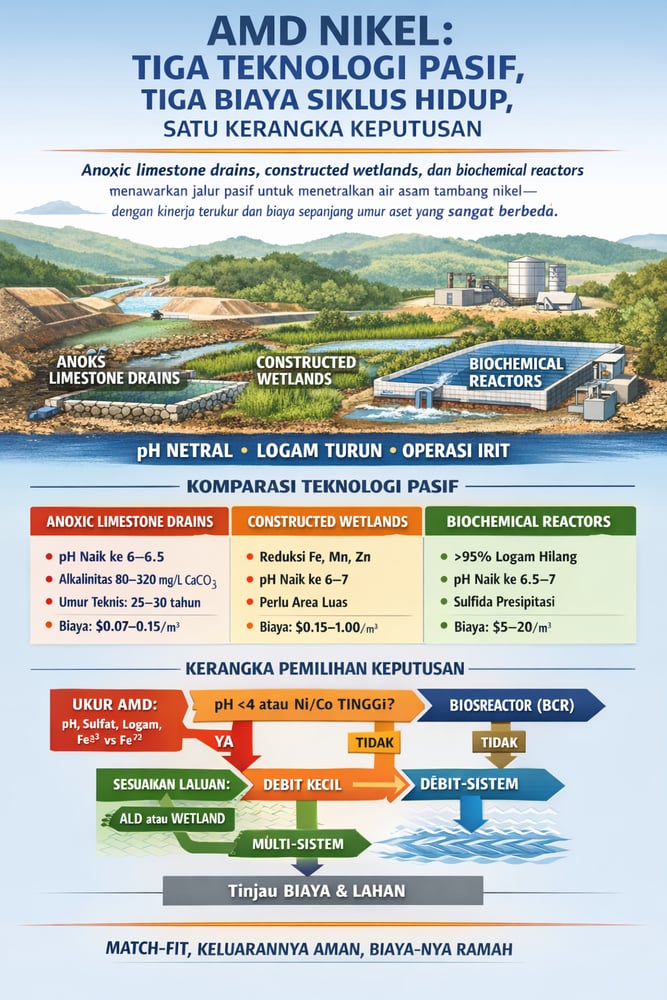
BCRs passively treat AMD by feeding sulfate‑reducing bacteria an electron donor (a carbon source) so they convert SO₄²⁻ to H₂S; that raises pH and drops metals as sulfides (nepis.epa.gov). The vessels can be open ponds, buried tanks, or trenches filled with a mixed substrate (organic matter plus limestone and/or gravel) to sustain downflow through the system (nepis.epa.gov; substrate loading guidance is framed per unit of electron donor: nepis.epa.gov).
These reactors are versatile, with field deployments in highly acidic, metal‑rich flows and cold or high‑altitude conditions (nepis.epa.gov; summary of effectiveness: nepis.epa.gov). For nickel‑bearing AMD, the chemistry is favorable: Ni and Co form insoluble sulfides. At Leviathan Mine (California), a compost‑free BCR achieved 95% removal of target metals, including Ni, and raised pH from 3.0 to 7.0 (nepis.epa.gov), with Ni dropping from 0.487 to 0.094 mg/L (>80% removal) at equilibrium (nepis.epa.gov).
Designers target ≥8–48 hours of retention (nepis.epa.gov), and removal rates for cationic metals often exceed 95% (e.g., the Luttrell BCR achieved 98% removal of problem metals, including Ni) (nepis.epa.gov). Downsides include substrate clogging or compaction — mitigated with gravel layers and periodic flushing (nepis.epa.gov). BCRs need depth (>3–4 ft) and temperature control, but buried or insulated cells operate year‑round; media replacement is rarely needed, though periodic sludge removal or flushing may be required (nepis.epa.gov).
Measured outcomes: pH uplift, metal removal, acid mass
Across 83 passive systems, 82 reduced acidity load, with ALDs neutralizing up to ~22 t of acidity per year in U.S. cases; typical ALD capacity ranges ~25–60 g acid/day per tonne of limestone (researchgate.net; capacity data: researchgate.net). A decade‑long study of 10 coal‑mine ALDs found effluent alkalinity consistently 80–320 mg/L as CaCO₃, plateauing after roughly 15 hours of contact time (nepis.epa.gov).
By contrast, a set of 15 anaerobic wetlands averaged ~2–4 t acid/yr each (researchgate.net). Metal‑wise, vertical‑flow SAPS excel at aluminum (≈90% Al removal in practice; Summitville data) and ~64% Fe removal (nepis.epa.gov), while aerobic wetlands reliably remove >80% Fe (nepis.epa.gov). Sulfate‑reducing bioreactors post the highest cationic metal removal, frequently >95% (e.g., 98% at Luttrell) (nepis.epa.gov).
For Ni specifically, passive removals in pilots span ~40–80%: a planted wetland achieved 44–50% Ni removal at 72 h HRT (etasr.com), versus ~80% in a sulfate‑reducing bioreactor at Leviathan (0.487→0.094 mg/L) (nepis.epa.gov).
Life‑cycle costs: capex, O&M, and disposal
ALDs are the budget leader. In Canada, an ALD installation runs about $6–37k (2013 USD), with large‑scale capacity estimated at roughly $0.27 per 1,000 gallons (nepis.epa.gov; capacity reference: nepis.epa.gov). Limestone replenishment is occasional (decadal) (nepis.epa.gov), yielding an operational cost near $0.07/m³ treated (US DOE estimate) (nepis.epa.gov).
Wetlands carry bigger site‑work bills: one Tennessee anaerobic–aerobic complex cost about $1.4M in 2013 dollars, with ~$0.38M added later (nepis.epa.gov). Generic estimates for constructed wetlands (including land and initial build) range $0.15–1.00 per gallon (≈$40–260/m³) (nepis.epa.gov), while SAPS O&M spans about $0.003–0.03 per gallon as flows scale up (nepis.epa.gov).
BCRs cost more per cubic meter. A commercial compost BCR (1,200 gpm) was about $1M (1996 USD), and a state‑of‑the‑practice 10 gpm system totaled ~$1.1M (nepis.epa.gov; detailed 10 gpm case: nepis.epa.gov). At Leviathan, O&M worked out to roughly $19.5 per 1,000 gallons (≈$5.2/m³), reflecting periodic pumping and maintenance (nepis.epa.gov).
On an acid‑mass basis, a survey of 83 passive systems found ALDs removed ~22.2 t acid/yr at about $83 per tonne — the lowest of any type — while anaerobic wetlands averaged ~$527 per tonne removed (researchgate.net). End‑of‑life handling can dominate the true bill: in one analysis, zinc recovery from 840 m³ of spent bioreactor compost fetched only ~€7,600 in metal value but avoided roughly €0.8M in disposal cost (researchgate.net).
Selection framework: chemistry, flow, land, and climate
Start with water characterization: pH, acidity, dissolved O₂, Fe³⁺/Fe²⁺ speciation, Al, Mn, Ni/Co, sulfate, temperature, and flow. For ferrous, moderately acidic AMD (pH≈4–6) with low ferric/Al, an ALD is often the first choice because it neutralizes acidity cheaply at long contact time (≈15 h; typical sizing uses ≈2,800 kg limestone per (L/min) of flow: nepis.epa.gov). If significant Fe³⁺ or Al³⁺ are present, their precipitation will choke an ALD; add a reducing stage (e.g., SAPS or a small BCR) ahead of limestone to convert Fe³⁺→Fe²⁺ and strip Al — Summitville’s SAPS posted ~97% Al removal (nepis.epa.gov). For very low pH (pH<4) or high‑sulfate, metal‑rich flows (Ni, Cu, Zn), a BCR is favored; these reactors elevate pH to neutral and remove metals at high efficiency with ≥8–48 h HRT (nepis.epa.gov), often exceeding 95% removal (e.g., Luttrell’s 98% case: nepis.epa.gov; Ni example: nepis.epa.gov).
Flow rate drives footprint. Small‑to‑moderate flows (up to ~100 gpm) fit any passive approach; large flows push designers to arrays in parallel (multiple ALD trenches or wetland cells). Wetlands need land and steady inflow (nepis.epa.gov); where land is scarce or expensive, subsurface ALDs or buried BCR tanks are preferable despite higher density capex.
Climate matters. In tropical regions (e.g., Indonesia), wetlands operate year‑round; in cold climates, sub‑surface systems (ALDs, compost beds) avoid freezing. All passive tanks and ponds are low‑energy (often gravity‑fed) but still need flow control and periodic inspections — supported by site water‑treatment ancillaries. Maintenance cadence varies: ALDs are low‑touch with decadal media changes (nepis.epa.gov); SAPS refresh compost at ~2–3 years (nepis.epa.gov); wetlands dredge sediments as needed (nepis.epa.gov); BCRs rarely need media replacement but may require periodic flushing (nepis.epa.gov).
Regulations set the bar. In Indonesia, thresholds demand neutral pH (≈6–9) and low metals (e.g., Fe <1.0 mg/L, Mn <2.0 mg/L for Class II); the coal‑mine wetland cited met pH ~6.9 and Fe 0.31 mg/L with Mn 2.75 mg/L (jiss.publikasiindonesia.id).
Cost‑benefit screens the short list: ALDs deliver the lowest capital/O&M for mild AMD (operational ~$0.07/m³; nepis.epa.gov); wetlands/SAPS sit in the middle with broad metal capture but larger footprint (~$0.15–1.00 per gallon for wetlands including land and initial work; SAPS O&M ~$0.003–0.03 per gallon) (nepis.epa.gov; nepis.epa.gov); BCRs cost more per volume (e.g., ~$19.5/1,000 gal O&M at Leviathan) but deliver the most robust Ni and cationic metal removal when required (nepis.epa.gov).
Summary decision steps (with field anchors)
- Measure: pH, acidity, dissolved O₂, Fe³⁺/Fe²⁺, Al, Mn, Ni/Co, sulfate, temperature, flow.
- Pre‑screen: If pH<4 or Ni/Co are extremely high → prioritize a sulfate‑reducing bioreactor (plus polishing); BCRs elevate pH and remove metals at ≥8–48 h HRT (nepis.epa.gov) and have documented >95% removals (e.g., Luttrell’s 98%) (nepis.epa.gov).
- Check ALD viability: If O₂ is very low and Fe³⁺/Al minimal, an ALD can neutralize acidity and precipitate some metals (stable performance under right conditions: nepis.epa.gov; Fe³⁺/Al cautions and pH threshold: nepis.epa.gov). Otherwise use a coupled system (e.g., SAPS or BCR followed by ALD).
- Wetland step: If pH is moderate/neutral and Fe/Mn dominate, an aerobic wetland can polish effluent, with >80–90% Fe removal documented (nepis.epa.gov); for mixed metal loads, include an anaerobic (compost) cell for Zn/Cu/Ni.
- Scale with flow: For high flows, stage multiple cells in parallel (e.g., ALD trenches or wetland ponds) and confirm detention time (typically 1–3+ days in wetlands; ≥15 h in ALDs per design guidance: nepis.epa.gov).
- Evaluate costs: ALDs have low operational costs (≈$0.07/m³; nepis.epa.gov); wetlands carry ~$0.15–1.00/gal inclusive of land/initial build (nepis.epa.gov); SAPS O&M spans ~$0.003–0.03/gal (nepis.epa.gov); BCR O&M is about $19.5/1,000 gal in the Leviathan case (nepis.epa.gov).
All selections should be pilot‑tested or modeled with local water data. The cited cases show that, when matched to water chemistry and sized for flow, passive systems meet discharge criteria at far lower life‑cycle cost than active treatment (ALD cost/performance guidance: nepis.epa.gov; BCR effectiveness example: nepis.epa.gov).
