
Dewatering pumps run nonstop in nickel operations, and the power bill shows it. Upgrading to IE3/IE4 motors and variable‑frequency drives is yielding double‑digit savings, fast paybacks, and lower CO₂ — with audits pointing to 10–30% efficiency upside.
Mine dewatering — the continuous pumping of inflow water in underground and open‑pit mines — can represent a major fraction of a site’s energy consumption. Electric motors (driving pumps, fans, and compressing air) account for roughly 50–60% of global industrial electricity use (id.hanzelmotor.org). Regulators have responded: about 76% of world electricity supply now operates under motor efficiency standards at IE2/IE3 levels (id.hanzelmotor.org). In markets like the EU and USA, “premium” (IE3) or superpremium (IE4) motors are mandated (e.g., EU Ecodesign Reg. 640/2009 demands IE3 motors from 0.75–375 kW).
For nickel mines that pump year‑round, even modest efficiency gains add up. Upgrading pump systems to high‑efficiency designs and controls is a proven route to cost savings and reduced carbon emissions.
High‑efficiency motors and pump hydraulics
New pumps and motors built to IE3–IE4 efficiencies draw several percent less power than older IE1–IE2 units. In a 75 kW centrifugal pump analysis, replacing an IE2 motor with an IE4 motor saved 192.6 MWh of energy (over 20 years), versus 82.4 MWh for IE3 — with paybacks ≈2.9 years and 5.2 years respectively (mdpi.com). The IE4 upgrade also avoided about 8.87 tonnes CO₂ per year (versus 3.78 for IE3) (mdpi.com). In practice, a mine electrifying dewatering with IE4 motors can recoup the higher motor cost in just a few years (mdpi.com).
Hydraulics matter. Many pumps are oversized for worst‑case inflow, spending time throttled or idling below best efficiency. Right‑sizing pump duty — via impeller trimming or installing a smaller pump — eliminates wasting flow through bypass valves. Energy‑management guides explicitly recommend “eliminating throttling operations by impeller trimming, resizing [pumps], or installing VSDs (variable‑speed drives)” (policy.asiapacificenergy.org). Upgrading to new pumps with improved volute/impeller shapes or multi‑stage diffusion systems can raise hydraulic efficiency by 5–15% over worn‑out units, according to manufacturers’ data.
Typical outcomes reinforce the point. In one mine study, specifying high‑efficiency motors across the site saved about 65 kW total, yet improved control exceeded this effect (danfoss.com). More generally, replacing IE2 with IE3/IE4 motors in pump systems commonly reduces power draw by a few percent to >10% per motor, depending on load factor. In heavy‑load applications (long operating hours), even a 2–3% motor efficiency gain yields large cumulative savings.
Regional context (Indonesia) is shifting too. Indonesia’s Ministry of Energy now mandates energy management and audits under PP 33/2023 (ireem.id). Large mines will thus need to justify their equipment efficiency. While Indonesia does not yet have separate laws for motor MEPS, it follows global trends: Asia‑wide, IE2/IE3 is becoming standard. Indonesian operations should plan to match or exceed these levels to stay competitive, especially given the country’s push for energy conservation and the high cost of diesel fuel in remote areas.
Variable‑frequency drives for fluctuating inflows
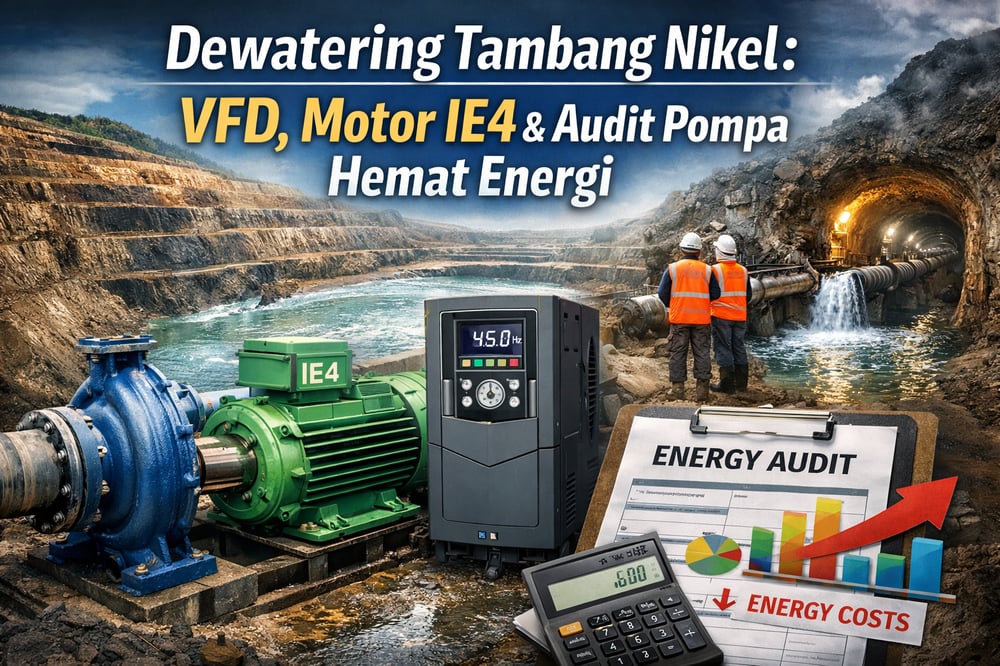
Because dewatering demand fluctuates with rainfall, pumping cycles, and reservoir buffering, fixed‑speed pumps often operate far from their best efficiency point. A VFD (variable‑frequency drive — electronic speed control for AC motors; also called VSD) lets output match real‑time requirements. By the Affinity Laws (pump performance scaling rules), power scales roughly with the cube of speed: cutting speed by 20% can reduce energy use by about 50%. In mine applications, adding VFDs typically cuts pump energy use by 10–20% or more (rmipsl.com).
One analysis of underground roof‑support pumps found that converting from fixed‑speed to full‑VFD operation saved over 20% of annual energy costs; an intermediate case (a single pump on VFD, others fixed) showed ~10% savings (rmipsl.com) (rmipsl.com). Extrapolating, retrofitting four 24/7 pumps in a mine would save roughly ¥1.5 million (US$205k) in one year (over 20 years, >¥22 million) (rmipsl.com). VFDs also eliminate start‑up power spikes and throttling losses, reducing mechanical stress.
Electrification economics versus diesel
Switching from diesel‑driven dewatering pumps to electric (with VFD control) multiplies these gains. Electric pumps have no fuel cost and far lower maintenance (no oil changes or fuel handling), so operating costs drop dramatically. Industry sources note that, all else equal, an electric VFD‑equipped pump can be 3–5 times cheaper per kWh‑equivalent than a diesel engine (miningmagazine.com). Danfoss observes that although an electric‑driven pump skid has higher upfront cost, the fuel/maintenance savings “are recovered very quickly, often within months” (danfoss.com).
A case from Kolomela mine (South Africa) underscores control as a lever: adding advanced VFDs with enhanced cooling to the dewatering system cut the substation’s AC power draw by 80 kW — more than the 65 kW saved by all high‑efficiency motors at the site (danfoss.com). Vendors cite paybacks on VFD systems often under 1–2 years; in the Kolomela case, integrated AC drives with back‑channel cooling immediately saved enough on AC demand (8–10% of drive costs) to deliver “payback from day one” (danfoss.com).
Pump energy audit: inventory to ROI
Achieving these savings systematically requires a pump energy audit. A structured approach for dewatering systems includes:
• Inventory and data collection: list all dewatering units (surface and underground), noting motor power, pump type, age, piping, valves, and typical operating conditions (flow, head). Gather historical operation (flow rates, start/stop times, control modes) and energy use from SCADA (supervisory control and data acquisition) or meters. Field instruments (flow meters, pressure gauges, power loggers) should be used to measure actual performance during normal operation, including partial‑load periods and idle times.
• Operation profiling: determine duty cycles at full load, partial load, or standby, and seasonal variation (e.g., rains). Note on/off waiting or throttling through bypass valves. For example, RMI analyzed 15‑day SCADA records of on‑load vs off‑load time for each pump (rmipsl.com). Profiling reveals pumps running at 30% flow but 100% speed.
• Performance analysis: compare measured flow/head against pump and motor curves. Identify mismatches: if a pump requires throttling (valve control) to hit demand, it is oversized. Check motor efficiency at loaded conditions (older motors may only achieve IE1 or IE2). Tools like pump‑metering kits or software (e.g., DOE’s PSAT) can estimate losses. Verify issues: excessive throttling, worn impellers, leaks, partial‑cycling, or wrong selection.
• Benchmarking: compare operation to best‑practice benchmarks. For instance, a pump drawing 37 kW to deliver 50 l/s at 30 m head might normally require only 30 kW if optimally sized (researchgate.net). Replacing a fixed‑running pump with a VFD at partial load often pays back in 1–3 years. High‑efficiency motor swaps (IE2→IE3/IE4) usually pay back ~3–5 years for 24/7 service (mdpi.com).
• Identify savings measures: common opportunities include VFDs on constant‑flow pumps; impeller trimming or smaller impellers; resizing or adding parallel pumps for varying flow; repairing worn components; and upgrading to IE3/IE4 motors. A pump throttling 20% of the time can save up to ~3× the throttled power by running ~20% slower on a VFD (Affinity Law). Similarly, replacing one 150 kW IE2 motor with IE4 yields ~40 MWh/year saving (at $0.1/kWh) and ~€5000/year in the MDPI case (mdpi.com).
• Prioritization and planning: rank measures by ROI and feasibility. Immediate low‑cost steps (impeller trimming, VFD parameter tuning) first; mid‑term replacements (high‑efficiency motors, pumps) aligned with maintenance cycles; then test after upgrades. Incorporate audit findings into the site’s formal energy management system — Indonesia’s Regulation 33/2023 specifically requires recurring audits and certified energy managers (ireem.id).
A disciplined audit typically identifies 10–30% energy‑savings potential in a dewatering system. Real‑world studies back this: one deep‑mine analysis found optimizing pump control and shifting to off‑peak pumping cut overall water‑system energy use by 2% (but cut peak demand 65%) (researchgate.net). Even if aggregate savings seem modest, the business impact is large given continuous operation and high energy rates.
Implications for nickel mines
For nickel mines — especially in Indonesia where electricity and diesel costs are high — investing in pump efficiency pays off. Upgrading to IE3/IE4 motors and precision pumps, adding VFDs, and systematically auditing pump systems can reduce dewatering energy use by double‑digit percentages (rmipsl.com) (danfoss.com). Measurable outcomes from case studies include tens‑of‑thousands of dollars saved per year per pump bank, and paybacks often under 5 years. Following the audit framework helps mine operators quantify gains, meet regulatory energy‑management requirements (ireem.id), and make confident upgrade decisions.
Sources and references
Industry reports, case studies, and energy‑audit guidelines support these conclusions. RMI Pressure Systems data show VFD retrofits cutting pump power by ~20% (rmipsl.com). Comparative studies document life‑cycle savings and CO₂ reductions from premium motors (mdpi.com) (mdpi.com). Regulatory and technical guides (Indonesia’s Permen‑Energy, IEC/IEA analysis) detail efficiency standards and audit processes (id.hanzelmotor.org) (policy.asiapacificenergy.org) (ireem.id).
