

Industry: Nickel_Mining | Process: Acid_Mine_Drainage_(AMD)_Treatment
In nickel mining, acid mine drainage (AMD — acidic runoff from sulfide oxidation) begins the moment sulfides meet air and water. Pentlandite (Fe,Ni)₉S₈, pyrrhotite Fe₁₋ₓS, and pyrite FeS₂ oxidize, generating sulfuric acid via reactions like FeS₂ + 3.5O₂ + H₂O → Fe²⁺ + 2SO₄²⁻ + 2H⁺, producing low pH (<4) drainage that dissolves metals (GARD Guide) (GARD Guide).
Nickel itself is relatively soluble at pH <7–8, so as pH falls toward neutral, Ni and Co are mobilized (GARD Guide). In humidity-cell data cited by GARD, nickel in drainage stayed below 0.01 mg/L until pH slipped from ~8 to ~7.5 — then Ni “spiked” (GARD Guide).
Field reality is similar: sulfidic nickel waste — even lateritic overburden — can generate acid with elevated Ni, Fe, and Zn. At one nickel waste dump, sulfur ran 2.7–3.3% (background 0.8%), with Maximum Potential Acidity (MPA — total acid potential) ≈100 kg CaCO₃ per tonne of rock and only ~5–8 kg CaCO₃ neutralizing potential (NP), an NPR (NP/AP) of ~1.1 (essentially unneutralized) (Kanda et al., 2017)). Surrounding soils showed high Ni (~195 mg/kg) and Cu (132 mg/kg), pointing to significant metal export (Kanda et al., 2017)). As a rule, any PAG (potentially acid-generating) rock in tropical/wet climates requires careful management to keep oxygen and water out (GARD Guide) (UNAIR).
Risk prediction and early indicators
Before design, thorough geochemical testing — acid–base accounting (ABA: static tests of total sulfur, NP, MPA, and Net Acid Producing Potential, NAPP) and NAG (Net Acid Generation) tests — classifies rock as PAF (potentially acid-forming) or NAF (non-acid-forming). An NPR ≈1 indicates almost no net neutralization capacity (Kanda et al., 2017)). Rock with positive NAPP is treated as acid-generating; even “inconclusive” ABA results are handled conservatively, with preventive measures (alkaline addition and containment) recommended (Kanda et al., 2017).
Early kinetic tests (humidity cells) may not show acid for months. Nickel tests cited by GARD showed Ni leaching delayed 20–50 weeks until pH drifted downwards (GARD Guide). Waste classification and risk modeling (e.g., MINTOX or PHREEQC) are done at design stage, and under Indonesia’s “dry cover” practice (borrowed from coal mining) NAF rock is reserved as cover while PAF is encapsulated (SCIRP). Regulatory guidance (e.g., KLHK Directive; Martens, etc.) generally requires an AMD management plan based on such characterization.
Alkaline amendment strategies (limestone)
Adding alkaline materials directly neutralizes acid as it forms. Limestone (CaCO₃) is most common. In practice it’s mixed or layered with waste, or installed as limestone drains/dosing stations, so percolating water dissolves CaCO₃, raising alkalinity and pH, precipitating Fe, and passivating sulfides; limestone placed over PAG material can form a “hardpan” coating on sulfide layers (GARD Guide). Computer modeling backs the benefit: MINTOX simulations showed adding limestone to tailings reduced heavy metal loads as higher pH drives metal precipitation; at Elliot Lake (Ni tailings), modeled carbonate addition cut dissolved metals — sulfate and Ni dropped as calcite dissolved (MEND).
Field approaches range from mixing crushed limestone into dumps to laying a limestone-rich cap or installing limestone drains. One full-scale example used a fluidized limestone reactor: a limestone slurry (60 g/L) treated ferruginous mine leachate, oxidizing Fe²⁺ even at pH≈2.5 at 16.1 g Fe²⁺/L-d and concurrently raising pH (Maree et al.). Limestone dosing stations often use metered slurry feed, a role served by dosing pumps.
Bench studies suggest roughly 300–500 kg limestone per tonne of highly acid-generating rock may be needed to neutralize ~100 kg CaCO₃‑equivalent acidity. Where available, alkaline by-products (e.g., fly ash, steel slag) or cement kiln dust may supplement or substitute limestone (as in some coal mines) (GARD Guide). This dovetails with sourcing a complete range of chemicals for mining when alkaline by-products are used alongside limestone.
Engineered cover systems
Soil/layered covers. The primary prevention method is a low‑permeability cap to block O₂ and infiltration, using compacted local soils/rock in layers. Indonesian practice commonly applies a 2–5 m “dry cover” of NAF material over PAG waste (SCIRP). At a Canadian sulfidic waste pile (Equity Mine), an engineered soil cover stayed >90% saturated (performing as an oxygen barrier) and passed only ~5% of rainfall into the waste (O’Kane & Wilson). By compaction and layering, covers achieve very low permeability (10⁻⁷–10⁻⁸ cm/s), comparable to geosynthetic liners; typical designs (1–3 m clayey soil + 0.5–1 m topsoil) achieve >90% infiltration reduction.
Covers with capillary barriers. Fine/coarse interfaces (e.g., fine clay under coarse rock) create a capillary break holding a perched water table that further reduces downward flow. Subsidence planning, runoff shedding, and erosion control are engineered, with thickness and drainage sized for monsoonal rainfall (often 1000+ mm/year).
Synthetic (geomembrane) covers. Where performance or space is critical, HDPE (high‑density polyethylene) membranes or GCLs (geosynthetic clay liners) are used. Even a single HDPE membrane under rock mulch can “dramatically reduce infiltration” (GARD Guide), but careful installation (sand cushions, anchoring, UV/mechanical protection) is essential (GARD Guide). GCLs self‑seal small punctures and are sometimes used under soil covers. Synthetic layers are costly — often doubling project costs for large areas (GARD Guide) — and are typically reserved for high‑risk or confined areas.
Organic and novel covers. Organic‑rich covers (compost, biosolids) act as “bioreactive” barriers. When saturated, they form an oxygen barrier (O₂ diffuses in water 10⁻⁴ times slower than in air) and an O₂ sink as microbes consume inflowing oxygen; leachates may also inhibit sulfur‑oxidizing bacteria, and organic degradation can promote reductive conditions that precipitate Fe/Mn (MEND) (MEND). Well‑compacted organic covers also have very low hydraulic conductivity, reducing infiltration (MEND). Pilot covers in Canada (OSMIX program) kept underlying tailings nearly anoxic. Organic covers need adequate thickness (often >0.5 m), moisture management, and occasional replenishment; GARD notes they can reduce acidity but not always stop ARD completely (GARD Guide) (MEND).
Water covers (wet caps). Fully saturated covers or tailings flooding cut off O₂. At Benambra, rehabilitation created a permanent ~2 m water cover over sulfide tailings and added passive limestone/organic capping; pH rose to ~7–9 and dissolved metals fell ~85–99% — Cu 2.4→0.03 mg/L, Pb 1.95→0.001 mg/L, Zn ~1→0.1 mg/L — and sulfate dropped from 1600→<200 mg/L (GARD Case Study) (GARD Case Study).
Design and implementation considerations
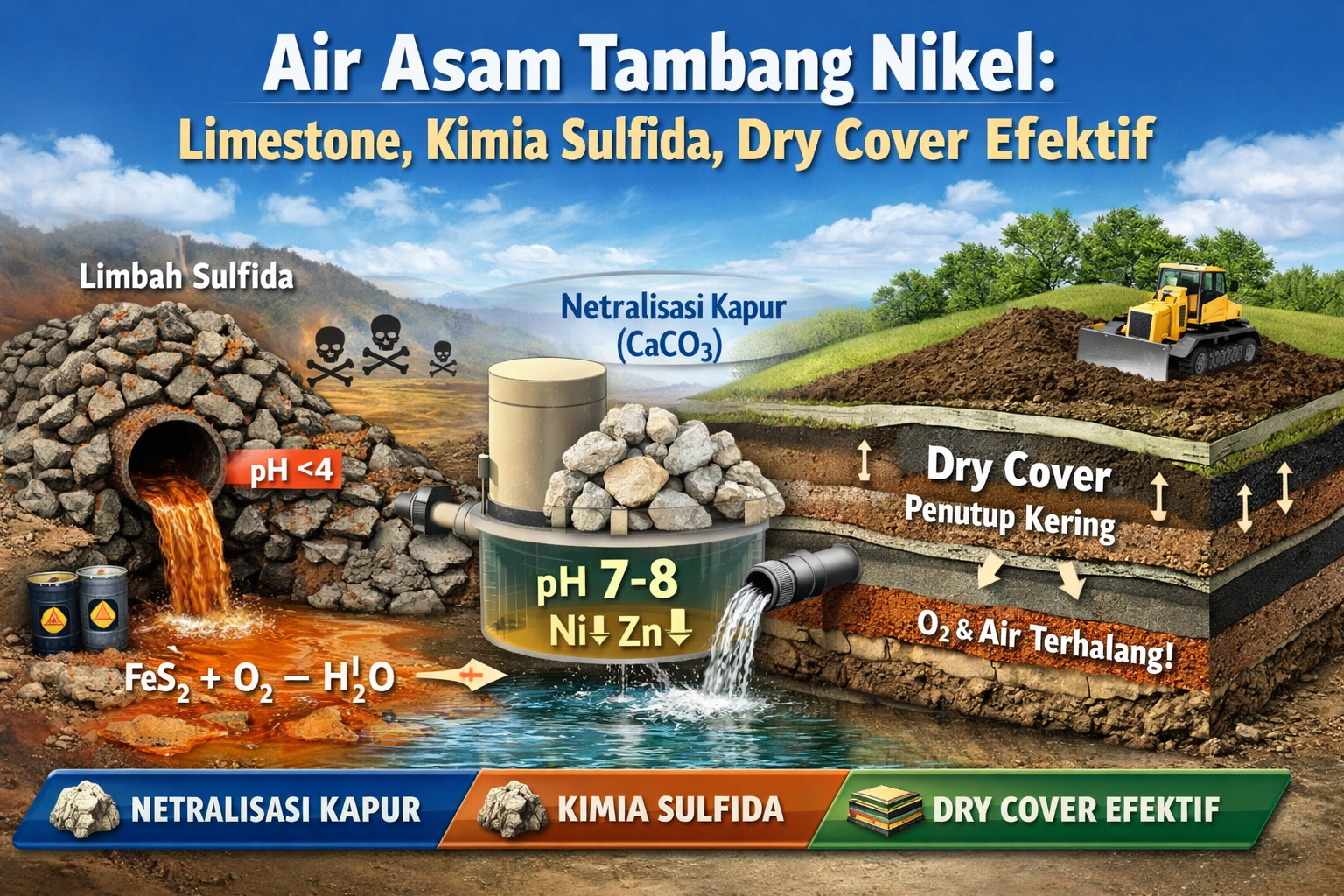
Material selection and quantity. Cover materials must be alkaline or inert. Indonesian nickel waste dumps segregate lithologies by ABA so only low‑S, carbonate‑bearing NAF material is used as cap (SCIRP). Typical thickness is ~1–5 m (SCIRP). Fine limestone reacts fastest; coarse rock dissolves gradually. The neutralizing mass is engineered for years of acid release — e.g., if waste generates 100 kg CaCO₃‑equiv per tonne, several to tens of tonnes of limestone per 10,000 tonnes of rock may be required. Synthetic liners, if used, are selected for durability; some geomembranes degrade after 10–20 years if exposed.
Hydraulic management. Designs include a surface drainage layer to prevent erosion and a graded sublayer to direct any infiltrate to collection drains or treatment (e.g., limestone trenches or wetlands). With good covers, infiltration can drop to <10% of rainfall (≈5% was observed at Equity Mine) (O’Kane & Wilson), but high‑intensity rains are diverted; steep slopes or seismic zones require additional engineering.
Long‑term performance. Even well‑designed covers need monitoring; settlement or cracking can open O₂ pathways (GARD Guide). Instrumentation in test piles or trial covers (e.g., lysimeters, oxygen sensors) supports adaptive management — adding soil or limestone if pH creeps — and vegetation is managed to prevent deep rooting through barrier layers.
Measurable outcomes and trends
Well‑designed covers plus alkalinity reduce AMD by an order of magnitude. Compacted soil covers have yielded only ~5% rainfall infiltration (O’Kane & Wilson), and synthetic liners can reduce infiltration nearly to zero (GARD Guide). In metal terms, rehabilitations typically see >80% reductions; Benambra’s capping raised discharge pH by ~3–5 units and cut dissolved Cu–Pb–Zn by ~90% (GARD Case Study).
Numerical modeling (MINTOX) indicates that even modest calcite addition in the first 1–2 years — when oxidation is most intense — can prevent downstream pH declines and heavy‑metal peaks; sulfate and Ni releases are halted in simulations (MEND). Conversely, inadequate covers fail quickly: a coal mine study in Indonesia found that mis‑placing acid‑forming rocks in the “cover” layer defeated the strategy (SCIRP).
Economically, prevention is more cost‑effective than passive treatment. Engineered covers — especially geomembranes — raise closure costs, but they shrink the volume of contaminated water needing treatment. GARD notes that synthetic cover systems might double upfront cost yet be justified where conventional tailings dams — and lifelong treatment — would be much greater (GARD Guide).
Practical recommendations and monitoring
- Characterize thoroughly. Conduct ABA and NAG tests on all waste lithologies. Classify rock into PAF/NAF and design covers accordingly (SCIRP) (Kanda et al., 2017)).
- Maximize passive neutralization. Blend or layer limestone (or other carbonates) with waste as early as practicable. Even spread a limestone cover (≥30–50 cm) on top of waste piles to neutralize seepage (GARD Guide). Use crushed lime or fly ash in ponds and collection trenches. Metering slurries is typically handled by dosing pumps.
- Design high‑integrity covers. Employ ≥1 m compacted soil cover (or geosynthetic liner) as an oxygen/water barrier. In wet climates like Indonesia, thicker (2–3 m) multi‑layer covers are advisable, using local soils and rock classified as non‑acid‑forming (SCIRP) (O’Kane & Wilson). Consider GCLs or HDPE where space/cost permits.
- Include vegetation and organo‑chemical layers. Seed covers with grasses or acid‑tolerant plants to reduce erosion and transpire water. Add an organic mat (e.g., compost layer) under or over the low‑perm layer to provide an active O₂ sink (MEND). This dual physical‑biological barrier can inhibit acidification.
- Monitor and adapt. Install lysimeters or piezometers to measure seepage quality. Test drainage pH, metals, alkalinity and adjust (e.g., add more lime) if acidity trends upward. Given delays in AMD onset, plan for decades of monitoring before declaring success.
By combining these measures, mines can prevent AMD formation at source. Designs that block ≥95% of infiltration and provide sufficient alkalinity have shown acute reductions in contaminant loads (often >85%) (O’Kane & Wilson) (GARD Case Study). Each project’s ore chemistry, climate and disposal geometry determines the exact mix of limestone, soil and cover, but the evidence is consistent: proactive AMD prevention avoids long‑term pH collapses and metal mobilization (Kanda et al., 2017) (MEND).
Sources: All figures and recommendations are drawn from recent peer‑reviewed studies, industry reports and guidance manuals as cited above.
References: Kanda et al., 2017; Maree et al., 2004; GARD Prevention Guide (2011); Matsumoto et al., 2016; O’Kane & Wilson, 2011; et al. (ResearchGate)) (ResearchGate) (GARD Guide) (MEND) (ResearchGate) (GARD Case Study) (MEND) (GARD Guide) (SCIRP).