

Industry: Nickel_Mining | Process: Tailings_Thickening_&_Disposal
Gravity thickeners now send underflow at roughly 50–60% solids to downstream dewatering, and next‑gen filter presses individually process about 10,500–12,500 tonnes per day while holding cake near ~15% moisture (www.mdpi.com www.mdpi.com www.mdpi.com). Ceramic‑disc vacuum filters on thick feeds reach 85–90% solids, and belt filters have hit ~18% moisture cakes in real plants (www.mdpi.com www.mdpi.com).
The catalyst is chemical. A sequenced shot — an inorganic coagulant to neutralize particle charge followed by a high‑molecular‑weight polymer flocculant to bridge fines — pushes solids, speeds settling and cuts filter times (www.mdpi.com). Bench and plant reports show two‑step shear flocculation taking slurries past >71% solids and trimming polymer use (www.mdpi.com www.mdpi.com).
High‑rate gravity thickening
High‑rate thickeners (deep‑cone or high‑rate designs that concentrate slurry by gravity) deliver underflow at 50–60% solids; one operation used two 30.5 m units to lift 27–30% feed to ~50–60% solids (www.mdpi.com). These systems recover most coarse water — often ~70–80% of the original liquid — for reuse (www.mdpi.com www.mdpi.com), crucial where ~0.8 m³ water is used per tonne of ore and where regulations favor thickening and reuse to minimize impoundments (www.mdpi.com).
Thickened tailings still carry ~40–50% moisture and typically move to filtration. Polymer addition in the thickener boosts settling rates and densifies underflow; flocculants form large aggregates that can even reduce thickener size (research.csiro.au www.mdpi.com). For polymer dosing consistency, operators pair coagulants and flocculants with an accurate dosing pump.
Vacuum filtration performance
Vacuum filters (rotary drum, disc or belt; continuous units that dewater by suction) further dry thickener underflow. On high‑solids (>60%) feed, modern units have produced cakes at ~18% moisture (vacuum belt) and 85–90% solids (10–15% moisture) on ceramic discs (www.mdpi.com www.mdpi.com). In general, vacuum filters yield wetter cakes than pressure filters at the same throughput (lower cake compression) (www.mdpi.com).
Feed density drives outcomes: with only 40–50% feed solids, vacuum systems typically produce 50–60% cake solids (40–50% moisture), while pre‑thickening to 60%+ enables much drier cakes (www.mdpi.com www.mdpi.com). Throughput per filter is moderate (a few thousand tonnes/day), and polymer consumption is modest when clay content is low (www.mdpi.com www.mdpi.com). In dry‑stack layouts, conveyored vacuum‑filter cake at 18% moisture has been spread and compacted in ~0.3 m lifts to >95% Proctor density (a geotechnical compaction standard) (www.mdpi.com www.mdpi.com).
Pressure filtration and scale
Filter presses (chamber plate‑and‑frame filters that apply high pressure to compress cakes) achieve the lowest moisture. Typical cakes are 10–20% water, with reported examples at 18–22% and others at 10–15% moisture, enabling direct dry stacking or transport (www.mdpi.com www.mdpi.com www.mdpi.com).
Scale is rising: a next‑generation press can handle ~150–175 t per 20‑minute cycle — about 10,500–12,500 t/day — while maintaining ~15% cake moisture (www.mdpi.com www.mdpi.com). The trade‑offs are batch operation and maintenance: roughly 80% of filter‑press downtime is due to cloth and plate wear (www.mdpi.com). Designers deploy multiple large presses — or new fast‑cycle variants — to keep availability high. Capital and O&M are higher than for vacuum filters, but solids recovery is much higher; in practice, cloth wear is cited as ~80% of costs (www.mdpi.com).
Two‑stage chemical conditioning
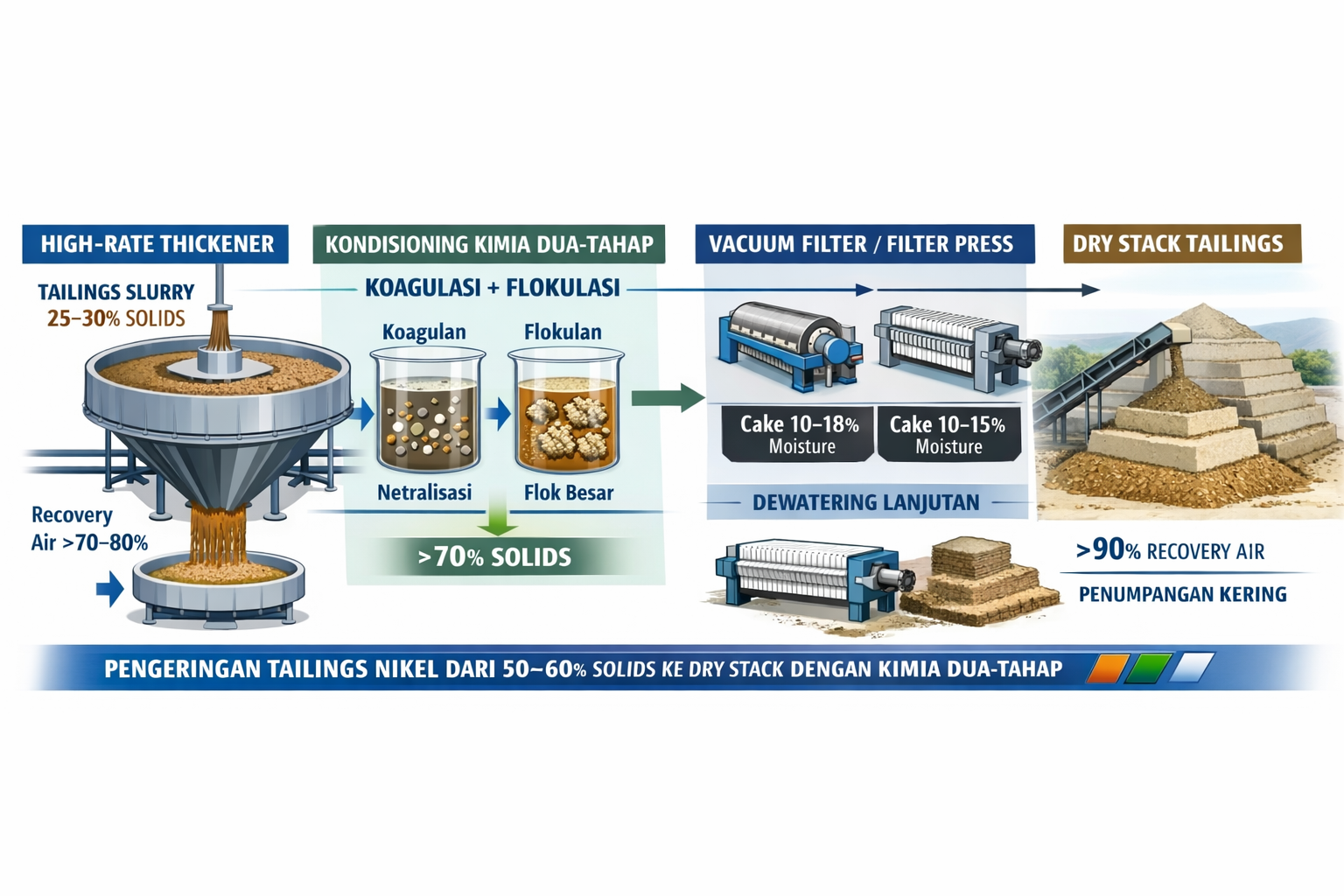
Two‑stage treatment targets ultra‑fine or clay‑rich tailings (common in nickel laterites): an inorganic coagulant is added first, then a polymer flocculant. The coagulant — cationic salts such as CaCl₂, FeCl₃ or poly‑aluminum chloride (PAC) — neutralizes particle surface charge and compresses the electrical double layer to promote micro‑floc formation (www.mdpi.com). In practice, mines standardize supplies via coagulants including PAC and ACH and meter them with an accurate dosing pump.
Next comes a high‑molecular‑weight flocculant (anionic or non‑ionic polyacrylamide) to bridge particles into large, dense flocs (www.mdpi.com). Many operations source specialty flocculants to match mineralogy. Lab and field results highlight the synergy: Ca²⁺ ions act as bridges between negative clay particles and anionic flocculant chains, often cutting polymer dose while strengthening flocs (www.mdpi.com).
Empirical examples are clear. Treating a coal slurry with Ca²⁺ followed by anionic PAM doubled floc size and greatly improved turbidity removal; iron ore tailings conditioned with CaCO₃ nearly halved filter times versus flocculant alone (www.mdpi.com www.mdpi.com). A recent two‑step shear flocculation study boosted tailings solids from ~40–50% (single‑step) to >71% solids, a dramatic moisture reduction (www.mdpi.com). In practice, coagulation then flocculation often lets thickeners and filters achieve 10–20% higher solids and higher settling rates (www.mdpi.com).
Process choices and trade‑offs
Thickening alone yields moderate solids (~50%) at low cost but generally needs filtration. Vacuum filters can continuously deliver ~10–20% moisture cakes when fed very thick slurry and have moderate cost — though typically wetter cakes than pressure filters at the same throughput (www.mdpi.com www.mdpi.com). Filter presses give the driest cakes (~10–15% moisture) and can handle ≥10,000 t/d per unit, but with higher capex/opex and maintenance (cloth wear ~80% of costs; downtime driven roughly 80% by cloth and plate wear) (www.mdpi.com www.mdpi.com www.mdpi.com).
Two‑stage chemistry significantly boosts any dewatering method: it produces larger flocs, faster sinking and drier cakes. Designers increasingly combine a deep thickener (50–60% underflow) with chemical conditioning, then vacuum or pressure filtration, to meet discharge limits and maximize water recovery (www.mdpi.com www.mdpi.com www.mdpi.com www.mdpi.com).
Key figures at a glance
High‑rate thickeners: ~50–60% solids underflow (www.mdpi.com). Vacuum systems with heavy pre‑thickening: cakes in the 10–18% moisture range (www.mdpi.com www.mdpi.com). Filter presses: ~10–15% moisture cakes routinely (www.mdpi.com www.mdpi.com). Combined‑coagulation tests: slurry solids >70% (www.mdpi.com). A next‑gen press: ~150–175 t per 20‑minute cycle (~10,500–12,500 t/d) at ~15% moisture (www.mdpi.com www.mdpi.com). These advances underpin dry‑stack tailings with >90% water recovery (www.mdpi.com www.mdpi.com).
Sources and references
Authoritative case studies and reviews underpin all figures. Fränkle–Morsch (2022) report filter‑press cakes <20% water (www.mdpi.com). Industry surveys (Cacciuttolo et al. 2022–2023) document typical underflow and cake moistures (www.mdpi.com www.mdpi.com www.mdpi.com www.mdpi.com www.mdpi.com). Khazaie et al. (2022) summarize coagulation/flocculation chemistry, including Ca²⁺ effects on flocculants (www.mdpi.com www.mdpi.com). Yang et al. (2025) quantify two‑step shear flocculation gains to >71% solids (www.mdpi.com).
References: Fränkle, B. & Morsch, P. (2022). Tailings Filtration Using Recessed Plate Filter Presses: Improving Filter Media Selection by Replicating the Abrasive Wear… Mining 2(2): 425–437 (www.mdpi.com www.mdpi.com). Fränkle, B., Morsch, P., Kessler, C., Sok, T., Gleiß, M. & Nirschl, H. (2022). Iron Ore Tailings Dewatering: Measurement of Adhesion and Cohesion for Filter Press Operation. Sustainability 14(6): 3424 (www.mdpi.com). Cacciuttolo, C. & Pérez Campomanes, G. (2022). Practical Experience of Filtered Tailings Technology in Chile and Peru: An Environmentally Friendly Solution. Minerals 12(7): 889 (www.mdpi.com www.mdpi.com). Cacciuttolo, C. & Atencio, E. (2023). Dry Stacking of Filtered Tailings for Large‑Scale Production Rates over 100,000 Metric Tons/day… Minerals 13(11): 1445 (www.mdpi.com www.mdpi.com www.mdpi.com). Khazaie, A.*, Mazarji, M.*, Samali, B., Osborne, D., Minkina, T., Sushkova, S. & Mandzhieva, S. (2022). A Review on Coagulation/Flocculation in Dewatering of Coal Slurry. Water 14(6): 918 (www.mdpi.com www.mdpi.com). Yang, Y., Liu, X., Zhang, L. & Guo, M. (2025). Two‑Step Shear Flocculation for High‑Efficiency Dewatering of Ultra‑Fine Tailings. Minerals 15(2): 176 (www.mdpi.com).