

Industry: Nickel_Mining | Process: Froth_Flotation
Low‑grade nickel sulfide ores routinely carry 70–80% magnesium‑silicate gangue — mainly talc, serpentine, and chlorite — intergrown with pentlandite, the primary Ni mineral (www.mdpi.com). Because talc is inherently hydrophobic, it floats with sulfides, dragging MgO into the concentrate and lowering grade (www.mdpi.com) (www.mdpi.com).
That’s a big deal: nickel sulfide ores account for roughly 40% of global nickel supply (www.mdpi.com), and Mg‑rich gangue compounds operational headaches — poorer concentrate grades, higher smelter MgO, more SO₂ emissions, and increased equipment wear (www.mdpi.com). The upshot for froth flotation (air‑bubble separation of hydrophobic particles): selective depressants (reagents that make specific minerals hydrophilic) are essential to keep talc/serpentine out without suppressing the Ni minerals.
Cellulose and polysaccharide depressants
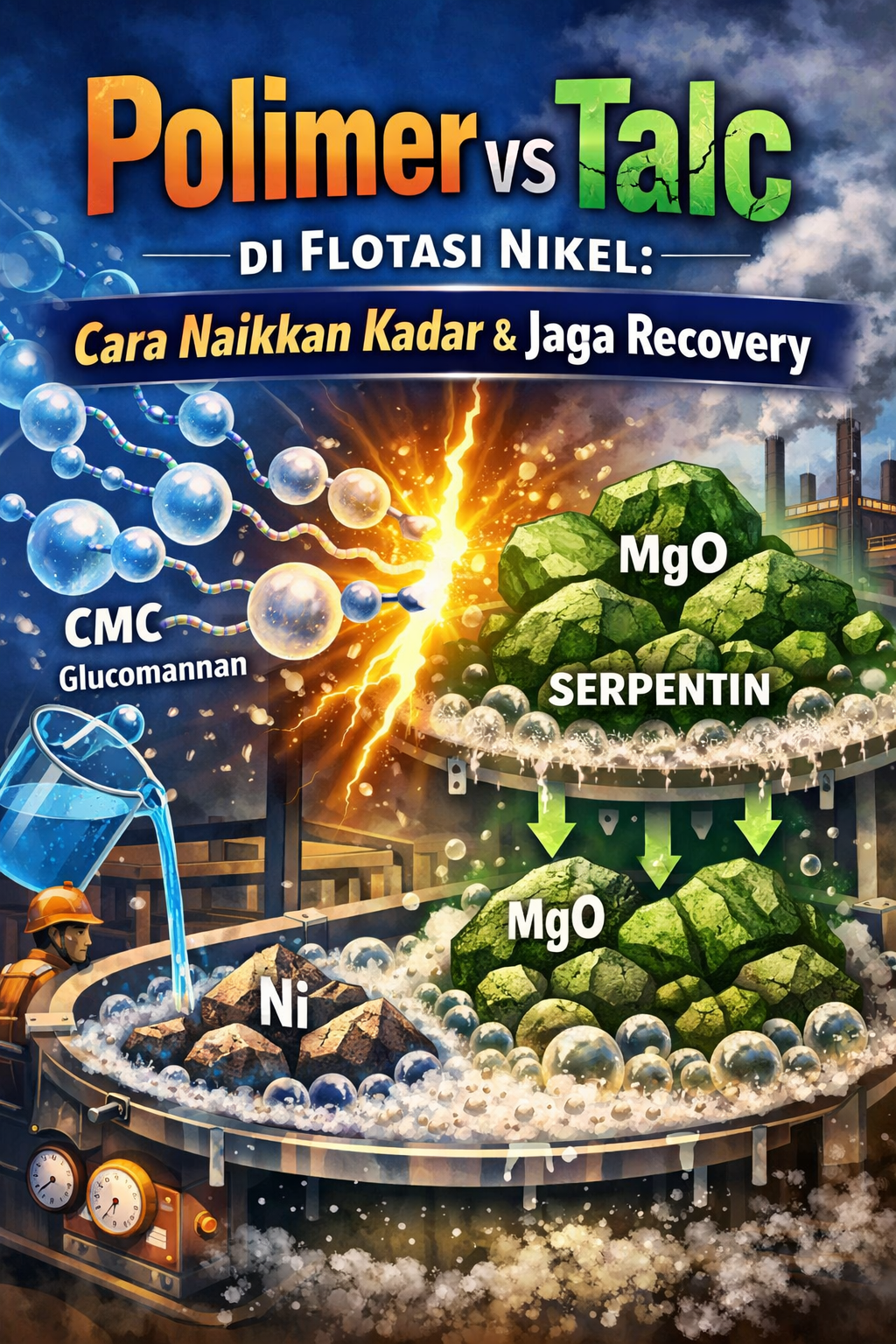
Carboxymethyl cellulose (CMC) — an anionic, water‑soluble cellulose ether — is a workhorse. High‑molecular‑weight (MW) chains adsorb onto talc/serpentine via hydrophobic interactions (cellulose backbone) and electrostatic attraction (–COO⁻ groups to Mg²⁺‑rich sites), flipping the gangue surface to hydrophilic (www.mdpi.com). In practice, high‑MW, low‑glycolate CMC grades depress talc best. On a Windarra [Au‑Ni] ore, 320 g/t of a high‑MW CMC (“7LT”) lifted Ni in the cleaner concentrate to 6.55% at 92.2% recovery, versus just 4.10% Ni with a low‑MW CMC (“Cellogen MG”, at 88.3% recovery) (c.coek.info).
CMC performance is pH‑sensitive: higher pH (≈8–9) markedly enhances depression on Windarra‑type ore (c.coek.info), while at low pH its carboxyl groups are protonated and less charged, reducing adsorption (www.mdpi.com). There are trade‑offs: CMC is non‑selective and can adsorb on pentlandite/pyrrhotite; overdosing or high degree of substitution (DS, the average number of substituted groups per monomer) can hurt Ni recovery. Calcium ions can shift the chemistry — small CaCl₂ additions can improve talc depression by precipitating CaCO₃ on talc surfaces (www.mdpi.com), and high ionic strength generally accelerates polymer adsorption on gangue (www.mdpi.com).
Plant‑derived polysaccharides act as flocculant/depressants. In Bulatović’s Mt Keith tests at 150 g/t, guar gum (a galactomannan) outperformed CMC on grade: the rougher concentrate reached ~2.02% Ni with guar versus 1.40% with CMC, while the cleaner concentrate was ~1.80% Ni (76.6% recovery) for guar vs 1.55% (76.1% recovery) for CMC (c.coek.info). Starch and dextrin (low‑MW carbohydrates) gave the poorest grades — ~0.61–1.16% Ni in concentrate — albeit with slightly higher mass and similar overall recovery (~78–79%) (c.coek.info).
Novel polysaccharides are moving the needle. Laboratory work (Zhao et al., 2015) found a high‑MW galactomannan dropped serpentine flotation recovery from 41.4% to 2.1% while keeping Ni recovery >85% (www.mdpi.com). Konjac glucomannan (KGM) at 0.05% on a Cu–Ni ore reduced MgO in concentrate from 7.61% to 4.54% (a 40% drop) and lifted Ni recovery from ~71% to ~91% (www.mdpi.com).
Emerging materials and lignosulfonates
Graphene oxide (GO), a carbon nanoflake with –COOH/–OH functional groups, shows promise: by adsorbing on Mg‑silicate surfaces, it disrupts sulfide–serpentine flocculation, and trials delivered higher pentlandite recovery than analogous CMC treatments (www.mdpi.com). Polyacrylamide (PAM) is often used as a slurry flocculant during grinding — thickening the pulp and reducing ultrafines — but is less selective in flotation; linking its role to plant reagents, flocculant programs align with flocculants used in mineral processing circuits.
Lignosulfonates are already industrial. Vale reported deploying a low‑MW (≈6 kDa) calcium lignosulfonate with 5% –SO₃Na content as a gangue depressant with good results. In general, polymers with larger MW or branching (e.g., high‑MW guar, PEO, or modified starches) flocculate gangue more strongly, whereas low‑MW or highly charged ones (CMC, SHMP) disperse fine clays.
Inorganic co‑depressants and water chemistry
Classic inorganics matter. Sodium silicate (water glass) and sodium hexametaphosphate (SHMP) are long‑standing dispersants; caustic soda or lime raises pH and precipitates Mg/Fe hydroxides, reducing gangue floatability. Chelators like EDTA and weak acids (citric, phytic) sequester Mg²⁺ on gangue surfaces. Notably, sodium citrate can dissolve the Mg layer on serpentine — up to 95% as Mg(OH)₂ — sharply cutting its propensity to float (www.mdpi.com).
Salts also shift behavior. Experimental NaCl brines (10%) have outdone CMC on fine slimes by suppressing float via salting‑out hydrophobic agents (www.researchgate.net). These inorganic routes change water chemistry (pH, ionic strength) and are often paired with organics sourced through mining reagent programs such as chemicals for mining applications.
Comparative results from Windarra and Mt Keith
Side‑by‑side data underscores the chemistry. On a Windarra ore at 320 g/t dosing, a 6CTL CMC grade delivered rougher+scavenger concentrate at 5.61% Ni and 90.9% recovery, while 7LT (higher MW) hit 6.55% Ni at 92.2% recovery; a cellulose gum (“Depramin‑12”) trailed at 5.10% Ni and 89.2% recovery (c.coek.info). In the same Windarra program, the high‑MW CMC 7LT raised cleaner concentrate Ni to 6.55% at 92.2% recovery versus 4.10% Ni with a low‑MW CMC (Cellogen MG, 88.3% recovery) (c.coek.info).
At Mt Keith (150 g/t dose across reagents), guar gum yielded a Ni cleaner concentrate around ~1.80% Ni at 76.6% recovery versus CMC’s ~1.55% Ni at 76.1% recovery; in roughers, guar reached ~2.02% Ni while CMC managed ~1.40% (c.coek.info). Starch and dextrin returned much lower grades (~0.61–1.16% Ni) despite slightly higher mass and similar overall recovery (~78–79%) (c.coek.info).
In newer lab work, polysaccharides changed the game: galactomannan slashed serpentine recovery from 41.4% to 2.07% with Ni recovery remaining >85% (www.mdpi.com), and KGM at 0.05% cut MgO from 7.61% to 4.54% while boosting Ni recovery from ~71% to ~91% (www.mdpi.com).
Dosage optimization and plant control
The optimization brief is straightforward and iterative. First, define the concentrate targets — smelter limits such as Fe:MgO ratio and total MgO (often <3–5%) set the required gangue rejection (www.mdpi.com). Then set the conditioning sequence: depressants are typically added after lime (pH control) and before collector in roughers and/or in cleaners.
Bench tests are the backbone. Run batch flotation with stepwise doses — for each candidate depressant, test about 50, 100, 200, 400 g/t — and track Ni grade/recovery and MgO in the concentrate, plotting grade–recovery to find the “knee” where returns diminish. Because CMC’s effect is pH‑dependent, run in parallel at pH ≈8.5–9 (vs lower pH), and optionally with/without small CaCl₂ (around 100 mg/L) or silicate additives to check synergy (c.coek.info) (www.mdpi.com) (www.mdpi.com).
Selectivity versus margin is the purchasing decision. If, for example, 200 g/t CMC gives 5.8% Ni at 88% recovery and 3% MgO, while 300 g/t yields 6.5% Ni at 87% recovery, the higher dose may be justified if smelter specs demand lower MgO. Depressants can slow kinetics, so timed tests or simple models help prevent recovery loss; two‑stage addition (lower in roughers, top‑up in cleaners) or switching reagents can preserve rates.
In plant, continuous feedback is vital. Operations commonly monitor Ni, Fe, and MgO and adjust in small increments (±10–20 g/t) while watching cleaner concentrate assays; accurate chemical dosing, as in an integrated dosing pump setup, supports those tight adjustments. Reagent mix matters too: small SHMP doses (dispersion) paired with CMC (depression) can outperform either on its own, and rougher–cleaner stages may benefit from different depressants. This aligns with the broader role of chemicals for mining applications for tailored blends across circuits.
Practical dosage ranges and pH windows
Effective doses often land in the 0.01–0.05% range (100–500 g/t of pulp). In Bulatović’s campaigns, 150–320 g/t was typical (c.coek.info) (c.coek.info). Modern practice may start around 100–200 g/t and scale up if grades lag. As a benchmark for selectivity, 0.05% glucomannan kept Ni recovery >85% while sharply cutting gangue (www.mdpi.com).
The pH target for CMC is typically ~8.5–9, where its anionic groups are fully deprotonated and adsorption on Mg‑silicate gangue is strongest (c.coek.info) (www.mdpi.com).
Bottom line
Polymeric depressants — especially anionic cellulose ethers and robust polysaccharides — are central to shutting down talc/serpentine in nickel sulfide circuits. High‑MW, low‑sulfonation CMC or strong polysaccharides (guar, konjac/galactomannans) deliver the best gangue suppression, with some recovery trade‑off (c.coek.info) (www.mdpi.com). Lower‑MW starches and dextrins yield lower grades. The operating playbook is to raise depressant dosage until concentrate MgO meets target specs, then stop before Ni recovery plunges — using real‑time assays and periodic lab checks to refine the sweet spot. Newer options like GO or selective polysaccharides can slash serpentinite recovery by ~95% while leaving pentlandite float largely intact (www.mdpi.com), complementing established reagents and standard plant controls, including flocculant handling common to flocculant programs.
Sources: Peer‑reviewed studies and industry reports underpin the data above (c.coek.info) (c.coek.info) (www.mdpi.com) (www.mdpi.com) (www.mdpi.com) (www.mdpi.com).
References: Detailed citations for each data point are provided above. All values quoted derive from the cited literature (e.g., Bulatović et al. 2007; Bazar et al. 2021; Yin et al. 2024) or industry tests (c.coek.info) (c.coek.info) (www.mdpi.com).
Notes: Gangue refers to non‑valuable minerals; MgO is magnesium oxide content in concentrate; g/t denotes grams of reagent per tonne of pulp; MW is molecular weight; DS is degree of substitution on a polymer; SHMP is sodium hexametaphosphate; PAM is polyacrylamide; GO is graphene oxide; KGM is konjac glucomannan; pH indicates acidity/alkalinity on a 0–14 scale; “rougher,” “scavenger,” and “cleaner” are successive flotation stages.