

Industry: Nickel_Mining | Process: Extraction
In nickel mining, the most durable fix for acid mine drainage (AMD, acidic water formed when sulfides oxidize) is not a treatment plant—it’s preventing acid from forming at all. That means sorting waste rock by chemistry, burying the bad stuff inside the good, and dosing in alkalinity where needed.
The playbook is backed by decades of testing: keep potentially acid‑forming (PAF) waste isolated inside non‑acid‑forming (NAF) material, and apply reactive alkaline layers such as limestone so acid gets neutralized before it moves. Controlled columns with Indonesian sulfide overburden show pH rising toward neutral when NAF covers reach 50%, with sulfate and metals falling by orders of magnitude (Heliyon 2020) (Heliyon 2020).
The economics also lean preventative: a synthesis drawing on Brady et al. (1990) notes lime capping can cost less than 5% of long‑term treatment outlays—avoiding decades of chemical feed and sludge disposal—while achieving near‑neutral drainage in the first place (Heliyon 2020).
Waste‑rock classification and segregation
AMD prevention starts with geochemistry on the run‑of‑mine stream. Mines use static tests such as acid‑base accounting (ABA, a balance of acid potential and neutralization potential) and net carbonate value to distinguish PAF from NAF. One example: Newmont sorts waste into seven categories, from “highly acidic” to “highly basic,” using net carbonate value (ResearchGate).
Design targets are explicit: blended waste should be net‑alkaline with NNP (net neutralization potential) > 10 kg CaCO₃/t and NP/AP (neutralization potential/acid potential) > 2—an engineering rule adapted from U.S. Appalachian coal practice (MEND). Rock with positive NNP and favorable NP/AP is handled as NAF; rock below cut‑offs is PAF.
Once classified, the streams are kept separate. PAF goes to lined facilities or is buried within NAF buffers, while NAF forms protective shells or cover layers—economically favored because it minimizes reactive exposure (MDPI) (ResearchGate). Indonesian operators explicitly follow this: geochemical models steer placement, and PAF overburden is encapsulated in NAF at large sites such as Grasberg, where high‑pH, limestone‑bearing units are placed above sulfide‑rich units (ResearchGate).
Lab work agrees. Blending Papua nickel/alloy overburden until NAPP (net acid‑producing potential) was balanced by carbonate neutralization produced leachate near pH ~7 (MDPI). In Heliyon (2020) column tests with Indonesian pyrite/jarosite overburden, a 50% NAF cover raised effluent pH above 4 and then to near‑neutral (~7) over 23 weeks, while 25% cover reached about pH ~5; partial NAF coverage lifted pH from ~1.7 to ~2.5 (25%) or to neutral >6 (50%), with sulfate and Fe/Mn concentrations dropping by orders of magnitude under cover (Heliyon 2020) (Heliyon 2020).
The caveat is discipline. A 2016 Indonesian coal‑mine survey found the supposed cover contained NAPP of 10–30 kg H₂SO₄/t down to 1 m depth—evidence PAF rock had been misused as cover—leading directly to AMD (SCIRP). The same reviews warn that extra haulage is a cost line item: mines with abundant PAF incur added expenditures to bring NAF for encapsulation (ResearchGate).
Alkaline amendments and layering
Physical encapsulation is reinforced by chemical treatments that neutralize acid as it forms. The simplest method is to add limestone (CaCO₃) or lime (CaO) to PAF piles—either blended through lifts or layered as blankets—so infiltrating acidity reacts before it migrates. Experience from Appalachian coal trials showed that fine limestone distributed through a pile delayed the onset of acidic effluent, while layered limestone discs or coarse chips reduced net acidity and postponed acid conditions (though they did not completely eliminate AMD in the PAF core) (MEND).
Reactivity matters. Fresh lime and lime kiln dust performed even better than equivalent limestone, preventing acid onset more effectively due to higher alkalinity (MEND). In practice, these alkaline additions sit squarely within mining‑chemical workflows (</products/mining>), and their application is often engineered around controlled chemical feed systems (</products/dosing-pump>).
The chemistry is straightforward: limestone consumes acidity (H₂SO₄ → CaSO₄ + CO₂), raises pH, and can coat sulfide grains with CaCO₃, slowing oxidation. Secondary mineral precipitation (gypsum, Fe(OH)₃) can also clog pores and reduce permeability, slowing acid generation further (MDPI). Blends of limestone with pyritic waste produced near‑neutral leachate by buffering acids and reducing permeability; alkaline industrial by‑products such as fly ash and cementitious wastes showed similar effects (MDPI).
Field and simulated pile tests converge. A MEND review noted layered limestone significantly cut net acidity; alternating limestone/fly‑ash layers delayed acid breakthrough by several years (no exact numbers were reported, but leachate pH delays were consistent) (MEND). At Grasberg, covering PAF overburden with limestone raised the pH of the waste (exact values not given) (ResearchGate).
Quantitatively, adding limestone can keep effluent near pH ≈ 6–7 where untreated piles might trend near pH ≈ 3. In the Heliyon (2020) columns, a 50% limestone‑like cover brought pH to ~7 within months; sulfate fell from about 9,600 mg/L to undetectable by week 23 as pH climbed (Heliyon 2020) (Heliyon 2020). Preventive neutralization with lime or limestone can cost a fraction of post‑facto AMD treatment; one synthesis put lime capping at under 5% of downstream treatment costs (MEND).
Design criteria and construction sequence
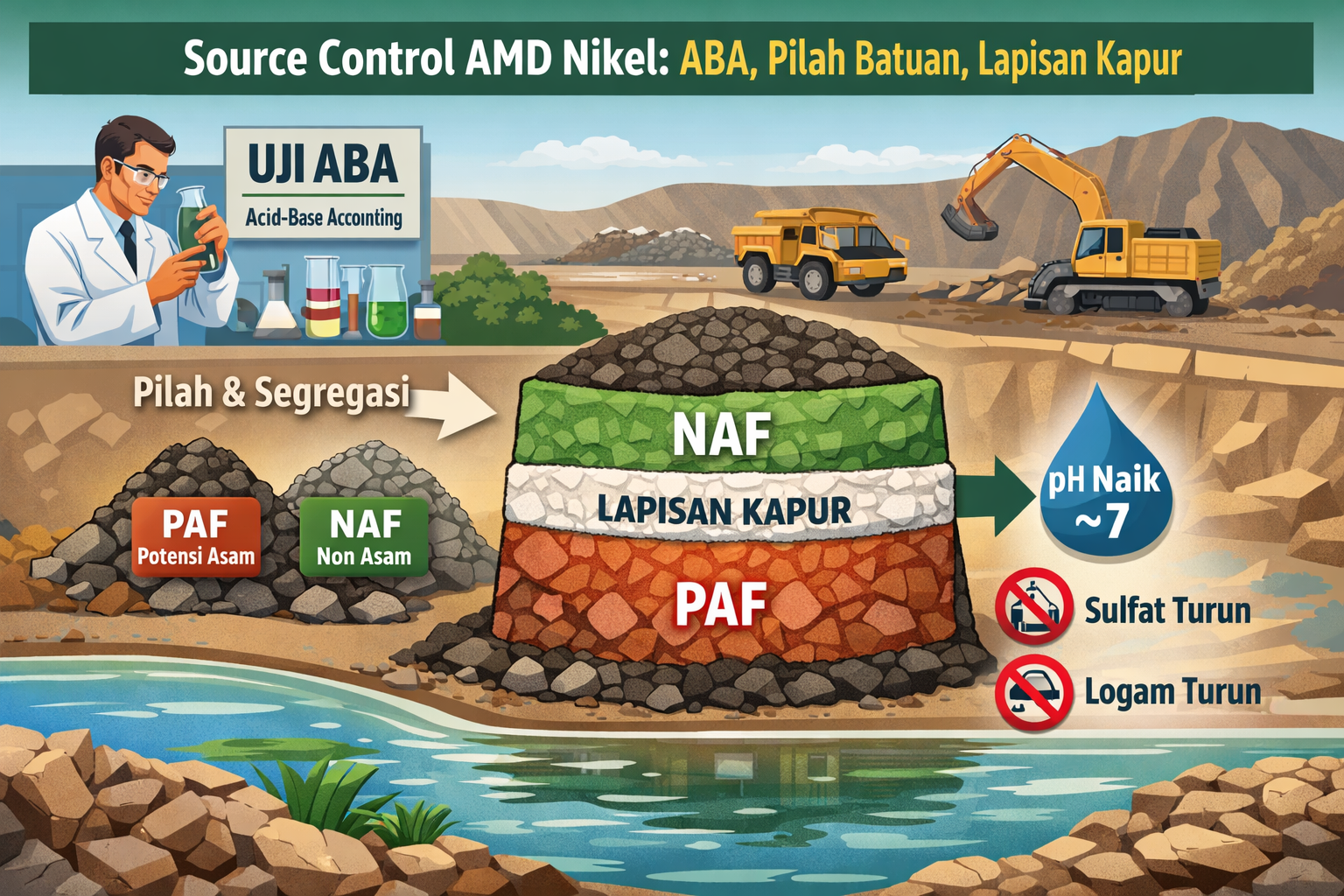
“Design for balance” is the guiding metric: configure dumps so overall (NP – AP) > 0 and, ideally, NNP ≫ 0. Benchmarks such as NP/AP ≈ 2 are used to guide blends (MEND). In practice, each rock type’s acid potential and neutralization capacity (NAPP or ABA) is calculated; geochemical modeling and kinetic tests verify that net drainage pH will be ≥ 6–7 (MDPI) (Heliyon 2020).
Cover thickness and placement are non‑trivial. The Heliyon study’s 50% coverage (roughly a 0.5 m cover over a 1 m column) neutralized acidity, while 25% was incomplete; open dumps commonly use ≥ 1–2 m of clean overburden or soil to reliably exclude oxygen and intercept acidity (Heliyon 2020) (Heliyon 2020).
Timing and order matter: placing NAF or alkaline covers “as soon as possible after excavation” reduces exposure; a dense, low‑permeability layer (e.g., clay or heavy rock) generally performs better as the primary seal than topsoil alone (MEND).
Costs, compliance, and on‑site discipline
There is no free lunch in haulage. Segregating and encapsulating PAF material—especially when PAF dominates—requires extra trucking of NAF cover, adding to operating costs (ResearchGate). But mines weigh that against decades of active AMD treatment and sludge management. Many elect the up‑front engineering to avoid long‑term liabilities.
Regulators are nudging the sector in that direction. Indonesia’s largest mines employ these measures, and the Indonesian AMD working group (INAD) recommends geochemical modeling and encapsulation of acid‑forming overburden; while rules emphasize effluent limits, practice is moving toward source control (ResearchGate).
Bottom line on source control
Selective handling—classifying, segregating, and encapsulating PAF waste within NAF—consistently reduces AMD, elevating effluent pH from highly acidic (~1.7) to > 4 with partial covers and to near‑neutral with robust covers, while cutting sulfate and metals by orders of magnitude (ResearchGate) (Heliyon 2020) (Heliyon 2020) (Heliyon 2020). Adding alkaline layers—limestone, lime kiln dust, fly ash—neutralizes acid before it exits the pile, with field and review studies documenting delayed or eliminated acidic drainage (MEND) (MDPI).
Sources: Peer‑reviewed studies, industry reports, and field cases (ResearchGate) (MEND) (MEND) (MDPI) (MDPI) (Heliyon 2020) (Heliyon 2020) (Heliyon 2020) (Heliyon 2020) (SCIRP) (ResearchGate) (ResearchGate) (ResearchGate).