

Industry: Nickel_Mining | Process: Refining
Nickel refining—especially laterite HPAL (high‑pressure acid leach)—is a chemical heavyweight. Indonesia’s swift build‑out has sent sulfuric acid demand soaring to roughly 8.5 million tonnes in 2024, a 22% annual rise since 2020 (spglobal.com). Typical HPAL flowsheets burn through about 5–10 tonnes of H₂SO₄ per tonne of nickel, then neutralize excess acid with limestone—creating gypsum—the Nickel Institute notes (nickelinstitute.org).
It’s a costly habit. Indonesia became a net acid importer in 2023 at ≈1 million tonnes—about eight times 2020 levels—and demand “will continue to rise at steady” pace (spglobal.com). Trends show reagent costs dominating new HPAL plant OPEX. And the chemical list isn’t short: neutralizers (lime or limestone), reductants (SO₂, H₂, H₂S or organics), and other pH‑adjusters; in sulfide refining, fluxes and ammonia join the cast.
Precision dosing and stoichiometry control
Refineries are attacking overuse at the source: precise addition to match real‑time needs. Tight control of leach pH (acidity) and redox (oxidation‑reduction) setpoints curbs unnecessary acid and alkali. Metso reports keeping PLS (pregnant leach solution, a metal‑rich liquor) acid at the optimum avoids “challenges such as high impurities… and increased reagent consumption” (metso.com). Any overshoot only means more neutralizer later.
On the dosing hardware, plants pair feedback controls with accurate chemical pumps; a dedicated dosing pump allows the DCS (distributed control system) to throttle acid or alkali minute‑by‑minute instead of shifting in large, wasteful slugs.
Selective chemistry tweaks can also pay. Adding sodium sulfite (Na₂SO₃) to convert Fe³⁺ to Fe²⁺ in nickel‑smelter leach solutions boosted copper recovery from 41.4% to 68.6%, according to Botelho et al. (onlinelibrary.wiley.com). By keeping more Ni/Co dissolved—and out of iron hydroxide waste—less acid or alkali is squandered co‑precipitating valuable metals. Similar strategies (e.g., SO₂ or glucose as reductants) can lift yield and cut reagent per unit Ni.
Process design and mineralogy levers
Flowsheet choices move the needle on chemical use. Partial atmospheric leaching before HPAL can dissolve easily soluble gangue and reduce high‑pressure acid demand (see, for example, Chinese patent CN101768665A). In SX (solvent extraction), careful balancing of strip vs feed pH trims surplus alkali. In precipitation, choosing mixed hydroxide product (MHP) versus mixed sulfide product (MSP) changes both acid and base requirements.
Physical fundamentals matter too. Finer grinding and better mixing deliver higher extraction at a given dose. Plants can exploit ore mineralogy: pre‑leach Mg‑rich layers to trim acid needed for Fe‑bearing zones, or use bioleaching of chromite side phases to avoid extra acid.
Online analyzers and feedback automation
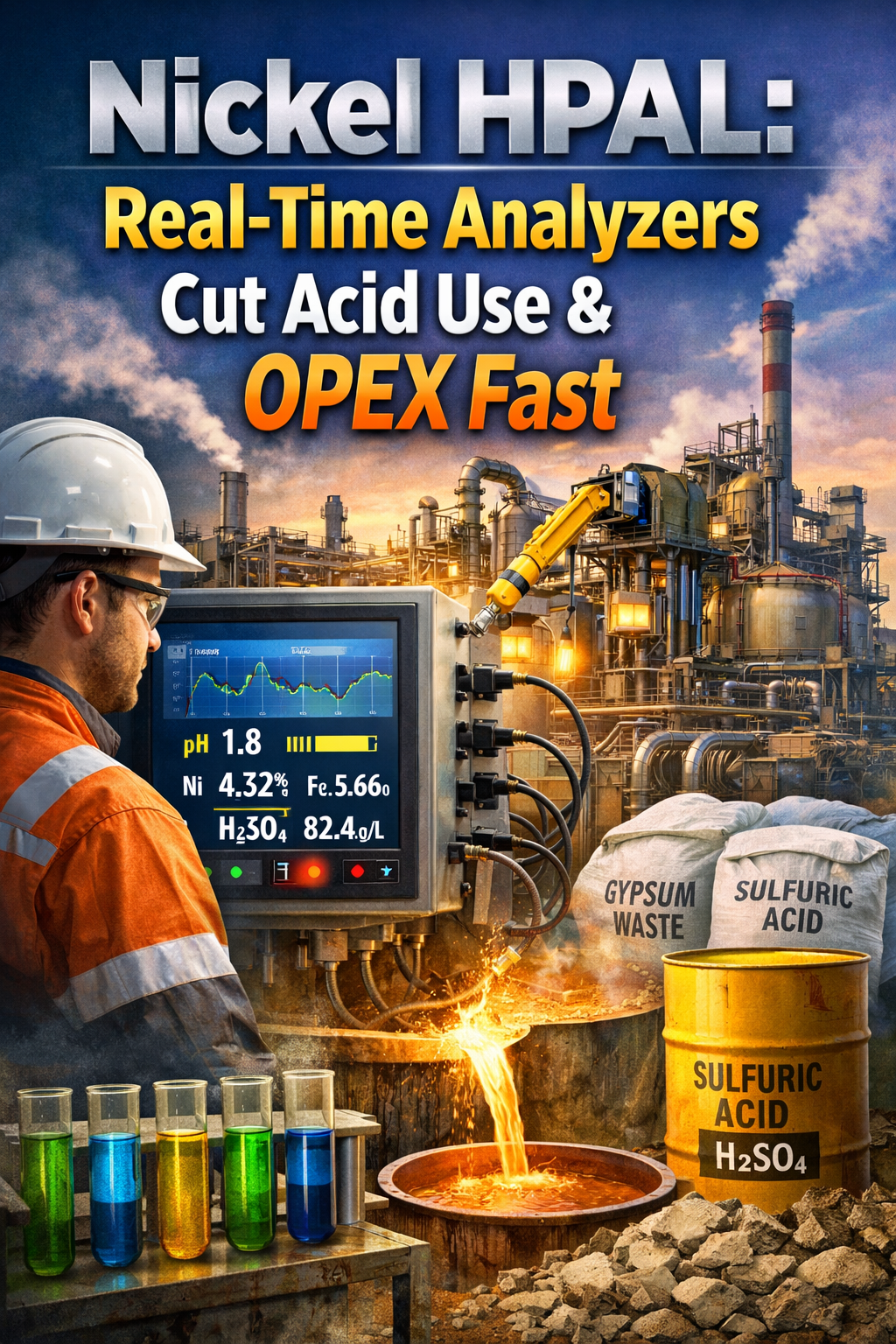
Modern circuits rely on real‑time analyzers—XRF (x‑ray fluorescence), ICP/OES (optical emission spectroscopy), titrators, ion chromatography—to get away from once‑a‑shift sampling. Multi‑stream platforms such as Metso’s Courier HX can monitor Ni, Co, Fe, Mn, acid and more; a Courier‑6X XRF can assay Ni/Co in minutes, and one analyzer “analyzing 12” streams can generate more than 100,000 data points per year with one operator (metso.com).
These data feed automated loops. Online pH and ORP (oxidation‑reduction potential) sensors built for hot, acidic slurries maintain tight leach conditions; Halland Instruments developed pH analyzers for nickel‑chlorine leaching designed to resist fouling (hain.technology). ORP control meters oxidant addition (air/SO₂/H₂/Cl₂) to precipitate iron as hematite without driving side reactions. Metso highlights automatic titrators for acid and redox that let the DCS pump just enough reagent to maintain extraction efficiency (metso.com; metso.com).
With integrated analyzers, plants can measure every 5–15 minutes rather than once per day, and that “on‑the‑fly” control reduces reagent consumption by up to 10–20% according to some estimates in base metals.
Advanced process control and AI layers
Adding APC/MPC (advanced/model predictive control) on top of the DCS lets engineers optimize multivariable setpoints continuously. Operators can specify “minimize acid use” or “maximise Ni recovery,” and the controller balances flows accordingly. Société Le Nickel (ferronickel) used MPC to stabilize kiln combustion; it cut temperature variability by 16.1% and improved uptime from 70% to 83% (controlglobal.com). In a companion account, the same AI‑driven MPC reduced furnace temperature overshoot by 6% and variability by 16% (controlglobal.com), illustrating how a 5–10% tightening of control in a leach plant could yield proportional chemical savings.
Automation is getting more turnkey. Fully automated reagent‑dosing panels are common in plating and hydrometallurgy; chemical dosing controllers (e.g., Walchem, Hach devices) can pump acid/solvent/additive precisely and self‑calibrate. One nickel circuit tied real‑time nickel analyzers into a feedback loop for a complex precipitation, boosting Ni recovery without manual titration.
Recycling and regenerating reagents
Instead of neutralizing spent liquor, plants are recovering acid. Membrane diffusion dialysis (anion‑exchange stacks) has recovered more than 80% of H₂SO₄ from acid leach residues (researchgate.net). Solvent extraction with tertiary amines (TEHA) can strip almost all residual acid; one study reported ~99% recovery of 86 g/L H₂SO₄ by hot‑water stripping (researchgate.net). In Indonesia, spent H₂SO₄ is classified as hazardous (waste B3), so recovery also reduces disposal burdens.
Reductive cycles can regenerate acid internally. Using H₂S or SO₂ to transform ferric sulfate to ferrous sulfate yields fresh H₂SO₄ (Fe₂(SO₄)₃ + H₂S → 2 FeSO₄ + H₂SO₄ + S), though H₂S handling is non‑trivial (patents.google.com).
Neutralizer byproducts aren’t all dead ends. In arid climates, HPAL tailings are evaporated, crystallizing magnesium sulfate (epsomite) while water is reclaimed—the Nickel Institute notes that the reclaimed water and its acid content are recycled, concentrating magnesium (nickelinstitute.org). Gypsum from limestone neutralization can potentially be sold for construction materials or even regenerated, though that remains rare.
Bases can loop, too. Spent caustic (NaOH or Na₂CO₃) is sometimes reprocessed via lime‑soda splitting or causticizing (a conversion route that regenerates hydroxide from carbonate). Solvent‑extraction organics (kerosene/phosphoric acids) are routinely purified—acid‑washing, caustic regeneration—and reused until spent. Ion‑exchange polishing resins in nickel sulfate circuits are regenerated on site; plants use purpose‑built ion-exchange resins for repeatable elution and service. Even some precipitation reagents (e.g., ammonium) can be stripped from wastes and closed‑looped.
Flotation and other organics aren’t easily recycled, but tighter collector dosing—bolstered by real‑time XRF feedback—reduces losses. Spent organics often form immiscible wash phases and are distilled back into service.
What plants report after upgrades
The quantified benefits are stacking up. One plant cut acid consumption by about 30% after installing online acid analyzers and optimization loops. Automated pH control alone often saves 5–15% on neutralizer. Recovering 80–90% of spent acid directly cuts fresh acid purchases by the same fraction, a multi‑million‑dollar annual swing at HPAL scale.
All told, continuous analyzers can produce tens of thousands of data points per year (metso.com); optimized chemistries such as Na₂SO₃ can lift recoveries by more than 60% (onlinelibrary.wiley.com); and acid‑recovery systems reclaim the majority of waste acid (researchgate.net; researchgate.net). The upshot: lower reagent bills, less gypsum and other waste, and closer alignment with tightening environmental standards where spent acid disposal is tightly regulated.