
Geotextile tubes slash volume by “up to 80%,” while belt presses deliver fast, continuous cycles at ~30–35% dry solids. In both cases, polymers make or break performance.
In mine water treatment plants, sludge is the line item that keeps growing. Two paths dominate the dewatering shortlist: simple geotextile tubes (geobags) that trade time and space for very low cost, and mechanical belt filter presses that trade higher capex/opex for speed and control. Studies of coal and mineral slurries consistently show that flocculant polymers are the lever that turns either option into a workable, cost-effective solution.
The headline numbers are stark. Geotubes can reduce slurry volume by “up to 80%” relative to raw tailings (ResearchGate). Belt presses, run with optimized polymer, typically yield ~31–33% cake solids at throughputs near 307 kg solids per hour per meter of belt () (EPA), with bench tests reaching 35% (EPA).
Costs pull in different directions too. Belt presses posted about $32.4 per ton of sludge solids for dewatering—with polymer chemicals around $9 per ton of solids—according to a U.S. design study that found it the “lowest cost” device tested at the time (EPA; EPA). Geotubes, by contrast, are repeatedly described as “low investment, maintenance and running cost” (ResearchGate) and “cost‑effective compared to traditional methods” (Layfield).
Geotextile tubes: passive filtration performance
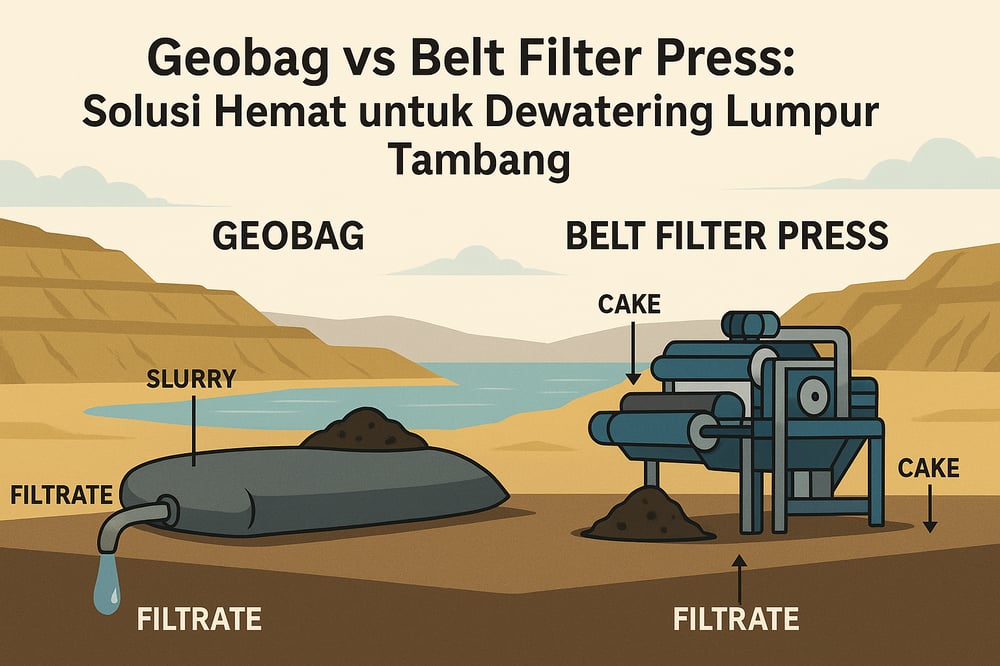
Geotextile tubes are large woven polypropylene containers; operators pump slurry in and let water drain through the fabric over days to weeks. The system needs pumps and land (often with a liner to catch filtrate), but not much else (ResearchGate).
Volume shrinkage is the calling card: reviews cite “up to 80%” volume reduction (ResearchGate). With polymer conditioning and the right fabric, final cakes commonly land in the 30–60% solids range; one titanium dioxide plant treating acidic gypsum slurries (~16% solids feed) ran an 8.8 m × 27.5 m tube and achieved 39% dry solids—a ~2.4× concentration factor—after jar testing to optimize the flocculant, then scaled to >100 geotubes over a year and captured ~180,000 m³ of dry solids (Solmax; Solmax).
Exceptional feeds can go even drier. In a heavy‑mineral magnetite sump example using passive tubes and no flocculant, final cake reached 89.3% solids (10.7% moisture) after one week from a 20% solids feed (ZebraTube).
Effluent clarity is often high once a filter cake forms. A controlled study reported filtrate turbidity meeting Brazilian Class 2 water standards after 168 h, and in tests the geotube effluent outperformed some mechanical methods on clarity metrics (MDPI). The trade‑offs are space and dwell time; the payoffs are simplicity and minimal power draw.
Belt filter press: continuous dewatering metrics
Belt filter presses are continuous machines that compress sludge between moving belts and rollers to expel water. Without chemical conditioning, cakes land in the 20–30% solids range; with optimized polymer, they “may reach the low 30%” solids—about 30–35%—in line with a large U.S. study that averaged ~31–33% solids and ~307 kg solids/(hr·m) of belt () (EPA). Bench tests hit 35% solids in controlled conditions (EPA), though full‑scale variability often trims that figure.
Solids capture is high: about 95% of suspended solids are recovered into the cake (EPA). But even high capture leaves a relatively wet product—70–80% moisture—unless multi‑stage pressing or additives such as lime/salts are used (which increase mass). Operating costs are significant: one design study pegged belt‑press dewatering at about $32.4 per ton of sludge solids, with polymer chemicals around $9 per ton of solids, and reported belt plus vacuum filters at ~$32–39 per ton (EPA; EPA). Expect meaningful energy demand and power/draper maintenance.
Polymer conditioning: dose and efficiency
Across both technologies, flocculation agents are essential. Organic polymers—typically high‑molecular‑weight polyacrylamides (PAMs)—agglomerate fines and consolidate cakes (MDPI). In coal and broader mine slurries, anionic PAMs are frequently applied (sometimes with metal coagulants) (MDPI). Cationic PAMs neutralize negative clay charges and bridge particles; anionic PAMs bind fine alkali/alkaline‑earth clays—so charge density and molecular weight must suit the slurry chemistry (MDPI).
Commercial doses typically range from 1–50 mg PAM per g of dry solids (i.e., about 100–5000 ppm of sludge by mass), chosen via jar testing or rapid dewatering tests (RDTs) (MDPI). In geotube pilots, jar/RDT work has identified optimal doses that yielded clear filtrate and coherent cakes (Solmax), and studies consistently note the need for polymers to flocculate fines and raise throughput (ResearchGate; MDPI). Overdosing is avoided because it can cause cake blinding. Many plants meter flocculants using accurate chemical dosing equipment such as a dosing pump and source polymer through dedicated flocculants programs.
The efficiency gains are large. Proper polymer selection and mixing can significantly cut sedimentation time, decrease turbidity, and boost cake solids; in one example, optimizing mixing reduced consumption by 3–5× (ResearchGate; MDPI). Despite high unit prices for quality PAM, the small doses mean polymer spend is often a modest share of total dewatering costs; the belt‑press case cited above used about $9 per ton of sludge solids for PAM (EPA).
Dryness, cost, and site constraints
Average outcomes overlap. Belt presses typically deliver ~30–35% dry solids; geotubes with polymer commonly land in the 20–50% range, and heavy solids cases have exceeded belt performance (e.g., 39% in TiO₂ gypsum and 89.3% in magnetite) (EPA; Solmax; ZebraTube). One lab study even found geotubes (with polymer) yielding higher final solids than mechanical filters for municipal sludge while producing very clear filtrate (MDPI).
Cost and logistics tend to decide. Geotubes are attractive where land is available and budgets are tight—low investment, minimal power, and stable volume reduction of around 80%—but they need days or weeks to consolidate (ResearchGate). Belt presses fit constrained sites needing rapid, continuous dewatering and conveyor‑ready cakes, with opex around $32–39 per ton of sludge solids in the cited study and polymer around $9 per ton of solids, at the cost of energy and maintenance (EPA; EPA). Notably, geotubes contain solids in place; no conveyor or haulage is needed beyond removing the bag.
Regulatory compliance: effluent clarity
Environmental rules make clarity non‑negotiable. Indonesia’s mining water regulations (via KLHK) require treated effluent to meet stringent suspended‑solids limits (often <50–100 mg/L). Both technologies, with proper polymer use, can produce the low turbidity needed to comply, including the geotube effluent that met Brazilian Class 2 standards after 168 h (MDPI; Solmax).
Typical outcomes and throughputs
Geotextile (geobag) systems: about ~80% volume reduction, typical final cakes in the 30–50% dry‑solids band (with documented cases at 39% and an exceptional 89.3%), very clear effluent once a cake forms, and minimal opex (ResearchGate; Solmax; ZebraTube; MDPI).
Belt filter presses: cake around ~30–35% dry solids, solids capture ≈95%, continuous throughput ~300 kg solids/(hr·m) of belt, and costs about $32 per ton of sludge solids plus about $9 per ton‑solids of polymer, with power/draper maintenance considerations (EPA; EPA; EPA; EPA).
Decision factors and sources
Site conditions drive the choice. If space and time are available, geotubes deliver a low‑cost, high‑volume route to ~80% volume reduction; if footprint is tight and fast cycles are critical, belt presses provide continuous, controlled dewatering to roughly 30–35% solids (ResearchGate; EPA). Either way, polymer programs determine success, and a jar/rapid dewatering test is standard practice before full‑scale operation (Solmax).
Sources: Peer‑reviewed studies and industry reports. Kiffle et al. (2023) cite geotube “reduction of slurry volume by up to 80%” (ResearchGate). Solmax/TenCate document the TiO₂ geotube upgrade from 16% to 39% solids and ~180,000 m³ of dry solids captured (Solmax; Solmax). EPA reports provide belt‑press performance (~31–33% cake solids; $32/ton dewatering; ~$9/ton‑solids polymer) and capture (~95%) (EPA; EPA; EPA). Flocculant reviews confirm polyacrylamides’ impact on dewatering and the importance of dose optimization (MDPI; ResearchGate). All source data is cited inline above.
