

Industry: Landfill | Process: Leachate_Collection_Systems
At modern landfills, the most consequential equipment may be buried in a sump. One IBM‑installed survey found 82% of companies suffer pump‑related unplanned shutdowns every three years (pumpsandsystems.com). At the same time, traditional leachate management can consume 20–30% of a landfill’s O&M budget in temperate climates (minetek.com). Downtime risks fines and non‑compliance, so operators are moving toward purpose‑built pumps, tight preventive maintenance, and redundant designs.
The choices matter. Aboveground self‑priming pumps are claimed to run 25+ years because motors and belts sit out of the corrosive stream, while submersibles tend to wear out far sooner (envirep.com). Serviceability is another edge: above‑ground units can be serviced by one technician in about one‑quarter the time needed to overhaul a submersible in a pit (scsengineers.com).
Pump classes used in leachate service
Leachate pumps face abrasive, chemically aggressive fluids and explosive gases, driving the use of specialized designs. In practice, landfills deploy several classes: submersible centrifugal pumps (usually solids‑handling, ATEX‑rated models such as Flygt or equivalent) for small‑diameter sumps; aboveground suction‑lift (self‑priming) centrifugal pumps (e.g., multi‑stage centrifugal by Gorman‑Rupp) in buildings; progressing‑cavity (Walker) pumps for high solids; pneumatic reciprocating (diaphragm/piston) pumps using compressed air with float valves; hydraulic‑drive centrifugal pumps (e.g., “Hydrainer”); and venturi/eductor systems for remote or oversize applications (leachate.co.uk).
One UK guide lists the common use of “ATEX zone”‑rated submersible solids pumps and includes progressive‑cavity borehole pumps, multi‑stage submersibles, and explosion‑proof pumps among typical electric types (leachate.co.uk). Pneumatic float pumps, introduced in the mid‑1990s, are also widespread in some markets for their self‑regulating action without electrical parts submerged (leachate.co.uk).
Application‑specific materials and safety ratings
Landfill leachate blends high‑strength organic and inorganic contaminants (e.g., ammonia, sulfides, heavy metals) and abrasive solids, requiring corrosion and wear resistance (iopscience.iop.org). Designs often use HDDPE, stainless steel, special seal materials, and hardened components, plus vortex or chopper impellers and large clearances to pass solids. Manufacturers market stainless‑steel wetted parts specifically to survive harsh leachate chemistry (envirep.com). Generic wastewater pumps not rated for corrosive or explosive environments tend to fail quickly.
Explosive landfill gases impose safety requirements. Equipment in gas‑prone enclosures should meet explosion‑proof standards such as ATEX (a European explosive‑atmospheres standard) or UL HazLoc (hazardous‑location electrical classification). EPA guidance advised locating pumps outdoors “wherever there may be a build‑up of potentially explosive gases” and called backup pumps “desirable” for emergencies, including portable units (nepis.epa.gov) (nepis.epa.gov).
Regulatory and budget drivers
Meeting regulations also shapes equipment choice. In Indonesia and elsewhere, landfill rules (Permen LHK, SNI standards) require dual‑lined cells and full leachate collection, with no specific pump mandated, prompting operators to select pumps that assure compliance. Because leakage risks heavy fines or closure, designers default to reputable manufacturers and conservative specs.
Costs focus the mind. One study cites leachate management at 20–30% of O&M in temperate climates (minetek.com). Engineering analyses attribute longer life and fewer clogs to hygienic, accessible pump setups (envirep.com) (envirep.com). In one case study, conveyance upgrades cost only an eighth as much as not addressing inefficient pumps (scsengineers.com).
Preventive maintenance program elements
Industry authorities say the majority of pump breakdowns can be prevented by a comprehensive maintenance and service schedule (wiseonwater.com). In the UK and EU, legal regimes tie unlimited fines to pollution incidents, making unplanned downtime and any resulting overflow especially costly (wiseonwater.com) (pumpsandsystems.com).
Typical programs combine scheduled inspections (e.g., quarterly), vibration and thermal checks on motors, weekly sump clean‑outs, and parts replacement intervals. Xylem’s data‑driven approach suggests adjusting service frequency to failure history—annual service if no callouts in 12 months, shifting to semi‑annual or quarterly once pumps log 1–5 callouts per year (wiseonwater.com). Planned replacement of seals and impellers is straightforward when sites maintain a stock of spare parts and consumables. Modern setups add SCADA (supervisory control and data acquisition) monitoring of flow, level, and motor current to flag clogging or seal leaks early; basic level and flow instrumentation fits within common supporting equipment used alongside pump skids.
The business case is quantifiable: preventive maintenance reduces “unscheduled downtime [which is] one of the costliest events” in any plant (pumpsandsystems.com). An optimally tuned pump consumes less energy and avoids the 2–5× wear seen in starvation or recirculation events. SCS Engineers report that better sizing and reduced failure rates can cut labor; one landfill that once needed two maintenance crews could be managed by one after improvements (scsengineers.com).
Redundant pump architecture and controls
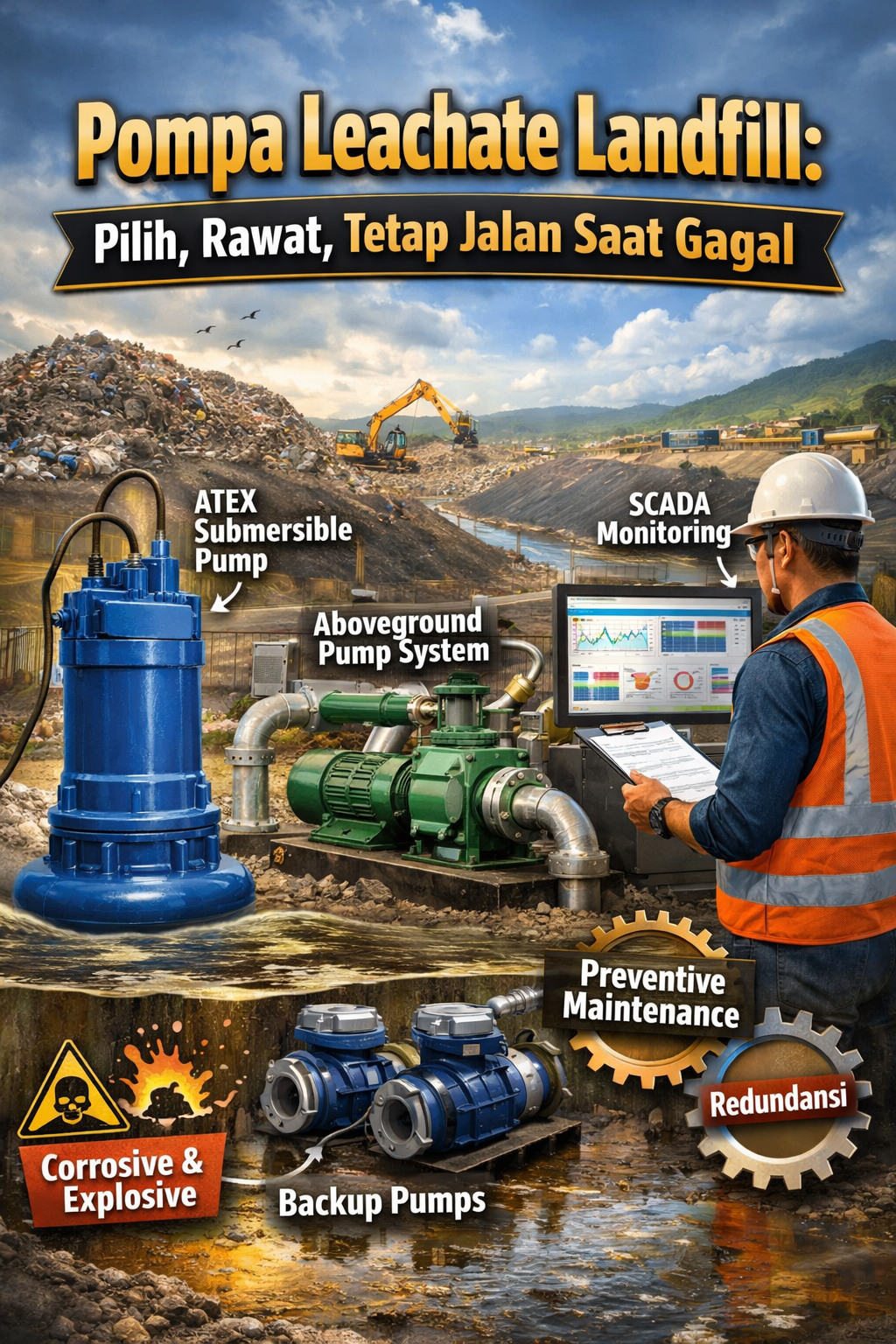
Because failures are inevitable, redundancy is standard practice. Designers often provide two riser pipes emerging from each collection sump so staff can insert a fresh pump while another is pulled for service; a second pump also functions as an emergency spare “if one pump gets stuck or otherwise hung up,” allowing the other to run and help recover it (stormwater.com). EPA guidance likewise deemed backup pumps “desirable” for emergencies—including portable units—to ensure collection continues during malfunctions (nepis.epa.gov).
In practice, redundancy is implemented via automatic controls or manual switchover. PLCs (programmable logic controllers) or level controls alternate the “lead” pump daily to equalize wear. Many sites wire an identical secondary pump in parallel with pressure/level interlocks so it auto‑starts—or can be started manually—if the primary fails. Two‑pump configurations are designed to deliver higher MTBF (mean time between failures) for the system as a whole. The payoff is straightforward: avoiding emergency retrievals that might require confined‑space work on pumps locked in gravel, and preventing unplanned discharge bypass with potential penalties.
Bottom line for leachate reliability
Landfill leachate demands rugged, purpose‑built pumps and vigilant upkeep. Selection should consider chemical compatibility, solids size, and explosive atmospheres—favoring stainless wetted parts, large clearances, and explosion‑proof motors (envirep.com) (leachate.co.uk). Preventive maintenance—regular inspection, timely replacement of seals/impellers, and remote monitoring—is essential (wiseonwater.com) (scsengineers.com). And redundancy—dual pumps and standby units—is widely adopted to keep extraction running during service or failures (stormwater.com) (nepis.epa.gov). These practices—supported by operational data and guidance—help landfills meet regulations and protect the environment with measurable risk and cost reductions (minetek.com) (wiseonwater.com).
Sources cited include peer‑reviewed reviews (iopscience.iop.org), EPA design manuals (nepis.epa.gov), engineering handbooks and case reports (stormwater.com) (wiseonwater.com) (minetek.com), and manufacturer/consultant analyses (envirep.com) (leachate.co.uk) (scsengineers.com).